
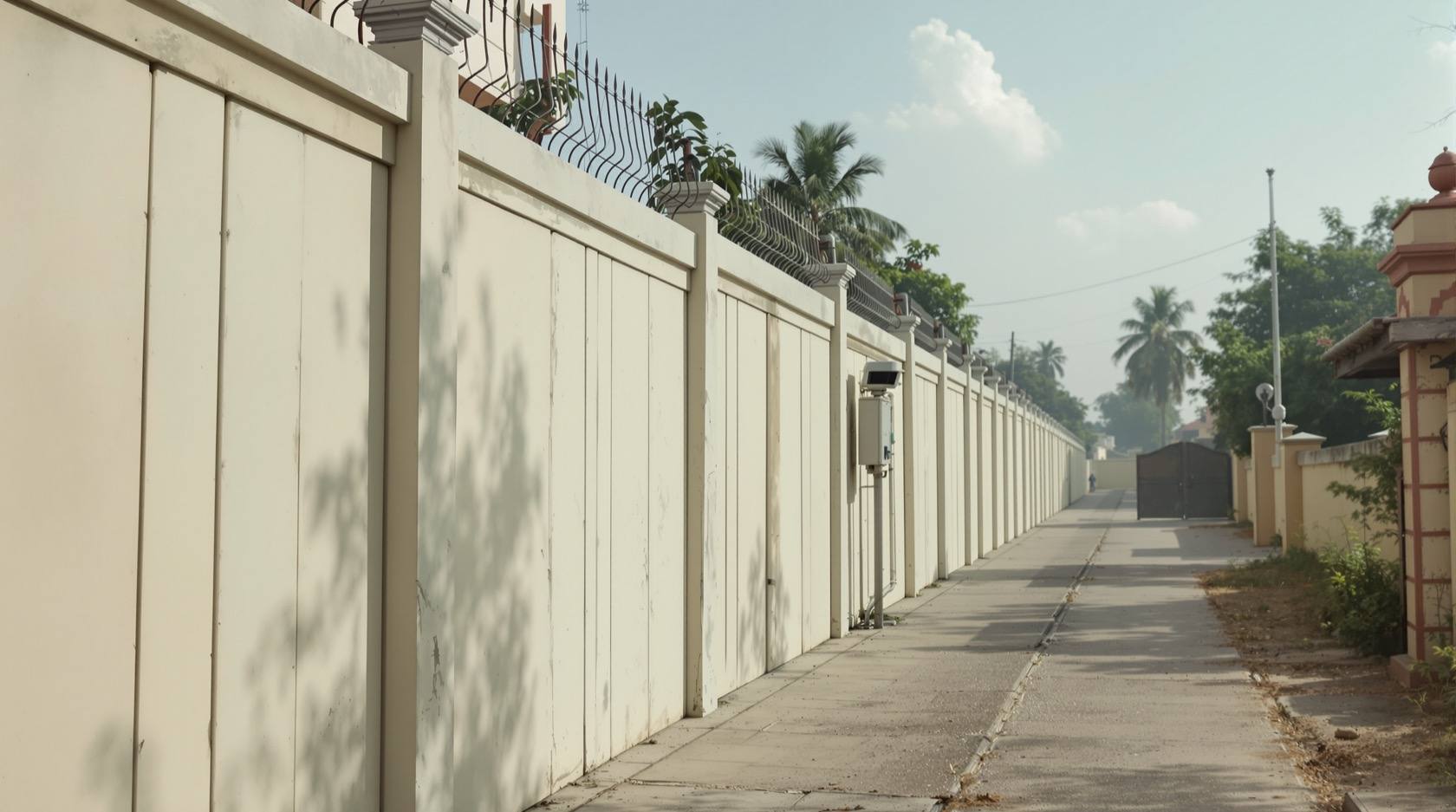
Perimeter Security Cost in India (2026): Priced by the Metre and by the Layer
What a boundary really costs to secure — priced by the running metre of line and by the layers you add (wall or fence, anti-climb topping, detection, lighting, gates and monitoring), with the two big cost drivers, capex versus opex, and how to right-size the spend to the real threat.
Ask "what does perimeter security cost?" and the honest first answer is a question back: how long is your boundary, and what are you actually defending against? Unlike a single gadget with a price tag, a perimeter is a line — and almost everything about its cost scales with the length of that line and the number of protective layers you stack onto every metre of it. A short urban plot and an isolated farm boundary can use the very same specification and still differ by an order of magnitude in total, simply because one has forty metres of line and the other has eight hundred.
So the sensible way to budget a perimeter is not to shop for a product, but to price the line. Walk the layers — the physical boundary itself, the anti-climb topping, the gate and vehicle control, the detection that turns a dark edge into an alert, the lighting, and the monitoring behind it — and cost each one per metre or per site. Then multiply by the length that is really yours to defend, and right-size the layers to the threat. That is the whole method, and it keeps you from both the cheap wall that a determined intruder steps over and the over-specified military line that a modest home never needed.
This guide is the perimeter chapter of the wider home security system cost guide, and it sits inside the security cost planning guide that ties the whole budget together. It gives wide, honest, verify-locally bands, names the drivers that move you up or down each band, and separates the one-time build from the running cost that buyers so often forget.
Scope & safety. These are indicative ballpark bands for planning, not quotes, and not a price list. Prices move with place, time, terrain, brand, spec and site access, and GST applies on top of every figure here. Always get at least three written, itemised quotes before deciding, and read each quote against the drivers described below. This guide separates one-time capex (the wall, fence, topping, detection, lighting and installation) from ongoing opex (power, servicing, false-alarm calls, maintenance and monitoring). Right-size to the real threat: a modest home does not need an isolated farmhouse's perimeter. And one rule overrides all cost logic — a perimeter must never trap anyone inside. Every escape route keeps a gate that opens from within, per the National Building Code (NBC = SP 7:2026); life-safety is never a line item to cut.
The two cost drivers that decide everything
Before any per-metre number is useful, understand the two forces that dominate a perimeter budget. Get these two right and the rest is detail.
- Boundary length — the multiplier. Nearly every perimeter cost is quoted per running metre: the wall, the fencing, the topping, the detection line, the lighting run. Length is the multiplier on all of them at once. This is why a long rural farm boundary and a small city plot with the identical specification land in completely different totals. The single most important number in your budget is the measured length of the line you must defend — pace it, or read it off the site plan, before you price anything.
- Detection choice — the level. The second driver is how much protection you layer onto each metre. A plastered wall with a simple topping is one level; add fence-mounted sensors, beam detection or camera analytics and monitoring, and the per-metre figure can multiply several times over. Detection is where "right-sizing to the threat" bites hardest, because it is the layer most often either skipped when it was needed, or bought when it never was.
Layer 1 — the physical boundary itself
The boundary is the foundation, and usually the single largest capex line. It is what forces everyone to the gate instead of the easy gap in the back fence.
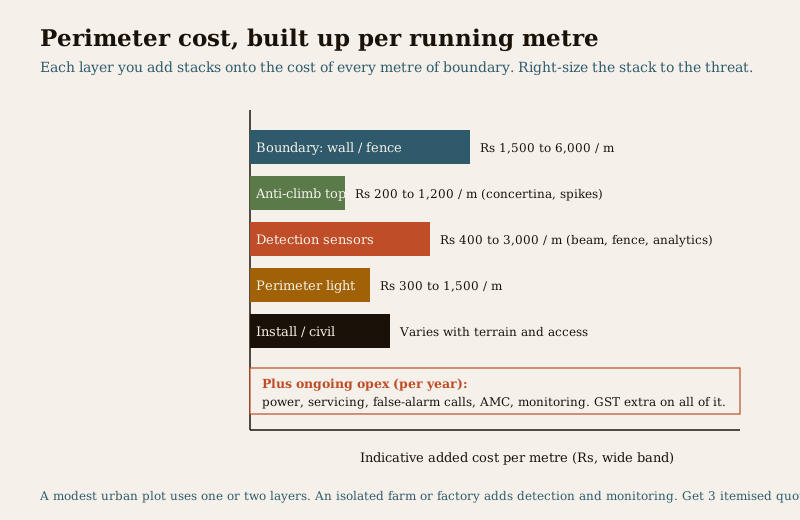
- Compound wall. A plastered brick or block boundary wall is the common Indian default. As a very wide planning band, expect roughly Rs 1,500 to 6,000 per running metre depending on height, foundation, blockwork, plaster, coping and finish. A taller wall, a deeper foundation on poor soil, or a stone or precast finish pushes you up the band; a modest low wall on firm ground sits at the bottom.
- Fencing. Chain-link, weld-mesh or palisade fencing is often cheaper per metre than a full wall and faster to run over a long rural line, broadly Rs 800 to 3,500 per running metre installed depending on mesh gauge, post spacing, height and whether it is galvanised or powder-coated. Fencing suits a long farm or industrial boundary where a full masonry wall would be ruinously expensive; a wall suits a shorter urban line where privacy and solidity matter.
- Terrain and access. The same wall costs more on a slope, on rock, on soft soil needing deeper footings, or on a plot a mixer truck cannot reach. These site conditions can move the boundary line by a large margin and are exactly what a cheap "per metre" phone quote quietly ignores.
The boundary alone is rarely enough on its own — but it is the layer everything else attaches to, so it is worth building honestly.
Layer 2 — anti-climb topping
A wall or fence that is easy to climb is only half a barrier. Topping is a modest add per metre that meaningfully raises the effort to cross.
- Concertina or razor coil, spikes, or an angled extension arm typically add on the order of Rs 200 to 1,200 per running metre depending on type, height and mounting. Concertina over a long factory or farm line is the workhorse; a discreet spike or wall-top extension suits a home that does not want a fortress look.
- Electric fencing is a separate, regulated specialist topic with its own safety rules, signage, energiser and installation discipline — and its own cost profile. It is not a casual topping to bolt on. Price and plan it through its dedicated electric fence cost guide, not as a line in a general fencing quote.
Topping is one of the best value-for-money layers on a genuinely exposed boundary, and one of the easiest to over-specify on a suburban home.
Layer 3 — gates and vehicle control
The gate is the one deliberate gap in the line, and it carries a disproportionate share of both cost and importance, because it is where legitimate movement is meant to concentrate.
- A pedestrian and vehicle gate ranges enormously with material, span, automation and finish — from a simple manual swing gate to an automated sliding gate with a controller. A boom barrier for vehicle control, gate automation, and an intercom or reader each add their own cost.
- Because the gate is really its own sub-system, price it through the access control system cost guide rather than guessing. That guide covers boom barriers, gate automation, readers and vehicle control as a costed component, which is the honest way to budget the busiest, most failure-prone point on the whole perimeter.
Spend here with intent: a strong wall with a weak, always-open gate is a wall with a hole in it.
Layer 4 — perimeter detection (the level that moves the band most)
Detection is what turns a long, dark, unwatched edge into something that alerts you before an intruder is at the door. It is also the layer with the widest cost spread, and the one to match most carefully to the threat.
| Detection type | Roughly how it is priced | Indicative band | Best suited to |
|---|---|---|---|
| Camera analytics on the line | Per camera plus recorder and software | Per-camera cost, spread over covered length | Boundaries already getting CCTV; medium sites |
| Fence-mounted sensors | Per running metre of fence | Rs 400 to 2,000 / m | Continuous fenced lines, factories, farms |
| Beam / IR detection | Per pair, covering a run between posts | Rs 8,000 to 40,000+ per zone/pair | Straight, clear runs and gate approaches |
| Buried or taut-wire | Per metre, specialist install | Higher end, specialist | High-security, isolated, long boundaries |
The honest guidance is that most homes do not need dedicated perimeter detection at all — a good wall, topping, light and a couple of cameras cover them. Detection earns its cost on a long, isolated or high-value line where nobody can watch the whole boundary at once: an isolated farmhouse, a warehouse yard, a factory perimeter. There, it is the difference between knowing at the fence and discovering at the front door.
Layer 5 — perimeter lighting
Light is one of the highest-value, lowest-drama perimeter layers: it deters, it lets cameras and people actually see, and it need not be expensive. As a wide band, boundary and yard lighting runs on the order of Rs 300 to 1,500 per running metre of covered line depending on fitting type, spacing, pole or wall mounting, and whether it is mains or solar. Motion-triggered and well-aimed lighting beats blanket floodlighting on both cost and effectiveness — over-lighting wastes both money and goodwill. Because lighting has its own design and running-cost logic, budget it through the dedicated security lighting cost guide.
Layer 6 — monitoring, guards and response
A detected intrusion is only useful if something happens next. The response layer is largely an opex story, and it is where a perimeter's real running cost lives.
- Remote monitoring of perimeter alarms and cameras is a recurring subscription, not a one-time buy. Understand honestly what it guarantees before relying on it — automatic police dispatch is not a given in India, and the realistic model is remote verification plus a keyholder or guard response.
- Guards and a gatehouse are the largest recurring cost on many large sites, and must be deployed only through a PSARA 2005-registered agency. A guarded gate needs somewhere to sit and see from; budget that through the guardhouse cost guide.
Monitoring and guarding are where an under-budgeted perimeter quietly bleeds money for years, so decide the response model before you sign for the hardware.
Boundary length: the number that dominates the total
Return to the first driver, because it is the one buyers most underestimate. Two properties can buy the exact same wall, topping, light and detection specification per metre and receive totals that are worlds apart — purely because of length. Forty metres of urban plot boundary and eight hundred metres of farm line at the same per-metre rate differ twentyfold before a single upgrade is chosen.
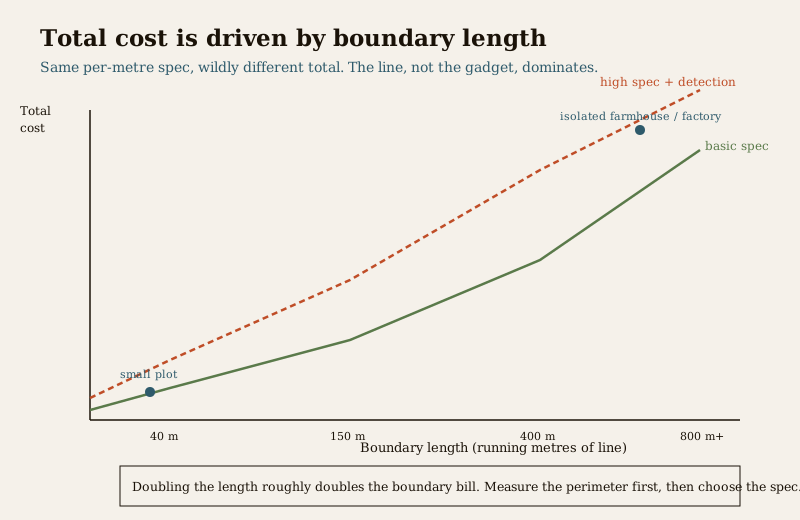
The practical consequence: measure the line first, choose the spec second. On a long boundary, a small per-metre saving compounds into a large total saving, and a small per-metre indulgence compounds into a large overspend. It is also why a long rural line often justifies cheaper fencing plus targeted detection over an expensive continuous wall — the length changes which layer is the sensible place to spend.
Capex versus opex — the running cost buyers forget
The most common perimeter budgeting mistake is pricing only the build and ignoring the running cost. A perimeter keeps costing money after the last brick is laid.
| One-time capex (build) | Ongoing opex (per year) |
|---|---|
| Wall or fencing per metre | Electricity for lighting and detection |
| Anti-climb topping | Sensor and camera servicing / calibration |
| Gate, automation, boom barrier | False-alarm attendance and re-tuning |
| Detection sensors and controllers | AMC on gates, barriers and detection |
| Lighting fittings and wiring | Monitoring subscription |
| Civil work and installation | Guard salaries and gatehouse running |
Two honest points on opex. First, detection-heavy perimeters carry a real false-alarm servicing cost — wind, animals and stray movement on a long line generate call-outs, and tuning them out is ongoing work, not a one-off. Second, guarding is usually the single largest lifetime cost on a large site, dwarfing the hardware over a few years. A cheap quote that wins on capex can lose badly on total cost of ownership once these are counted. GST applies to equipment and services throughout.
Right-sizing: match the spend to the threat
The value-honest heart of perimeter budgeting is right-sizing. The cheapest perimeter is rarely the best value; the most expensive is rarely necessary. Spend where the threat is real and stop where it is not.
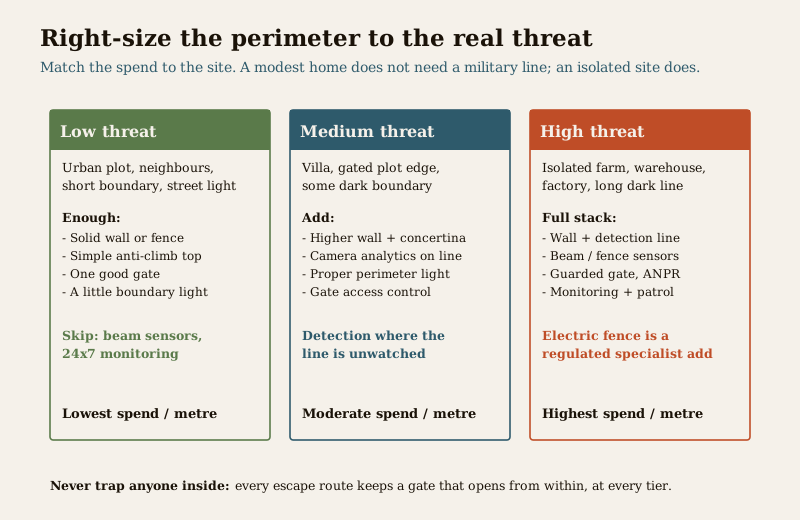
- Low threat — the modest urban home. Neighbours nearby, a short boundary, street lighting, a low base rate of intrusion. A solid wall or fence, a simple anti-climb top, one good gate and a little boundary light is genuinely enough. Dedicated beam sensors and round-the-clock monitoring are money spent on a threat that is not there.
- Medium threat — the villa or exposed plot edge. A longer line, some dark or unwatched stretches. Here it pays to add camera analytics where the line cannot be seen, a taller wall with concertina on the exposed face, proper perimeter lighting and gate access control — detection targeted at the specific blind stretches, not the whole line.
- High threat — the isolated farmhouse, warehouse or factory. A long, dark, remote boundary where nobody can watch the whole line and help is far away. This is where the full stack earns its cost: continuous detection, beam or fence sensors, a guarded gate with vehicle control, monitoring and patrol — and, where justified, a properly engineered electric fence as a regulated specialist add.
Deciding your tier honestly, before you price, is worth more than any per-metre saving. Overspending on a low-threat home and underspending on an isolated high-value site are the two classic, expensive mistakes — and they are mirror images of the same failure to right-size.
How to read a perimeter quote
- Insist on the measured length. A quote that does not state the running metres it priced is not a quote you can compare or trust.
- Insist it is itemised by layer. Wall, topping, gate, detection, lighting and installation should each be a separate line, so you can see where the money goes and cut a layer you do not need.
- Ask what is excluded. Civil work on difficult terrain, cabling runs, controllers, power supply and the recurring monitoring or AMC are the usual "extras" a cheap headline number hides.
- Get three, and read them against the drivers. Three itemised quotes on the same measured length and spec are the only way to see a genuine difference from a corner cut. A price far below the others is telling you what it left out.
Key takeaways
- Perimeter security cost is driven by two things: boundary length and detection level. Measure the line first; choose the layers second.
- Price the line, not a product. Cost the boundary, topping, gate, detection, lighting and monitoring per metre or per site, then multiply by your real length.
- Bands are ballparks with drivers, never quotes. Height, terrain, spec, brand and site access move every figure; get three written, itemised quotes and read them against the drivers.
- Separate capex from opex. The build is one-time; power, servicing, false-alarm calls, AMC, monitoring and guarding run every year — and guarding is often the biggest lifetime cost. GST applies throughout.
- Right-size to the threat. A modest home needs a wall, top, gate and light; an isolated farm, warehouse or factory earns the full detection-and-monitoring stack. Overspending and underspending are mirror mistakes.
- Electric fencing is a separate, regulated topic — cost and plan it through its own guide, never as a casual topping.
- A perimeter must never trap anyone inside — every escape route keeps a gate that opens from within, per NBC (SP 7:2026). Life-safety is never the line you cut.
Where to go next
- The pillar: the home security system cost guide, and the security cost planning guide that frames the whole budget.
- Component cost guides: access control system cost for gates and vehicle control, security lighting cost for the lighting layer, guardhouse cost for the response layer, and electric fence cost for the regulated specialist option.
- Hubs: the perimeter security section, the security costs sub-hub, and the main security hub.
References
- National Building Code of India (SP 7), Bureau of Indian Standards — means of egress, exit routes and the principle that boundaries and gates must never obstruct escape from a site. Verify the current edition (SP 7:2026) via the BIS catalogue: https://www.services.bis.gov.in/
- Digital Personal Data Protection Act, 2023 — perimeter cameras, ANPR and access logs hold personal data; agree in writing who may view footage, retention periods and how it is protected.
- Private Security Agencies (Regulation) Act, 2005 (PSARA) — any guard deployed at a gate, gatehouse or on patrol must be supplied through a PSARA-registered agency; verify licensing before contracting.
- Goods and Services Tax — applies to perimeter equipment and installation and monitoring services; confirm the applicable rate with your supplier and factor it into every band above.
This is an educational, right-sizing cost overview for homeowners, facility managers, architects and security consultants — not a quote, a price list, or an installation manual. All rupee figures are wide, indicative planning bands that move with place, time, spec and site conditions; verify locally and obtain at least three written, itemised quotes before deciding. Life-safety and clear egress take priority over any security measure or cost saving; engage a licensed installer or security consultant, deploy guards only through PSARA-registered agencies, and verify any standard's current status via the BIS catalogue before relying on it.
Export this guide
Related Guides — Deep-dive reading
Wireless CCTV Cost in India (2026): Cheap to Buy, Read the Running Costs First
What Wi-Fi and wire-free CCTV really costs an Indian home — a low, DIY-friendly install price that hides a subscription, battery and reliability bill. An honest, capex-versus-opex look at where the money actually goes over three to five years, with indicative bands and the drivers that move them.
SecurityHome Security System Cost in India (2026): The Honest Budgeting Guide
There is no single price for a home security system — it is a stack of choices. This pillar gives you the mental model to budget the whole home: the cost drivers, the split between one-time capex and ongoing opex, wide indicative tier bands, a five-year total-cost lens, and how to read and compare quotes.
SecuritySecurity Lighting Cost in India (2026): What Fixtures, Sensors and Wiring Really Add Up To
A homeowner's honest, indicative-band guide to what security lighting costs in India — the floodlights, wall-packs, bollards and motion lights, plus the sensors, the hidden wiring and the running electricity — with capex-versus-opex thinking, the mains-versus-solar-versus-motion trade-off, and why over-lighting wastes money and annoys the neighbours.
SecurityRelated Tools — Try Free
Home Security Risk Scorecard
Score your home across six security layers — perimeter, entry points, lighting, detection, alarm and habits — and get a prioritised action plan.
Security ScorecardCCTV Cable-Length Calculator
Total cable to buy for a CCTV job and a warning when a run exceeds the cable's maximum length.
Cable LengthSecurity System Cost Estimator
Estimate the all-in capex with GST, annual running cost and 5-year total cost of ownership of a home or building security system.
Cost Estimator