
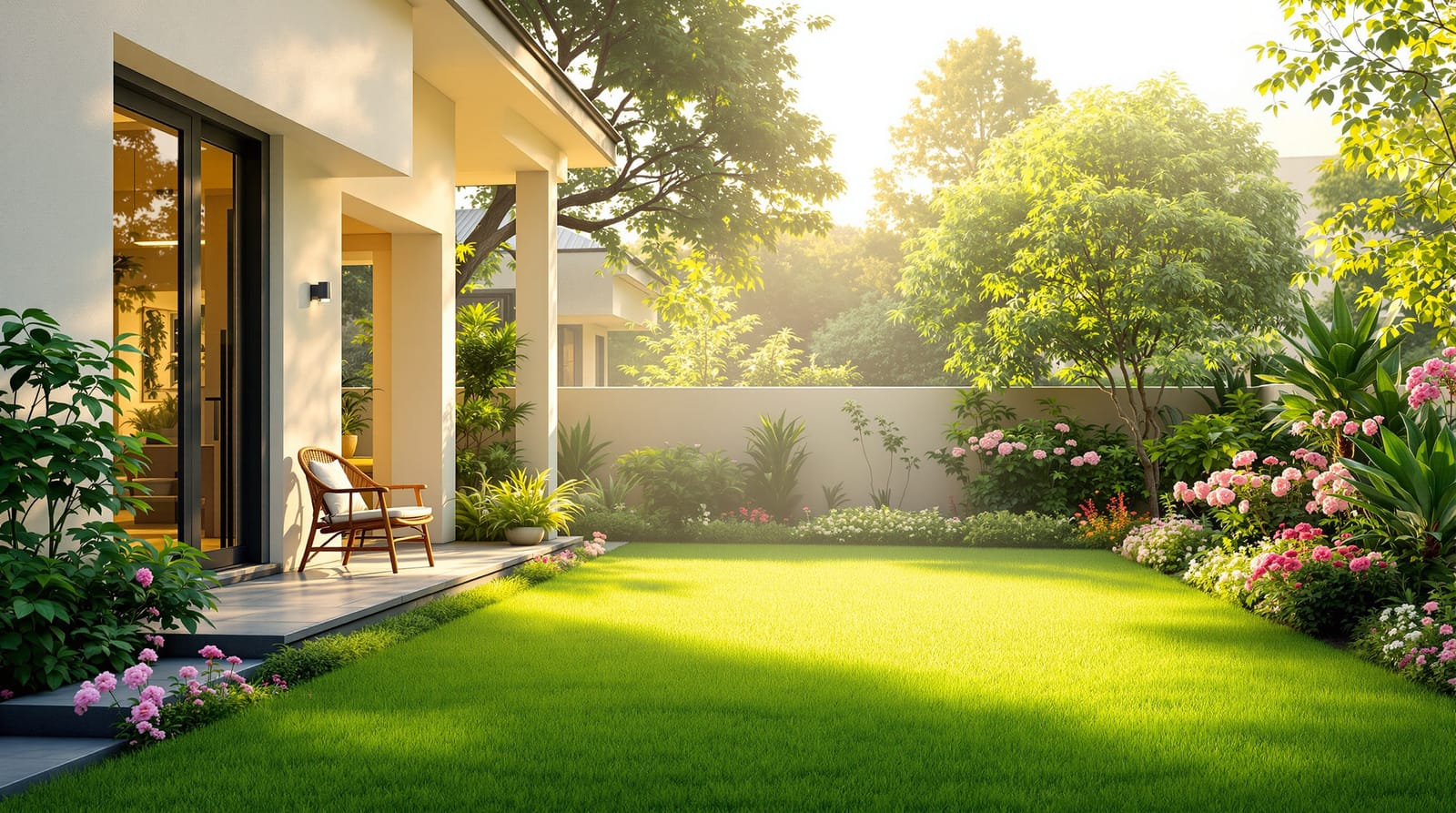
Landscape Design for East-Facing Homes
Making the most of gentle morning sun — the morning garden, planting by orientation, taming the harsh west, and Vastu notes for an east-facing plot
An east-facing home is handed the single most generous gift in Indian landscape design — the soft, cool, golden morning sun — and the whole art of its garden is to throw that east open and gratefully receive it, while quietly building a defence on the west against the brutal afternoon glare.
Of all the orientations, east is the one homeowners hope for. The morning sun rises low and gentle, slanting across the front of the house when the air is still cool and the lawn still holds dew. It is the pleasantest light of the entire day — kind to skin, flattering to flowers, warm without being punishing. People and plants both love it. The landscape design job, therefore, is almost the opposite of a west-facing plot: instead of fighting the front of the house, you celebrate it. But east-facing does not mean you escape the heat. The same sun that is a blessing at 7 a.m. becomes a tyrant on the west and south-west flank by 3 p.m. So the discipline is simple to state and harder to execute — open up to the east, shade the west.
This guide is purely about the GARDEN of an east-facing home — the planting, the sitting spaces, the materials. If you want the room-by-room interior layout (kitchen in the south-east, bedrooms placed for morning light), read the companion East-Facing House Plan. For the underlying physics of how the sun tracks across the year, see Climate-Responsive Landscape Design. Here we stay outdoors, on the soil.
Why east orientation is a landscape gift
Morning sun is low-angle and low-intensity. Between roughly 6 a.m. and 9 a.m. across most of India, the radiation hitting an east-facing front is a fraction of what the west wall takes in the late afternoon. The light arrives almost horizontally, raking across the garden, lighting up dewy grass and the undersides of leaves. This is the photographer's "golden hour", and it lasts longer in winter when you most want it.
Three practical consequences follow:
- The east front is the natural place for the family's outdoor morning life. A breakfast court, a tea corner, a swing — anything you want to use between 6 and 9 a.m. belongs on the east. This is where a morning sitting garden earns its keep.
- East-facing flowering plants thrive. Many ornamentals want bright but gentle light and open their blooms in the morning. They get exactly that here, then are spared the leaf-scorching afternoon sun.
- Dew lingers longer on the east. Cool morning air plus low evaporation means the east garden stays moist into mid-morning — good for the plants, but something to design around with the right materials (more on that below).
The cost of all this is the flip side: the sun does not vanish at noon. It swings to the south and then bears down hot on the west and south-west by afternoon. An east-facing plot that does nothing about its west boundary will bake. The landscape's second job is to build a living wall of shade on that flank.
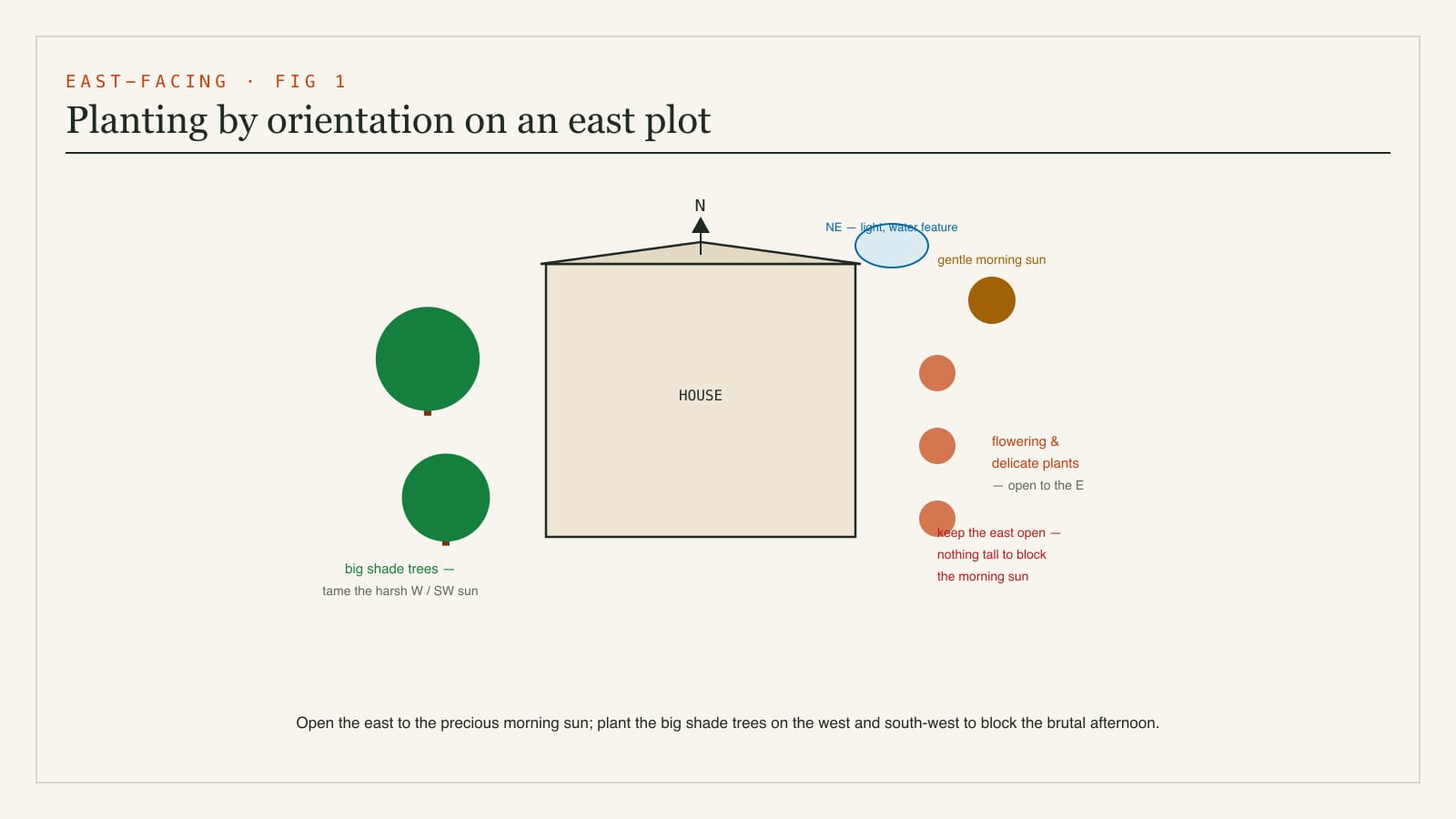
Plant placement by orientation on an east-facing plot
The whole composition can be reduced to one rule per direction. Get this right and everything else is detail.
| Direction | Sun character | Landscape job | What to plant |
|---|---|---|---|
| East (front) | Gentle cool morning sun | Receive it — keep open and low | Flowering shrubs, lawn, seasonal beds; nothing tall near the gate |
| North-east | Soft, indirect | Light green buffer, water feature | Ferns, ground cover, a small pond or birdbath |
| North | Even, cool light | Calm green backdrop | Foliage plants, hedges, shade-tolerant species |
| West | Harsh afternoon sun | Block and shade aggressively | Large dense shade trees, tall screening |
| South-west | Hottest, longest exposure | Heaviest shade and mass | The biggest tree on the plot; thick canopy |
| South | Strong but high-angle | Partial shade, taller planting | Medium trees, climbers on a pergola |
The cardinal mistake on an east-facing plot is to plant a big tree or a tall hedge right in front, on the east, "for shade". It is the one place you must keep clear. A large neem or a tall ashoka row on the east boundary will steal your morning sun for the whole house and the garden — exactly the asset you bought the plot for. Keep the east low: lawn, knee-to-waist-high flowering beds, at most a slim ornamental tree set well to one side of the entrance axis so it never shadows the front.
The east — keep it low and flowering
This is your jewel box. India-real species that love morning sun and reward you with blooms:
- Hibiscus (Hibiscus rosa-sinensis) — opens fresh flowers each morning; happy in bright direct morning light.
- Ixora (Ixora coccinea) — dense flowering shrub, takes morning sun beautifully.
- Jasmine (Jasminum sambac / mogra) — fragrant in the cool morning air; lovely beside a sit-out.
- Pentas, periwinkle (vinca), and seasonal annuals — petunia, marigold, salvia for winter colour beds.
- Champa / frangipani (Plumeria) as the one slim accent tree, placed to the side so it does not block the front.
The west and south-west — your shade fortress
Here you spend your tree budget. Big, dense, fast-establishing canopy:
- Neem (Azadirachta indica) — the classic; tough, evergreen-ish, casts deep shade. India's default west-side tree.
- Indian beech / pongam (Pongamia pinnata, karanj) — dense canopy, drought-hardy, excellent shade.
- Rain tree (Samanea saman) only on large plots — a magnificent umbrella but needs room.
- Gulmohar (Delonix regia) for a flowering shade tree, though it is brittle in storms — keep it away from the house.
A simple rule of thumb on tree-to-wall distance: keep large-canopy trees at least 3–4 m off the boundary wall and the building, so roots do not lift the plinth or the compound, and aim the canopy to throw afternoon shade onto the west wall by mid-afternoon. For the full species shortlist with growth rates and root behaviour, see Best Trees for Indian Homes.
The north and north-east — a light green buffer
The north gets soft, even light all day and never the harsh sun, so it is the place for a calm green buffer that does not need to be a barrier: a low hedge of "Clusia" or "Murraya" (kamini), ferns, ground covers, and — if Vastu matters to you — a water feature in the north-east. This corner asks for the lightest touch: open, green, a little reflective water. The principle of using planting mass to control what each edge does is covered more fully in Climate-Responsive Landscape Design, and the same logic of zoning the garden by how each part is used is in Landscape Zoning for Family Activities.
The morning garden concept
The signature move of an east-facing home is a dedicated morning garden — an outdoor room on the east side, designed to be used in the first three hours of the day.
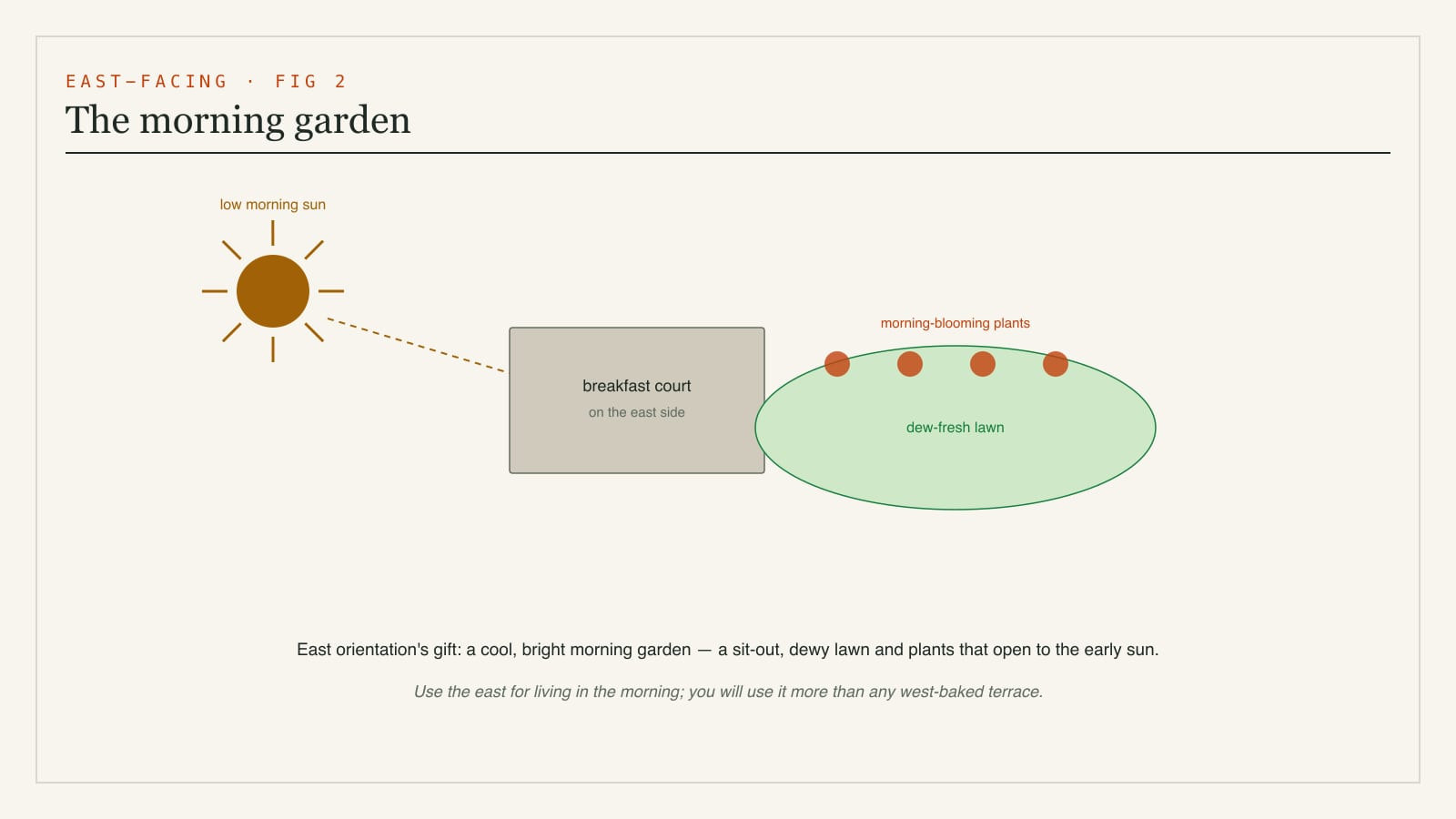
Picture it: a paved sit-out or breakfast court just outside the east-facing living or dining space, a strip of dew-fresh lawn beyond it, and morning-blooming flowering beds catching the low golden light. This is where the family has its first cup of tea, where children read before school, where you do yoga on a winter morning while the sun warms your back. It works because the east sun is warm but never harsh at that hour.
Designing it well:
- Orient the seating to face east-ish, so the low sun is on you, not in your eyes. A slight north-east bias avoids glare and aligns with Vastu if that matters.
- Hard surface for the court, soft lawn beyond. A small paved court (kota stone, exposed-aggregate, or a timber-look deck) gives you somewhere dry to put chairs even when the lawn is dewy.
- Plant the morning bloomers around it — mogra and hibiscus close enough to smell, a champa for dappled light by 9 a.m.
- Keep it open overhead on the east so the morning sun reaches in; a light pergola is fine, a dense canopy is not.
A morning garden of even 3 × 4 m transforms how a family uses its home. For how to connect it to the front gate and the rest of the garden with paths that work in dew and monsoon, see Outdoor Circulation Design.
Taming summer morning glare without losing winter warmth
There is one genuine catch with east. In peak summer (April–June across much of India), even the morning sun gets strong enough by 8.30 a.m. to make the east sit-out uncomfortable. But you must not block it permanently, because in winter that same low morning sun is precious — it warms the house and the garden when you want it most. The sun is higher in summer and lower in winter, and you exploit that difference.
The answer is adjustable or seasonal shade, not a fixed wall:
- Deciduous climbers on a pergola over the east court — "Bougainvillea" (semi-deciduous), or a thunbergia / quisqualis (rangoon creeper) that leafs out heavily in the hot months and thins in winter. Dense leaf cover in summer, bare-ish in winter — automatic seasonal control.
- A light deciduous tree set to the south-east, like a tabebuia or a frangipani, that filters the higher summer sun but lets the lower winter sun slide underneath.
- Retractable shade — a bamboo chik, a roll-up canopy, or a removable shade-cloth on the pergola — pulled out for summer mornings, rolled up in winter. The cheapest and most flexible option.
The principle is "shade the high summer sun, admit the low winter sun" — and because the summer sun is higher in the sky, an overhead element tuned to the right depth does this almost on its own.
Vastu for east-facing plots — honestly
East-facing is considered auspicious in Vastu, and several of its prescriptions happen to align with good landscape sense, so they are easy to honour without compromise:
- North-east (Ishanya) for water and the lightest, openest garden. A pond, birdbath, or fountain in the NE is both a Vastu positive and genuinely the best-lit corner for a reflective water feature.
- Keep the NE and E lighter, lower and more open. This matches the design logic exactly — you want the east low and open for the morning sun anyway.
- Heavier mass to the south-west. Vastu wants weight in the SW; landscape wants your biggest shade tree there against the worst afternoon sun. Same answer.
- Avoid large trees in the NE and directly on the E. Again, this coincides with not blocking your morning light.
Where Vastu and climate disagree, follow the climate — the sun does not read Vastu. But on an east-facing plot they rarely disagree, which is part of why these plots feel so good to live on. For a Vastu-led front-garden treatment, balance these notes against your own beliefs and budget rather than treating any single rule as binding.
Dew, moisture and material choices on the east
The east garden's one quirk is moisture. Cool morning air, lingering dew, and slower evaporation mean east-facing surfaces stay damp longer than west-facing ones. Over time, that invites algae, moss and slippery patches — a real safety issue on a morning sit-out where people walk barefoot.
Design for it:
| Element | Avoid on the east | Prefer instead |
|---|---|---|
| Paving | Polished/glazed tiles (slippery when damp) | Textured kota, leather-finish granite, exposed aggregate, anti-skid stone |
| Decking | Untreated softwood (rots, grows algae) | Treated hardwood, WPC, or composite decking |
| Lawn edge | Smooth painted concrete kerb | Brick-on-edge or rough stone, for grip |
| Metalwork | Untreated MS that rusts in dew | Galvanised or powder-coated steel, SS fittings |
| Drainage | Flat paving that ponds | A 1:80 to 1:100 fall to a channel; never let water sit |
Keep a clear fall on all east paving so dew and rain run off, and choose a slip-rated finish for any surface used early in the morning. Trim back planting that traps humidity against walls. The morning damp that makes the garden lush is the same damp that makes a glazed tile lethal at 7 a.m.
A note on cost
You do not need a large budget to do an east-facing garden justice — the orientation does most of the work for free. Indicative ranges (material and planting only; labour and earthwork vary by city):
- Morning sit-out / breakfast court paving: ₹150–400 per sq ft for kota or exposed-aggregate; ₹500–900 per sq ft for granite or quality deck.
- Flowering shrubs (hibiscus, ixora, mogra): ₹60–250 per plant from a good nursery.
- A west-side shade tree sapling (neem, pongam): ₹150–600; the value is in the 5–8 years of patience, not the price.
- Light pergola with a deciduous creeper: ₹400–900 per sq ft depending on MS vs timber.
- A small NE water feature: ₹15,000–60,000 for a simple recirculating pond or fountain.
Spend where it counts: the morning court and its flowering frame on the east, and the shade trees on the west. The north and the rest can be simple green.
Bringing it together
An east-facing home rewards a landscape that knows the difference between its two flanks. Throw the east open — keep it low, flowering and dew-fresh, and build your morning life there. Close the west down — mass your biggest shade trees and densest planting against the afternoon sun. Keep the north-east light and watery, the north calm and green. Shade summer mornings with something seasonal you can take away in winter, and pick materials that shrug off the morning damp. Do that, and the gift the orientation hands you — that soft golden hour at the start of every day — becomes the best room in the house, and it has no roof.
References & further reading
- National Building Code of India 2016, Part 10 (Landscape Development, Signs and Outdoor Display Structures) — Bureau of Indian Standards. Guidance on planting, soft and hard landscape, and site development.
- ISOLA (Indian Society of Landscape Architects) — professional standards and resources for residential landscape practice in India.
- ICAR–IIHR (Indian Institute of Horticultural Research, Bengaluru) — species suitability, ornamental and flowering plant guidance for Indian conditions.
- "Trees of Delhi" / "Flowering Trees" by Pradip Krishen — authoritative field guides to Indian trees, their canopy and seasonal behaviour.
- Royal Horticultural Society (RHS) — general horticultural principles on light, aspect and plant siting, adaptable to Indian conditions.
- CPWD Horticulture Manual — Central Public Works Department guidance on lawns, planting and garden maintenance in the Indian context.
Export this guide
Related Guides — Deep-dive reading
The Best Trees for Indian Homes
A research-grade guide to choosing and placing trees around an Indian home — the real cooling and clean-air numbers, the right species for shade, flowers, fragrance and fruit, and the placement science that keeps roots out of your walls and drains.
LandscapeOrientation, Light & Views: Designing With Your Space, Not Against It
How reading your plot's sun, breeze and views — and placing each room on the right face — gives an Indian home that is cooler, brighter and quietly right, instead of one that fights its site forever.
Design PrinciplesUnderstanding Sun Path Analysis for Your Home
How the sun actually moves over an Indian site through the day and the year — and why that single fact quietly decides where your kitchen, bedroom and living room should sit.
Site PlanningRelated Tools — Try Free
Cross-Ventilation Analyzer
Estimate airflow and air changes per hour (ACH) from room size, window areas, layout, and local wind — with NBC 2016 Part 8 compliance check.
Ventilation CalculatorGarden Planning Toolkit
Get a tailored garden plan — planting layers, Indian species, features and a checklist — from your climate, space, sun and goals.
PlannerLandscape Cost Calculator
Estimate a garden's cost — hardscape, softscape, lawn, irrigation, lighting and annual upkeep — by area, tier and city.
Budget Calculator