
Dual Flush Toilet India: 3/6 Litre Two-Button WCs & Water Saving
How a dual-flush toilet with a 3/6 (or 4/6) litre two-button cistern cuts water against an old 10-12 litre single flush — litres and rupees saved a year, retrofitting a dual-flush valve to an existing WC, why trap design decides whether less water still clears the pan, and IGBC/GRIHA credit.
Walk into most Indian homes built before the mid-2000s and the WC still carries an old single-flush cistern that dumps 10, 12, sometimes 13 litres of clean drinking water down the pan every single time — whether you needed a full clear or just a quick rinse. Multiply that by a family of four flushing a dozen-plus times a day and the toilet quietly becomes the single thirstiest fixture in the house, out-drinking every tap and shower combined. The dual-flush toilet fixes exactly this waste: two buttons, a small half flush of around 3 litres for liquid waste and a full flush of around 6 litres for solids, so you spend only the water each job actually needs.
This is the dual-flush toilet guide of the Studio Matrx bathroom hub. Read it alongside the eco-friendly bathroom guide for the whole-house water strategy it belongs to, and the complete toilet and WC guide for India for pan shapes, rough-in and installation. For the other big water levers, see greywater recycling for Indian homes and the low-flow showerhead guide.
A dual-flush toilet is the single biggest per-fixture water saving in an Indian home: swapping a 10-12 litre single flush for a 3/6 litre two-button system cuts toilet water by roughly 60-70%, and you can often retrofit it without changing the pan.
What "dual flush" actually means
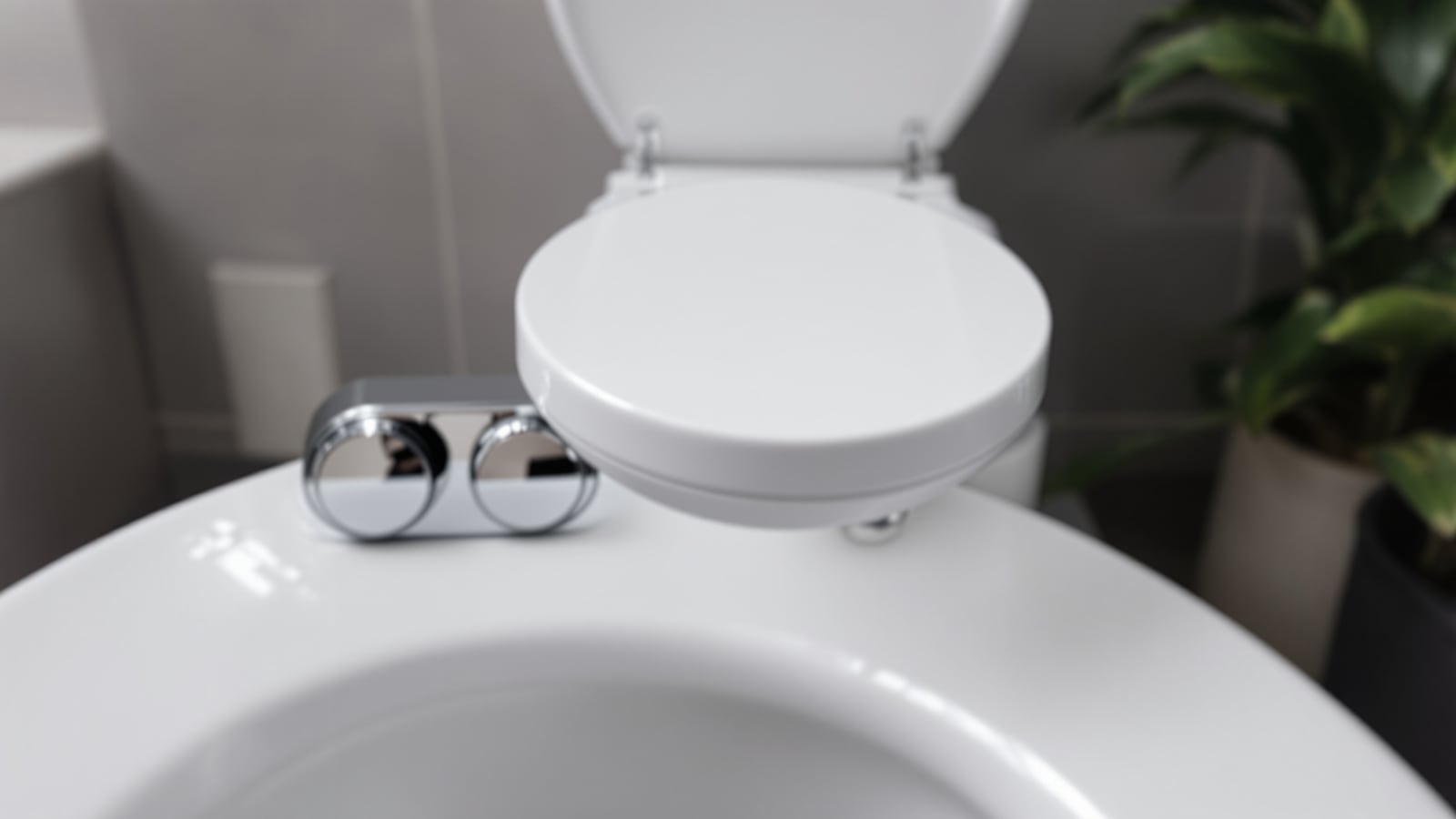
A dual-flush cistern has two release mechanisms behind one twin-button plate. Press the smaller button and a valve opens for a short, calibrated reduced (half) flush — typically 3 litres, meant for urine and tissue. Press the larger button for the full flush — typically 6 litres — which delivers the bigger, faster surge needed to move solid waste and clear the pan. Some Indian ranges are calibrated 4/6 or even 4.5/6 for the harder water and flatter drain gradients common here, trading a little water for more reliable clearance.
The saving is real precisely because the small flush gets used far more often. In an ordinary household, roughly three out of four flushes are liquid-only, so most of the day the toilet is running on 3-4 litres instead of 10-12. That is where the water goes down — not from any one heroic flush, but from the everyday majority you no longer over-water.
| Cistern type | Water per flush | Typical daily use (family of 4) | Verdict |
|---|---|---|---|
| Old single flush, high-level | 12-13 L | Every flush at full volume | Replace or retrofit |
| Old single flush, close-coupled | 10-11 L | Every flush at full volume | Replace or retrofit |
| Single-flush "eco" | 6 L | Every flush at 6 L | Better, but no half option |
| Dual flush 4/6 L | 4 or 6 L | Mostly 4 L, some 6 L | Recommended for hard water |
| Dual flush 3/6 L | 3 or 6 L | Mostly 3 L, some 6 L | Best saving where pan suits it |
The numbers: litres and rupees a family saves
Take a family of four averaging about 14 flushes a day between them, of which roughly three-quarters are liquid-only. The arithmetic is blunt and convincing.
- Old single flush at 11 L: 14 flushes × 11 L = 154 litres a day, about 56,000 litres a year.
- Dual flush 3/6 L: roughly 10-11 small flushes at 3 L plus 3-4 full flushes at 6 L ≈ 50-54 litres a day, about 19,000 litres a year.
- Saving: on the order of 35,000-37,000 litres per year for one toilet — enough to fill a 1,000-litre overhead tank around three dozen times.
In rupee terms the value depends on how you get your water. On metered municipal supply the direct bill saving is modest — perhaps a few hundred to a couple of thousand rupees a year. But in the many Indian cities and gated societies that run on tanker water, where a 1,000-litre tanker can cost ₹300-1,000, 35,000 litres saved is genuinely ₹10,000-30,000 a year off the tanker bill for a single WC. Add a second and third toilet and the payback on a ₹1,500-4,000 retrofit is measured in months.
Does less water still clear the pan? Trap design decides
This is the honest worry, and the answer is: only if the pan is designed for the lower volume. You cannot simply cap the flush on any old pan and expect it to clear — the pan and the cistern are an engineered pair. Two things make a low-volume flush work.
- A well-shaped trapway and a steep, glazed pan. A modern washdown pan uses the sheer push of the incoming water to shove waste over the weir; a siphonic pan primes a full trapway so it pulls waste out by suction. Both can be tuned to clear reliably on 4-6 litres — but the internal geometry, the outlet diameter and the glaze all have to be right.
- A good rim wash and flow path. The water has to sweep the whole bowl, not just drop straight down. Rimless and optimised-rim pans spread the reduced volume around the full circumference so it still rinses.
The practical rule: an old pan designed for a 10-12 litre flush may streak or need double-flushing on 3 litres, which throws away the saving. If you are keeping the pan, prefer a 4/6 L dual-flush and test it. If you are replacing the whole WC, buy the pan and cistern as a matched dual-flush set rated for the low volume, so the half flush is guaranteed to clear. Indian conditions add two more cautions: hard water scales the rim jets and slowly weakens the wash, and flat or under-fall drain lines (common in retrofits) need the full 6 litres to carry solids the distance — so keep gradients right and descale the rim.
Retrofit: dual flush without changing the pan
You often do not need a new toilet at all. Three retrofit routes, cheapest first.
- Dual-flush conversion valve / kit. For an existing close-coupled or concealed cistern, a two-button dual-flush flush valve replaces the old single siphon or flapper. It drops into the same cistern, and a new two-button plate replaces the old lever or single button. Cost about ₹600-2,000 for the valve plus ₹300-1,200 for a plate. This is the standard, high-return retrofit — pick a valve whose small and full volumes are adjustable so you can dial in reliable clearance on your pan.
- Adjustable dual-flush cistern. If the old cistern itself is cracked or crusted, fit a whole new dual-flush cistern (external low/mid-level or a new close-coupled tank) matched to the existing pan spigot. Cost roughly ₹2,000-6,000 installed.
- Full matched WC replacement. The surest performer: a new floor-mounted or wall-hung toilet with a factory-matched dual-flush concealed cistern sized for 3/6 or 4/6. Cost ₹8,000-40,000+ depending on pan and plate.
| Route | What changes | Approx cost | Best when |
|---|---|---|---|
| Conversion valve + plate | Internals of existing cistern | ₹900-3,200 | Cistern is sound, quick win |
| New dual-flush cistern | Whole cistern, keep pan | ₹2,000-6,000 | Old cistern failing |
| Matched WC + concealed set | Pan and cistern together | ₹8,000-40,000+ | Renovation / new build |
A note for apartment owners: a like-for-like cistern or valve swap is almost always within your rights and needs no society permission, since you are not touching the shared stack or the pan outlet. Keep it a straight internal replacement and you avoid the wet-work and approvals a full WC change can trigger.
Living with a dual flush: hard water and upkeep
- Descale the flush valve seal and rim jets every few months. Hard-water scale on the drop-valve seal is the number-one cause of a silently running cistern, which wastes far more water than the toilet ever saved. A weeping seal can leak thousands of litres a month unnoticed.
- Check the fill valve and overflow. If water trickles into the pan continuously, the fill or flush seal has failed — fix it the same week.
- Set the volumes deliberately. On an adjustable valve, start the full flush at 6 L and the half at 3-4 L, then nudge up only if the pan streaks. Do not leave both buttons doing a full flush "to be safe" — that quietly cancels the whole point.
- Teach the household which button is which. The saving is behavioural as much as mechanical: the small button must become the default for liquid waste.
- Prefer a good-brand valve in hard-water regions — cheap plastic drop valves warp and leak within a year.
Green ratings: IGBC, GRIHA and the code
Water-efficient WCs earn credits under India's green-building systems, and dual flush is the easiest lever to pull. IGBC (Green Homes and Green New Buildings) awards water-efficiency points for flushing fixtures that beat a baseline — dual-flush WCs at effective flush volumes around 4 litres or below score well. GRIHA similarly rewards reduced water demand from low-flush toilets. The water-conservation intent of NBC 2016 (Part 9, Plumbing Services) and IS 2556 (sanitary appliances, vitreous china) frame the flushing-cistern requirements, with modern flushing cisterns rated at 6 litres or dual 3/6. If you are chasing a rating, specify the WC's flush volumes in the fixture schedule and keep the datasheet — auditors want the certified small/full litres, not a nominal claim.
Do and don't
| Do | Don't |
|---|---|
| Retrofit a dual-flush valve to a sound cistern first | Assume you must replace the whole WC to save water |
| Match a low-volume flush to a pan designed for it | Cap an old high-volume pan and accept streaking |
| Use 4/6 L where water is hard or drains are flat | Force 3 L on a pan that needs double-flushing |
| Make the small button the household default | Full-flush everything "to be safe" |
| Descale the valve seal; fix a running cistern fast | Ignore a silently running toilet — it wastes thousands of litres |
A dual-flush toilet is the rare upgrade that saves the most water for the least disruption: for many homes it is a ₹1,000-3,000 internal swap that halves the thirstiest fixture in the house, keeps working with your existing pan, and helps a green rating along the way. Start with a conversion valve on your main WC, get the small button into daily habit, then specify matched dual-flush sets from the outset in any new bathroom or renovation. For the full water picture, pair it with a low-flow showerhead and greywater recycling.
References
- NBC 2016 (National Building Code of India), Part 9 Plumbing Services — flushing cisterns and water-conservation provisions.
- IS 2556 — Vitreous sanitary appliances (vitreous china): water closets, flushing cisterns and related requirements.
- IS 774 — Flushing cisterns for water closets and urinals (specification).
- IGBC Green Homes / Green New Buildings rating — water-efficiency credits for low-flush and dual-flush fixtures (Indian Green Building Council).
- GRIHA (Green Rating for Integrated Habitat Assessment) — reduced water-demand criteria for flushing fixtures.
- CPHEEO Manual on Water Supply and Treatment — per-capita demand and conservation benchmarks.
Export this guide
Related Guides — Deep-dive reading
Bathroom Toilet India: The Complete Guide to WCs, Commodes & Water Closets (2026)
Indian squat vs Western commode, floor-mounted vs wall-hung with concealed cistern, the S-trap and P-trap outlet and its rough-in distance, dual-flush water norms, rimless and comfort-height trends, the health-faucet rule, and a rupee cost comparison — everything that decides which toilet is right for an Indian home.
BathroomsWater Efficiency Standards Bathroom India: Flow Limits, Dual-Flush & Green Credits
A professional reference to the water-efficiency standards and norms that govern Indian bathrooms — dual-flush cistern volumes, low-flow tap and shower limits, BIS/ISI marking for fixtures, IGBC and GRIHA water credits, and CGWB rainwater and greywater rules.
BathroomsHow to Choose a Toilet in India: A Buyer's Guide to WCs, Traps, Flush & Budget (2026)
The make-or-break trap and rough-in check, floor-mounted vs wall-hung, one-piece vs two-piece, flush type and water use, seat and rimless upgrades, good/better/best rupee tiers, what's actually in the box, and how to spot a fake before you pay.
BathroomsRelated Tools — Try Free
Apartment Video Door System Planner
Enter flats, entrances, floors and guard desk for a first-pass building intercom plan — door stations, indoor monitors, guard station, the right architecture and an indicative cost band.
Building PlannerShower Water Flow Calculator
Shower water use per shower, day and month by head type, plus a pressure-adequacy check for your tank height or pump and low-flow savings.
Bathroom CalculatorBathroom Water Savings Calculator
See the water and money saved by switching to efficient bathroom fittings — dual-flush, low-flow shower and tap aerators — per year.
Bathroom Calculator