
Water Efficiency Standards Bathroom India: Flow Limits, Dual-Flush & Green Credits
A professional reference to the water-efficiency standards and norms that govern Indian bathrooms — dual-flush cistern volumes, low-flow tap and shower limits, BIS/ISI marking for fixtures, IGBC and GRIHA water credits, and CGWB rainwater and greywater rules.
Water efficiency in an Indian bathroom is no longer a nice-to-have — it is written into product standards, plumbing codes, green-rating credits and, increasingly, into groundwater and municipal bye-laws. But the rules are scattered across BIS product specifications, the National Building Code, the CPHEEO manual, IGBC and GRIHA rating tools, and state-level Central Ground Water Board (CGWB) directions. This reference pulls the water-efficiency standards and norms that actually apply to bathroom fixtures into one place, with the real numbers a designer or plumbing consultant needs to specify against.
This is the water-efficiency standards reference of the Studio Matrx bathroom hub. Read it alongside the bathroom building regulations for India for the broader code picture, the green-rating bathroom guide for how IGBC and GRIHA score fixtures, and the fixture-level guides on water-saving faucets and the dual-flush toilet.
Verify locally before you rely on this. Codes are revised, and municipal and state water bye-laws vary widely across India. Confirm the current edition of every standard and check your local authority or a licensed plumbing professional before you specify or certify against these figures.
The two things a "water-efficient" bathroom controls
Almost every water-efficiency norm reduces to one of two levers:
- Flush volume — how many litres each WC or urinal flush consumes. The lever here is the flushing cistern and its dual-flush mechanism.
- Flow rate — how many litres per minute (LPM) a tap or shower delivers at a given supply pressure. The lever here is aeration, flow restriction and pressure-compensating cartridges.
Standards act on both: product standards set what a compliant fixture must do, plumbing codes set how it is installed and supplied, and green-rating tools reward going below a defined baseline.
Flush-volume norms: dual-flush cisterns
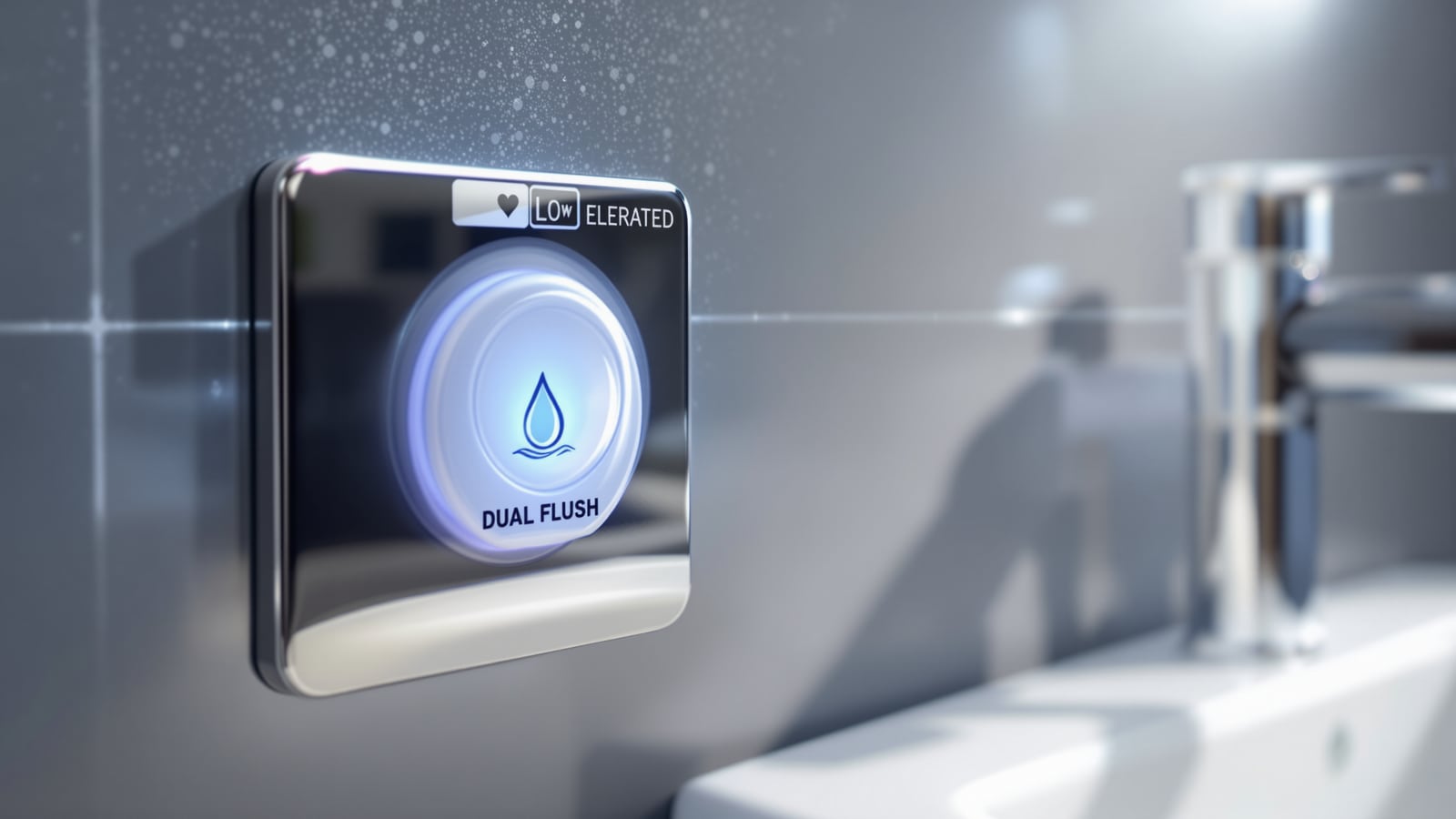
The single biggest water fixture in a home is the WC. Older single-flush cisterns dispensed 10–13 litres per flush; modern practice is the dual-flush cistern with a reduced (half) flush and a full flush on a two-button plate.
- Typical dual-flush volumes are 3 litres / 6 litres — around 3 L for liquid waste and 6 L for solids. Many Indian ranges are calibrated 4 L / 6 L or 4.5 L / 6 L to cope with harder water and flatter drain gradients, trading a little water for reliable pan clearance.
- Flushing cisterns are covered by IS 774 (flushing cisterns for water closets and urinals). The vitreous-china pan and appliance itself falls under the IS 2556 series (vitreous china sanitary appliances).
- The National Building Code of India (NBC 2016), Part 9 (Plumbing Services) and IS 1172 (code of basic requirements for water supply, drainage and sanitation) govern how cisterns, traps and stacks are installed and supplied.
Treat the exact half/full split as indicative — confirm the marked rating on the specific cistern and the current edition of IS 774, because manufacturers calibrate within a range.
Flow-rate norms: low-flow taps and showers
Flow rate depends on pressure, so any single "LPM" figure is a typical value at a stated test pressure, not an absolute. The following are the indicative flow bands designers commonly specify for water-efficient fixtures:
| Fixture | Conventional flow (indicative) | Water-efficient target (indicative) | Mechanism |
|---|---|---|---|
| Basin / lavatory tap | 8–12 LPM | ~4–6 LPM | Aerator or laminar flow insert |
| Kitchen-style mixer (bath use) | 10–15 LPM | ~6–8 LPM | Aerator + flow restrictor |
| Shower (overhead) | 12–20 LPM | ~6–9 LPM | Low-flow / aerating showerhead |
| Health faucet / bidet spray | high, uncontrolled | pressure-limited | Flow-limited trigger valve |
| WC full flush | 10–13 L/flush | 6 L/flush | Dual-flush cistern |
| WC reduced flush | — | 3–4.5 L/flush | Dual-flush half button |
Green-rating tools such as IGBC and GRIHA define baseline flow rates for each fixture and award water-efficiency credit for beating them by a set percentage; the aerated targets above are the range that typically achieves those reductions. CP fittings and pillar taps have their own BIS product standards (for example the pillar-tap specification family), and buyers should look for the ISI mark as evidence the fixture meets its BIS specification.
BIS, the ISI mark and what "certified" means
BIS (Bureau of Indian Standards) publishes the product standards and administers the ISI mark. A fixture carrying the ISI mark against the relevant standard has been certified to meet that specification — for sanitaryware this is the IS 2556 series, for flushing cisterns IS 774, and CP fittings have their own BIS specifications. There is no single mandatory national "water label" star scheme for taps and showers the way there is a BEE star rating for water heaters and other appliances, so for flow efficiency the practical proof points are the manufacturer's stated flow rate at a test pressure plus third-party or green-rating verification. Specify the flow rate in the schedule and require test data — do not assume a fitting is low-flow because it is marketed that way.
IGBC and GRIHA: where efficiency earns credit
Both national green-rating systems reward bathrooms that use less water.
- IGBC (Indian Green Building Council) rating tools include a Water Efficiency section. Credits are earned by installing fixtures whose flow and flush rates fall a defined percentage below a baseline, and by rainwater harvesting and wastewater treatment/reuse. The dual-flush WC and aerated taps and showers are the core fixture moves.
- GRIHA (Green Rating for Integrated Habitat Assessment) includes water-conservation criteria that similarly reward reduced fixture consumption, on-site treatment and reuse, and reduced landscape and municipal water demand.
Neither tool prescribes one universal LPM number — they compare your specified fixtures to a baseline case, so the design lever is choosing fittings that beat that baseline by the margin the credit requires. Confirm the current version of each rating tool, since baselines and credit weightings are revised between versions.
Codes and standards reference table
| Code / standard | What it covers | Key water-efficiency point |
|---|---|---|
| IS 774 | Flushing cisterns for water closets and urinals | Basis for dual-flush cisterns; typical 3/6 or 4/6 L split |
| IS 2556 (series) | Vitreous china sanitary appliances (WC pans, wash basins, urinals) | Product standard behind the ISI mark on sanitaryware |
| IS 1172 | Basic requirements for water supply, drainage and sanitation | Fixture provisioning and supply/drainage basis |
| NBC 2016, Part 9 | Plumbing Services | National plumbing framework for supply, storage and fixtures |
| CPHEEO Manual | Water supply and sewerage (MoHUA) | Demand norms, per-capita water and reuse guidance |
| IGBC rating tools | Green building certification | Water-efficiency credit for below-baseline fixtures and reuse |
| GRIHA | National green rating | Water-conservation criteria and low-flow fixture credit |
| BEE star rating | Appliance energy labelling | Applies to water heaters/geysers (energy, not fixture flow) |
| CGWB directions | Groundwater extraction control | Rainwater harvesting mandates in notified/over-exploited areas |
Descriptions are by scope. Verify the exact current edition and clause of any standard before certifying against it.
Source-side rules: CGWB, rainwater and greywater
Efficiency is not only about the fixture — it is about where the water comes from and where it goes.
- CGWB / groundwater authorities regulate borewell abstraction, and in many notified and over-exploited blocks require rainwater harvesting as a condition of approval. Several states and city bye-laws make rainwater harvesting mandatory above a defined plot size.
- Greywater reuse — treating water from basins and showers (not WC blackwater) for flushing or landscape — is the highest-value tie-in to a water-efficient bathroom, and is exactly what IGBC and GRIHA reward. It usually needs dual plumbing designed in from the start.
- Municipal water bye-laws increasingly cap per-capita municipal supply and expect on-site treatment for larger developments, which pushes bathroom flow and flush volumes down.
A specification checklist for professionals
- WC: dual-flush cistern, 6 L full / 3–4.5 L reduced, IS 774-compliant, ISI-marked pan to IS 2556.
- Taps: aerated basin mixers with a stated flow rate around 4–6 LPM at test pressure; require manufacturer flow data.
- Showers: low-flow or aerating heads targeting roughly 6–9 LPM; consider pressure-compensating cartridges for high-rise supply variation.
- Health faucet: flow-limited spray to curb uncontrolled use.
- Source/reuse: design rainwater harvesting and, where viable, greywater dual plumbing to satisfy CGWB/state rules and green-rating water credits.
- Documentation: keep the fixture schedule, flow-test data and ISI/BIS references for green-rating submissions and municipal approvals.
Efficiency compounds: a dual-flush WC, aerated taps and a low-flow shower together can cut bathroom water demand by a large fraction versus conventional fittings, before you add any reuse. The standards above tell you what "compliant" and "efficient" mean — but always confirm the current edition and your local authority's bye-laws first.
References
- IS 774 — Flushing cisterns for water closets and urinals (BIS).
- IS 2556 (series) — Vitreous china sanitary appliances (BIS).
- IS 1172 — Code of basic requirements for water supply, drainage and sanitation (BIS).
- National Building Code of India, NBC 2016, Part 9 — Plumbing Services (BIS).
- CPHEEO Manual on Water Supply and Treatment / Sewerage — Ministry of Housing and Urban Affairs.
- IGBC — Indian Green Building Council green-building rating tools, Water Efficiency section.
- GRIHA — Green Rating for Integrated Habitat Assessment, water-conservation criteria.
- BEE star rating — Bureau of Energy Efficiency (water heaters/geysers).
- CGWB — Central Ground Water Board / state groundwater authority directions on abstraction and rainwater harvesting.
- BIS ISI mark — product certification against the relevant Indian Standard.
This reference is indicative and India-first. Codes are revised and local bye-laws vary — verify the current standard and your local authority or a licensed professional before relying on it.
Export this guide
Related Guides — Deep-dive reading
Sanitaryware IS Standards India: IS 2556, IS 774, IS 771 & the ISI Mark (2026)
A professional reference to the Bureau of Indian Standards codes that govern sanitary appliances in India — IS 2556 for vitreous china wash basins, water closets and urinals, IS 774 for flushing cisterns, IS 771 for glazed fireclay, IS 2963 for waste fittings — what each covers, the quality parameters they test (water absorption, crazing, warpage, flush performance) and the ISI mark to look for.
BathroomsBathroom Plumbing Code India: NBC 2016 Part 9, UPC-I & the IS Standards That Govern Pipework
A professional reference to the codes and standards that govern bathroom plumbing in India — the National Building Code (NBC 2016) Part 9 on Plumbing Services, the Uniform Plumbing Code India (UPC-I), the CPHEEO Manual, and the IS standards for water supply, drainage, trap seals, pipe sizing, slopes and venting — with a caveat to always verify the current code and your local authority.
BathroomsPlumbing Regulations in India: A Plain-English Map of the Rules
The Regulations pillar for the Studio Matrx Plumbing Knowledge Hub — how NBC 2016 Part 9, BIS/IS standards, CPHEEO manuals, state PHED norms, local municipal bye-laws, rainwater-harvesting mandates, groundwater permissions and building-plan approvals fit together, who issues what, and why the binding rules are almost always your local bye-laws.
PlumbingRelated Tools — Try Free
Rainwater Tank Sizer
How big should your rainwater tank be? Computes annual harvest, recommended tank capacity in litres, water-bill savings, and payback — for 10 Indian cities.
RWH CalculatorGreen Building Water Score Calculator
Score a building's water efficiency 0–100 from treated-water reuse, rainwater harvesting, low-flow fixtures and metering, with an IGBC/GRIHA-style rating and your biggest improvement lever.
SustainabilityGreywater Calculator
Estimate how much greywater a home generates for reuse from occupants, per-person use and the reusable share.
Plumbing Calculator