
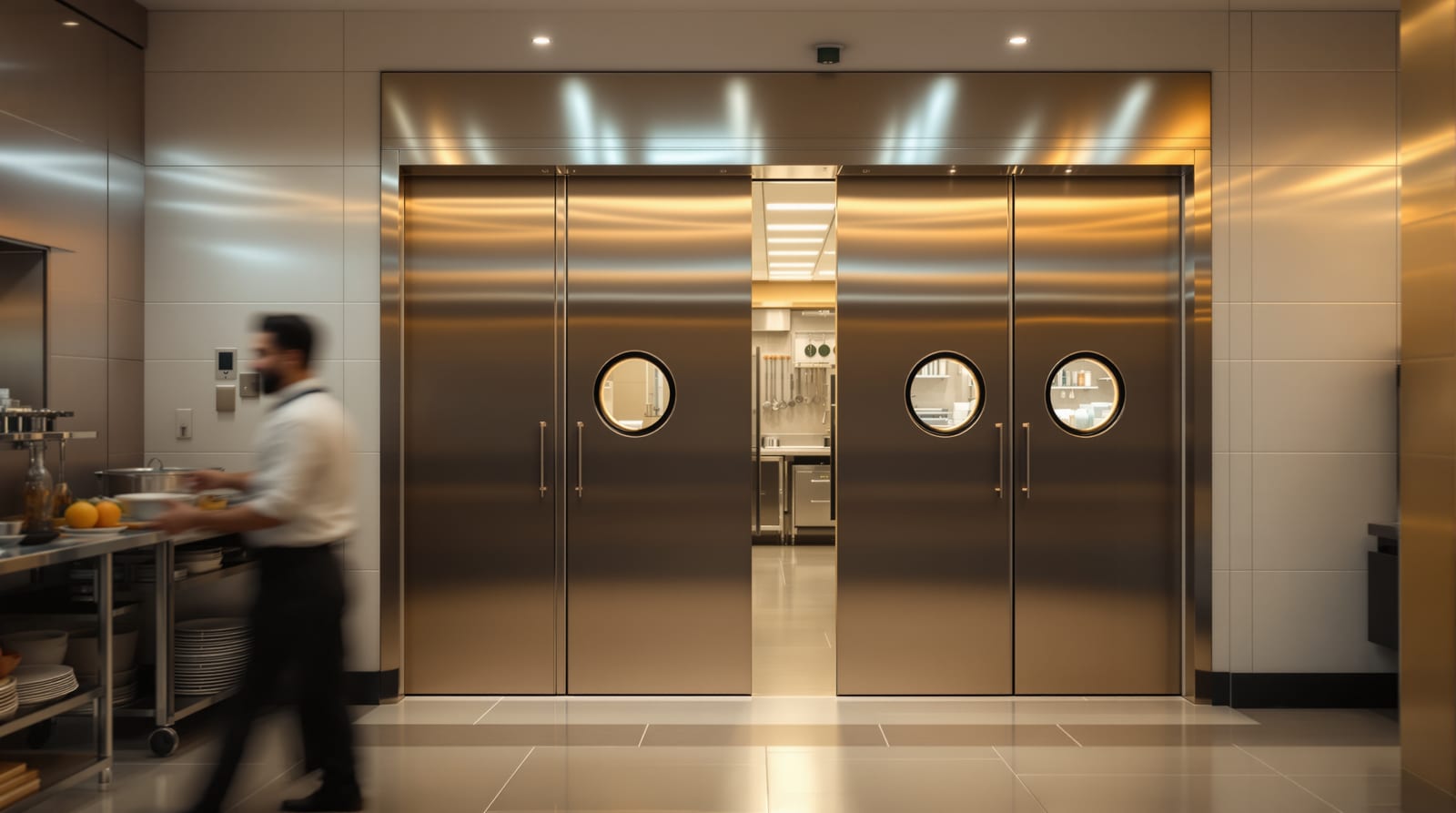
Double-Action Swing Doors: Two-Way Traffic Doors India 2026
Rigid double-swing leaves on gravity or floor-spring hinges that self-centre, open both ways and shrug off cart traffic in kitchens and hospitals.
A double-action swing door is a rigid traffic door hung on double-acting hinges or a floor spring so a single leaf swings both ways from a closed, centred position and then self-returns to that neutral plane. You push through with a trolley going in, push back through coming out, and the door settles shut behind you every time. This is the workhorse of high-throughput service routes — commercial kitchens, hospital corridors, supermarket back-of-house, hotel pass-doors — where hands are full and the door must be hands-free in both directions. It is a rigid-leaf product, which is the key distinction from the soft, gasketless flexible impact doors (PVC swing doors) that are its closest sibling: same two-way idea, very different leaf. For a fuller map of advanced types see the specialty doors hub and the cluster complete door guide.
What "double-action" actually means
Three ideas are bundled into the term, and specifiers should keep them separate:
- Double-acting — the hinge mechanism permits rotation in both directions (typically ±90° to ±100°) from a single rest plane, instead of a normal butt hinge that only opens one way.
- Self-centring (self-closing) — a spring or counterweight returns the leaf to closed/centred without a person or a conventional surface closer arm. This is what makes it hands-free.
- Impact-tolerant traffic detailing — vision ports, kick/scuff protection and finger-guard edges, because the door is meant to be struck by carts and bodies.
A plain "swing door" usually means a single-direction hinged door with a hydraulic closer; do not conflate the two. A double-action swing door has no projecting closer arm to clip a passing trolley, and it works whichever side you approach from.
The mechanism: gravity hinges vs floor springs
The self-centring force comes from one of two families, and the choice drives both cost and feel.
| Mechanism | How it self-centres | Typical leaf weight | Where it suits | Notes |
|---|---|---|---|---|
| Double-acting spring (gravity) hinge | Cammed pivot lifts the leaf slightly as it opens; gravity drops it back to centre | Up to ~40-50 kg/leaf | Kitchens, light service doors, retail back-of-house | Cheapest; tension/closing speed set by spring; pair top + bottom |
| Floor spring (double-acting) | Concrete-set hydraulic box drives a bottom pivot; top pivot or patch above | 80-150+ kg/leaf, wide glazed leaves | Hospital corridors, hotel lobbies, heavier SS or glazed leaves | Hidden, durable, adjustable speed/latch; needs floor pocket at slab stage |
| Pivot + overhead concealed closer | Concealed transom closer plus floor/top pivot | Heavy, tall leaves | Premium architectural double-swing | Costliest; coordinate with frame head |
A practical rule of thumb: gravity hinges for light, frequently struck kitchen leaves; floor springs for anything heavy, wide, glazed or in a public corridor where controlled closing speed and a clean look matter. Floor springs must be cast into the slab, so they have to be decided before the floor is poured — a classic site-sequencing trap.
Reading the swing — section through a double-acting door
The gap on the hinge side, where the leaf rotates through the frame, is exactly where fingers get crushed — so the finger-guard (a rolled or hinged edge cover sealing the pivot gap through the full swing) is not optional on doors the public uses.
Leaf materials and construction
The rigid leaf is what you are really paying for, and material follows the room's hygiene and abuse profile.
| Leaf type | Build | Best for | Indicative ₹ band (supply-only/leaf) |
|---|---|---|---|
| HPL / laminate on ply or particle core | Decorative high-pressure laminate, ABS/PVC lipping, kick plates | Restaurant front-to-kitchen, hotel service | ₹6,000-14,000 |
| Stainless steel (SS 304) faced | SS skins over honeycomb/PUF core, fully welded edges | Commercial kitchens, washdown, FSSAI food areas | ₹14,000-32,000 |
| FRP / GRP faced | Moulded glass-fibre skins, chemical/moisture proof | Wet, corrosive, dairy/meat processing | ₹12,000-26,000 |
| Glazed aluminium / SS frame | Large vision panel, toughened glass, floor spring | Hospital corridors, hotel lobbies, public flow | ₹18,000-45,000 |
| Solid timber / flush architectural | Veneer or paint-grade flush leaf, edge banding | Premium back-of-house, club/banquet | ₹10,000-28,000 |
These are supply-only bands per leaf at 2026 prices; installed cost adds the floor spring or hinge pair, frame, vision glazing, finger-guards and labour, and GST on doors is 18%. Wide or tall custom leaves, full-vision glazing and SS welded edges push to the top of each range and beyond. Treat every figure as a starting point and get a vendor quotation against your exact opening and traffic. Where food contact or GMP is involved, coordinate with the requirements in food-grade doors and pharma cleanroom doors — a double-action SS leaf is often the cheapest compliant trolley door, but it is not a gasketed airlock leaf.
Essential detailing
Vision ports
Because both sides push blind, a vision port (kick-height to eye-level glazed panel) is the primary collision-prevention feature; on hospital and busy kitchen doors specify a generous panel, not a porthole. Toughened or laminated glass; in food areas, flush-glazed and gasket-free seams for cleanability.
Finger-guards and edge protection
Fit a continuous hinge-side finger-guard wherever non-staff pass, and stainless kick plates / scuff bands to the trolley strike zone. The hardware approach overlaps with general door hardware but the load case is impact, not security.
Speed, hold-open and stop
Set closing speed and a soft latch so the leaf does not slam a following trolley; some floor springs offer a hold-open detent for restocking. Confirm the leaf clears the floor finish through full swing — uneven tiles foul a low gravity-hinge leaf.
Where it is not the answer
A double-action swing door is a traffic door, not a fire, smoke, acoustic, thermal or hygienic-airlock door. It does not seal. If the opening must hold a rating use a proper fire-rated doors assembly; for sound use soundproof doors; for cold rooms use freezer doors; for OT/airlock use a hermetic or cleanroom door. For very high cycle volumes a high-speed doors roll-up may beat a swing leaf.
Selection at a glance
| If your route is... | Lean toward |
|---|---|
| Restaurant kitchen, light carts, budget | Laminate leaf on double-acting gravity hinges |
| Heavy SS washdown kitchen, FSSAI | SS 304 leaf, floor spring, full finger-guard |
| Hospital / hotel public corridor | Glazed leaf on floor spring, large vision port |
| Wet/corrosive food processing | FRP leaf, SS hardware |
| Dust, draught or temperature only (not traffic seal) | Reconsider — strip curtain or high-speed door |
Use the specialty door selector to shortlist a configuration, and the specialty door cost estimator to bracket a budget before you brief vendors. For supplier scale, double-action and traffic doors are made to order across India by general specialty-door fabricators; frame the brief by opening size, traffic type, leaf material and hinge family rather than by brand.
Frequently asked questions
How is a double-action swing door different from a flexible impact (PVC) door?
Both swing two ways and self-centre, but a double-action swing door has a rigid leaf (laminate, SS, FRP, glazed) on a hinge or floor spring, giving a finished, lockable, vision-glazed door. A flexible impact door is a soft, transparent PVC/rubber leaf that simply flexes open on contact — cheaper, more forgiving of forklifts, but not a finished architectural leaf.
Gravity hinge or floor spring — which should I specify?
Use double-acting gravity hinges for light, frequently struck leaves up to roughly 40-50 kg (most restaurant kitchen doors). Use a double-acting floor spring for heavy, wide, glazed or public-corridor leaves where you want adjustable, controlled closing speed and a concealed look. Floor springs must be cast into the slab, so decide before the floor is poured.
Are double-action swing doors fire-rated or sealed?
No. By design they have hinge-side gaps and no perimeter seals, so a standard traffic door provides no fire, smoke, acoustic or thermal rating. If the opening needs a rating, use a tested fire or hermetic assembly instead; a double-action door is purely a high-throughput traffic door.
What does a double-action swing door cost in India?
Supply-only leaves run roughly ₹6,000-14,000 (laminate), ₹12,000-26,000 (FRP) and ₹14,000-32,000+ (SS 304); installed cost adds the floor spring or hinge pair, frame, vision glazing, finger-guards, labour and 18% GST. Wide, tall, full-vision or welded-SS custom leaves cost more — these are made-to-order products, so price against your exact opening.
Do I need a finger-guard?
Wherever non-staff or patients pass through, yes — the rotating hinge gap is a genuine crush hazard. Fit a continuous finger-guard over the pivot edge plus kick plates in the trolley strike zone; on staff-only back-of-house it is good practice but less critical.
Can one door swing both ways without a closer arm?
Yes — that is the point. The self-centring force comes from the double-acting gravity hinge or floor spring, so there is no projecting hydraulic closer arm to be struck by a passing trolley, and the leaf works identically from either side.
Export this guide
Related Guides — Deep-dive reading
Hygienic food-grade doors: washdown specs, India 2026
Spec SS304/316 and FRP washdown doors for food, dairy, beverage and meat plants — sealed, crevice-free and FSSAI/HACCP-ready.
Home Doors & EntrancesFlexible Impact Doors in India 2026: Traffic Door Guide
How tough double-swing PVC and ABS traffic doors take forklift and trolley hits, self-close and keep cold rooms and wet areas sealed.
Home Doors & EntrancesSwing Doors in India: Double-Action Café Doors, Self-Closing & How to Read Door Handing
Two-way swinging pass-through doors, self-closing AC-room doors, and a plain-English guide to door handing — left/right hand, inswing/outswing — so you order the right swing the first time.
Home Doors & EntrancesRelated Tools — Try Free
Acoustic Privacy (STC) Visualizer
Indian healthcare acoustic visualizer — compare wall assemblies and noise sources, see received SPL after STC attenuation, and check FGI 2018 / IS 1950 / NABH speech-privacy compliance with live dual-canvas waveform.
Acoustic ToolHealing View Impact Calculator
Evidence-Based Design dashboard quantifying the recovery impact of nature view + daylight factor on analgesic use, length of stay, and HCAHPS patient-experience uplift. Calibrated against Ulrich 1984 (Science), Park & Mattson 2008, and the CHD EBD evidence base.
EBD CalculatorDoor Cost Calculator
Estimate the all-in cost of a door — leaf, frame, hardware, fitting and GST — by type, material and size.
Door Calculator