
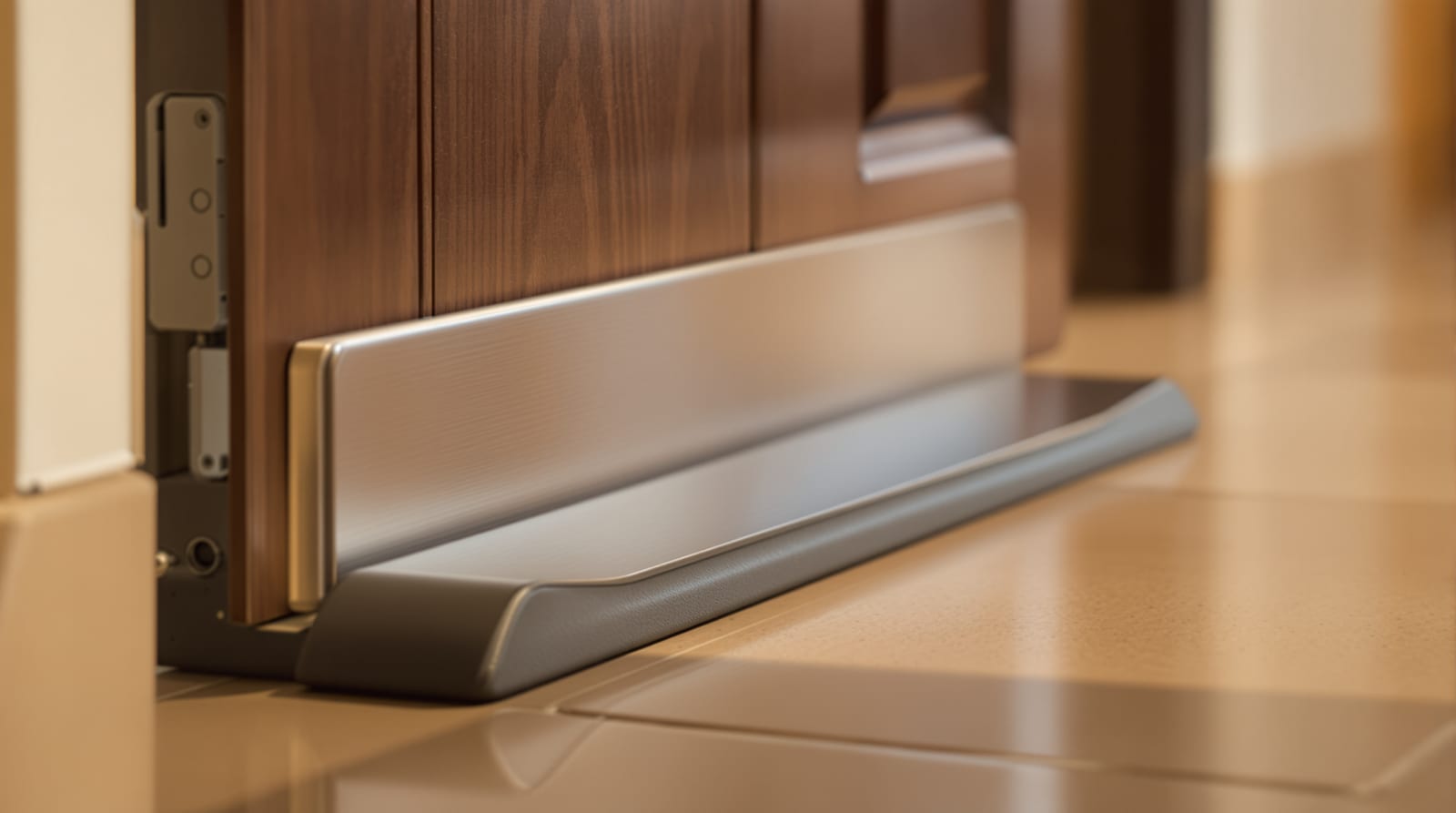
Door Stoppers in India: Types, Placement & Prices Guide (2026)
Floor, wall, magnetic, hydraulic hold-open and hinge-pin door stoppers for Indian homes - which to use where, finishes, fitting and 2026 costs.
A door stopper is the cheapest piece of hardware in the house and the one most people forget until the handle has punched a crater into the wall or the bedroom door has slammed shut in the night breeze. For sixty rupees to four hundred, it stops a swinging leaf at exactly the right point, holds it open against an AC draught or a monsoon gust, and protects your plaster, your skirting and your fingers. This guide covers every type sold in India - floor, wall, magnetic, hydraulic hold-open, hinge-pin, baseboard and kick-down - and tells you which one belongs behind which door.
A stopper is not a door closer. A closer (see our door closers guide) pulls a door shut on its own; a stopper does the opposite job - it limits travel or holds a door still. Many homes need both. And a stopper is not a magnetic catch either, though the two are often confused; a catch holds a cupboard or light interior leaf gently latched (covered in our magnetic door catches guide), while a magnetic stopper anchors a fully open door flat against the wall.
Why door stoppers matter more than you think
Walk through any five-year-old Indian flat and you will find the evidence: a semicircle of cracked POP or chipped paint behind every door, exactly at handle height. That is a missing or wrongly placed stopper. The handle, lever or knob hits the wall, and over hundreds of swings it gouges the plaster, loosens the lever rose and eventually cracks the door panel itself.
Stoppers earn their keep in four ways:
- Protect the wall and skirting. They arrest the leaf before the handle reaches the plaster - the single most common failure in new homes.
- Protect the door and its hardware. Repeated impact loosens hinges, mortise locks and lever handles. A stopper absorbs the shock in a rubber buffer instead.
- Hold the door open on purpose. In Indian summers a door left ajar for cross-ventilation will not stay put. AC pressure, ceiling-fan wash and pre-monsoon gusts swing it. A magnetic or hydraulic hold-open stopper keeps it parked.
- Stop slamming and trapped fingers. A soft buffer at the open end, or a top-mounted cushion, prevents the bang that wakes a sleeping child - and the joint-family classic of a finger caught in a slamming bedroom door.
For a heavy main door of solid teak or a steel security leaf, a stopper also stops the leaf over-swinging and tearing the hinge screws out of the frame - a real risk with the cross-breezes a top-floor or corner flat gets.
The seven types, and where each belongs
Floor-mounted (dome / half-moon) stopper
The default in India: a small dome, half-moon or wedge screwed to the floor a few inches in from the wall, with a rubber buffer the door leaf strikes. It is cheap, strong and works with heavy doors. The catch is that it is a toe-stub hazard in a doorway and a nuisance when you mop. Best for main doors, balcony doors and any heavy leaf where you want the stop low and out of the swing of the handle. Choose SS304 with a thick rubber bumper for wet zones.
Wall-mounted stopper
A short stud with a rubber tip that screws into the wall (or skirting) where the handle would otherwise hit. It keeps the floor clear - good for doorways you walk through constantly. The weakness is the fixing: into hollow POP or weak plaster it pulls out, and the load goes straight into the wall, so you need a solid wall or skirting and a good rawl plug. Ideal for bedroom and bathroom doors over hard skirting.
Magnetic (hold-open) stopper
Two parts - a small floor or skirting puck with a magnet, and a steel catch plate on the door bottom. Swing the door fully open and it clicks and holds against the magnet; a firm pull releases it. This is the answer to the "door won't stay open in the breeze" problem. Strong neodymium versions hold heavy doors; weaker ferrite ones suit light internal leaves. Excellent for doors you keep open for ventilation - living room, kitchen, passage doors.
Hydraulic / automatic hold-open stopper
A telescopic damped strut, usually wall-to-door, that lets the door open smoothly, cushions the last few degrees and holds it open at the chosen angle until you push it past the catch point. It is the premium option - no slam, no toe-stub puck, controlled hold. Used on wider or heavier doors and where you want a clean, hardware-store-modern look. Costs more and needs careful fitting.
Hinge-pin stopper
A clip or arm that fits over a hinge knuckle and stops the door at a set angle - no floor or wall fixing at all. Quick, tidy, and the only sensible choice when you cannot drill the floor (tiled marble you do not want to breach) or the wall (RCC or tile). It limits over-swing but does not hold the door open. Good for light to medium internal doors.
Baseboard / skirting-mounted stopper
A wall-stopper variant fixed low onto the skirting board itself rather than the wall, so the load goes into timber instead of plaster. Tidy and reliable where you have a proper wooden or stone skirting. Common on bedroom doors.
Kick-down (lever / foot-operated) stopper
A spring-loaded arm mounted on the door bottom that you flick down with your foot to wedge the door open, and kick up to release. Genuinely useful for the front door when you are carrying shopping, a gas cylinder or moving furniture, and for shop or office doors. Cheap, but the rubber foot wears and it scratches softer floors.
Which stopper for which door - quick comparison
| Stopper type | Best use | Holds door open? | Fixing | Indicative price (per piece, +18% GST) |
|---|---|---|---|---|
| Floor-mounted dome / half-moon | Main door, balcony, heavy leaves | No (limits swing) | Floor screws | Rs 60-250 |
| Wall-mounted stud | Bedroom, bathroom over hard wall | No | Wall plug + screw | Rs 70-300 |
| Magnetic hold-open | Living, kitchen, passage (ventilation) | Yes | Floor/skirting + door plate | Rs 120-400 |
| Hydraulic / automatic hold-open | Wide or heavy doors, premium look | Yes (set angle) | Wall + door bracket | Rs 600-2,500 |
| Hinge-pin | Light internal doors, no-drill floors | No | Clips on hinge | Rs 80-250 |
| Baseboard / skirting | Bedroom doors with timber skirting | No | Skirting screws | Rs 70-300 |
| Kick-down (foot lever) | Front door, moving loads, office | Yes (manual) | Door-bottom screws | Rs 150-500 |
Prices are indicative and vary by city, brand and finish; branded SS304 and designer finishes sit at the top of each band, while local hardware-shoppe pieces sit at the bottom. Add fitting labour of roughly Rs 50-150 per stopper if a carpenter does it, or treat it as a five-minute DIY job with a drill and the right plug.
Placement - get this right or the stopper is useless
The whole point is to arrest the leaf before the handle reaches the wall, so measure first.
- Floor stopper: open the door to the angle you want it to stop at, mark where the lower outer edge or the handle stile lands, and set the dome a centimetre or two inside that so the rubber takes the hit, not the handle. Keep it out of the main walking line to avoid toe-stubs - tuck it close to the wall.
- Wall / baseboard stopper: fix it at the exact height the handle or lever strikes (usually 900-1050 mm above floor, matching the lock height). Hit a stud, brick or skirting timber - never bare POP false-wall or it will rip out.
- Magnetic hold-open: the puck goes where the door bottom rests when fully open and flat to the wall; the catch plate goes on the door to meet it. A 3-5 mm air gap when held is normal.
- Hinge-pin: clip it to the top or middle hinge and adjust the arm to the stop angle; on heavy doors use the middle hinge for leverage.
In Vastu-conscious homes, remember the main door is meant to open inward and clockwise (see vastu-main-door-india and entrance-vastu); place the floor stopper so it does not foul the threshold or dehleez, and avoid a stopper that forces the door to a "blocked" half-open position across the entry.
Materials and finishes that survive Indian conditions
A stopper lives at floor level, gets mopped, sees monsoon damp and, on the coast, salt-laden air. Material choice is the difference between a five-year part and a rusting eyesore in one season.
- Stainless steel (SS304): the safe default. Genuine 304 resists the mopping water and humidity of most homes. For Mumbai, Goa, Chennai, Kochi and other coastal cities, insist on SS304 (not the cheaper SS202, which pitches and rusts in salt air).
- Zinc alloy / die-cast with chrome or satin plating: common on designer pieces; fine in dry interiors but the plating can blister near constant water.
- Brass: traditional, ages to a warm patina, and pairs with brass-fitted heritage and teak doors; polished brass needs occasional cleaning, antique/aged brass hides marks.
- Rubber / silicone buffer: the part that actually takes the impact. Cheap rubber hardens and cracks in a year or two in the heat; better stoppers use a replaceable silicone bumper.
Match the finish to the rest of your door hardware so it reads as deliberate, not an afterthought - our door hardware finishes guide covers coordinating satin nickel, matte black, brass and chrome across handles, hinges and stoppers. The broader door hardware guide sets out the full ironmongery set a door needs. Brands you will see across Indian counters and sites include Dorset, Ozone, Europa, Godrej, Hettich and Hafele, alongside countless unbranded local options.
Fitting a stopper yourself
Most stoppers are a genuine DIY job:
1. Mark the spot with the door swung to the stop angle (as above). Use a pencil and a spirit level for wall types.
2. Drill - a masonry bit for tile/concrete floors and walls, a wood bit for skirting. For glazed vitrified tiles, start with a tile bit or a dab of masking tape over the mark so the bit does not skate.
3. Insert the wall/rawl plug, tap it flush.
4. Screw the base home; for SS pieces use the SS screws supplied so you do not get a rusting steel screw in a stainless body.
5. Magnetic types: fit the puck first, then hold the catch plate to the door, swing closed-to-open to find the meeting point, and screw the plate.
For a heavy main door, a tiled floor you do not want to breach, or a hydraulic hold-open, get a carpenter - the fixing has to take real load and a pulled-out floor screw in marble is an expensive lesson. If you are setting up door hardware from scratch, our door installation guide and the door size calculator help you plan the whole leaf, swing and clearances before the stopper goes in.
Frequently asked questions
Do I really need a door stopper on every door?
Practically, yes - any door whose handle can reach a wall needs one, or you will be repainting that patch every year. Doors fitted with a closer that limits the open angle, or doors in tight recesses that physically cannot over-swing, can skip it. Bedrooms, balcony doors and the main door benefit most.
What is the difference between a magnetic door stopper and a magnetic door catch?
A magnetic stopper anchors a fully open door flat against the wall so it does not swing in a breeze. A magnetic catch gently holds a closed cupboard, wardrobe or light interior door shut. Different jobs, different parts - see our magnetic door catches guide.
Floor-mounted or wall-mounted - which is better?
Floor-mounted is stronger and suits heavy doors but is a toe-stub and mopping nuisance in the walkway. Wall or skirting-mounted keeps the floor clear and looks neater but needs a solid wall or timber skirting to fix into - it pulls out of hollow POP. For a heavy main door choose floor; for through-traffic bedroom doors choose wall or baseboard.
Which finish lasts on the coast?
Genuine SS304 with a silicone buffer. Avoid SS202, zinc with thin plating, and bare mild steel - all rust quickly in coastal salt air. In dry inland homes, brass and chrome-plated zinc are fine.
How do I stop my door slamming in the AC/breeze?
A magnetic or hydraulic hold-open stopper parks the door open so the draught cannot swing it, and the hydraulic type also cushions the last few degrees so there is no bang. Pair it with a soft buffer, or consider a door closer if you instead want the door to drift shut quietly on its own.
Export this guide
Related Guides — Deep-dive reading
Door Hardware Guide India 2026: Hinges, Handles, Locks, Closers and Every Fitting Explained
What each piece of door hardware actually does, where it belongs, which material (SS304, brass, zinc or iron) survives Indian conditions, the quality signals to check before you pay, and a buyer's checklist with 2026 prices.
Home Doors & EntrancesDoor Hardware Finishes in India: Satin SS, Brass, Matte Black, PVD & Coastal Picks
How to choose handle, lock and hinge finishes that look right, age well and survive Indian humidity and coastal salt air.
Home Doors & EntrancesDoor Handle Guide for Indian Homes: Levers, Knobs & Pull Handles (2026)
How to choose the right door handle — lever-on-rose, knob, pull or mortise handle set — for every door and room in an Indian home.
Home Doors & EntrancesRelated Tools — Try Free
False Ceiling Cost Estimator
Live ₹/sqft across 8 ceiling types — POP, gypsum, designer, metal, PVC, wooden — with cove and spot lighting for 20 Indian cities.
Cost CalculatorWindow Hardware Cost Calculator
Estimate window hardware cost — hinges, handles, locks, rollers and multipoint gears.
Window CalculatorFull-Room BOQ — Living, Bedroom, Kitchen, Bath
Room-wise BOQ across living, bedrooms, kitchen, utility, and bathrooms with line-item pricing.
Full-Room BOQ