
Door Key Handover: Keying Schedule & Register (India 2026)
Count, label, secure and hand over door keys in India — keying schedule, key register, smart-lock credentials and re-keying on possession.
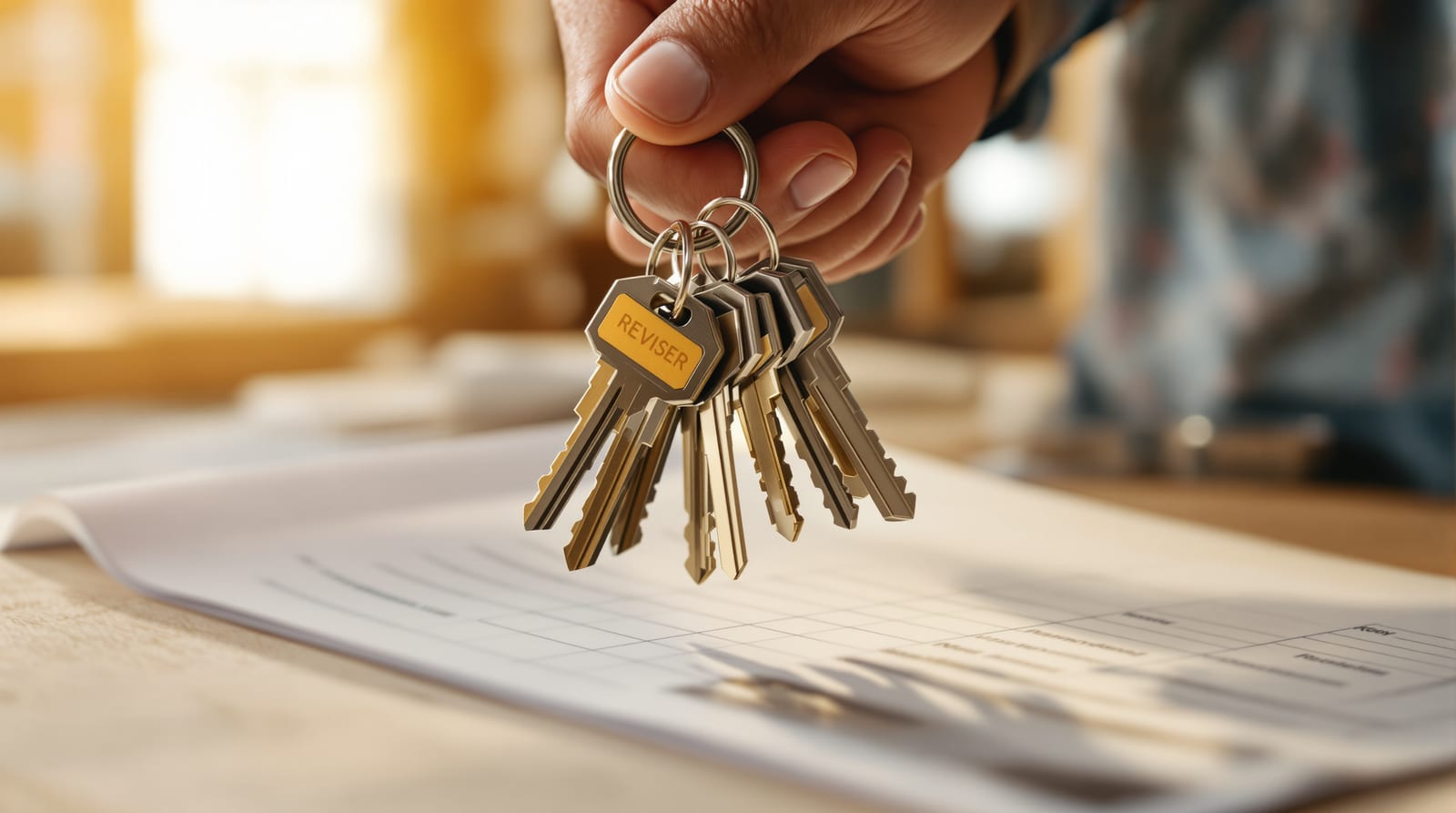
The door key handover is the quiet, easily-rushed step that decides whether your new home is actually yours — or whether a builder's construction key, a fitter's spare and three unlabelled bunches still float around the city. Handing over keys is not just passing a bag at the door: it is a documented event with a keying schedule, a counted and labelled set, a signed key register, the credentials for any smart locks, and — critically — a plan to re-key the locks that mattered during construction. Done properly, you leave the handover knowing exactly how many keys exist, who holds each, which key opens what, and that no one outside your household can walk in. Done casually, you inherit a security gap you cannot even measure.
This guide is the keys half of the door handover guide. It assumes the hardware itself is already specified — the cylinders, suites and finishes come from the ironmongery schedule for doors — and focuses on the keying schedule, counting, labelling, the register, smart credentials and re-keying so possession is clean.
What a keying schedule actually decides
Before a single key is cut, someone decides how the locks relate to one another. That decision is the keying schedule, and it is the heart of door key handover. It answers one question for every lock in the home: which keys open this, and which keys must it ignore? Three conventions cover almost every Indian home:
- KD — keyed different. Every lock has its own unique key, and no key opens any other lock. Maximum separation; maximum number of keys to carry. Sensible for the main door and a strong-room or store you want isolated.
- KA — keyed alike. A group of locks all open with the same key. One key for several internal doors is convenient, but it means one lost key compromises the whole group. Common for a cluster of bedroom doors a single owner controls.
- MK — master keyed. Each lock keeps its own change key, but a single master key also opens the whole group. Standard where one person (you, or building facilities) needs override access while occupants keep private keys.
Larger homes, villas and small buildings extend master keying into a suite — a tree of authority. A grand master key (GMK) sits at the top, sub-masters govern zones (a floor, a wing, the services), and change keys open individual doors. The suite is what lets a facilities manager open any common-area door with one key while each flat owner holds only their own. Lay the suite out cleanly with the door key schedule builder, and record it against each door reference in the door schedule guide so the manufacturer pins every cylinder correctly before delivery.
One life-safety rule overrides all of the above: never key a fire-escape or final-exit door so that it needs a key to leave. Free egress under NBC 2016 means escape doors open from the inside without a key, master or otherwise. A keying schedule that defeats egress is not clever — it is illegal and dangerous.
The keying schedule, written out
A keying schedule is just a small table that anyone can read. Below is a worked example for a typical Indian 3BHK with a service entry and a master suite — the kind you should receive (and check) at handover.
| Door ref | Location | Keying | Suite role | Keys to issue |
|---|---|---|---|---|
| D-01 | Main entrance | KD | Change key + Master M-1 | 4 + 1 master |
| D-02 | Service / kitchen entry | KD | Change key + Master M-1 | 2 + (master) |
| D-03 | Master bedroom | KA-bed | Master M-1 opens | 2 |
| D-04 | Bedroom 2 | KA-bed | Master M-1 opens | 2 |
| D-05 | Study / store | KD | Master M-1 opens | 2 |
| D-06 | Meter / services cupboard | KD | Sub-master SM-S (facilities) | 1 + sub-master |
Read it as: every door has its own everyday key (the change key), a single household master M-1 overrides the lot, and the services cupboard also answers to a facilities sub-master so the building can read meters without your everyday keys. The "keys to issue" column is the bridge between the schedule and the count you physically receive. Define the suite once, here, and the rest of handover is bookkeeping. Cross-check the cylinder types and finishes against the ironmongery schedule so the schedule names real, pinned products rather than a wish.
Counting and labelling every key
A keying schedule on paper is worthless if the physical keys do not match it. The handover must reconcile the count — the actual keys in your hand against the "keys to issue" column. For each lock confirm how many change keys were supplied (typically 2-4 per cylinder), how many masters and sub-masters exist, and — the question most buyers forget to ask — how many spares were cut and where they are. A bunch "missing one key" is not a minor snag; it is an unaccounted-for key to your home.
Label before you leave the table. Every key gets a tag carrying the door reference (D-01, D-03) — never the plain words "main door" or your flat number, which tells a finder exactly what the key opens. Use a coded scheme that only your register decodes. Keep masters and sub-masters physically separate from everyday keys, and store the master in a different, secured place from the bunch you carry. Tagging the keys to the same references used in the door and ironmongery schedules keeps the whole paper trail aligned with door numbering and tagging.
The key register and secure handover
The key register is the signed record of the handover event — the document that, months later, proves what you received and lets you trace any key that goes missing. It is a simple table, signed and dated by both the handing and receiving parties.
| Key ID | Door ref / suite | Type | Qty issued | Held by | Notes |
|---|---|---|---|---|---|
| K-01 | D-01 main | Change key | 4 | Owner | 2 daily, 2 reserve in safe |
| K-M1 | M-1 household master | Master | 1 | Owner (secured) | not carried daily |
| K-SMS | SM-S services | Sub-master | 1 | Facilities | acknowledged by FM |
| K-03 | D-03 / KA-bed | Change key | 2 | Owner | bedroom group |
| K-06 | D-06 meter | Change key | 1 | Facilities | services cupboard |
| K-SP | construction spares | Spare | 0 | — | re-keyed; see below |
The register does three jobs at once: it confirms quantities received, it assigns custody (who holds each key), and it gives you a baseline so that if a key is later lost you know precisely which cylinder to re-key. Have the builder, contractor or fitter sign it alongside you; file it with the as-built schedule in your door care handover pack and keep a copy with the door warranty claims paperwork. The door handover pack generator can assemble the register, schedule and care notes into one document. CPWD specifications and IS 1200 govern measurement and workmanship on contracts, but the keys register is the buyer's own protection — insist on it even when it is not contractually demanded.
Smart locks: handing over credentials, not just keys
A growing share of Indian homes fit smart or transponder locks on the main door — PIN keypads, RFID cards, fobs, fingerprint and app access. These have no physical key to count, so the handover instead transfers credentials and administrative control, and this is where most smart-lock handovers go wrong. The installer or builder often retains the admin account and the factory master PIN, which means they can still add users after you move in.
At handover, insist on: the admin/owner account transferred to you (with the installer's account removed), all factory and installer default PINs changed, a full list of enrolled cards, fobs and fingerprints with any unknown entries deleted, the mechanical override key (most smart locks keep one — count and label it like any other), and the firmware/app set-up details. For a transponder or immobiliser-style credential, confirm how many tokens were programmed and that no extra blanks remain enrolled. Treat a smart lock exactly as you would a master suite: assume anything you did not personally set could be known to someone else, and reset it.
Re-keying on possession and the builder-key changeover
During construction, the builder often runs the home on a construction key — a temporary keying so trades can access doors without you handing out your real keys. A well-managed site uses a construction keying lock that the first turn of your permanent change key disables the builder's key forever. Confirm whether your locks had this feature and whether the changeover has been triggered. If not, the builder's construction key may still open your main door.
The safest stance on any door that mattered during construction — the main entrance above all — is to re-key or replace the cylinder on possession. Through the build, dozens of people held or could have copied keys: the contractor, fitters, painters, the watchman. Re-keying (a locksmith re-pins the existing cylinder to a new key, cheaply) or swapping the cylinder resets that completely. As a rule of thumb, re-pinning a cylinder runs ₹300-800, a new pin-cylinder ₹500-2,000+, and a fresh smart-lock credential reset is usually free in the app — small money for the certainty that the only keys to your home are the ones in your register. Note the re-key in the register (key ID K-SP above), and you have closed the loop from the complete door guide build sequence to a genuinely secure home.
Frequently asked questions
What should I check at a door key handover?
Reconcile the physical keys against the keying schedule's "keys to issue" count, including masters, sub-masters and any spares cut during the build. Confirm every key is tagged to a coded door reference, sign a key register that assigns custody, transfer smart-lock admin accounts and reset all default PINs, and agree which cylinders will be re-keyed on possession. Anything "missing" is a security gap, not a minor snag.
What is the difference between keyed-alike and master keying?
Keyed alike (KA) means a group of locks all open with the same key — convenient, but one lost key compromises the whole group. Master keyed (MK) means each lock keeps its own unique change key, but a single master also opens the group. Master keying gives override access (for you or facilities) while occupants keep private keys; keyed-alike simply shares one key across several doors.
Should I re-key the locks when I take possession?
Yes, on any door that mattered during construction — the main entrance above all. Through the build, contractors, fitters, painters and watchmen may have held or copied keys, and the builder's construction key may still work. Re-pinning a cylinder (roughly ₹300-800) or swapping it resets access entirely, so the only keys to your home are the ones recorded in your register.
How do I hand over a smart lock?
Transfer the admin/owner account to yourself and remove the installer's account, change all factory and installer default PINs, list and verify every enrolled card, fob and fingerprint (deleting unknown entries), and take possession of the mechanical override key. Treat any credential you did not personally create as potentially known to someone else and reset it.
What goes in a key register?
A key register is a signed, dated table listing each key by ID, the door or suite it opens, its type (change key, master, sub-master, spare), the quantity issued, who holds it, and notes. Both the handing and receiving parties sign it. It confirms quantities, assigns custody, and gives you a baseline so a lost key can be traced to the exact cylinder to re-key.
Can a master key open a fire-escape door from the outside?
A master may be allowed on the access side, but no master, sub-master or grand master may ever stop a fire-escape or final-exit door opening from the inside without a key. Free egress under NBC 2016 is non-negotiable: escape doors must release from within in one action. A keying schedule that defeats egress is unsafe and non-compliant, however convenient it seems.
Export this guide
Related Guides — Deep-dive reading
Door Handover Guide: Pack, Keys & DLP India 2026
What a complete door handover looks like at project completion in India: the handover pack, keys register, as-built schedule, final snag sign-off and the defect liability period.
Home Doors & EntrancesDoor Numbering & Tagging on Site: A Project Guide (India 2026)
How to reference, number and tag every door (D01, D02…), key the schedule to the floor plan and avoid mix-ups on an Indian project.
Home Doors & EntrancesEntry and Exit Assessment for Indian Homes
How to audit every way IN and OUT of your home or building — a complete inventory of doors, gates, windows, balconies and forgotten access points, rated for how easily each could be used to get in and how well it serves escape in an emergency, turned into a hardening priority list.
SecurityRelated Tools — Try Free
Access-Card Quantity Calculator
How many access cards or fobs to order and re-order, from users, spare stock, a visitor pool and annual loss.
Card CountAccess-Control Schedule Generator
Build the time schedules that decide when each access group can enter — an editable list for your integrator.
Time SchedulesDoor Key Schedule Builder
Build a door keying schedule — keyed-alike groups, master and sub-master suites — with key counts and an indicative cost.
Keying Builder