
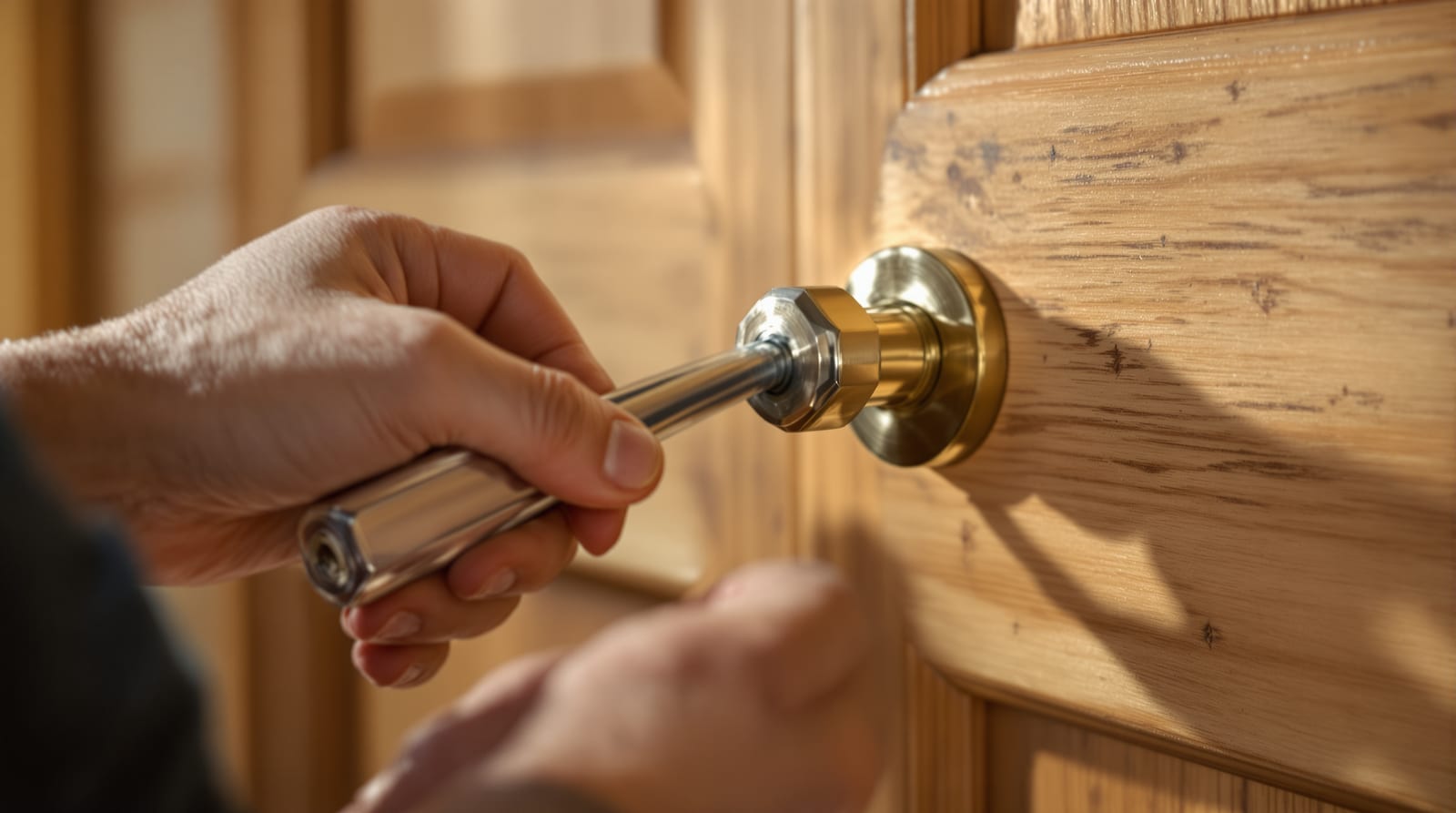
Door Handle Replacement: Easy DIY Steps (India 2026)
Swap a worn knob, lever or mortise handle set yourself — identify the type, match the spindle and backset, and fit a fresh one in under an hour.
A door handle replacement is the most beginner-friendly door job there is — no carpentry, no power tools, and a brand-new look for the price of a meal out. A loose, rattling or dated handle drags down an otherwise smart door, and after a few years of daily use the spring tension in a lever sags, the finish flakes, or the screws simply give up. The good news: if you can wield a screwdriver and match a few measurements, you can do this yourself in 30 to 60 minutes. This guide walks you through identifying your handle type, buying the right replacement, and fitting it cleanly — whether you are refreshing a bedroom lever or upgrading the main door to brushed steel.
Before a door handle replacement, identify what you have
Most handles you will meet in an Indian home fall into four families. Get this right before you shop, because they are not interchangeable without changing the latch or lock too.
| Handle type | What it looks like | Common location | Swap difficulty |
|---|---|---|---|
| Lever-on-rose | Lever on a small round/square plate (the "rose"), separate keyhole | Bedrooms, study | Easy |
| Knob set | Round knob on a rose | Older homes, store rooms | Easy |
| Mortise handle set | Long backplate with lever + keyhole together | Main door, often with lock | Moderate |
| Tubular latch + handle | Handle drives a tubular latch through the door edge | Apartments, internal doors | Easy–moderate |
The quickest tell: pull the lever and watch the door edge. If a sprung latch bolt retracts, you have a tubular or mortise latch handle. If there is also a separate dead bolt you turn with a key, it is a mortise lock and the handle is part of that set.
The three measurements that matter
Before buying anything, take these so the new set drops in without enlarging holes:
- Spindle size — the square steel rod that runs through the latch. India standard is 8 mm; some imported sets use 7 mm. Measure across the flats.
- Backset — distance from the door edge to the centre of the spindle hole. Internal doors are typically 60 mm; main doors and lock sets often 65–85 mm.
- Fixing-hole spacing (PCD) — the gap between the two screw holes on the rose or backplate. If you match this, you reuse the same holes.
For lock-handle combinations, also note the distance between the spindle and the keyhole/cylinder — get this wrong and the holes won't line up. A door hardware guide explains these dimensions and the common Indian standards in more depth.
Tools & materials you'll need
- Phillips and flat screwdrivers (a #2 Phillips covers most sets)
- A small hex/Allen key (many levers hide a grub screw under the lever neck)
- Measuring tape or vernier for spindle and backset
- The new handle/lever set (with matching spindle, springs and screws)
- A pencil, masking tape, and a torch
- Optional: graphite or silicone spray, a touch-up marker for screw scuffs, longer screws if the old holes are worn
| Item | DIY part cost (₹) | Notes |
|---|---|---|
| Lever-on-rose (zinc/SS) | 300–1,200 | GST 18% usually included on MRP |
| Brass mortise handle set | 800–2,500 | Heavier, main-door grade |
| Tubular latch (if changing) | 150–500 | Match backset |
| Spindle (spare) | 30–100 | If new set's spindle is short |
| Carpenter (if you'd rather not) | 400–800 | Half-day visit |
Step-by-step: replacing a lever or knob set
Difficulty: easy. Time: 20–40 minutes.
1. Take the old handle off. Look for a small grub screw under the lever neck or on the rose — loosen it with the Allen key and the lever slides off. If there is no visible screw, the rose may snap off to reveal screws underneath; prise gently with a flat blade wrapped in tape.
2. Remove the rose/backplate. Undo the two fixing screws on each side. The spindle will now slide out. Keep both halves and the spindle until the new set is fully on.
3. Check the latch. If the new handle uses the same spindle and backset, leave the latch in place. Wipe it and give the bolt a light spray of silicone so it glides.
4. Insert the new spindle through the latch, centred so equal length sticks out each side.
5. Fit the new roses/backplates. Slide each side onto the spindle, line up the screw holes, and drive the screws in finger-tight first, then snug — over-tightening warps the rose and stiffens the action.
6. Mount the levers. Push each lever onto the spindle and lock it with its grub screw. Some designs clip on.
7. Test. Operate the lever ten times. The latch should snap back briskly and the lever should return level. If it sags, the return spring isn't seated — recheck the spindle orientation.
8. Align the strike. Close the door. If the latch doesn't catch cleanly, see door strike plate alignment.
Replacing a mortise handle set (with lock)
This is moderate. The handle backplate sits over a mortise lock body buried in the door edge. Remove the lever set first, then the screws holding the backplate. You usually keep the lock body in place — only the handle and trim change — but confirm the new backplate's spindle-to-keyhole distance matches the lock. If you are also changing the lock itself, follow door lock replacement instead.
The fit and the finish
When you upgrade for style rather than necessity, match the finish to the room's other metals — taps, hinges, light fittings. Stainless steel and matte black wear well in humid coastal homes; brass and antique finishes look warm but need occasional polishing and can spot in salty air. For main doors, choose a solid handle with a real metal core, not a hollow zinc casting that loosens within a year.
| Symptom before replacing | Likely cause | Quick check |
|---|---|---|
| Handle wobbles | Loose grub screw or worn spindle | Tighten first — see loose door handle fix |
| Lever droops, won't return | Tired return spring | Replace the set |
| Latch won't retract | Seized latch, not the handle | Spray latch; check before buying |
| Key turns but lever dead | Lock body fault | This is a lock issue, not the handle |
If the handle merely feels loose, don't buy a new one yet — a loose door handle fix often solves it in two minutes. And if the lock mechanism behind the handle is the real culprit, head to door lock repair. For a wider symptom-to-fix map, the door troubleshooting hub and the complete door guide cover everything from sticking doors to security.
When to stop and call a carpenter
DIY this freely on internal doors. Call a professional if: the new set needs the spindle or latch hole enlarged or repositioned (drilling a door edge off-square ruins it); the existing screw holes are stripped and won't bite even with longer screws (the timber may be split); the handle is on a toughened-glass door (glass cut-outs are fixed — wrong handle means a new pane); or it operates an automatic/sensor door (isolate the power and leave the operator to a technician). A swollen or warped leaf that grips the handle is a door problem, not a handle problem — fix the door first.
Use the door repair cost estimator to sanity-check a carpenter's quote, and the door problem diagnoser if you are unsure whether the handle is really at fault.
Frequently asked questions
Can I replace just the lever and keep the latch?
Yes — if the new lever uses the same spindle size and backset, the latch stays put. This is the easiest swap and what most people do. Only change the latch if it is seized or the backset doesn't match.
What spindle size do Indian door handles use?
Almost all use an 8 mm square spindle. Some imported or designer sets use 7 mm, so always measure across the flats before buying. A spare spindle costs ₹30–100 if the new one is too short.
How much does it cost to replace a door handle in India?
The handle set itself runs ₹300–1,200 for a lever-on-rose and ₹800–2,500 for a brass mortise set, GST usually in the MRP. Doing it yourself costs only the part; a carpenter adds ₹400–800 for a half-day visit.
My new handle holes don't line up with the old ones — what now?
The fixing-hole spacing (PCD) differs. Either buy a set that matches the old PCD, or fit a model with a larger rose/backplate that covers and re-uses fresh pilot holes. Never force screws into the old, worn holes — use longer screws or fresh positions hidden by the plate.
Why does my lever sag and not spring back after fitting?
Usually the return spring in the set is weak or the spindle is seated wrong. Re-check that the spindle is centred and the spring cassette in the rose faces the right way. If a cheap set sags within months, the spring has failed — replace with a sturdier handle.
Should I upgrade my main door handle to a smart or security model?
For a main door, consider a heavier handle paired with a good lock rather than a thin internal lever. If you want keyless entry, see smart door locks — but fit those per the maker's instructions, as they involve a different cut-out and wiring.
Export this guide
Related Guides — Deep-dive reading
Door Hinge Replacement: DIY Step-by-Step Guide (India 2026)
Match the size, type and finish, then swap a worn or rusted hinge yourself without taking the whole door off its frame.
Home Doors & EntrancesDoor Lock Replacement: DIY Step-by-Step Guide India 2026
Identify your lock type, measure backset and door thickness, then remove, fit and align a new lock yourself — with tools and ₹ costs.
Home Doors & EntrancesDoor Hardware Guide India 2026: Hinges, Handles, Locks, Closers and Every Fitting Explained
What each piece of door hardware actually does, where it belongs, which material (SS304, brass, zinc or iron) survives Indian conditions, the quality signals to check before you pay, and a buyer's checklist with 2026 prices.
Home Doors & EntrancesRelated Tools — Try Free
Window Hardware Cost Calculator
Estimate window hardware cost — hinges, handles, locks, rollers and multipoint gears.
Window CalculatorDoor Hardware Cost Estimator
Estimate the all-in hardware cost for a door — hinges, lock, handle, closer, bolts, stopper and fitting — with GST.
Door CalculatorDoor Problem Diagnoser
Tell us the symptom and get the likely cause, the fix, DIY difficulty and indicative cost for any door fault.
Diagnostic Tool