
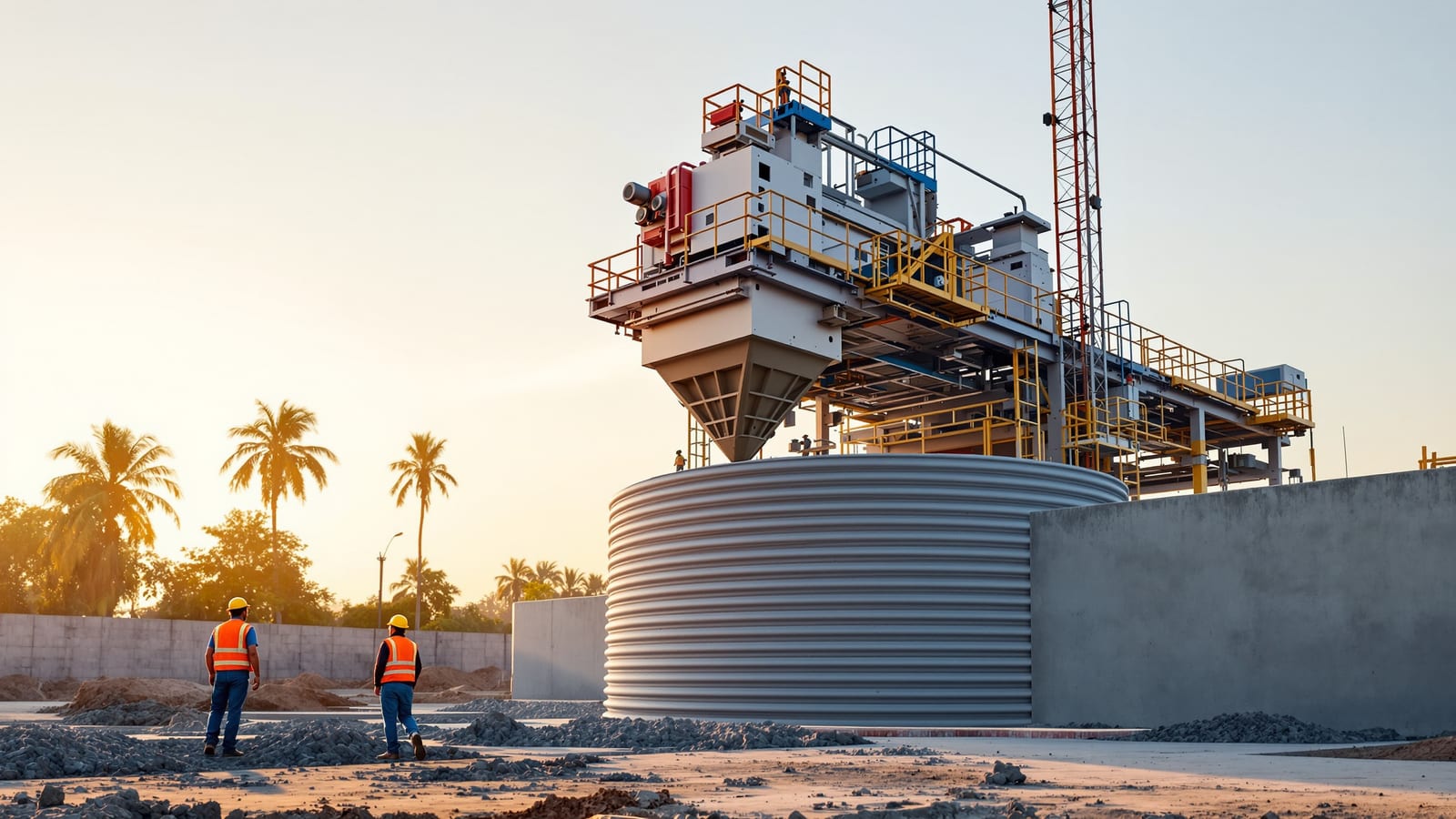
Robotics and 3D Printing in Construction: How Machines Are Starting to Build Homes in India
Inside the printers, robots and drones changing how houses get built, and what they really mean for cost, speed, quality and labour in India
For most of human history, a house has been built the same way: many pairs of hands, stacking and plastering, brick by brick. That is still how nearly every Indian home goes up today. But quietly, on a handful of sites in Chennai and Bengaluru, machines have started doing the actual building. A printer the size of a room squeezes out concrete in layers, like soft-serve ice cream, until a wall appears. A robotic arm lays bricks faster than any human crew. Drones fly over a plot and hand back a precise survey in minutes.
This guide takes you inside that change. It is the companion to our walk-through of modular and prefab homes in India, but it deliberately goes one level deeper, into the machines and methods doing the work, rather than the types of prefab building. We will be honest with you throughout: in India this is still early. Most of what you read here will reach you through a developer or contractor over the next decade, not as something you order for your plot tomorrow. But it is real, it is here, and it is worth understanding before someone tries to sell it to you.
1. What "construction automation" actually means
When people say robots are building homes, they usually mean one of a few very different things bundled together. It helps to separate them.
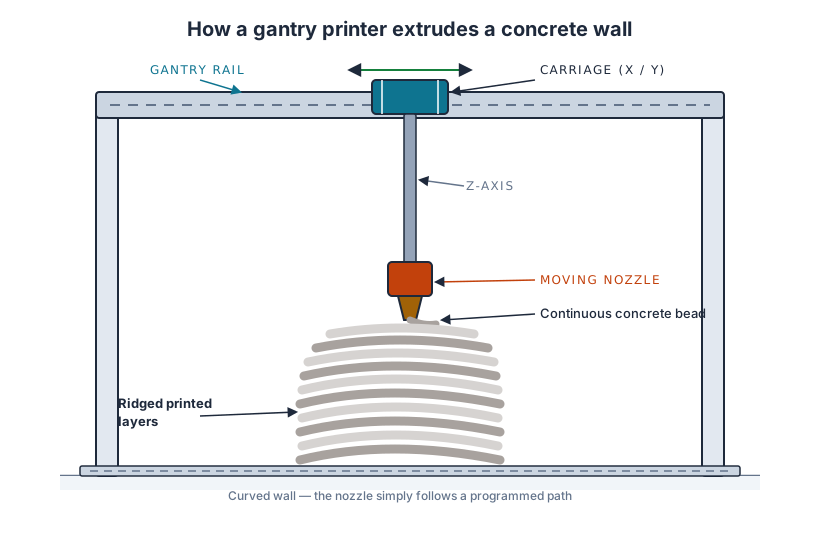
Additive construction (3D printing) builds a structure by adding material, layer on layer, instead of casting it into moulds or stacking pre-made units. A pump pushes a special concrete mix through a nozzle that moves along a programmed path, leaving a ridged bead of concrete that hardens fast enough to support the next layer on top. The trade calls this 3DCP, short for three-dimensional concrete printing.
Robotic assembly uses programmable arms or machines to do a repetitive task a human would otherwise do by hand, such as laying bricks, tying steel reinforcement, or fitting panels together in a factory.
Digital sensing and survey uses drones, laser scanners and cameras to measure a site or inspect work with far more accuracy and speed than a tape and a theodolite (the tripod-mounted angle-measuring instrument surveyors use).
Worker augmentation does not replace people at all. Exoskeletons, which are wearable braces that take load off a worker's back and arms, simply make hard manual work safer and less exhausting.
None of these is science fiction. All of them exist on real sites somewhere today. What differs hugely is how mature each one is, and how soon it matters in India.
2. 3D-printed concrete homes: how a printer makes a wall
Picture a steel frame, like the gantry of an overhead crane, straddling your plot. Hanging from it is a nozzle that can move left-right, forward-back and up-down. A computer feeds it a digital model of the house. The nozzle traces the outline of every wall, extruding a continuous bead of fast-setting concrete. It goes round and round, raising the walls a centimetre or two at a time, leaving the now-familiar corrugated layer texture on the surface.
What it cannot do on its own is just as important. A printer makes walls; it does not make a finished house. Doors, windows, roof, plumbing, wiring, flooring and finishing are still installed the conventional way, by people, afterwards. Steel reinforcement, the bars that give concrete its tensile strength so it does not crack and fail, is also a challenge: a printer extrudes concrete in a continuous path and cannot easily weave steel through it, so reinforcement has to be placed by hand in pockets or added through clever mix design. That single limitation is why so many printed buildings so far have been single-storey and small.
The honest summary: 3D printing is genuinely good at producing the structural shell of a building quickly and with little formwork (the temporary moulds normally needed to cast concrete). Everything before and after the shell is still ordinary construction.
3. The Indian story so far: Tvasta, IIT Madras and L&T
India's milestones here are real, and you should know them accurately, because they are often exaggerated in marketing.
In 2020, Tvasta Manufacturing Solutions, a startup founded by IIT Madras alumni, printed what is widely described as India's first 3D-printed house, on the IIT Madras campus in Chennai. It was a single-storey home of roughly 600 square feet, with a bedroom, hall and kitchen. The structure itself was printed in a matter of days. The finance minister inaugurated it in 2021. It was a pilot and a proof of concept, not a product you could yet buy.
In late 2020, L&T Construction, India's largest construction firm, printed a small two-storey building, about 700 square feet, at its Kanchipuram facility near Chennai, using a large COBOD printer (a Danish-made gantry printer) and a printable concrete mix it developed in-house. What made this notable was the use of real structural concrete with integrated reinforcement, designed to comply with Indian building codes, rather than the weaker ready-mix mortars used in many earlier demos.
In 2023, L&T, working with COBOD and IIT Madras, printed India's first 3D-printed post office in the Cambridge Layout area of Bengaluru, around 1,021 square feet. It was reported as built in roughly 43 days and at a fraction of conventional cost, and was inaugurated with national attention.
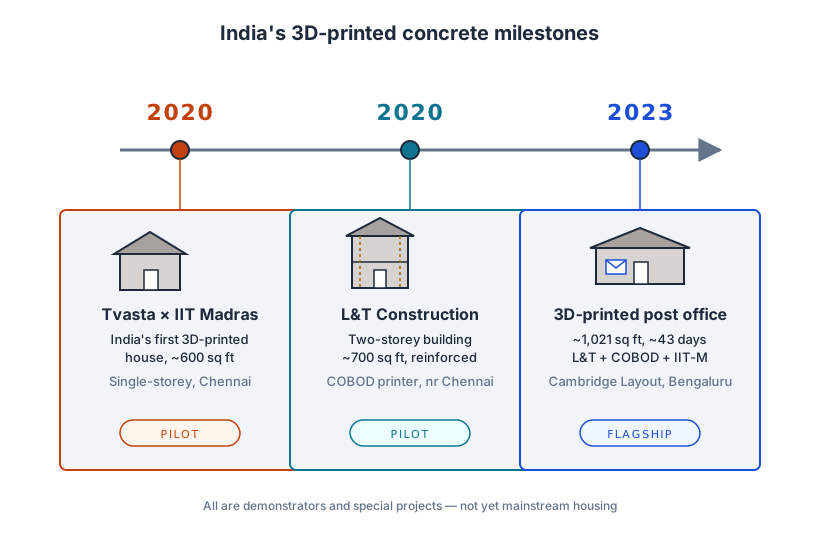
Notice the pattern. These are pilots, demonstrators and special buildings, championed by a top engineering institute and the country's biggest contractor. That is exactly how a new construction technology matures: not in your gully first, but in flagship projects that prove the codes, the mixes and the economics. Treat anyone claiming printed homes are mainstream in India today with healthy scepticism.
4. Robots that lay bricks, tie steel and assemble panels
Printing is the headline, but robotic assembly may touch Indian construction sooner in factories than on open sites.
Bricklaying robots already exist abroad. Machines such as the American SAM (Semi-Automated Mason) work alongside human masons, placing bricks and mortar at high speed while the human handles corners and finishing. The Australian Hadrian X uses a long arm to lay bricks far faster than a crew, and has built houses in the United States. These are impressive, but they suit large, repetitive masonry, and they are expensive imported machines. In India, where skilled masons are plentiful and relatively low-cost, the business case for a bricklaying robot on a typical site is weak today.
Rebar tying and steel work is another candidate: tying thousands of reinforcement intersections by hand is slow and hard on the body, and robotic tiers exist to automate it.
Factory assembly robots are where automation quietly does the most. In a controlled factory making prefabricated components, robotic arms can weld, cut, fit and handle panels with consistency no open site can match. This is the engine room behind the typologies covered in our modular and prefab homes guide; here, just note that the precision comes from machines, not only from working indoors.
5. Drones, scanners and the digital eye on site
Some of the most immediately useful automation needs no robot arm at all.
Drones fly a plot and produce an accurate topographic survey, a 3D point cloud and progress photos in a fraction of the time a ground crew takes, and they reach roofs, facades and tall structures safely for inspection. On large Indian projects this is already becoming normal.
Laser scanners capture an existing building or a half-finished structure as millions of measured points, so designers can verify that what was built matches the drawings, catching errors early when they are cheap to fix.
For a homeowner, the payoff is indirect but real: better surveys mean fewer nasty surprises about your land's slope, drainage or boundaries, and digital progress records make it harder for a contractor to hide slipping schedules or sloppy work.
6. From model to machine: the BIM-to-robot workflow
A printer or robot is only as good as the instructions it receives, and those instructions come from a detailed digital model of the building, known as BIM (Building Information Modelling). BIM is a 3D model that also carries data about every component: dimensions, materials, services and how parts connect.
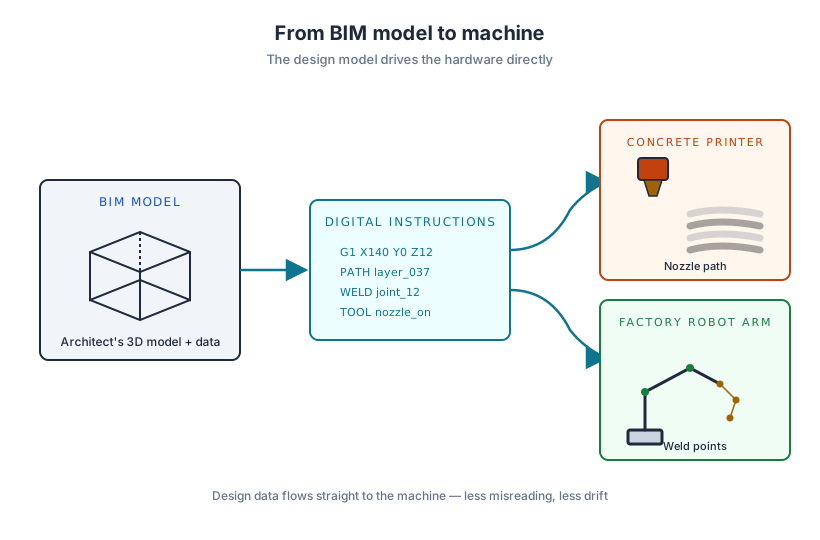
In an automated workflow, the architect's BIM model is translated into precise machine paths: the printer learns exactly where to lay each layer, the factory robot learns where to weld each joint. This is the real revolution underneath the hardware. When the design model drives the machine directly, there is far less room for the misreadings, "site adjustments" and quality drift that plague hand-built construction. It also means design errors get baked in faithfully if the model is wrong, so good upstream design matters more than ever. We explore the design-side of this shift in AI and the future of residential design.
7. What automation actually changes
Here is an honest scorecard of where these technologies help, and where the hype outruns reality.
| Technology | What it does | What it changes | India maturity (2026) |
|---|---|---|---|
| 3D concrete printing (3DCP) | Extrudes structural walls layer by layer | Fast shells, little formwork, curved/organic walls possible | Early: real pilots (Tvasta, L&T), not yet mainstream |
| Bricklaying robots | Place bricks and mortar at high speed | Faster, more consistent masonry | Very early in India; weak business case vs cheap skilled labour |
| Factory assembly robots | Weld, cut, fit prefab components indoors | High precision, consistent quality | Growing inside prefab factories |
| Rebar-tying robots | Automate steel reinforcement tying | Less slow, injury-prone manual work | Negligible in India today |
| Drones and laser scanning | Survey, map and inspect | Faster, accurate surveys and progress checks | Established on larger projects |
| Exoskeletons | Wearable braces that reduce strain | Safer, less exhausting manual work | Negligible in India today |
Three changes are worth dwelling on.
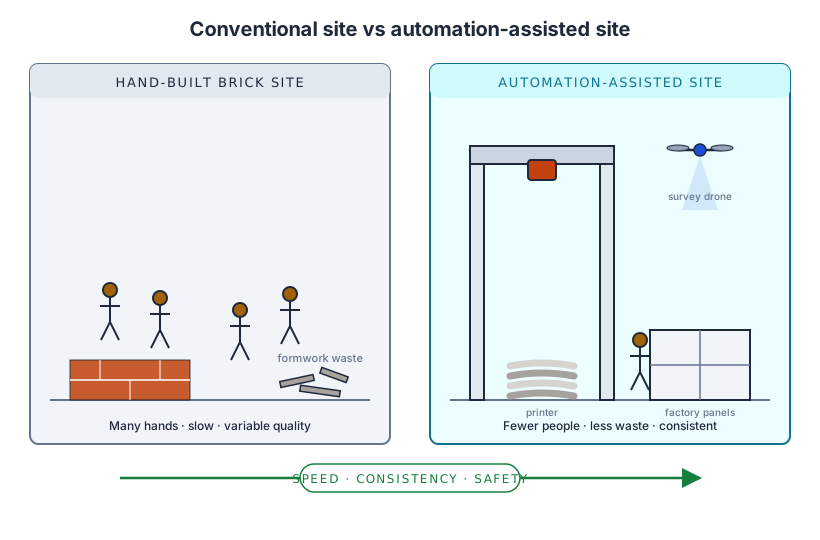
Speed and waste. A printer needs almost no formwork and lays only the material the wall requires, so it can cut both construction time and concrete waste. Conventional sites generate a lot of debris from broken formwork and over-ordering.
Design freedom. Because a nozzle simply follows a path, curved and organic walls cost a printer no more than straight ones. The flat, rectilinear box that dominates Indian construction exists partly because curves are expensive to mould by hand. Printing could loosen that constraint.
Labour. This is the sensitive one. In a high-wage country, automation's appeal is replacing scarce, expensive labour. India is different: construction employs tens of millions of workers, and labour is comparatively cheap and abundant. So in India the stronger arguments for automation are speed, quality, safety and consistency, not pure labour cost. The likely path is augmentation, machines handling the dangerous and repetitive work while people do the skilled finishing, rather than wholesale replacement.
8. The honest limits in India
It is easy to be dazzled by a video of a house printing itself. Keep these brakes in mind.
Codes and approvals. Indian building codes were written for conventional construction. Getting a printed structure certified, insured and loan-eligible is still a hurdle, which is exactly why early projects leaned on IIT Madras and L&T to prove compliance.
Scale and cost of the machines. A large gantry printer is a serious capital investment, only worthwhile across many buildings. For a single home, the economics rarely work yet.
Reinforcement and multi-storey. As noted, integrating steel into printed walls is hard, which has limited most printed buildings to low rise.
Finishing. Printed walls show a ridged texture that many owners want plastered over, adding back manual work. The machine builds the shell; people still finish the home.
The material question. Most 3D printing today uses cement-heavy concrete, and cement carries a heavy carbon footprint. Automation that prints more concrete faster is not automatically greener. Whether these methods help the planet depends on the mix and on offsetting waste savings against cement use, a thread we pick up in the future of green building materials in India.
What this means for you
For the next several years, none of this is something you will do yourself. You will not buy a printer for your plot, and you almost certainly should not be an early adopter for your own home unless you actively want to be a pioneer and can absorb the risk.
What you should do is recognise it when it arrives through others. A developer may advertise a printed or robot-assembled project; a contractor may use drones for survey or a factory with robotic assembly for components. When that happens, ask the grounded questions: Is the structure code-compliant and certifiable? Will a bank lend against it? Who finishes and warranties the work? What is actually automated, and what is still done by hand? Treat dramatic speed and cost claims as starting points to verify, not gospel.
The honest forecast is that automation will reach Indian homes gradually, from the factory and the flagship project outward, accelerating affordable and disaster-relief housing first, where speed matters most. Over a decade, expect printed and robot-assisted structures to move from curiosity to a normal option offered by serious builders. For a fuller picture of where this is all heading, read our companion looks at AI and the future of residential design and what homes might look like in 2050.
You do not need to act on any of this today. You need to understand it, so that when a builder says "robots built this," you can tell the genuine progress from the sales pitch.
Sources
- IIT Madras / Tvasta Manufacturing Solutions: India's first 3D-printed house, Chennai (2020-2021), as reported by ANI News, The Better India and Careers360.
- L&T Construction: India's first 3D-printed two-storey building with integral reinforcement near Chennai (2020), as reported by Global Construction Review, 3D Printing Industry and Construction Management.
- L&T Construction with COBOD and IIT Madras: India's first 3D-printed post office, Bengaluru (2023), as reported by COBOD, Manufactur3D and Deccan Herald.
- Bricklaying robots (SAM, Hadrian X) and construction exoskeletons: reporting from The Robot Report, Neuroject and AZoRobotics.
This is a forward-looking literacy guide. Specific projects, costs and timelines reflect reporting available at the time of writing and should be re-verified before any decision.
Export this guide
Related Guides — Deep-dive reading
Modular & Prefab Homes in India: An Honest Guide
What prefab, precast, LGSF and 3D-printing really mean for an Indian home — the speed, the trade-offs, and where they actually make sense.
Future-Ready HomesDFAB House: The First Building Where the Robots Held the Trowel
ETH Zurich's three-storey demonstrator at NEST in Dübendorf is the world's first house both designed and built predominantly by digital processes — six robotic and 3D-printing technologies stacked into one small dwelling. A case study in what happens when fabrication, not drawing, becomes the frontier of architecture.
The Future of ArchitectureThe 3D-Printed Community at Wolf Ranch: When a Fleet of Robots Builds a Neighbourhood
ICON, BIG and Lennar's 100-home development near Austin is the largest 3D-printed community on Earth — a full subdivision whose walls were extruded, layer by layer, by a gantry robot. This deep study reads its Vulcan-and-Lavacrete wall system, BIG's decision to leave the print lines showing, and the hard question the mid-$400,000s price puts to the affordability promise.
The Future of ArchitectureRelated Tools — Try Free
Before vs After — Cost Reality Check
Compare what you expected to pay vs what you actually paid, category by category.
Reality CheckMaterial Schedule Generator
Generate a room-wise finish schedule — walls, floors, ceilings, trim, and joinery by location.
Material ScheduleConcept Generator
Get 3 AI-generated design concepts for any room with style, materials, and cost estimate.
DesignAI