
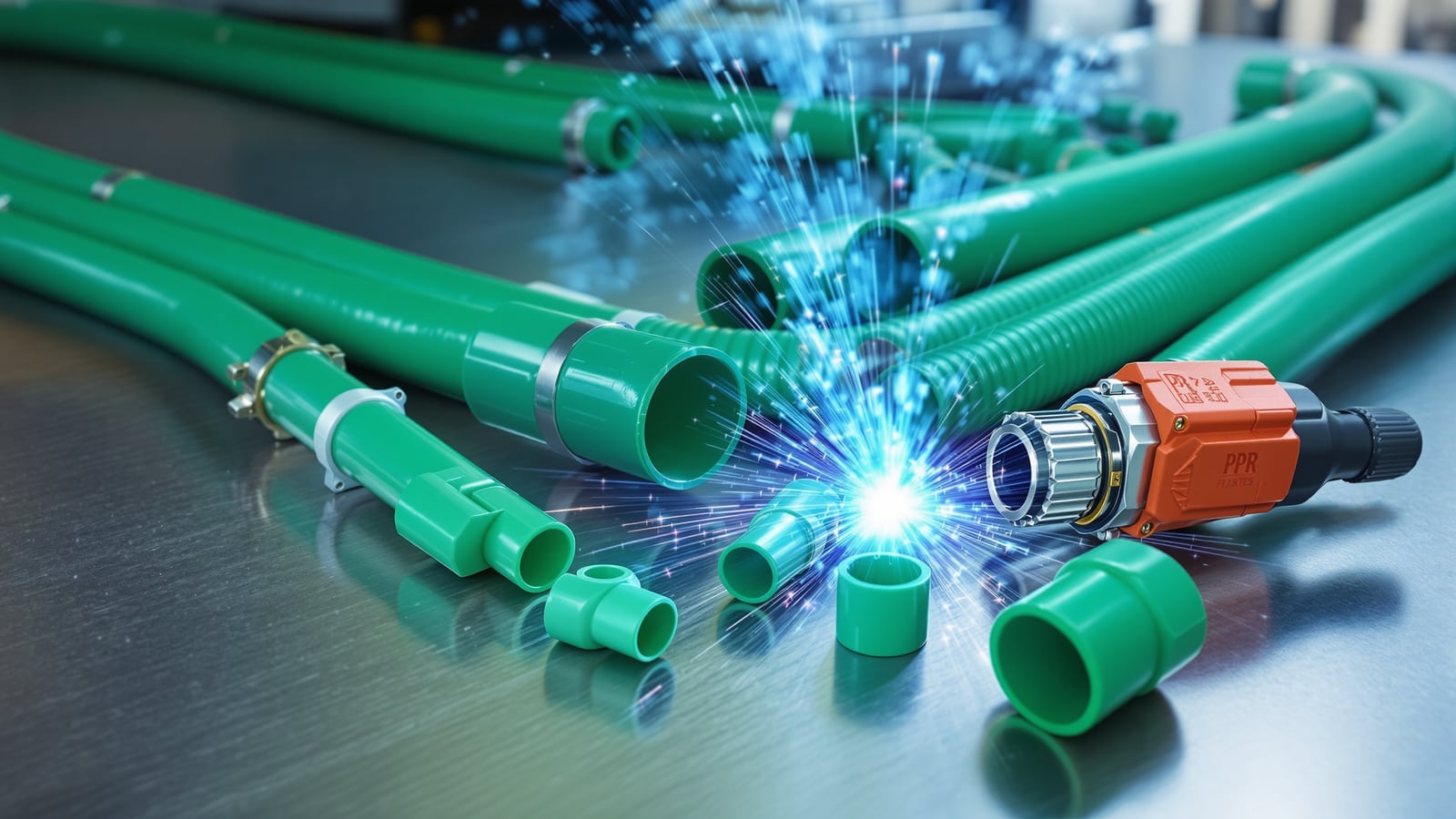
PPR Pipes in India: The Green Heat-Fused Pipe for Hot & Cold Water
What PPR pipe is, why its heat-fused joints are effectively leak-free, PN pressure classes, fibre-composite PPR for hot lines, how it compares with CPVC, and what it costs in India.
Walk onto almost any large apartment or commercial building site in India today and you will spot it: thick, rigid, unmistakably green pipe being joined not with glue or threads but with a hot iron that melts the plastic and welds pipe to fitting. That is PPR pipe — polypropylene random copolymer — and it has quietly become the default for concealed hot and cold water supply in high-rise and institutional work.
This is a material profile within the Studio Matrx Plumbing Pipes guide. It sits alongside the CPVC pipes guide — the other serious hot-water plastic — and connects to the hot water distribution guide for how these pipes are actually laid out. Here we answer one thing well: what PPR is, and when it is the right pipe for your building.
The signature of PPR is the fused joint. Because the pipe and fitting melt into one continuous piece of plastic, a correctly welded PPR joint has no glued seam, no threaded gap, and effectively nothing left to leak — the whole line behaves as a single moulded object.
What PPR pipe actually is
PPR stands for polypropylene random copolymer (written PP-R). It is a thermoplastic — a plastic that softens when heated and hardens again when cooled — and that single property is the key to everything that makes PPR distinctive. Unlike CPVC or uPVC, which are joined with solvent cement, PPR is joined by melting: heat the pipe end and the fitting socket, push them together, and as they cool they become one homogeneous mass of plastic.
- Colour. Almost always green in India (sometimes grey or white in imported ranges), which makes it easy to identify on site and behind walls.
- Feel. Rigid and noticeably thick-walled compared with CPVC — a PPR pipe of the same bore has heavier walls to carry pressure.
- Health. Polypropylene is inert, taste-free and food-grade, so PPR is widely used for potable drinking water as well as general supply.
- Temperature. PPR handles genuinely hot water — continuous service around 70 degC and short peaks higher — which is why it competes directly with CPVC for hot lines rather than plain PVC.
Because polypropylene resists most salts, acids and alkalis, PPR does not corrode, scale or rust the way galvanised iron does, and it will not tuberculate to slowly choke its own bore over the years. In hard-water and coastal Indian conditions, that corrosion immunity is a large part of its appeal.
PN ratings: how PPR pipe is classed for pressure
PPR is not sold by a strength "schedule" like CPVC — it is sold by PN rating. PN means Pressure Nominal, and the number is roughly the pipe's safe working pressure in bar at 20 degC (cold water). A higher PN means a thicker wall for the same outside diameter, so the bore shrinks as the class rises.
| PN class | Nominal cold rating | Common sizes (OD mm) | Continuous temp limit | Typical India use |
|---|---|---|---|---|
| PN10 | ~10 bar | 20, 25, 32 | Cold only | Cold water, low-pressure branches |
| PN16 | ~16 bar | 20, 25, 32, 40 | ~40 degC | Cold supply, moderate pressure |
| PN20 | ~20 bar | 20, 25, 32, 40+ | ~70 degC | Hot & cold supply — the common all-rounder |
| PN25 | ~25 bar | 25, 32, 40+ | ~70 degC (short peaks higher) | Hot water, high-rise risers, heating |
Indicative classes; the printed PN and the maker's pressure-temperature table govern — safe pressure drops steeply as water gets hotter. Confirm before buying.
The catch that catches everyone out is the same one that governs CPVC: a pipe's safe pressure falls sharply as the water gets hotter. A PN20 pipe rated ~20 bar cold may only safely carry a few bar at 70 degC over a 50-year design life. This is precisely why hot lines are specified in the heavier PN20 and PN25 classes — the extra wall buys back the strength lost to heat. For ordinary domestic hot and cold work, PN20 is the sensible default; cold-only branches can drop to PN16.
Fibre and composite PPR — taming the expansion
Plain PPR has one real weakness: it expands a lot when it heats. A long hot PPR run can grow visibly and, if rigidly clamped, will bow and sag between clips. The industry's answer is fibre PPR (also called composite or PPR-CT/PPR-FR): a middle layer of glass fibre is sandwiched inside the pipe wall.
- The fibre layer cuts thermal expansion roughly by two-thirds compared with plain PPR, so hot runs stay straighter and need fewer supports.
- Composite pipe is usually reserved for hot lines, risers and heating loops, where the movement matters most; cold branches often stay plain PPR to save cost.
- It fuses exactly like plain PPR — the same welding tool and technique — with no change to how it is installed.
If you are running long concealed hot lines, specifying fibre/composite PPR for the hot circuit is one of the cheapest ways to avoid the creaks, sags and stressed joints that plague under-supported plain PPR.
Heat-fusion welding: the leak-free joint, if the welder is skilled
The single most important thing to understand about PPR is how it is joined. There is no glue and no thread on a standard PPR line. Instead, a socket-fusion welding tool — an electrically heated plate carrying paired metal dies — heats the outside of the pipe end and the inside of the fitting socket at the same time to around 260 degC. The two softened faces are pushed together and held still for a few seconds while they cool.
What results is not a joint in the ordinary sense at all: the pipe and fitting have melted into a single continuous piece of plastic. There is no seam of cement to fail, no threaded gap to weep, no gasket to perish. A properly fused PPR line is, in effect, one moulded object from tank to tap.
- Larger pipes (from ~63 mm up) are usually joined by butt fusion (end-to-end) or electrofusion (fittings with a built-in heating coil), used on mains and risers.
- Everyday domestic and branch pipe uses socket fusion with the hand-held bench or clamp tool.
- The welded joint is why PPR is trusted for long-life concealed and buried service where you never want to touch the pipe again.
The honest caveat: the joint is only as good as the welder. The technique is genuinely skill-dependent. Under-heat the parts and they never truly fuse; over-heat them and molten plastic squeezes inward, forming a bead that chokes the bore or, worse, blocks it. Get the timing or alignment wrong and you build in a weak point you cannot see. Solvent-cement (CPVC) work is more forgiving of a mediocre hand; PPR rewards a trained fitter and punishes an untrained one.
Insist on an installer who does PPR fusion daily. A good welder gives you the leak-free line PPR promises; a careless one gives you hidden internal beads and cold joints behind sealed walls — the worst kind of plumbing fault to find.
PPR vs CPVC — a quick orientation, not a verdict
Both PPR and CPVC carry hot and cold water, both are corrosion-proof, and both are excellent when installed well. The real difference is how they join and who they suit. For the full head-to-head — including the closely related uPVC comparison — see the CPVC vs uPVC pipes guide and the dedicated CPVC pipes guide. In brief:
- CPVC joins with solvent cement — quick, tool-light, and forgiving, which suits smaller jobs, retrofits and the individual plumber. It is the more common choice in standalone Indian homes.
- PPR joins by fusion — needs a welding tool and a trained hand, but delivers a truly homogeneous, long-life line. It dominates apartment blocks, commercial buildings and institutional work where scale justifies the tooling and a crew welds all day.
- PPR's thick walls and green colour make it visually obvious; CPVC is slimmer and cream/tan.
If your project is a single home renovation, CPVC is often the pragmatic pick. If it is a tower, a hospital or an office fit-out with kilometres of concealed supply, PPR's fused, tool-driven consistency is why specifiers keep choosing it.
Sizes, cost and where PPR goes in India
PPR is sized by outside diameter in millimetres — common domestic sizes are 20, 25 and 32 mm, with 40 mm and up for risers and mains. It is used almost entirely for pressurised supply — hot and cold potable water — not for drainage or soil (which stay on PVC/uPVC). Cost is broadly comparable to CPVC and varies with PN class and whether the pipe is plain or fibre-composite:
| Item | Indicative India rate | Note |
|---|---|---|
| PPR pipe, 20 mm PN20 | ₹90-₹160 per metre | Common hot/cold branch size |
| PPR pipe, 25 mm PN20 | ₹140-₹240 per metre | Larger branches / short risers |
| Fibre-composite PPR (hot) | +15-30% over plain | Lower expansion on hot lines |
| Socket-fusion welding tool | ₹2,500-₹8,000 | One-time; pro-grade costs more |
| Fusion labour | Priced per point/running metre | Skilled fitter premium |
Rates are indicative for 2026 and vary by brand, city and quantity — get a current local quote before budgeting.
Pros of PPR: genuinely leak-free fused joints; no corrosion, scaling or rust; food-grade for drinking water; excellent hot-water and long-life performance; smooth low-friction bore; fibre variants control expansion. Cons: joining needs a special tool and a skilled welder, so it is unforgiving of poor labour and less suited to quick one-off repairs; plain PPR expands significantly on hot lines; a bad weld can hide an internal bead; thick walls mean a slightly larger pipe for a given bore.
The bottom line
PPR earns its place wherever a building wants supply piping it can bury and forget: the fused joint removes the glued seam and the threaded gap, leaving a line that behaves as one continuous piece of inert, corrosion-proof plastic. Choose PN20 for hot and cold, fibre-composite for long hot runs, PN16 for cold-only, and — above all — a fitter who welds PPR every day. Treat the figures here as indicative and confirm pipe class, temperature rating and cost with your pipe material selection plan and a licensed plumber before you commit a single fused joint behind a wall.
References
- IS 15801 — Bureau of Indian Standards specification for polypropylene random copolymer (PP-R) pipes for hot and cold water supply. Confirm the current edition and the PN class applicable to your installation.
- National Building Code of India (NBC) 2016, Part 9 — Plumbing Services — the governing framework for water supply piping in Indian buildings.
- Manufacturer pressure-temperature rating tables for the specific PPR pipe brand, PN class and fibre/plain variant chosen — the authoritative source for safe working pressure at your water temperature. Verify all sizing, welding parameters and cost locally with a licensed professional.
Export this guide
Related Guides — Deep-dive reading
Pipe Jointing Methods in India: Solvent, Threaded, Fusion, Soldered & Push-Fit
How every plumbing pipe material is actually joined — solvent cement for PVC/CPVC/uPVC, threaded joints for GI and metal, heat fusion for PPR and HDPE, soldering and brazing for copper, compression and push-fit for quick work, flanged connections for large bore, and rubber-ring socket-and-spigot for drains. Which method suits which material, how reliable each is, and the skill it demands.
PlumbingCopper vs CPVC Pipes: Which to Use in India (2026)
A fair, India-first head-to-head: copper is the premium, decades-lasting, heat-proof metal that needs a skilled brazier and costs a fortune; CPVC is the cheaper, corrosion-proof, DIY-friendly plastic that has become the default modern Indian supply pipe. Cost, lifespan, heat, install skill, water quality, theft — and a clear verdict by use-case.
PlumbingPlumbing Pipes Guide: Every Material & How to Choose (India)
The section pillar for plumbing pipe materials in India — the full family of thermoplastics, metals, iron, concrete and clay, which pipe belongs on hot supply, cold supply, drainage, underground and sewer duty, a comparison-at-a-glance table, sizing basics, jointing methods, and a plain-language method for choosing.
PlumbingRelated Tools — Try Free
Plumbing Pressure-Test & Leak Checklist
Pre-closure pressure and leak test — 9 categories, 60+ checkpoints across water supply, drainage, fixtures, waterproofing, hot water, tanks.
Pre-Closure TestRainwater Tank Sizer
How big should your rainwater tank be? Computes annual harvest, recommended tank capacity in litres, water-bill savings, and payback — for 10 Indian cities.
RWH CalculatorRenovation vs New Build Calculator
Compare renovating vs building new interiors city-wise across 13 work scopes with GST and per-sqft rates.
Cost Comparison