
Concrete (RCC) Pipes in India: Specifying NP2, NP3 and NP4 for Drainage and Stormwater
A professional's guide to reinforced cement concrete pipe under IS 458 — the NP2, NP3 and NP4 classes, spigot-and-socket rubber-gasket versus collar joints, large-diameter gravity drainage, bedding and strength, indicative rates, and where RCC still beats HDPE and DI for buried drains, culverts and external sewers.
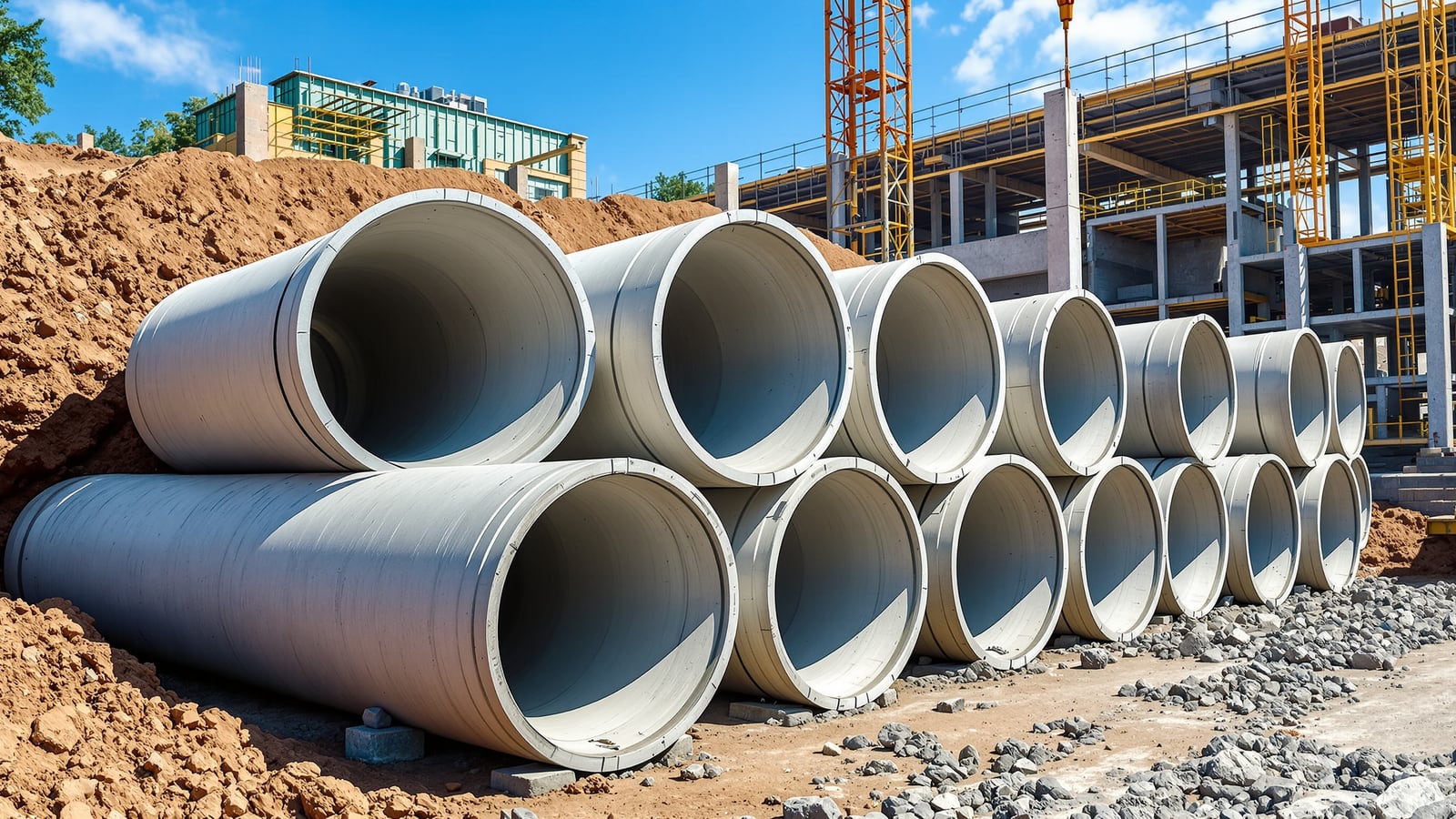
For the plumbing that runs outside the building line — the stormwater drain under the road, the box culvert crossing, the external sewer main from the last manhole to the municipal connection — the default material in India is not plastic or metal but reinforced cement concrete (RCC) pipe, still widely called "Hume pipe" after the spun-concrete process. It is heavy, buried, gravity-fed and boringly reliable, and it moves water at diameters that no domestic pipe ever reaches.
This guide sits in the Studio Matrx Plumbing Knowledge Hub as a material profile. It covers concrete pipes for buried gravity drainage: what they are, the IS 458 classes, how they are jointed, how they are bedded, what they cost, and when to choose them over HDPE or ductile iron. For the interior supply and waste pipes that this material never touches, start at the plumbing pipes guide; the small-bore vitrified clay alternative for building drains is the clay pipes guide.
Concrete pipe is a gravity, non-pressure product. It carries stormwater and sewage downhill under its own fall, not under pump pressure. Get the class, the bedding and the joint right and an RCC line lasts fifty years underground; get the bedding wrong and even an NP4 pipe cracks.
What an RCC pipe actually is
An RCC pipe is a precast concrete cylinder with one or two cages of steel reinforcement cast into the wall. The steel takes the tension; the concrete takes the compression and forms the water-carrying bore. Pipes are made by spinning (centrifugal), vertical casting or roller-suspension methods, cured, and delivered to site in standard lengths — usually 2.0 m to 2.5 m effective per length.
The governing Indian standard is IS 458 (Precast Concrete Pipes), which sets out the classes, wall thicknesses, reinforcement and the load tests every pipe must pass. Two broad families exist under it:
- Non-pressure (NP) pipes — for gravity drainage, sewerage and stormwater, where the pipe flows part-full under its own fall. This is the overwhelming majority of RCC pipe laid in India, and the subject of this guide. Classes NP1, NP2, NP3, NP4.
- Pressure (P) pipes — classes P1, P2, P3, hydrostatically rated for low-pressure gravity mains and irrigation. Far less common on building projects; for pressurised water and rising mains, ductile iron or HDPE are usually specified instead.
The single number a designer chooses is the class, because it fixes how much external load — earth cover plus traffic — the buried pipe can carry.
The NP classes: matching pipe to load
The NP number is a structural rating, not a size. It is proved by the three-edge-bearing test, in which a pipe is loaded across its crown until it reaches a defined crack and then an ultimate load. A higher class simply survives more load per metre of length before cracking, so it can take deeper cover and heavier traffic.
| IS 458 class | Reinforcement | Duty / where it goes | Typical diameter range (mm) |
|---|---|---|---|
| NP1 | Unreinforced | Light, no traffic — field drains, culvert outfalls | 80–250 |
| NP2 | Single/light cage | Medium duty — internal stormwater drains, non-traffic areas, house-to-manhole | 100–1800 |
| NP3 | Heavier cage | Heavy duty under roads, driveways, moderate traffic | 100–2600 |
| NP4 | Heaviest cage | Extra-heavy duty — deep cover, highways, rail, industrial loads | 100–2600 |
Diameter ranges are indicative of what IS 458 covers and what mills routinely produce; confirm availability of a given class-and-size against a current manufacturer schedule.
The practical rule on an Indian site:
- NP2 for stormwater and drains inside a campus or plot, away from vehicle loads or under thin cover.
- NP3 as the workhorse under any road, driveway or parking that carries traffic — the most commonly specified class for municipal drains and external sewers.
- NP4 where cover is deep, loads are exceptional (highway, rail crossing, heavy industrial yard) or the design engineer's load calc demands it.
Under-specifying the class to save money is the classic buried-drainage failure: the pipe is fine on delivery and cracks a year later under a truck.
Jointing: gasket versus collar
Because the pipe is non-pressure, the joint's job is to stay reasonably water-tight against infiltration and exfiltration while tolerating a little ground movement. Two systems dominate:
- Spigot-and-socket with rubber gasket. One end is shaped as a bell (socket), the other as a spigot carrying an EPDM/rubber ring that compresses into the socket as the pipe is pushed home. This is a flexible, self-sealing joint: it accommodates settlement, resists root and groundwater infiltration, and needs no on-site mortaring. It is the preferred joint for sewers and any line where leakage matters, and the modern default on well-run projects.
- Collar (band) joint. Two plain-ended pipes are butted and a separate concrete collar is slipped over the junction, then the annular gap is packed with cement mortar and cured. It is cheaper and tolerant of rough site work, but it is rigid — any settlement cracks the mortar — and far more prone to leak. It survives on stormwater lines where minor leakage is acceptable and budgets are tight.
For an external sewer carrying foul water, specify the rubber-gasket spigot-and-socket joint: a leaking collar joint contaminates soil and groundwater. Remember that the pipe only conveys sewage — the actual sewage treatment plant sits at the end of the line, and its design is a separate discipline.
Sizes, strength and bedding
RCC's real advantage is diameter. Where a building's internal waste stack tops out around 110–160 mm and even a large HDPE drain rarely exceeds a metre economically, RCC pipe is routinely made from 80 mm up to 2600 mm and beyond as bespoke box or pipe culverts. For a stormwater main draining a township, a road cross-culvert or a trunk sewer, nothing else is as economical at large bore.
| Nominal bore (mm) | Class typically used | Effective length (m) | Typical role |
|---|---|---|---|
| 150–300 | NP2 / NP3 | 2.0–2.5 | Plot / campus stormwater, house-to-manhole |
| 450–600 | NP3 | 2.0–2.5 | Street stormwater drain, external sewer branch |
| 700–1000 | NP3 / NP4 | 2.0–2.5 | Trunk sewer, main road stormwater |
| 1200–2600 | NP3 / NP4 | 2.0–2.5 | Culverts, township trunk drains, outfalls |
But the class is only half the load story — the bedding is the other half. A buried pipe's real capacity depends on how the earth load is distributed around it, defined by the bedding class (roughly Class A concrete cradle down to Class D plain trench). A higher bedding class spreads load and lets a lower pipe class carry the same cover; a poor bedding wastes an expensive pipe.
- Grade the trench bottom true to line and level and bed the pipe on compacted granular material or a concrete cradle per the design bedding class — never on lumps of rock or soft pockets.
- Support the barrel, not the socket. Dig socket holes so the pipe bears on its full length, not point-loaded on the bell.
- Haunch and surround with well-compacted granular fill up to the specified height before backfilling, so the pipe is held all round.
- Match class to cover and traffic using the design engineer's load calculation — do not eyeball it.
Pros and cons versus HDPE and DI
RCC is not the only buried-drainage option. Double-wall corrugated HDPE and ductile iron (DI) compete, especially at the smaller and mid diameters. The honest trade-off:
| Factor | RCC (concrete) | HDPE (double-wall) | Ductile iron (DI) |
|---|---|---|---|
| Best use | Large-bore gravity storm/sewer, culverts | Small–mid gravity drainage, flexible routes | Pressure mains, rising mains |
| Diameter economy | Excellent at 600 mm+ | Good to ~1000 mm | Costly at large bore |
| Weight / handling | Very heavy; needs crane | Light; hand-laid | Heavy |
| Corrosion / H2S | Can suffer crown corrosion in septic sewers | Immune | Needs lining |
| Structural strength | Rigid, self-supporting by class | Flexible; relies on bedding | Very strong |
| Relative material cost | Low per metre at large bore | Moderate | High |
Where RCC wins is large-diameter gravity drainage — stormwater trunks, culverts, township sewers — on cost per metre and structural rigidity. Where it loses is smaller flexible runs (HDPE is faster to lay) and anything pressurised (DI or HDPE). One caution: in a septic, slow-moving foul sewer, biogenic hydrogen-sulphide (H2S) attack can corrode the concrete crown over decades; specify sulphate-resistant cement or an internal lining for aggressive effluent. For a head-to-head on the interior plastic supply materials, see the CPVC versus UPVC comparison.
Indicative cost in India
RCC pipe is priced per metre by diameter and class, and the rate climbs steeply with bore. Laid cost also carries heavy earthwork, bedding, jointing and crane handling, so the pipe is often less than half the installed cost. Indicative material rates (ex-works, verify locally against current quotes):
- 150–300 mm NP2/NP3: roughly ₹450 to ₹1,200 per metre.
- 450–600 mm NP3: roughly ₹1,500 to ₹3,500 per metre.
- 900–1000 mm NP3/NP4: roughly ₹5,000 to ₹9,000 per metre.
- 1200 mm and above: ₹10,000 per metre and up, quickly reaching several ₹1,00,000 for a short culvert run of the largest bores.
A jump from NP2 to NP3 to NP4 at the same diameter typically adds 15–35% for the extra reinforcement — cheap insurance against a class-related failure, and almost always worth it under any trafficked area.
Specifying it right
For a professional specification, pin down five things: the class (from the load and cover calc — usually NP3 under roads), the nominal bore (from the hydraulic/stormwater design), the joint (rubber-gasket spigot-and-socket for sewers, collar acceptable for tight-budget stormwater), the bedding class (matched to class and cover), and the cement type (sulphate-resistant for aggressive or septic effluent). Detail all of it on the drawings and call up IS 458 by name in the schedule.
The wider gravity-drainage design — falls, manhole spacing, catchment sizing and the surface-water network — belongs in the forthcoming stormwater drainage guide and the drainage systems guide. Always have the pipe class, bore and bedding checked by the drainage design engineer against the site's load and hydraulic calculations before ordering — an RCC line, once buried under a road, is the hardest plumbing in the project to replace.
References
- IS 458 — Precast Concrete Pipes (with and without reinforcement) — classes NP1 to NP4 and P1 to P3, dimensions, reinforcement and load tests.
- IS 783 — Code of Practice for Laying of Concrete Pipes — trenching, bedding classes, jointing and testing on site.
- IS 3597 — Methods of Test for Concrete Pipes — including the three-edge-bearing and hydrostatic tests.
- CPHEEO Manual on Sewerage and Sewage Treatment, Ministry of Housing and Urban Affairs — gravity sewer and drainage design.
- National Building Code of India (NBC) 2016, Part 9 — Plumbing Services — drainage and external services.
Figures, diameter ranges and rates here are indicative for planning. Confirm the pipe class, bore, joint and bedding against a current IS 458 schedule, manufacturer availability and your drainage engineer's load and hydraulic calculations before ordering.
Export this guide
Related Guides — Deep-dive reading
Plumbing Pipes Guide: Every Material & How to Choose (India)
The section pillar for plumbing pipe materials in India — the full family of thermoplastics, metals, iron, concrete and clay, which pipe belongs on hot supply, cold supply, drainage, underground and sewer duty, a comparison-at-a-glance table, sizing basics, jointing methods, and a plain-language method for choosing.
PlumbingExternal Underground Drainage in India: Layout, Inspection Chambers, Gradients and the Connection to Sewer or STP
The buried gravity network that carries soil and waste from the building to the boundary — how it runs from the stack to the property line, where inspection chambers and manholes sit, the fall each pipe size needs, the materials and bedding that hold it, and how it hands over to a municipal sewer, a septic tank or an on-site treatment plant.
PlumbingDuctile Iron (DI) Pipes in India: Specifying Water Mains, Fire Mains & Pumping Mains
The engineer's guide to ductile iron pipe for large external water infrastructure — cement mortar lining, push-on and flanged joints, K7/K9 classes, DN sizing, pressure capacity, cost, and where DI beats HDPE on a society or municipal main.
PlumbingRelated Tools — Try Free
Before vs After — Cost Reality Check
Compare what you expected to pay vs what you actually paid, category by category.
Reality CheckFalse Ceiling Cost Estimator
Live ₹/sqft across 8 ceiling types — POP, gypsum, designer, metal, PVC, wooden — with cove and spot lighting for 20 Indian cities.
Cost CalculatorPlumbing Pressure-Test & Leak Checklist
Pre-closure pressure and leak test — 9 categories, 60+ checkpoints across water supply, drainage, fixtures, waterproofing, hot water, tanks.
Pre-Closure Test