
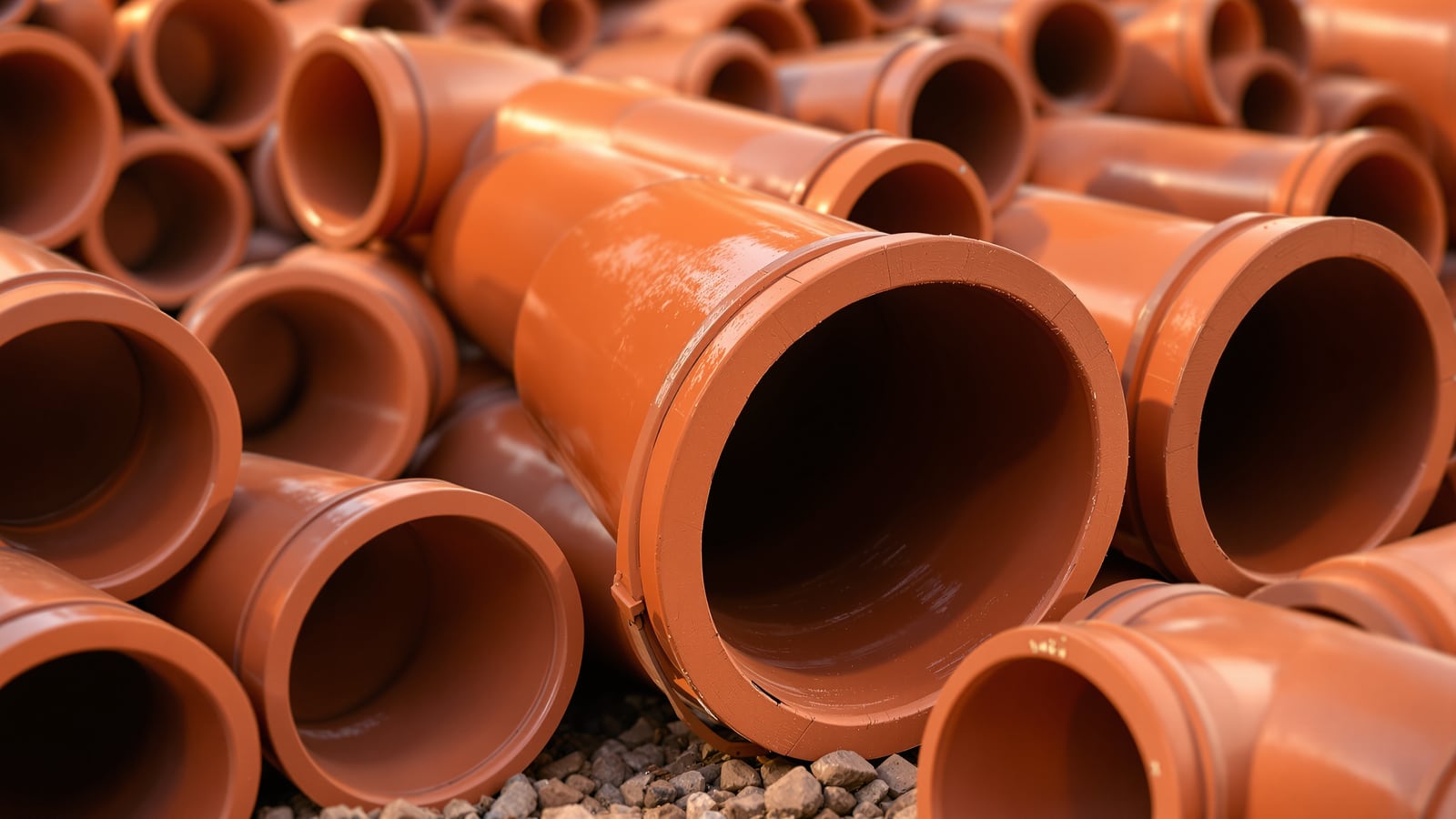
Clay Pipes in India: Salt-Glazed Vitrified Stoneware for Sewers & Drainage
The glazed fired-clay pipe that still carries external sewage and drainage under Indian streets — why vitrified stoneware is chemically inert and abrasion-resistant, how socket-and-spigot joints are made, where it holds its ground against PVC and concrete, and how to specify it to IS 651.
Long before uPVC and HDPE reached the Indian trench, the external sewer line was made of fired clay — and on a surprising number of jobs it still is. Clay pipes, correctly called salt-glazed vitrified stoneware pipes, are baked from refractory clay at temperatures high enough to fuse the body into a dense, glass-hard ceramic. The result is a pipe that shrugs off the two things that destroy most sewer materials: aggressive chemistry and grit.
This guide sits inside the Studio Matrx Plumbing Knowledge Hub as a material profile. It covers one material — what stoneware pipe is, where it belongs, and how to specify it — for engineers, contractors and site staff working on external drainage and gravity sewers. It is not a versus article; where alternatives matter we name them and link across.
A clay sewer pipe is the only common drainage material that is fired, not extruded or cast. Vitrification — melting the clay body until its pores close — is what makes it chemically inert and hard-wearing. It is also what makes it brittle, and that single trade-off dictates everything about where and how you use it.
What a vitrified clay pipe actually is
Stoneware pipe starts as a blend of plastic fireclay and shale, extruded to shape and then fired in a kiln to roughly 1,100–1,200°C. At that temperature the clay vitrifies: the mineral body partially melts and re-fuses into a dense, near-zero-porosity ceramic. Traditionally a salt glaze was formed by throwing common salt into the hot kiln — the sodium vapour reacts with the clay surface to leave a glossy, impervious skin inside and out. Modern plants often use applied ceramic (slip) glazes, but the term "salt-glazed stoneware" has stuck.
The finished pipe has properties no plastic can match:
- Chemically inert. It resists domestic sewage, hydrogen-sulphide attack, dilute acids and alkalis, industrial effluent and the sulphuric acid that biogenic corrosion generates in sewers. This is why it long outlived competitors in trade-waste and effluent lines.
- Abrasion-resistant. The vitrified body is glass-hard, so grit-laden flow and rodding do not scour it the way they wear softer materials.
- Impervious. A properly fired pipe absorbs almost no water and does not soften, rot, rust or support root ingress through the pipe wall itself.
- Fire- and heat-stable. It does not deform at the temperatures that soften thermoplastics.
The pipe is supplied in a socket-and-spigot (bell-and-spigot) form: one plain "spigot" end and one flared "socket" end, so lengths telescope together into a continuous line. Standard barrels are typically 0.6 m to about 1.0 m long, kept short deliberately — more joints mean more articulation and easier handling of a heavy, brittle unit.
Where clay pipe is used — and where it is not
The scope of stoneware is narrow and specific: underground, gravity, external. It is a drainage and sewer material, never a pressure-supply material.
- External house drains and building connections — the run from the last inspection chamber to the public sewer.
- Gravity foul and combined sewers laid to a designed fall (self-cleansing velocity, typically around 0.6–0.75 m/s at design flow).
- Storm-water and surface drains where abrasion from grit is a concern.
- Trade-effluent and industrial-waste lines carrying corrosive discharge that would attack cement or metal — its historical stronghold.
Clay pipe is not used for:
- Water supply, hot or cold — it carries no internal pressure. For pressurised runs see the material pillar and the supply guides.
- Inside the building, above ground — soil, waste and vent stacks are plastic or cast iron, not stoneware.
- Rising mains or pumped sewage — vitrified clay is strictly a gravity pipe.
Remember the division of labour: the pipe conveys sewage; treating it is a separate system. Where the line discharges to a package plant, that is covered in what a sewage treatment plant is, not here.
Sizes, grades and the spec table
IS 651 covers salt-glazed stoneware pipes and fittings in two grades — Standard (Grade A/AA) and Extra Strength — the difference being crushing strength for the same bore. Nominal internal diameters commonly available in India run from 100 mm (the usual house-connection size) up through 150, 200, 250 and 300 mm, with larger public-sewer sizes made to order. Because the pipe carries no internal hydraulic pressure, the governing rating is crushing strength (load per metre of run), not a PN pressure class.
| Nominal bore | Typical use | Barrel length | Indicative crushing strength (kN/m) | Indicative rate |
|---|---|---|---|---|
| 100 mm | House drain / building connection | 0.6–0.9 m | ~15–20 | ₹200–₹350 per m |
| 150 mm | Branch & lateral sewers | 0.6–1.0 m | ~18–24 | ₹350–₹550 per m |
| 200 mm | Street laterals | 0.75–1.0 m | ~22–28 | ₹600–₹900 per m |
| 250 mm | Collector sewers | 0.9–1.0 m | ~26–32 | ₹1,000–₹1,500 per m |
| 300 mm | Trunk gravity sewers | 0.9–1.0 m | ~30–38 | ₹1,600–₹2,400 per m |
Crushing-strength figures and rates above are indicative; confirm the class against the current IS 651 tables and the manufacturer's test certificate, and price against a live local quote. Buried-pipe load depends on cover depth, trench width and bedding — a structural check governs which grade you specify, not the price list.
Jointing: socket-and-spigot, cement or rubber
A stoneware line is built by seating each spigot into the next pipe's socket and sealing the annular gap. Two joint types are used:
1. Cement-mortar (rigid) joint. The traditional method. A tarred gasket / spun yarn (jute) rope is caulked into the back of the socket to centre the spigot and stop mortar entering the bore, then the remaining annulus is packed and finished with a 1:1 or 1:2 cement–sand mortar collar, chamfered off neatly. Cheap and long-serving, but rigid — it tolerates little ground movement and can crack if the bedding settles.
2. Rubber-ring (flexible) joint. Modern pipes are supplied with factory-formed joint profiles and an elastomeric ring that compresses as the spigot pushes home. This gives a leak-tight, root-tight seal that flexes with minor settlement and is far faster to lay — the preferred detail on any significant sewer today.
Either way the pipe is laid to a true, continuous fall on a prepared granular or concrete bed, socket facing up-gradient, with the trench backfilled in compacted layers. Because barrels are short, the finished line has many joints — that articulation is a feature on settling ground when the joint is flexible, and a liability when it is rigid.
Pros, cons and how it compares
| Strength | Limitation |
|---|---|
| Chemically inert — resists sewage acids, H₂S, effluent | Brittle — cracks under point load, impact or careless handling |
| Abrasion-resistant, glass-hard bore | Heavy per metre; slow, labour-intensive to lay |
| Very long service life; does not rot, rust or corrode | Gravity only — no internal pressure, no pumped mains |
| Impervious, root-resistant through the wall | Rigid cement joints intolerant of ground settlement |
| Fully recyclable, made from abundant natural clay | Many joints (short barrels) = more potential leak paths if poorly sealed |
The honest position today: on ordinary house drainage and municipal gravity sewers, lightweight uPVC and HDPE have taken most of the market on cost, handling speed and joint reliability, while large public trunk sewers often go to RCC/NP-class concrete. Stoneware holds on precisely where its chemistry earns its keep — corrosive trade effluent and aggressive-ground sewers — and on heritage or specification-bound jobs. For the plastic alternatives see uPVC / PVC pipes and the concrete pipe profile; if you are choosing between plastic supply materials, the CPVC vs uPVC comparison covers that head to head.
Handling discipline is non-negotiable. Because the pipe is brittle, store it on level ground, never drop or roll it against hard edges, lower it into the trench rather than tipping, bed it fully so load spreads along the barrel, and sound every pipe for hairline cracks before laying. A cracked stoneware pipe is a future collapse.
Specifying clay pipe on an Indian job
- Call it up by IS 651 with the grade (Standard or Extra Strength) chosen from a buried-pipe structural check for the cover depth.
- Specify the joint type — flexible rubber-ring for any sewer of consequence, cement-mortar only where budget and stable ground allow.
- Detail the bedding and haunching class on the drawings; the pipe's crushing rating is only realised with correct bedding.
- Require manufacturer test certificates for crushing strength, hydraulic (bore) soundness and glaze/absorption.
- Route the material choice back to the plumbing pipes material pillar so the whole external network is specified consistently.
References
- IS 651 — Salt-glazed stoneware pipes and fittings (specification, grades, dimensions and crushing-strength tests). Verify against the current amendment.
- Studio Matrx Plumbing Knowledge Hub: plumbing pipes material guide, concrete pipes, PVC pipes, and what a sewage treatment plant is.
Always confirm grade, class and bedding against the current IS specification and a structural check for your actual cover depth and ground conditions before ordering.
Export this guide
Related Guides — Deep-dive reading
Plumbing Pipes Guide: Every Material & How to Choose (India)
The section pillar for plumbing pipe materials in India — the full family of thermoplastics, metals, iron, concrete and clay, which pipe belongs on hot supply, cold supply, drainage, underground and sewer duty, a comparison-at-a-glance table, sizing basics, jointing methods, and a plain-language method for choosing.
PlumbingExternal Underground Drainage in India: Layout, Inspection Chambers, Gradients and the Connection to Sewer or STP
The buried gravity network that carries soil and waste from the building to the boundary — how it runs from the stack to the property line, where inspection chambers and manholes sit, the fall each pipe size needs, the materials and bedding that hold it, and how it hands over to a municipal sewer, a septic tank or an on-site treatment plant.
PlumbingConcrete (RCC) Pipes in India: Specifying NP2, NP3 and NP4 for Drainage and Stormwater
A professional's guide to reinforced cement concrete pipe under IS 458 — the NP2, NP3 and NP4 classes, spigot-and-socket rubber-gasket versus collar joints, large-diameter gravity drainage, bedding and strength, indicative rates, and where RCC still beats HDPE and DI for buried drains, culverts and external sewers.
PlumbingRelated Tools — Try Free
Before vs After — Cost Reality Check
Compare what you expected to pay vs what you actually paid, category by category.
Reality CheckPlumbing Pressure-Test & Leak Checklist
Pre-closure pressure and leak test — 9 categories, 60+ checkpoints across water supply, drainage, fixtures, waterproofing, hot water, tanks.
Pre-Closure TestRenovation vs New Build Calculator
Compare renovating vs building new interiors city-wise across 13 work scopes with GST and per-sqft rates.
Cost Comparison