
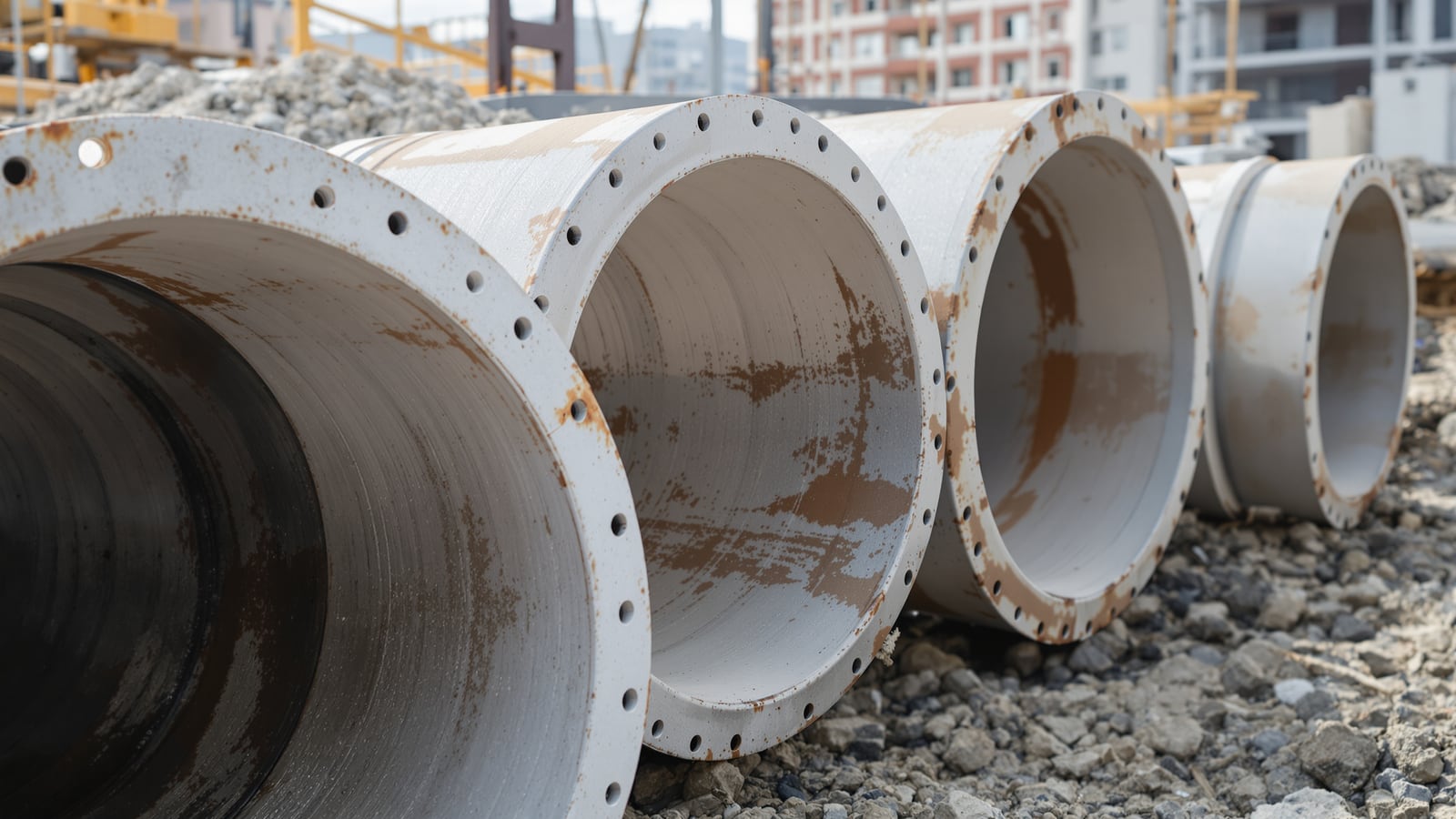
Ductile Iron (DI) Pipes in India: Specifying Water Mains, Fire Mains & Pumping Mains
The engineer's guide to ductile iron pipe for large external water infrastructure — cement mortar lining, push-on and flanged joints, K7/K9 classes, DN sizing, pressure capacity, cost, and where DI beats HDPE on a society or municipal main.
When a water main has to carry high pressure across a township, feed a fire hydrant ring, or run from a pump house to an overhead reservoir, thin plastic pipe stops being the obvious answer. Ductile iron (DI) pipe is the workhorse of large external water infrastructure in India — strong, high-pressure, cement-lined iron pipe used for society and layout mains, municipal distribution, fire mains and pumping mains where diameter, pressure and mechanical toughness all matter at once.
This guide is written for the engineer, plumbing consultant or contractor specifying DI on a real project. It sits within the Studio Matrx plumbing pipes guide as the material profile for external, large-diameter iron mains. For where DI fits in the wider building services picture, see the building plumbing services guide.
DI is not a plumbing pipe for inside the flat. It is an infrastructure pipe — DN 80 and up, buried in trenches or run through pump houses, carrying the bulk water before it ever reaches a riser or a fixture.
What ductile iron actually is
Ductile iron is cast iron in which the graphite is formed as spheroidal (nodular) particles rather than the flakes found in old grey cast iron. That single metallurgical change transforms the material: where grey cast iron is brittle and cracks under shock or bending, ductile iron flexes, absorbs impact and carries far higher internal pressure. It keeps the corrosion behaviour and long service life of iron while behaving much more like steel under load.
Modern DI water pipe is centrifugally cast (spun) to IS 8329, then finished with a corrosion-protection system on both faces:
- Internal cement mortar lining — a factory-applied Portland or sulphate-resisting cement mortar layer that isolates the water from the iron. It prevents internal corrosion and tuberculation, keeps the bore smooth (so friction stays low over decades), and does not taint potable water.
- External protection — typically a metallic zinc coating followed by a bituminous or synthetic finishing layer, giving the buried pipe a sacrificial barrier against soil corrosion. In aggressive soils a loose polyethylene sleeve is wrapped over the pipe as extra protection.
The result is a pipe that combines high strength, high pressure capacity and a genuinely long design life — 50 years and beyond is routine — which is why utilities and large developments keep choosing it for trunk mains.
Where DI is used — and where it is not
DI earns its place wherever water is moved in bulk, under pressure, outside the building:
- External water supply mains for gated societies, townships and residential layouts — the ring or spine main that feeds every block from the master sump or reservoir.
- Municipal distribution mains — the utility trunk and sub-mains running under roads.
- Fire mains and hydrant rings — the external fire-fighting loop that must hold pressure and survive mechanical abuse; DI's strength and pressure margin suit it well (specify to the fire consultant and local fire NOC).
- Pumping mains (rising mains) — the high-pressure delivery line from a pump house to an elevated reservoir or the next zone, where surge and sustained pressure rule out lighter pipe.
- Raw-water and gravity mains between headworks, treatment and storage.
Where DI is not the answer: inside the flat or the riser shaft (that is CPVC, PEX or GI territory), small branch runs, and small-bore service connections where HDPE is cheaper and easier. DI also does not treat what it carries — a DI sewer main only transports effluent; the treatment belongs to a separate STP system.
Sizes, classes and pressure — the spec table
DI is specified by DN (nominal diameter in mm) and by thickness class. The traditional Indian classes under IS 8329 are the K classes — K7, K8, K9 — where a higher K number means a thicker wall and a higher pressure rating for a given diameter. K9 is the common default for pressure water mains; K7 is used for larger diameters and lower-pressure or gravity duty where the thinner wall is adequate. Newer pressure-based C classes (C25, C30, C40 — the number being the allowable operating pressure in bar) are also increasingly specified.
Pipes are supplied in standard 5.5 m or 6 m lengths with a socket at one end. The figures below are indicative and must be confirmed against the current IS 8329 tables and the manufacturer's data sheet for the exact class ordered.
| DN (mm) | Class | Typical wall thickness | Indicative allowable pressure | Typical use |
|---|---|---|---|---|
| DN 80 | K9 | ~6.0 mm | ~40+ bar (PN 40 range) | Layout branch mains, hydrant spurs |
| DN 100 | K9 | ~6.1 mm | ~40 bar | Society distribution, fire mains |
| DN 150 | K9 | ~6.3 mm | ~40 bar | Layout spine mains, pumping mains |
| DN 200 | K9 | ~6.4 mm | ~35 bar | Township mains, rising mains |
| DN 300 | K9 | ~7.2 mm | ~30 bar | Municipal sub-mains |
| DN 400+ | K7 | ~7.8 mm+ | ~25 bar | Large trunk / gravity mains |
Temperature is rarely the governing limit for buried cold-water DI — the pipe comfortably handles ambient water — so the design case is almost always internal pressure plus external soil and traffic load, not heat. Size the wall class to the sum of working pressure, surge (water hammer) allowance and a safety factor, not to the static head alone; pumping mains in particular need the surge check.
Jointing DI — push-on, mechanical and flanged
The joint is where DI systems are made or broken on site. There are three families in common use:
- Push-on / Tyton (spigot-and-socket) joint. The workhorse buried joint. The spigot end of one pipe is pushed into the socket of the next, compressing a single rubber gasket seated in the socket groove. It is fast, needs no bolts, and flexes a few degrees to follow gentle bends and settlement. It is not self-restrained — thrust at bends, tees and dead-ends must be taken by concrete thrust blocks (or a restrained-joint system where blocks are impractical).
- Mechanical / restrained joints. A gland and bolts (or a locking gasket) grip the spigot so the joint resists pull-out, used at bends, valves, and above-ground or shallow-cover runs where thrust blocks cannot be relied on.
- Flanged joint. Bolted flange faces with a gasket between, used inside pump houses, valve chambers and above-ground pipework where the run must be rigid, demountable and connect to pumps, valves and specials. Flanged DI is standard for the manifolds and headers around a booster set.
A practical site rule: push-on for the buried straight runs, flanged for the plant room, restrained joints and thrust blocks at every change of direction. Fittings (bends, tees, tapers, collars) are ductile iron to IS 9523 and must match the pipe class.
Pros and cons — and DI vs HDPE
The real specification decision on an external main is almost always DI versus HDPE. Both are excellent; they win in different places. Treat the table below as a decision aid, not a verdict — this is a material profile, not a versus article, and the right choice depends on diameter, pressure, soil and budget.
| Factor | Ductile iron (DI) | HDPE |
|---|---|---|
| Strength / stiffness | Very high; rigid, resists point loads and traffic | Flexible; tolerant of ground movement |
| Pressure capacity | Very high (PN 25–40+) | Good (PN 6–16 typical) |
| Large diameters | Excellent, up to DN 1000+ | Common up to ~400–630 mm |
| Corrosion | Cement-lined bore + external coating | Fully inert, immune |
| Joints | Push-on, mechanical, flanged | Butt/electrofusion (fully welded) |
| Leak path | At joints; needs thrust blocks | Homogeneous welded line, few joints |
| Handling | Heavy; needs lifting plant | Light; long coils for small DN |
| Best fit | High-pressure mains, fire mains, pumping mains, plant room | Long buried service runs, corrosive soil, smaller DN |
DI's strengths: high strength and pressure margin, large-diameter availability, resistance to mechanical damage and traffic loading, a smooth cement-lined bore that stays clean, and long service life. DI's trade-offs: it is heavy (needs cranes or excavators to lay), the buried joints are potential leak paths and demand thrust restraint, and the external coating must be protected during handling and backfill. For the full head-to-head on the plastic side, see the HDPE pipes guide; for the smaller CPVC/UPVC decision inside the building, the CPVC vs UPVC comparison covers it.
Indicative cost
DI is priced by weight and diameter, so cost climbs steeply with DN and class. The figures below are indicative supply rates for cement-lined K9 pipe and exclude fittings, jointing, excavation, thrust blocks and laying — always take a live quote against current IS 8329 material.
| DN (mm) | Class | Indicative supply rate |
|---|---|---|
| DN 100 | K9 | ~₹700–₹950 per metre |
| DN 150 | K9 | ~₹1,000–₹1,400 per metre |
| DN 200 | K9 | ~₹1,600–₹2,200 per metre |
| DN 300 | K9 | ~₹3,200–₹4,500 per metre |
Installed cost typically runs well above the supply rate once trenching, bedding, thrust blocks, specials, valves and testing are added. On a like-for-like small-diameter service run HDPE is usually cheaper installed; DI's economics turn favourable as diameter and pressure rise and as fire-main robustness becomes non-negotiable.
Specifying DI well — a short checklist
- Class to the duty: K9 (or an appropriate C-class) for pressure and pumping mains; K7 considered only for large-diameter, lower-pressure gravity runs.
- Restrain the thrust: concrete thrust blocks or restrained joints at every bend, tee, taper, valve and dead-end.
- Flanges in the plant room: demountable flanged DI around pumps, headers and valve chambers.
- Protect the coating: avoid dragging pipe over rock; use a PE sleeve in aggressive or made-up soils.
- Pressure-test the laid main to the specified test pressure before backfill and commissioning, per the code of practice.
- Match fittings and gaskets to the pipe class and to potable-water approval where the main carries drinking water.
Get these six right and a DI main will outlast most of the building it serves. For how the main then hands over to internal risers, storage and distribution, return to the building plumbing services guide.
References
- IS 8329 — Centrifugally cast (spun) ductile iron pressure pipes for water, gas and sewage: specification (dimensions, K classes, testing).
- IS 9523 — Ductile iron fittings for pressure pipes for water, gas and sewage.
- IS 12288 — Code of practice for use and laying of ductile iron pipes.
- National Building Code of India (NBC) 2016, Part 9 — Plumbing Services — water supply mains and fire-fighting water requirements.
- CPHEEO Manual on Water Supply and Treatment, Ministry of Housing and Urban Affairs — trunk and distribution main design.
Sizes, wall thicknesses, pressure ratings and rates here are indicative for planning. Confirm every specific against the current IS 8329 tables, the manufacturer's data sheet and a licensed plumbing/water-supply engineer before ordering or laying.
Export this guide
Related Guides — Deep-dive reading
Plumbing Pipes Guide: Every Material & How to Choose (India)
The section pillar for plumbing pipe materials in India — the full family of thermoplastics, metals, iron, concrete and clay, which pipe belongs on hot supply, cold supply, drainage, underground and sewer duty, a comparison-at-a-glance table, sizing basics, jointing methods, and a plain-language method for choosing.
PlumbingPlumbing Comparisons: How to Choose Between Pipes, Tanks, Pumps & More (India)
The decision layer for every plumbing 'X vs Y' choice in India — the seven axes that actually decide it (cost, lifespan, temperature and pressure rating, corrosion, maintenance, local availability and warranty), the mistakes that trip up most homeowners, and a curated index that routes you to the exact comparison you need.
PlumbingButterfly Valves in India: Wafer vs Lug vs Flanged, Sizing, Operators & Cost
The compact quarter-turn disc valve that isolates and throttles large-diameter lines — building risers, pump headers, tank connections, HVAC chilled-water and fire mains — at a fraction of the size, weight and cost of a gate valve. How the rotating disc works, which body style to specify, lever versus gear operator, materials and sizes, pros, cons and indicative pricing.
PlumbingRelated Tools — Try Free
Structural Modification Approval Checklist
41 items across structural assessment, society approval, municipal compliance, and safety.
Approval ChecklistBefore vs After — Cost Reality Check
Compare what you expected to pay vs what you actually paid, category by category.
Reality CheckLift Safety Audit Checklist
Interactive checklist that scores your home lift on safety devices, compliance and upkeep.
Checklist