
Community Emergency Preparedness in India (2026): A Society's Shared Plan
How a housing society prepares as a community for fire, medical, flood, earthquake, gas leak and security emergencies — a written plan with roles, assembly points, posted contacts, shared equipment, communication and drills — while the statutory fire design stays with a licensed agency and the fire officer.
When an emergency hits a housing society, the first ten minutes are decided long before — by whether the community has a plan, whether people know where to go, and whether the gate, stairs and extinguishers actually work. A single flat can call 101 or 108; but a fire on the sixth floor, waterlogging in the basement or a gas leak in a block is a community event. It needs a shared response: someone to raise the alarm, wardens to clear floors, a clear route to a known assembly point, and a guard who can open a gate for a fire engine. This guide is about that people-and-plan readiness — community emergency preparedness as a housing society, RWA or apartment owners' association can build it.
Preparedness is collective work, so it belongs with the committee and the residents, decided openly and funded from maintenance. It sits alongside your everyday security setup — the gate and access rules of a gated community, the group that owns these decisions in a housing society security committee, and the honest look at what your society is actually exposed to in a neighbourhood risk assessment. One boundary is firm throughout: the fire detection, alarm and suppression design, installation and certification is statutory life-safety work for a licensed fire agency and the fire officer, not for a committee to improvise.
Scope & how to read this. This guide helps a society plan, organise and practise its human response to emergencies. It is not a fire-safety design, an evacuation certificate or legal advice. The fire system design, install and certification, and the statutory occupancy clearances, are done by licensed professionals and signed off by the fire officer / AHJ. Roles, contacts and equipment here are a starting template — adapt them to your building, verify obligations with your society's legal advisor and the authority, and never let a written plan substitute for a working, certified fire system and clear, usable escape routes.
The scenarios a society plans for
A community plan is only as good as its grasp of what can actually happen in that building. Most Indian societies should plan, at minimum, for the six scenarios below — the response to each shares the same backbone (raise the alarm, protect life, evacuate or shelter, call the service, account for people) but differs in the detail.
| Scenario | First actions | Evacuate or shelter | Who to call |
|---|---|---|---|
| Fire (flat, shaft, DG/meter room, basement) | Raise alarm, do not use lifts, warn the floor, small fire only tackle with the right extinguisher if trained and safe | Evacuate via stairs to the assembly point; close doors behind you | Fire 101 or 112, then estate office |
| Medical emergency (cardiac, fall, breathlessness) | Send for the first-aid kit / AED, start basic first aid if trained, clear a path for the stretcher | Bring help to the person; keep the lift and gate clear for the ambulance | Ambulance 108, the listed local hospital |
| Flood / waterlogging (monsoon, basement, drains) | Cut power to affected areas at the board (by a competent person), move people and vehicles up | Move to higher floors; keep clear of submerged wiring | Estate office, civic / municipal helpline, 112 if trapped |
| Earthquake | Drop, cover, hold during shaking; do not run down stairs mid-shake | After shaking stops, evacuate calmly to the open assembly point; avoid lifts | 112; fire 101 for any collapse / rescue |
| Gas / LPG leak | No flames, no switches; open windows, shut the cylinder valve if safe, evacuate the area | Evacuate the flat/block to open air upwind; keep others away | Gas agency emergency line, fire 101, 112 |
| Security lockdown / intruder | Alert the guard and committee, secure your flat, do not confront | Shelter in place, doors locked, account for household | Police 100 or 112, then estate office |
Match the plan to the building
A ground-plus-three walk-up, a 20-storey tower and a sprawling villa community face different odds. A high-rise leans hard on stair discipline, refuge floors and no-lift rules; a basement-heavy layout worries more about flooding and vehicle egress; an older colony may have narrow internal roads a fire engine cannot enter. The honest starting point is a neighbourhood risk assessment of your own site — what is likely, what is severe, and what the building's own weak points are — so the plan spends effort where the risk actually is.
A written community emergency plan
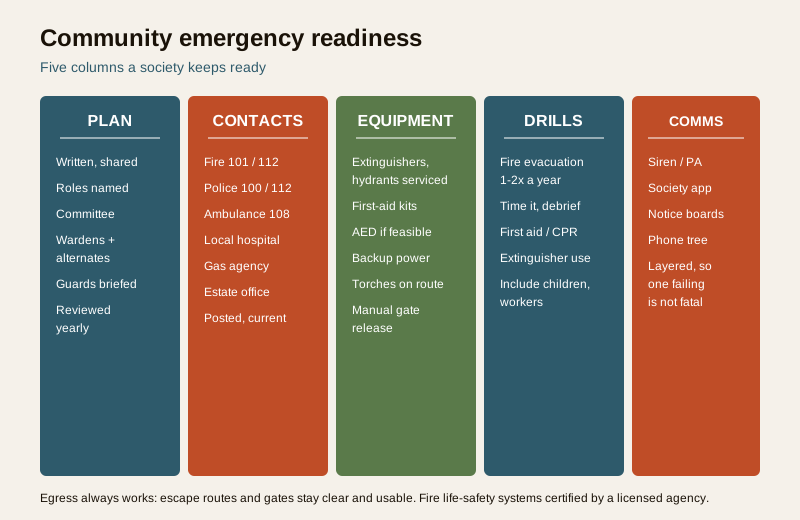
Verbal understandings evaporate under stress. A society needs a short written plan — a few pages, not a binder no one reads — approved by the committee, shared with every household, and reviewed at least yearly. It should name the roles, the assembly points, the contacts, the equipment and the drill schedule, in plain language and, ideally, in the languages residents actually speak.
The roles
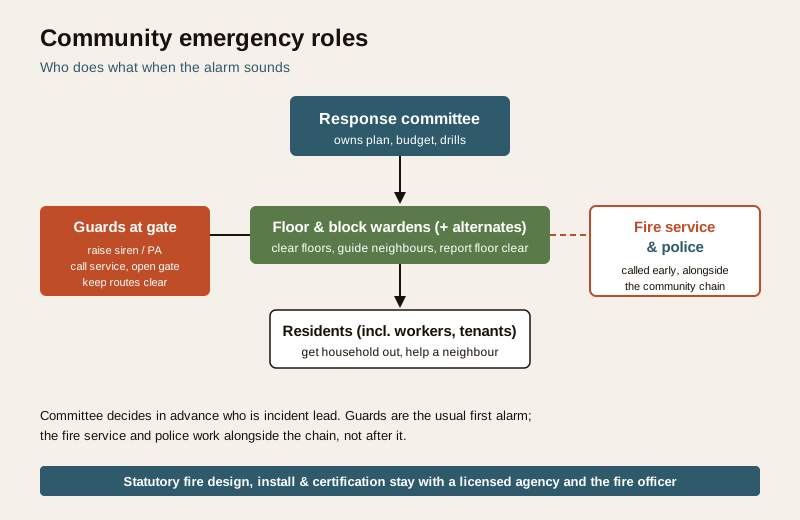
- Emergency / response committee — a small standing group (often a sub-set of the managing committee) that owns the plan, the budget line, the equipment servicing and the drills. It decides in advance who is the incident lead when something happens.
- Floor or block wardens — resident volunteers, one or two per floor or block, who on an alarm check their floor, guide neighbours to the stairs, help vulnerable residents and report "floor clear" to the assembly point. Have a named alternate for each, because the primary warden may be out.
- The guards' part — the on-duty security staff are usually first to notice or be told. Their job is defined in advance: raise the siren/PA, call the fire service or ambulance, open the gate and keep it open for the vehicle, guide the vehicle in, and keep the escape routes and driveway clear — not to fight a serious fire or perform rescues they are not trained or equipped for. Engage them through a licensed agency (PSARA 2005) with fair wages and proper training, and put emergency duties in their brief.
Everyone else is a resident with two jobs: get themselves and their household out safely to the assembly point, and help a neighbour who needs it.
Keep it fair and lawful
A community plan must protect everyone in the community — including the domestic workers, delivery staff, drivers and tenants who are inside the gates when an emergency strikes. They evacuate too, they need to reach the assembly point too, and they are counted too. Preparedness is never a cover for treating workers or tenants as second-class or as suspects; a "security lockdown" is about an external threat, not a pretext to detain or profile people who live and work there. Any resident data the plan gathers — emergency contacts, medical needs, vehicle numbers — is personal data under the Digital Personal Data Protection Act, 2023: collect only what the emergency response genuinely needs, keep it secure and current, share it only with the wardens and services who must have it, and do not repurpose it. Decisions to spend maintenance funds on equipment or drills are taken properly and transparently — committee or AGM, books open — within the society's bye-laws and the state Apartment Ownership / Cooperative Societies Act.
Assembly points and evacuation coordination
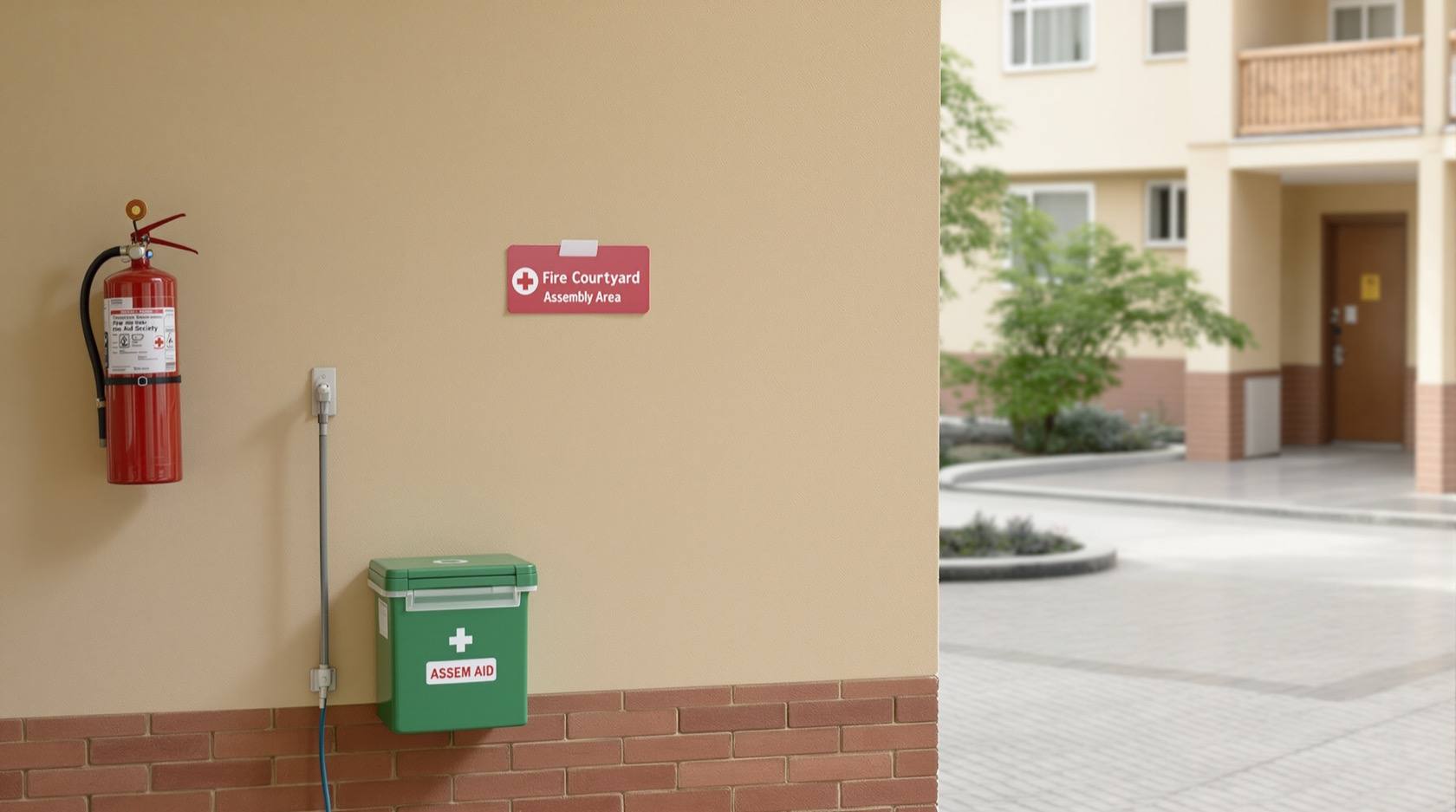
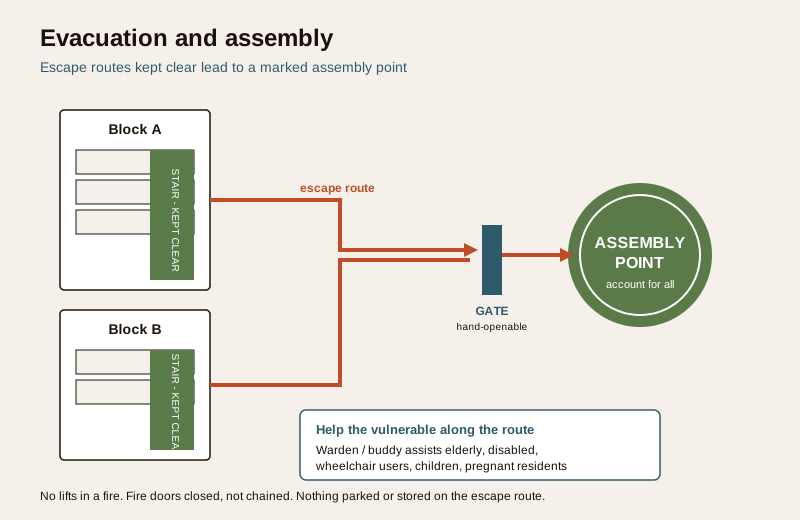
Every resident should know, without thinking, where to go. Designate one or two assembly points — an open area clear of the building, away from where fire engines will park, large enough for everyone, and reachable without crossing the hazard. Mark them, put them on the plan, and name a fallback if the primary is unusable.
The single most important physical fact in any evacuation: egress always works. Escape stairs, corridors, fire doors and the main gate must be clear and usable at all times — not blocked by parked scooters, storage, locked shutters or grilles no one can open. A fire door propped or chained, a stairwell used as a store, a gate that only opens with a key the night guard does not have — each of these has killed people. The committee's standing job is to keep every escape route and exit clear, and to make sure at least the guard on every shift can release the main gate by hand.
Helping vulnerable residents
Evacuation is hardest for those who cannot simply take the stairs — elderly residents, people with disabilities or reduced mobility, children, and pregnant residents. Plan for them specifically: keep a confidential list (with consent) of flats needing assistance, assign a warden or neighbour buddy to each, know which flats have wheelchair users or bed-bound residents, and agree a refuge and a carry plan where a stair descent is not possible. In a high-rise, know your refuge floors. Never assume someone will manage alone.
| What to keep clear / ready | Why it matters | Who owns it |
|---|---|---|
| Escape stairs and corridors free of parking and storage | The only safe way down in a fire; lifts are not used | Committee + wardens, checked monthly |
| Fire doors closed, not propped or locked | They hold back smoke and buy time on the stairs | Wardens, checked monthly |
| Main gate and a second exit openable by hand | Fire engine and ambulance access; escape if power fails | Guards every shift + committee |
| Marked, reachable assembly point(s) with a fallback | Somewhere to gather and account for everyone | Committee, on the plan |
| Confidential assistance list for vulnerable residents | So no one who needs help is missed | Emergency committee, consent-based |
| Buddy / warden assigned per vulnerable flat | A named person, not "someone", helps them out | Wardens |
Posted emergency contacts
Contacts help only if they are found in seconds, by anyone, without a smartphone. Post them prominently — at the gate, in every lift lobby, on each floor and in the estate office — printed large, laminated, and reviewed so numbers stay current. Put the same list in the society app and on the notice board.
| Contact | Number / detail | Notes |
|---|---|---|
| Fire and rescue | 101 (or 112) | The all-India emergency number 112 also reaches fire |
| Police | 100 or 112 | For intruder / security incidents and to keep order |
| Ambulance | 108 | State emergency medical service in most states |
| Nearest hospital | (specify — name, number, address) | Pre-identify the closest capable hospital and the route |
| Gas agency emergency line | (specify — your LPG distributor) | For a piped-gas or cylinder leak |
| Estate / society office | (specify — manager, guard room) | The internal first point of contact, 24x7 |
| Electricity / water utility | (specify — local discom / board) | For downed lines, outages, mains issues |
Verify the numbers for your area. 112, 101, 100 and 108 are the widely used national/state emergency numbers, but availability and routing vary by state and city. Confirm the working numbers for your location with the local authorities and print the ones that actually connect where you are.
Shared equipment and readiness
Equipment is a community asset that must be present, serviced and findable — not bought once and forgotten. The life-safety fire equipment (detection, alarm, hydrants, sprinklers, the pump and tanks) is designed, installed, serviced and certified by a licensed fire agency under the fire officer's oversight; the community's job is to make sure it is maintained on schedule, unobstructed and never disabled to stop nuisance alarms.
| Item | Community readiness role | Keep in mind |
|---|---|---|
| Fire extinguishers, hydrants, hose reels | Serviced on schedule, unobstructed, tags current | Servicing and certification by a licensed fire agency; residents only use a portable extinguisher if trained and it is safe |
| Smoke / heat detectors, alarm, sprinklers, pump | Never disabled; faults logged and fixed fast | Design, install and certification is statutory — the fire agency and fire officer, not the committee |
| First-aid kits | Stocked, in-date, at known points (gate, gym, clubhouse) | A trained first-aider list is worth more than the kit alone |
| AED (automated external defibrillator), if feasible | Consider for larger communities; visible, maintained, residents shown its location | A budget/feasibility call for the committee; pairs with CPR training |
| Backup power (DG / inverter) for lights, lift homing, pump | Tested under load; fuel checked | Keeps stairs lit and the fire pump running in an outage |
| Torches / emergency lighting on escape routes | Charged, on the routes, tested | People evacuate in darkness and smoke |
| Manual gate release / second exit | Every shift's guard knows and can operate it | An automated gate must never trap people when power fails |
Communication during an emergency
You need to reach everyone fast, through more than one channel, because any single channel can fail. Build layers: a loud siren or PA the whole site can hear; the society app / WhatsApp broadcast for detail and status; notice boards for the standing plan and contacts; and a phone tree — a pre-agreed calling chain (committee to wardens to residents) so word spreads even if the app or power is down. Agree in advance who is authorised to trigger the siren and send the broadcast, so there is no hesitation and no false-alarm confusion. Keep messages short and factual: what happened, what to do, where to go.
Drills, training and coordinating with the authorities
A plan no one has practised fails on the day. Run a fire evacuation drill at least once or twice a year: sound the alarm, have wardens clear floors, walk everyone to the assembly point, account for residents, and time it. Debrief honestly afterwards — what was blocked, who was missed, which numbers were wrong — and fix those things. Offer residents and guards basic training: how to use an extinguisher, basic first aid and CPR, how to shut a gas valve, what to do in each scenario. Include children and domestic staff; an emergency does not check who is a member.
Preparedness is stronger when the society is known to the services before the emergency. Invite the local fire service to visit, advise on access and hydrants, and ideally observe or support a drill; know the route a fire engine takes in and make sure it fits. Keep a working relationship with the local police for security incidents and crowd order, and with civic / municipal authorities for flooding, drains and disaster warnings. Coordinating in calm times means the right people arrive faster and know your site when it counts.
How it connects
Community emergency preparedness is the people-and-plan layer that sits on top of your everyday setup. It builds on the access and gate discipline of a gated community, is owned and driven by the housing society security committee, and is scoped honestly by a neighbourhood risk assessment. Its one firm boundary is the statutory fire work covered in residential building fire safety requirements — designed, installed and certified by licensed professionals and the fire officer. All of these live in the Community & RWA Security library.
Key takeaways
- Emergencies in a society are community events; plan for fire, medical, flood/waterlogging, earthquake, gas/LPG leak and a security lockdown, matched to your building.
- Write a short plan and name the roles — a response committee, floor/block wardens with alternates, and a clearly briefed part for the guards, engaged fairly through a licensed agency.
- Egress always works: keep escape stairs, fire doors, corridors and the main gate clear and hand-openable at all times, and plan specifically to help elderly, disabled, child and pregnant residents.
- Post emergency contacts (101, 100/112, 108, the local hospital, the gas agency, the estate office) where anyone can find them in seconds, and verify the numbers work in your area.
- Keep shared equipment present, serviced and findable — extinguishers, first-aid, an AED if feasible, backup power, torches, a manual gate release — with fire life-safety systems certified by a licensed agency.
- Use layered communication (siren/PA, the app, notice boards, a phone tree) and practise with drills and basic training, coordinating with the fire service, police and civic authorities in calm times.
- Treat everyone inside the gates — workers, tenants, visitors — with equal dignity and safety, and handle residents' emergency data lawfully under the DPDP Act, 2023.
References
- Digital Personal Data Protection Act, 2023 — emergency contacts, medical needs, vehicle numbers and resident lists are personal data; collect the least needed, secure it, and share it only with those who must respond.
- Private Security Agencies (Regulation) Act, 2005 (PSARA) — engage guards through a licensed agency with fair wages, welfare and training, and define their emergency duties in their brief.
- National Building Code of India (NBC), current edition (SP 7:2026) — the source for fire and life-safety, means of egress and evacuation requirements; the fire design, install and certification are done by licensed professionals and the fire officer / AHJ.
- The state Apartment Ownership / Cooperative Societies Act and the society's registered bye-laws — the framework within which the committee/AGM decides and spends on shared emergency preparedness; verify current rules with the society's legal advisor and the registrar.
- National and state emergency services — the fire service, police (100/112), and state emergency medical service (108) and disaster-management authority; confirm the working numbers and access arrangements for your own location.
This is an educational, ready-to-adapt guide, not fire-safety design, an evacuation certificate or legal advice. The fire system design, install and certification and statutory clearances are done by licensed professionals and the fire officer / AHJ; verify your obligations with the society's legal advisor and the authority, apply security fairly to everyone inside the gates, and handle resident data lawfully under the DPDP Act, 2023.
Export this guide
Related Guides — Deep-dive reading
Visitor Vehicle Management in India: A Professional Guide
The everyday weak point of every society and office gate is not the resident's car — it is the visitor, the cab, the delivery rider and the contractor who must be let in without opening the whole park to anyone. This is the process, not just the hardware: verify at the gate before the boom lifts, park visitors away from resident bays, and never jam the gate a fire tender needs.
SecuritySecurity for People Living Alone in India (2026): Calm, Practical Habits When There Is No Second Person to Notice
Living alone is an ordinary and growing part of Indian life - the student in a new city, the working single, the elder whose children are abroad, the person after a separation. It does not call for fear. It calls for a few deliberate habits, because there is no second person in the home to notice trouble, raise the alarm, or catch an accident. This is calm self-reliance, layer by layer.
SecurityEmergency-Evacuation Planning for a Secure Indian Home
The flip side of keeping intruders out is getting your family out. Map primary and secondary escape routes from every room, make sure your security hardware can never trap anyone, fix a muster point, and drill it — the evacuation plan every secure home needs.
SecurityRelated Tools — Try Free
Acoustic Privacy (STC) Visualizer
Indian healthcare acoustic visualizer — compare wall assemblies and noise sources, see received SPL after STC attenuation, and check FGI 2018 / IS 1950 / NABH speech-privacy compliance with live dual-canvas waveform.
Acoustic ToolFire Door Rating Checker
See the likely fire-door rating (30/60/90/120 min) and components a location needs per IS 3614 / NBC — guidance, confirm with your architect.
Compliance ToolApartment vs Villa Interior Planning Guide
Compare ceiling height, structural flexibility, lighting, storage, and services between apartments and villas.
Planning Guide