
Commercial Occupancy Security Requirements in India (2026): When Business Raises the Bar
The security, fire and compliance duties that switch on the moment a premises is used for business, a shop, office, restaurant, clinic, showroom or warehouse, rather than a home. Plain-language literacy on why occupancy raises the bar, which licences and clearances apply, and who to ask.
The same four walls ask very different things of you depending on who walks through the door. When a building is your home, the law leaves most of the safety choices to you and your good sense. The moment those walls host a business, a shop with customers, an office with staff, a restaurant full of diners, a clinic with patients, a showroom, a warehouse of stock, the expectations rise. More people are present, many of them members of the public who did not choose your building and cannot judge its risks. There is cash and stock worth taking, staff whose safety you are responsible for, and a duty of care that a home simply does not carry. Commercial occupancy raises the bar, and this guide is about understanding, calmly, what that higher bar generally involves and who sets it.
This is compliance literacy, not a ruling. The aim is to help you recognise which duties are triggered when a premises turns commercial, ask the right questions, and engage the right authority and professional early, rather than discover a missing approval the hard way. It closes our regulatory file, so it also steps back at the end to what compliance is really for.
Scope & how to read this. This is practical compliance literacy, not legal advice or authoritative code. Requirements vary by state and city and change over time, and they depend heavily on your premises size and use. Always confirm the current position with the Authority Having Jurisdiction, the fire service, the municipal or development body, the police or a licensed professional, before you act. For the wider map of rules, start at the security and fire regulations hub and the security and fire regulations guide.
The key idea: occupancy classification drives everything
Building codes and local bye-laws do not treat every building the same. They sort premises by how they are used, into broad occupancy classes, and the class decides how strict the fire and safety rules are. In plain terms, the National Building Code of India, published as SP 7, and your local rules recognise categories such as residential, business (offices), mercantile (shops and showrooms), assembly (places where people gather, such as restaurants, halls and cinemas), institutional (hospitals, clinics, schools) and storage (warehouses, godowns). A home sits in the gentlest class. Nearly every commercial use sits in a stricter one, and assembly and institutional uses, where crowds gather or occupants cannot easily save themselves, are the strictest of all.
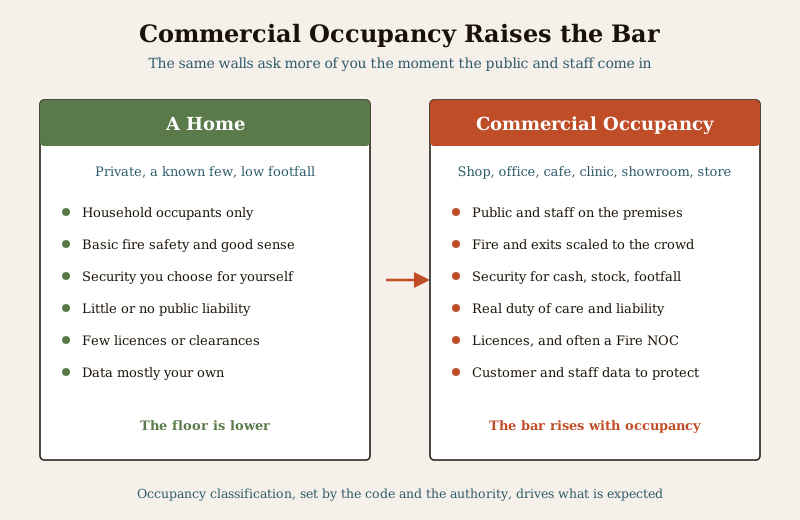
Why does the class matter so much? Because the difference between occupancies is really a difference in who is at risk. A family knows its own home, its stairs, its exits and its habits. A crowd in a restaurant does not, so the code compensates with clearer exits, better signage, alarms and limits on how many people the space may hold. Understanding your occupancy class is therefore the first move: it tells you, roughly, which chapter of the rules applies to you. The detail of what each class demands belongs to the code and the authority, so the NBC security and fire safety requirements guide is the right next stop, and a licensed fire engineer or architect can confirm your exact class and its consequences.
The licences and clearances that commonly apply
Turning a premises commercial usually means registering the activity and, for many uses, obtaining a fire clearance and any sector-specific approvals. The names, thresholds and processes vary widely by state and city, so treat the following as the general shape, not a fixed list, and confirm each with your local body.
- Trade or business licence and shops-and-establishments registration. Most local bodies require a business to register its premises and its trade, and states typically require establishments that employ people to register under a shops-and-establishments framework governing hours, records and working conditions. What exactly is needed depends on your city and your activity.
- The Fire NOC. For many occupancies and above certain sizes, the fire service issues a No Objection Certificate confirming the premises meets fire and life-safety norms. Whether you need one, and what it takes, depends on your occupancy class, height and area, so read the Fire NOC process guide and ask the fire service directly rather than assuming you are exempt.
- Sector-specific approvals. Food service needs food-safety registration or licensing; a clinic or pharmacy needs health-sector approvals; signage, liquor, entertainment and pollution consents each have their own regulator. Which apply depends entirely on what you do.
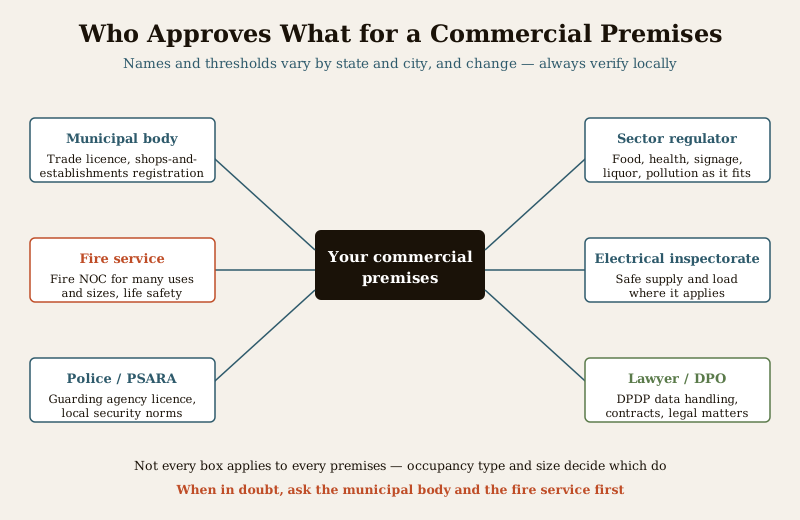
The honest summary is that no online checklist can tell you the precise set that applies to your premises. The municipal body and the fire service are the two authorities to approach first; between them they will point you to the rest.
The fire and life-safety step-up
This is where commercial occupancy asks the most, and rightly so. When members of the public are present, the building has to be able to get everyone out safely in the worst moment. Compared with a home, a commercial premises is generally expected to provide clearer and often more numerous exits, illuminated exit signage that works in a power cut, fire alarms and detection appropriate to the space, and portable extinguishers and other firefighting provision scaled to the area and its risk. Assembly and dining spaces carry occupancy limits, a maximum number of people the space may safely hold, and those limits exist to keep escape routes from becoming crushes.
None of the specific figures belong in a guide like this. Travel distances, exit widths, extinguisher counts, alarm coverage and occupancy limits are all set by the fire code and the fire officer for your exact premises, and they change, so they must be confirmed with the authority, never guessed or copied from another building.
Life-safety is not negotiable, and not DIY. The single cheapest and most important thing you can do is keep every exit route clear during business hours, unlocked, unobstructed and well signed. Beyond that, have the fire provision for your premises specified by a competent fire professional and accepted by the fire service. A blocked exit or a dead extinguisher is measured in lives, not fines.
The security step-up
Alongside fire, the everyday-security expectation rises too, because a commercial premises holds things worth taking and people worth protecting. The right level is proportionate to your footfall, your cash handling and the value and attractiveness of your stock. A quiet consulting office is not a jewellery showroom. In general, business premises are expected to have surveillance and access control suited to their risk, cash and stock secured sensibly, and, where guards are used, an agency licensed under the Private Security Agencies (Regulation) Act.
Two things deserve care. First, CCTV in a commercial setting must be planned lawfully and proportionately: cover the entrances, the till, the stockroom and the public areas that need it, but respect privacy, cameras do not belong in washrooms, changing rooms or areas where staff have a reasonable expectation of privacy, and staff should be told they are monitored. The commercial CCTV guide covers designing a business system properly, and the CCTV in workplaces guide covers doing staff monitoring fairly and lawfully. Second, insurers increasingly expect certain protections, working alarms, shutters, fire provision, as a condition of cover, so your security posture and your insurance are linked.
The DPDP overlay for a business handling data
The moment you are a business handling other people's information, customer contact details, booking records, CCTV footage of identifiable people, staff and visitor records, the Digital Personal Data Protection Act, 2023 applies to you in a way it largely does not to a household. The Act asks you to collect only what you genuinely need, use it for the stated purpose, keep it secure, be transparent about what you hold, and not keep it forever. In practice that means having a reason for each piece of data you gather, protecting it, telling people plainly what you collect and why, and being able to respond if someone asks about their data. For anything beyond the basics, or if you handle sensitive information at scale, take advice from a lawyer or a data protection professional rather than improvising.
A commercial occupancy compliance checklist
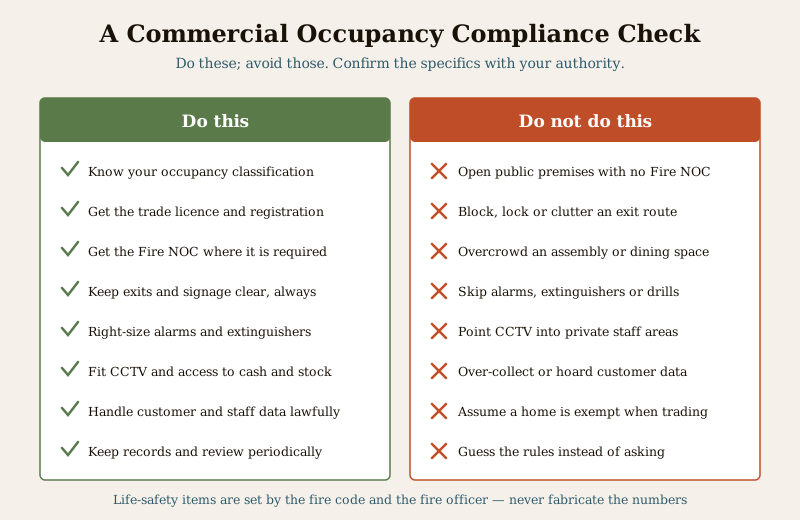
Use this as a starting map for a conversation with your authority and professional, not as a final ruling:
| Area | What to confirm | Who to ask first |
|---|---|---|
| Occupancy class | Which class your use falls in, and what it triggers | Architect or fire engineer, and the code |
| Business registration | Trade licence and shops-and-establishments registration | Municipal or local body |
| Fire clearance | Whether a Fire NOC is required for your use and size | State or city fire service |
| Fire and life-safety | Exits, signage, alarms, extinguishers, occupancy limits | Fire officer and a fire professional |
| Sector approvals | Food, health, signage, liquor, pollution as applicable | The relevant sector regulator |
| Security | CCTV, access and guarding proportionate to the risk | Security professional, and your insurer |
| Data | DPDP-compliant collection, security and transparency | Lawyer or data protection professional |
A short "do not do this" list
- Do not run public premises without the Fire NOC where it is required. It is not paperwork for its own sake; it is the confirmation that people can get out safely.
- Do not block, lock or clutter an exit route during business hours, ever, for any reason.
- Do not overcrowd an assembly or dining space beyond the limit set for it.
- Do not point cameras into washrooms, changing rooms or private staff areas, and do not monitor staff covertly.
- Do not over-collect customer data or keep it long after you need it.
- Do not assume a home used for trade is exempt; commercial use can change the rules that apply, so check.
Who to ask, and when
The right instinct throughout is to defer to the people who set and enforce these rules. Approach the municipal or local body for registration and building matters, the state or city fire service for occupancy, the Fire NOC and life-safety, the police or the PSARA controlling authority for guarding, the relevant sector regulator for your specific activity, and a lawyer or data protection professional for legal and data questions. Bring in a licensed architect or fire engineer early, before you fit out or open, because retrofitting exits and fire provision into a finished space is far costlier than designing them in. Getting the right person in the room at the start is almost always cheaper and calmer than fixing a refusal later.
In closing: what compliance is really for
This guide closes our regulatory file, so it is worth saying plainly what all of it has been about. Compliance can feel like red tape, one more form, one more inspection, one more approval standing between you and opening the doors. But strip it back and the rules in this whole section are not there to obstruct you. They are the floor beneath which we agree not to let each other fall: the assurance that the person who walks into your shop can walk out safely if something goes wrong, that your staff are protected, that the data of a stranger who trusted you with it is handled with care. That is not bureaucracy for its own sake. It is the quiet infrastructure of a society where a stranger can trust a building they have never been in before.
So the whole file comes down to four calm habits. Know the rules that apply to you, in outline at least. Engage the right authority and the right professional early, and let them fill in the specifics for your premises. Keep your records, your licences, your certificates, your inspection notes, in order, because a well-kept file is proof of care. And review periodically, because these rules genuinely change, and the position that was correct last year may not be correct now. Do those four things and compliance stops being something done to you and becomes something you do well, with a clear conscience and a safer building. That is worth far more than avoiding a penalty.
This is not legal advice. It is educational compliance literacy. Requirements around commercial occupancy vary by state and city, depend on your exact use and size, and change over time. Always confirm the current position with the Authority Having Jurisdiction and engage a licensed fire engineer, architect, lawyer or other professional before you act.
References
- National Building Code of India (SP 7) — classifies buildings by occupancy and sets the fire and life-safety framework that commercial premises must meet; the current edition and the requirements for your occupancy class must be verified via the Bureau of Indian Standards and your local authority. https://www.services.bis.gov.in/
- State Fire Prevention and Life Safety Acts, municipal building bye-laws and the state or city fire service — set and enforce the Fire NOC, exits, signage, alarms and occupancy limits for commercial premises; requirements vary by state and city and must be confirmed locally.
- Digital Personal Data Protection Act, 2023 (DPDP) — governs how a business collects, uses, secures and retains the personal data of customers, staff and visitors; take professional advice for anything beyond the basics.
- Private Security Agencies (Regulation) Act, 2005 (PSARA) and state PSARA Rules — govern the licensing of private security agencies whose guards a commercial premises may engage.
Export this guide
Related Guides — Deep-dive reading
Security and Fire Regulations Guide for India (2026): Know the Rules and How to Navigate Them
There is no single national rulebook you can read off. This is the map of the whole regulatory landscape for home, housing-society and commercial security and fire systems in India, and a calm way to navigate it: who sets the rules, who approves what, and how to stay on the right side of them.
SecurityResidential Building Fire Safety Requirements in India (2026): Homes and Housing Societies
A plain-language literacy guide to the fire and life-safety expectations that scale with a home's size, from an independent house to group housing, and how flat owners, RWAs and builders share the duty of keeping people able to escape.
SecurityComplete Guide to Building Type Security in India (2026): Right-Sizing Protection to Homes, Schools, Hospitals, Warehouses and Temples
The same security building blocks — perimeter, gate and access, CCTV, alarms, lighting, fire, guards and cyber — are composed very differently for a villa, a school, a hospital, a warehouse or a temple. This pillar maps the whole library of building-type guides and gives you the framework to tailor security to each kind of building.
SecurityRelated Tools — Try Free
CCTV Camera Coverage & Count Calculator
Estimate how many CCTV cameras you need, the NVR channels, storage in TB for your retention period, and an indicative all-in cost with GST.
CCTV CalculatorCCTV Placement Compliance Checker
A quick DPDP-grounded privacy and safety self-check for where a camera is pointed — flags the items to fix.
ComplianceCPCB Compliance Checklist for STPs
Tick off CPCB/SPCB outlet standards, monitoring duties and record-keeping to score your sewage treatment plant's compliance readiness.
Checklist