
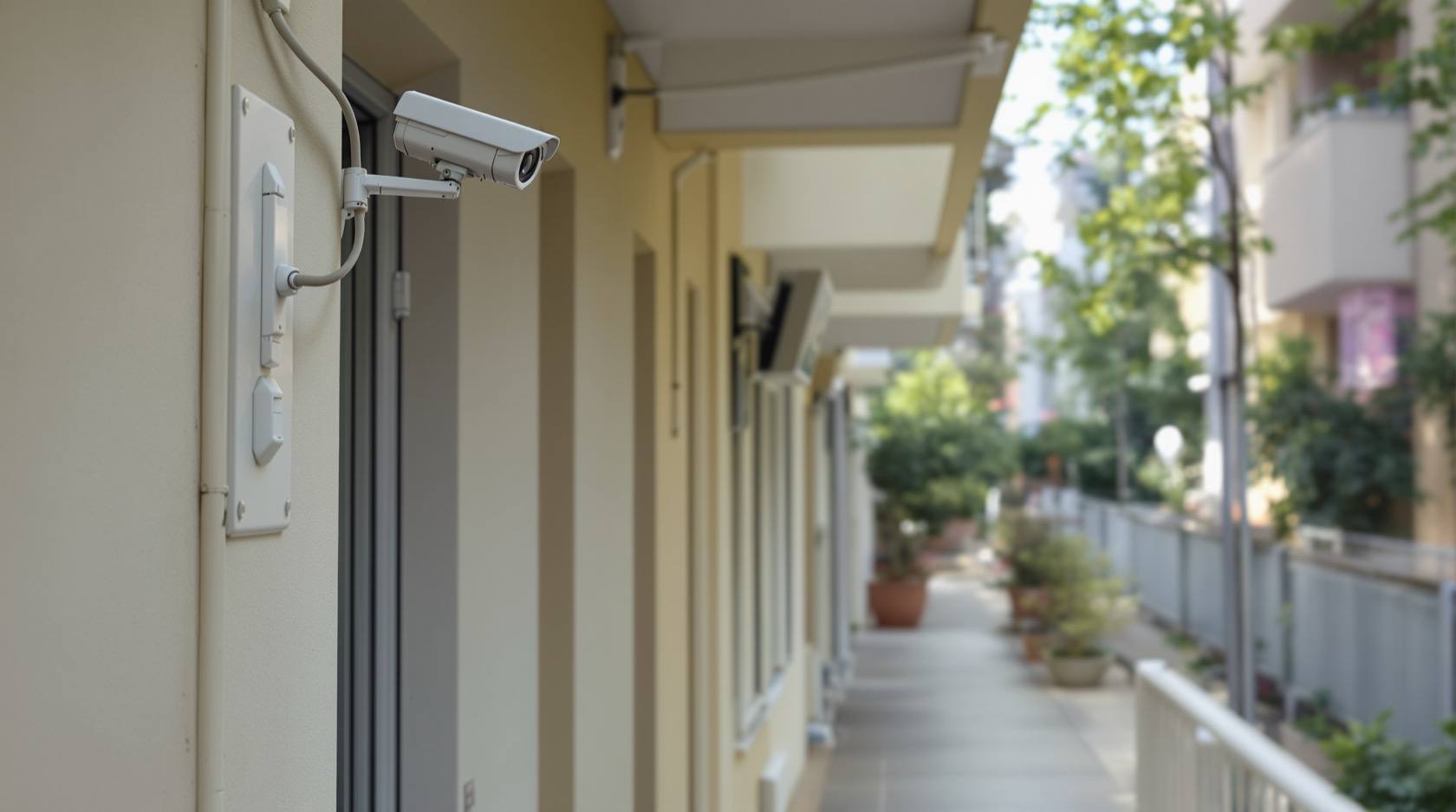
CCTV in Apartments in India (2026): Your Camera, Your Neighbour's Privacy
In a flat, walls are shared, doors face each other, and balconies overlook. A camera at your own door can be perfectly reasonable — as long as its view stops at your threshold. Here is how to protect your own entrance without watching the people next door.
Putting a camera at your own front door feels like the most personal, private decision in the world. In an apartment it is anything but. Your flat is compact, the walls are shared, your door faces someone else's across a narrow corridor, and your balcony looks straight into the flat opposite. So the camera you mount to watch your entrance almost always catches your neighbour too — their door, their comings and goings, their guests, sometimes their living room through an open window.
None of that makes cctv in apartments a bad idea. A camera at your threshold is a genuinely useful, reasonable thing to have. It just has to be done considerately, because in a building this close together your security and your neighbour's privacy sit a metre apart. This guide is about drawing that line well: protecting your own home while keeping your lens off the people who share your floor. It sits inside Studio Matrx's privacy and ethics sub-hub.
Scope & how to read this. This is practical, neighbourly guidance grounded in the spirit of the Digital Personal Data Protection Act, 2023 (DPDP Act), not legal advice. A couple of cameras for your own household may fall outside some formal obligations, but the ethical duties — restraint, notice, not pointing at neighbours — still apply. For anything with legal weight (a tenancy, an RWA dispute, a complaint), take professional advice, and always choose the least-intrusive option that meets your need.
The core idea: your view stops at your threshold
There is one test that solves most apartment-camera problems: the field of view should end where your home ends. A camera at your door exists to see who approaches your door — not to keep a running log of the whole corridor, the lift lobby, or the neighbour's entrance opposite.
That distinction matters because footage of an identifiable person is personal data, and the DPDP Act's plain-language spine is purpose limitation and data minimisation: collect only what your genuine purpose needs, and no more. Your purpose is your own doorstep. The neighbour's door, the shared landing and the lift area are the building's common spaces — securing those is the Residents' Welfare Association's (RWA) job, not something you do unilaterally from your own wall. That larger question is covered in CCTV in common areas.
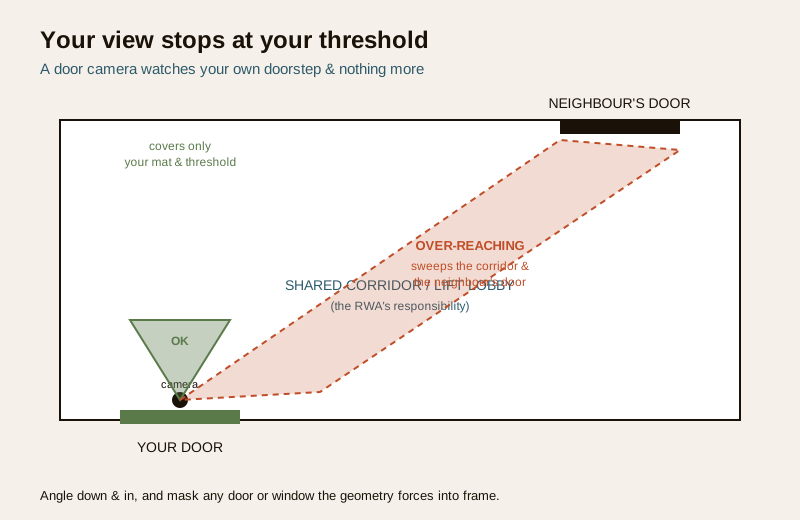
So a camera at your entrance is generally fine — but aim and constrain it:
- Angle it down and in, toward your own mat and threshold, not straight across the corridor.
- Use privacy masking (a software zone that blacks out part of the frame) to blank the neighbour's door and any window if the geometry forces it into view. The technique is covered in where not to install CCTV.
- Do not cover the lift lobby, staircase or the corridor wholesale from your private camera — that is common-area surveillance and belongs to the RWA, with its own notice and governance.
- Prefer a video door phone for a doorbell-style view: it is designed to look at the person at your door and is easier to keep narrow than a wide wall camera.
Inside your flat: family, and the people who work in it
Cameras inside your own home are your call — but "your call" is not unlimited, because other people live in and work in that space too.
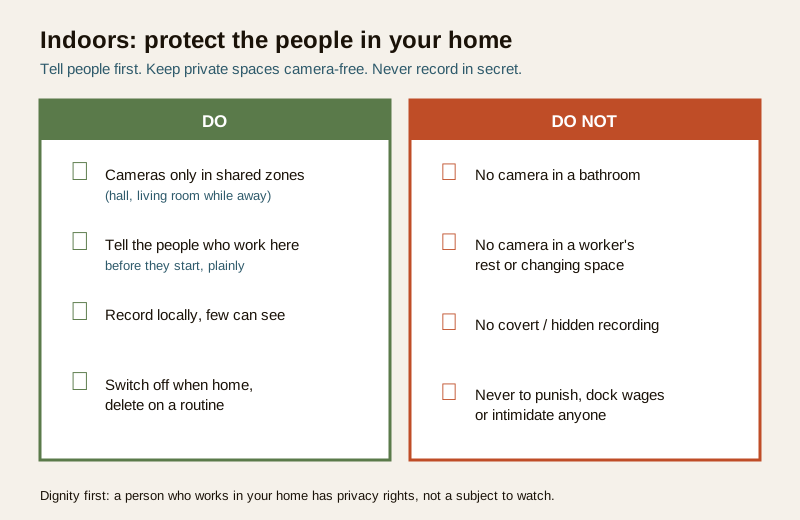
Your family. An indoor camera records everyone who lives there. Keep them to shared zones (an entrance hall, a living room while you are away) and out of bedrooms and bathrooms entirely. Prefer cameras that record locally, review who can see the feed, and switch them off when the household is home if the only purpose was to check on an empty flat. The full case for restraint indoors is in indoor CCTV.
Domestic workers. This is where dignity matters most. A cook, a cleaner, a nanny or a carer who works in your home is a person with privacy rights, not a subject to be watched. The DPDP principles and basic decency point the same way:
- Tell them. If there are cameras in the areas where they work, say so plainly, in a language they understand, before they start — not after an incident.
- No cameras in their rest area, changing space or any bathroom. A live-in worker's sleeping space is off-limits, full stop.
- Never covert. Hidden recording of the person who works in your home is the exact abuse privacy law and ethics exist to prevent. If you would not say it to their face, do not do it behind their back.
- Do not use footage to punish, dock wages or intimidate. A camera is for security, not for controlling a worker's every movement.
The detailed do's and don'ts for cameras and household staff are handled in the domestic-worker material reachable through the privacy sub-hub; treat this as the short version: tell people, keep private spaces camera-free, never record in secret.
Balconies and windows that overlook a neighbour
Balconies are the classic apartment flashpoint. Your balcony camera, meant to watch your own railing or a ground-floor entrance, can easily frame the balcony, window or living room of the flat beside or below you. That is precisely the intrusion to avoid.
- Point outward and down at your own boundary, not sideways along the building face into other balconies.
- If a neighbour's window or balcony unavoidably falls in frame, mask it out so the camera physically cannot record that zone.
- A camera that mainly watches someone else's home is not a security camera — it is surveillance of a neighbour, and no amount of "it is my wall" changes what it is pointed at.
The neighbour-privacy test. Before you fix any camera, stand where it will sit and ask three questions. Whose door, window or balcony can this see besides mine? Do I actually need to see that to protect my own home? Can I angle, lower or mask it so I do not? If a lens mostly captures a neighbour, it is over-reaching — narrow it or move it. Because you can see next door does not mean you should.
Tenants and landlords: who may put a camera where
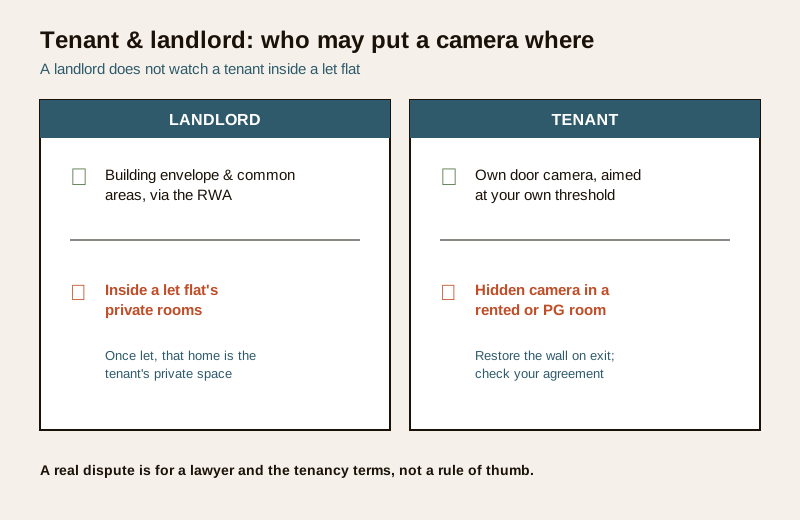
Renting adds a second person with rights to the same walls, and the line is clear in principle: a landlord does not get to watch a tenant inside the home they have let.
| Situation | Generally reasonable | Not acceptable |
|---|---|---|
| You own and live in the flat | A camera at your own door and in shared indoor zones, aimed at your threshold | Covering the neighbour's door, the corridor wholesale or the lift lobby yourself |
| You are the tenant | Putting up your own door camera during the tenancy (restore the wall on exit; check your agreement) | — |
| You are the landlord, flat is let | Nothing inside the tenant's private living space | Cameras inside a let flat's rooms; any camera watching the tenant's daily life |
| Shared PG or hostel | Cameras in genuinely common areas, with clear notice to residents | Cameras in bedrooms, bathrooms, or any private sleeping space |
Some specifics:
- A landlord cannot install cameras inside the private rooms of a flat they have rented out. Once a tenant is in lawful possession, that home is the tenant's private space. A landlord's security interest is met at the building envelope and common areas (through the RWA), not inside the let dwelling.
- A tenant may generally put up their own door camera, subject to their agreement and to the same rule everyone else follows — it must watch their own threshold, not the neighbour's. On moving out, remove it and make good the wall.
- Short-let and PG arrangements carry a heightened duty of notice: guests and paying residents must be told, in writing, exactly where cameras are — and there must be none in bedrooms, bathrooms or any sleeping space. Hidden cameras in a let or short-stay room are a serious violation.
Because tenancy is a legal relationship, a genuine dispute — a tenant who finds a camera indoors, a landlord unsure what is allowed — is a matter for a lawyer and the tenancy terms, not a rule of thumb. Say so, and get advice.
Talk to your neighbours and the RWA first
The most under-used privacy tool in an apartment is a conversation. Before you drill anything into a wall that faces a shared space:
- Tell the neighbour opposite what you are putting up and what it looks at. A camera you have discussed is rarely a problem; a camera discovered later feels like being watched, even when it is not.
- Anything mounted in or aimed at common space needs the RWA, not a unilateral decision. Common-area cameras are the association's remit, with their own placement, notice and access rules — see CCTV in common areas.
- Post a small, honest notice if your camera covers any shared approach — a simple "CCTV in use" sign near your door respects everyone and supports the DPDP spirit of notice.
Designing the whole scheme to intrude as little as possible — narrow views, masking, short retention, few people with access — is the privacy-by-design approach, and it applies just as much to one door camera as to a building system.
Apartment CCTV, done considerately — the checklist
Do:
- Aim the camera at your own threshold and angle it down and in.
- Mask out any neighbour's door, window or balcony the geometry forces into frame.
- Prefer a video door phone for a doorbell view of your own entrance.
- Keep indoor cameras to shared zones, out of bedrooms and bathrooms.
- Tell everyone who lives or works in the flat that cameras are there — especially domestic workers.
- Talk to the neighbour opposite and the RWA before mounting anything facing shared space.
- Post a simple notice where a camera covers a shared approach.
- Keep footage briefly, limit who can see it, and delete it on a routine.
Do NOT:
- Cover the shared corridor wholesale, the lift lobby or the neighbour's door from your private camera — that is the RWA's job.
- Point a camera into a neighbour's balcony, window or home.
- Put any camera in a bathroom, bedroom, or a domestic worker's rest or changing area.
- Record covertly — no hidden cameras on staff, family, tenants or guests.
- As a landlord, place cameras inside a let flat's private rooms.
- Use footage to punish, wage-dock or intimidate anyone.
When to get advice
- A tenancy or landlord dispute over cameras, a neighbour complaint that will not resolve, or an RWA disagreement about common-area cameras — take legal advice and follow due process; do not rely on a checklist for a legal fight.
- A camera that unavoidably overlooks someone else's home and cannot be masked — get an installer to reposition it, and if the neighbour objects, treat it as a real issue, not a nuisance.
- Anything about workplace-style monitoring of household staff beyond basic security — the safe answer is restraint and clear notice, and where it has legal weight, professional advice.
The bigger picture across every camera you own — masking, retention, access, notice — is drawn together in the CCTV privacy guide, which is the natural next read once your own door camera is aimed and masked.
Key takeaways
- A camera at your own flat door is reasonable — if its view stops at your threshold. The neighbour's door, the corridor and the lift lobby are the RWA's remit, not yours to watch.
- Mask what you must not see. Where geometry forces a neighbour's door, window or balcony into frame, black it out or re-angle the camera.
- Indoors, protect the people in your home. Keep cameras to shared zones, tell everyone including domestic workers, keep private spaces camera-free, and never record covertly.
- Landlords cannot watch tenants inside a let flat, and every let or PG room must be free of hidden cameras; disputes are for a lawyer.
- Talk first. A neighbour and RWA conversation, plus a simple notice, prevents most apartment-camera friction.
- Because you can see next door does not mean you should. Narrowest view, shortest retention, fewest eyes — the proportionate way.
References
- Digital Personal Data Protection Act, 2023 — collect personal data (including identifiable footage) only for a clear, legitimate purpose, with notice, and no more than needed; verify the current text and rules before relying on it.
- Reasonable expectation of privacy — recording a neighbour's home, or a person in their private or rest space, raises privacy issues; seek qualified legal advice for a specific dispute.
- Tenancy and household-staff rights — a tenant's private space and a domestic worker's dignity are protected under general law; for a real dispute, consult a lawyer rather than a general guide.
This is an educational overview, not legal advice. Whether and how you may lawfully place a camera in and around your apartment depends on your exact facts, your agreement and your RWA rules — consult a qualified professional for anything with legal weight, and always choose the least-intrusive option.
Export this guide
Related Guides — Deep-dive reading
Where Not to Install CCTV in India (2026): The No-Go Zones
A camera is a powerful thing, and pointing it at the wrong place can turn a security measure into a serious intrusion. This is the plain, humane list of places a camera must never point, plus the borderline spots to think twice about.
SecuritySecurity Privacy Assessment for Indian Homes
Getting the privacy side of home security right: camera placement ethics and limits, notice and consent, the extra caution audio demands, and treating footage as personal data you store, retain and delete responsibly under India's DPDP Act 2023 direction.
SecuritySecurity for Tenants in India (2026): Protect Your Rented Home and Your Privacy Without Losing the Deposit
Renting is home too. This guide covers a tenant's twin needs - securing a rented home with reversible, take-it-with-you measures the lease allows, and standing on your privacy rights so a landlord cannot surveil you inside your own walls. Practical, India-real, and firmly on the renter's side.
SecurityRelated Tools — Try Free
CCTV Placement Compliance Checker
A quick DPDP-grounded privacy and safety self-check for where a camera is pointed — flags the items to fix.
ComplianceApartment Video Door System Planner
Enter flats, entrances, floors and guard desk for a first-pass building intercom plan — door stations, indoor monitors, guard station, the right architecture and an indicative cost band.
Building PlannerFull-Room BOQ — Living, Bedroom, Kitchen, Bath
Room-wise BOQ across living, bedrooms, kitchen, utility, and bathrooms with line-item pricing.
Full-Room BOQ