

CCTV Footage Sharing in India (2026): Who You Can Show It To
A clip that shows a recognisable face is personal data about that person. Before you forward it, post it or share it, learn who footage may lawfully and decently go to in India, and where it must never go.
The camera did its job: it caught the moment. Now comes the part almost no one thinks about before they act on impulse. You have a clip that clearly shows a person's face, and your thumb is hovering over "forward". This guide is about that exact moment, because cctv footage sharing is where a reasonable home security setup most often tips over into a privacy wrong, a defamation risk, and real harm to a real person.
A recording of an identifiable individual is not just "your footage". It is personal data about them. The instant you send it somewhere, you have made a disclosure, and disclosures carry consequences that a quiet clip sitting on your recorder never does. The good news: a few simple rules keep you on the right side of both the law and basic decency, without leaving you helpless when something genuinely goes wrong.
Scope & how to read this. This is practical guidance grounded in the spirit of the Digital Personal Data Protection Act, 2023, not legal advice. For anything with legal weight — a police request, an insurance claim, a dispute headed for court, or a possible defamation — take professional advice and follow due process. Always share the least you can, with the fewest people, for the narrowest reason. This guide sits within the Studio Matrx privacy and ethics hub.
The golden rule: footage of a person is a disclosure, not a possession
Owning the camera does not make you the owner of the people it records. When a clip shows a recognisable face, a number plate, a uniform with a name, or someone's home routine, that clip is personal data about that person. Sharing it is a disclosure — and under the data-minimisation and purpose-limitation thinking of the DPDP Act 2023, a disclosure needs a real reason, the narrowest scope, and the fewest recipients.
Three separate harms ride along with careless sharing:
- Privacy. People have a reasonable expectation that their comings and goings are not broadcast. Forwarding footage of them, especially inside or near their home, intrudes on that.
- Defamation. Label a person a thief, a cheat or a snoop and circulate their image, and if you are wrong — or cannot prove it — you may have defamed them. In India defamation carries both civil and criminal exposure. A camera captures what happened, not why; a blurry frame is not proof of a crime.
- Dignity and safety. A shared clip can get someone harassed, beaten, sacked, or worse, long before any facts are established. That outcome is on the person who pressed share.
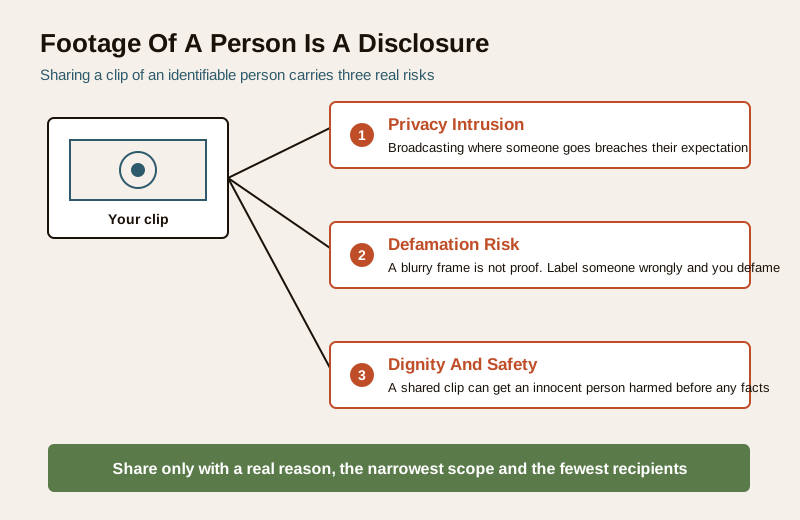
The whole rest of this guide flows from that one idea. If you internalise nothing else: a clip of a person is about that person, and you are its custodian, not its owner.
The big NO: never post or broadcast identifiable people
This is the firm line, and it does not bend for anger, suspicion or a "helpful" motive. Do not put footage of identifiable people into any of these:
- WhatsApp groups — society groups, "neighbourhood watch" chats, family groups. Once a clip is in a group it is uncontrollable: it gets forwarded, screenshotted and re-shared beyond anyone's reach.
- RWA broadcast lists and notice boards — a resident-body channel is a broadcast, not a private word with the right person.
- Instagram, Facebook, X, YouTube, community forums — public posting of a recognisable person is the single riskiest thing you can do with footage.
- "Name and shame" posts of a suspected thief, a domestic worker, a delivery rider, a maid, a driver or a guest. This is where good people cause the most damage.
Public shaming fails on every count that matters. It presumes guilt where the law presumes innocence. It substitutes a mob for due process. It defames if you are wrong and often even if you are right but cannot prove it. And it strips the dignity of someone — frequently a low-wage worker with no way to answer back — who may be entirely innocent of what your caption claims.
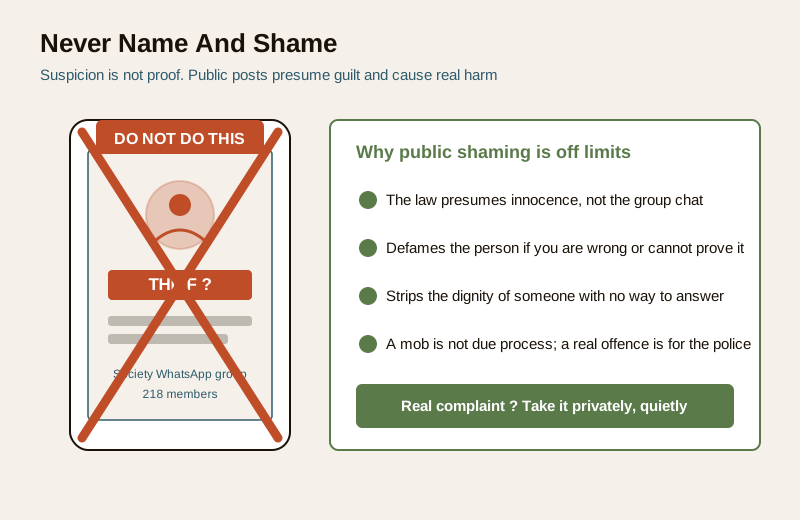
Dignity and rights callout. The person in your footage has a right to be presumed innocent and to not be publicly humiliated on the strength of a suspicion. Suspicion is not proof. If you genuinely believe a crime occurred, that belongs with the police, quietly — not with an audience. Never use footage to punish, intimidate, wage-dock or "make an example of" a worker or neighbour.
Legitimate sharing, with due process
Restraint does not mean paralysis. There are proper channels, and used correctly they protect you as much as the person in the frame. The test for every one of them is the same: minimise and route, do not broadcast.
To the police or a court
If footage may be evidence of a genuine offence, the right destination is the police or the court, through a proper request — not a public post. Hand over the specific relevant clip in response to a lawful request, keep a note of what you gave and to whom, and do not circulate it in parallel. The mechanics of doing this correctly, including verifying the request and logging it, are covered in responding to police requests.
To an insurer
For a break-in or damage claim, an insurer may legitimately need footage to assess it. Share only the clip that shows the relevant event, sent directly to the insurer through their claims channel, with a record of what you sent.
To the RWA custodian for a genuine incident
Where a society has a designated person or committee responsible for security, a genuine incident can be handed to that custodian privately — not blasted to every resident. A resident body holding footage is itself a data custodian with duties around access, retention and security; see CCTV in common areas and the retention discipline in how long to keep footage.
Across all three, two habits do the heavy lifting:
- Minimise. Share the ten seconds that matter, not the whole day's archive. Nobody downstream needs footage of every uninvolved person who walked past.
- Redact. Where uninvolved third parties, children or bystanders appear, mask or blur them before the clip leaves your hands. The same masking techniques you use on the live feed apply here — see privacy masking.
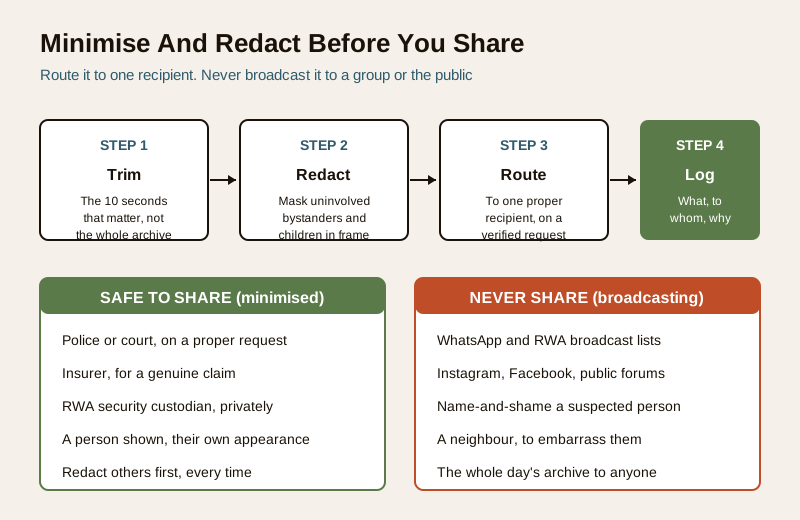
| Recipient | Share what | How | Guardrails |
|---|---|---|---|
| Police / court | Only the relevant clip | On a proper, verified request | Log it; do not also post it anywhere |
| Insurer | Only the incident clip | Direct through claims channel | Keep a record of what was sent |
| RWA security custodian | Only the incident clip | Privately to the designated person | Not to the resident group at large |
| A person shown in it | Their own appearance | On a fair request; mask others | Redact uninvolved third parties |
| WhatsApp / social media / broadcast lists | Nothing identifiable | Do not | This is disclosure to the world |
When the person in the footage asks for a copy
Here the tables turn, and it is worth handling well. Someone who appears in your footage is a data principal in relation to that recording, and it is reasonable for them to ask for what shows them — a worker accused of something, a visitor in a dispute, a neighbour after an incident. Treat such a request fairly and calmly rather than defensively.
- Give them their own appearance, not the whole archive. They are entitled to the footage of them, in the relevant window.
- Protect everyone else in the frame. Mask or blur other identifiable people before you hand it over — their privacy does not evaporate because someone else made a request.
- Keep it proportionate. You are not obliged to run a surveillance service on demand, but stonewalling a fair, specific request looks bad and undercuts the trust your cameras depend on.
- If it is contentious — an accusation, a termination, anything headed for a formal dispute — take advice before releasing, and route it properly. The broader rights and duties are set out in the privacy and ethics hub and the CCTV privacy guide.
Neighbour disputes and shared incidents
Two homes, one boundary, one incident — this is where sharing gets emotionally charged and legally messy fastest. A few principles keep it clean:
- Do not weaponise footage. A clip is not ammunition to shame a neighbour in the society group. If there is a real complaint, it goes to the RWA custodian or the police, privately.
- Watch your camera's reach. If your camera is capturing a neighbour's door, window or private space at all, the problem starts before sharing — fix the field of view. This is exactly what privacy masking and building your setup on privacy by design are for.
- For a shared incident, the neighbour who appears has the same fair-access interest described above; and if either of you takes it to authorities, the footage travels by the proper route, minimised and redacted.
A safe-to-share / never-share matrix
| Situation | Safe to share? | To whom, how |
|---|---|---|
| Evidence of a genuine offence | Yes, minimised | Police / court, on a proper request |
| Break-in for an insurance claim | Yes, minimised | Insurer, direct claims channel |
| Genuine society incident | Yes, minimised | RWA security custodian, privately |
| A person requesting their own appearance | Yes, redact others | Directly to them, fairly |
| A "funny" or "look at this" clip of a passer-by | No | Nowhere |
| Suspected thief / worker / delivery person | Never publicly | Police only, if a real offence |
| Any identifiable person to a WhatsApp / RWA group | No | This is broadcasting |
| Anything on Instagram / Facebook / public forum | No | Do not post identifiable people |
| A neighbour, to embarrass them | Never | Route real complaints privately |
Your sharing checklist
Before any clip leaves your hands, run these:
- Is there a real, specific reason — an actual incident, claim or lawful request — or am I reacting to emotion?
- Is this the narrowest recipient — one police officer, one insurer, one custodian — rather than a group or the public?
- Have I trimmed it to the seconds that matter, not the whole archive?
- Have I masked uninvolved third parties, children and bystanders?
- Have I logged what I shared, with whom, and why?
- If it has legal weight, have I taken advice and used the proper channel?
What NOT to do — ever
- Do not post or forward identifiable people to WhatsApp, RWA broadcast lists, Instagram, Facebook, YouTube or any public forum.
- Do not "name and shame" a suspected thief, worker, maid, driver, rider or guest. Suspicion is not proof; that is what the police are for.
- Do not share the whole day's archive when one clip is what is needed.
- Do not hand over footage full of uninvolved bystanders without masking them.
- Do not use footage to punish, intimidate, wage-dock or threaten a worker, tenant or neighbour.
- Do not treat a police-looking message as genuine without verifying it — follow responding to police requests.
When to get legal or professional advice
Some situations are past the point of a checklist. Take proper advice, and do not improvise, when:
- Footage may be evidence in a criminal matter or a court case.
- You are handling a termination, accusation or workplace dispute involving a worker or tenant.
- A person threatens defamation or a privacy complaint over something you shared, or you fear you may have overshared. A large or wrongful disclosure may even be a data-breach situation — see data breach response.
- You are unsure whether a request for footage is lawful and genuine.
Legal and ethics caution (not legal advice). Sharing footage of identifiable people in India can engage privacy, defamation and data-protection duties. The safe defaults are: never post or broadcast identifiable people, share the minimum through the proper channel, redact uninvolved third parties, keep a record, and take professional advice for anything with legal weight. Treat everything here as a starting point for that advice, not a substitute for it.
Key takeaways
- A clip of an identifiable person is personal data about them. Sharing it is a disclosure with privacy, defamation and DPDP consequences — you are its custodian, not its owner.
- Never post or broadcast identifiable people to WhatsApp, RWA lists or social media, and never "name and shame". Suspicion is not proof, and the law presumes innocence.
- Legitimate sharing exists — with due process. Police or court on a proper request, an insurer for a claim, the RWA custodian for a genuine incident. Minimise and redact every time.
- A person shown in footage can fairly ask for their own appearance; give it, masking everyone else.
- When in doubt, do less and ask. Take legal advice for anything with legal weight, and route it properly.
References
- Digital Personal Data Protection Act, 2023 — disclosing personal data (including footage of an identifiable person) should rest on a clear, lawful purpose, be minimised, and reach the fewest recipients; verify current text and rules before relying on it.
- Reasonable expectation of privacy and defamation — sharing a person's image or labelling them can engage privacy and defamation exposure in India; seek qualified legal advice for your specific facts.
- Due-process routing — footage that may be evidence belongs with the police or a court through a proper request, not a public post; keep a record of any disclosure.
This is an educational overview, not legal advice. Whether and how you may lawfully share footage depends on your exact facts — consult a qualified lawyer for anything with legal weight, and always share the minimum through the proper channel.
Export this guide
Related Guides — Deep-dive reading
Security Privacy Assessment for Indian Homes
Getting the privacy side of home security right: camera placement ethics and limits, notice and consent, the extra caution audio demands, and treating footage as personal data you store, retain and delete responsibly under India's DPDP Act 2023 direction.
SecurityCCTV Privacy Guide for India (2026): Watching Responsibly, Lawfully and Decently
A camera is a powerful thing, and the footage of an identifiable person is personal data. This is the front door to using home, RWA and small-business CCTV with dignity, restraint and respect for the people it watches.
SecurityResponding to Police Requests in India (2026): Handing Over CCTV Footage the Right Way
A police officer asks for your camera footage. You want to help a genuine investigation — and you also owe a duty to everyone caught in that clip. This guide shows how to cooperate properly: verify the request, share proportionately, keep the original, and record what you did.
SecurityRelated Tools — Try Free
CCTV Camera Coverage & Count Calculator
Estimate how many CCTV cameras you need, the NVR channels, storage in TB for your retention period, and an indicative all-in cost with GST.
CCTV CalculatorCCTV Placement Compliance Checker
A quick DPDP-grounded privacy and safety self-check for where a camera is pointed — flags the items to fix.
ComplianceLift Safety Audit Checklist
Interactive checklist that scores your home lift on safety devices, compliance and upkeep.
Checklist