
Responding to Police Requests in India (2026): Handing Over CCTV Footage the Right Way
A police officer asks for your camera footage. You want to help a genuine investigation — and you also owe a duty to everyone caught in that clip. This guide shows how to cooperate properly: verify the request, share proportionately, keep the original, and record what you did.
An officer turns up, or a message arrives from the local station: there was an incident nearby, and they would like your camera footage. Most of us feel two things at once. We want to help — a real investigation deserves cooperation, and a clip from your gate camera might matter to a family whose case depends on it. But your recording also holds the faces, number plates, movements and routines of neighbours, delivery workers, visitors and passers-by who did nothing wrong. Responding to police requests well means honouring both duties at the same time: help the investigation, and protect the people in your footage.
The wrong instinct is to panic and dump everything — hand over the whole hard drive, or WhatsApp a week of recordings to a number you were given. The other wrong instinct is to stonewall a genuine, lawful request. Neither is right. The calm middle path is simple: verify who is asking and for what, share only the specific relevant clip, keep your original intact, and write down what you did. This guide walks through that, in plain language.
Scope & how to read this. This is practical guidance for a homeowner, RWA or small business, grounded in the spirit of the Digital Personal Data Protection Act, 2023 and the ordinary duty to cooperate with a lawful investigation. It is not legal advice. Police powers, evidence and privacy in India are fact-specific and evolving. For anything with legal weight — an improper-seeming request, a dispute, anything you might rely on later — take advice from a qualified lawyer. When in doubt, cooperate with a lawful request while politely asking for it in writing, and choose the least-intrusive option that still helps.
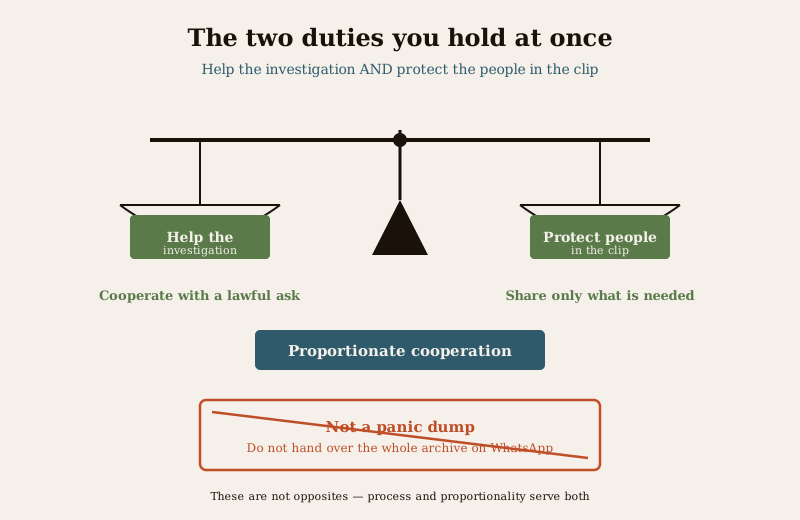
The two duties you are holding at once
It helps to name the tension honestly, because most bad decisions come from feeling only one side of it.
- The duty to cooperate. The police investigate real harm to real people. If your camera happened to see something relevant, that footage can be genuine evidence. Refusing or dodging a lawful request is not "protecting privacy" — it can obstruct an investigation and let someone down badly. Cooperation is the default posture.
- The duty to the people in your footage. Under the Digital Personal Data Protection Act, 2023, footage that identifies a person is personal data, and you are its custodian. That means you should share it for a clear, legitimate purpose, share no more than is genuinely needed, and not scatter people's images around casually. Handing your whole archive to settle one incident exposes dozens of uninvolved people for no reason.
These are not opposites. You can fully cooperate and be careful. The tools for doing both are proportionality and process — the same principles that run through the wider privacy hub and the CCTV privacy guide.
Step one — verify the request before you share anything
You cannot judge a request you have not understood. Before a single file leaves your hands, slow down and check the basics. This is not being obstructive; a genuine officer will not mind you getting it right, and verification protects you against the fraudster who pretends to be police to fish for footage.
- Who is asking? A real officer from a real station, identifiable, not just a voice on the phone or an unknown WhatsApp contact. It is reasonable to ask for a name, rank and station, and to call the station back on its own published number to confirm.
- Ask for it in writing. A written request — a note on station letterhead, an email, a formal slip referencing a complaint or FIR context — turns a vague ask into something you can act on and record. It is normal and courteous to say: "Happy to help, could you please put the request in writing so I have it on file?" A lawful investigation can accommodate that.
- What, exactly? A specific incident, a specific date and a specific time window, and which camera or view. "Everything you have" is a red flag, not a request you can act on responsibly.
- Be cautious of informal channels. A casual "just forward it to this number" carries real risk — you cannot verify the recipient, and the footage then lives on an unknown phone. Prefer a channel you can identify and record.
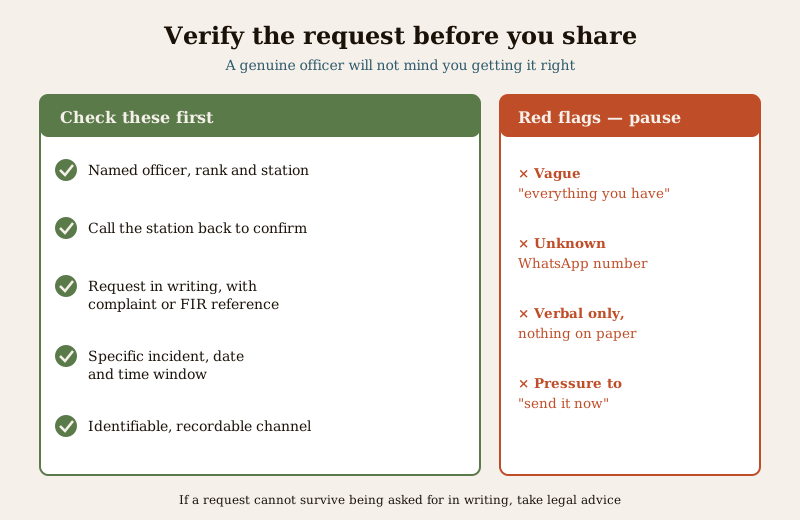
This is verification, not resistance. Asking who, what and in writing is exactly what a careful custodian should do, and a genuine investigator will expect it. If a request cannot survive being asked for in writing, that is precisely the moment to pause and take legal advice.
Step two — share proportionately, not everything
Once you are satisfied the request is genuine and lawful, give what helps — and only what helps. This is where the duty to the people in your footage does real work.
- Provide the specific clip. Export the relevant camera and the relevant time window around the incident, not your entire archive and not weeks of unrelated recording. If the incident was at a gate at a known hour, that camera and a sensible window around it is what to share.
- Do not hand over your whole system. Your NVR or hard drive holds footage of countless uninvolved people going about their lives. There is rarely any reason for all of that to leave your control to resolve one event.
- Mind the surrounding people. The relevant clip may still show neighbours or passers-by. That is usually unavoidable and acceptable when the clip genuinely bears on the incident — but it is another reason to keep the window tight rather than sprawling.
- Use a sensible format. A copy on a clean USB drive or a secure transfer you can identify is better than a forward to an unknown number. Label it plainly with the date, camera and time window.
The principle is the same minimisation test that governs everyday footage handling — see the footage sharing guide for the general version. A police request does not switch minimisation off; it just gives you a legitimate purpose for one narrow disclosure.
| Situation | Proportionate response | Avoid |
|---|---|---|
| Incident at your gate, known time | Export that camera, a tight window around it | Handing over the whole hard drive |
| Officer asks for "all footage you have" | Ask which incident, date and time; share that | Dumping the full archive to be safe |
| Request to forward to a personal phone | Ask for an identifiable, recordable channel | Casual WhatsApp to an unknown number |
| You are unsure the request is proper | Cooperate in principle, ask in writing, take advice | Refusing outright, or over-sharing in a panic |
Step three — keep the original, do not delete
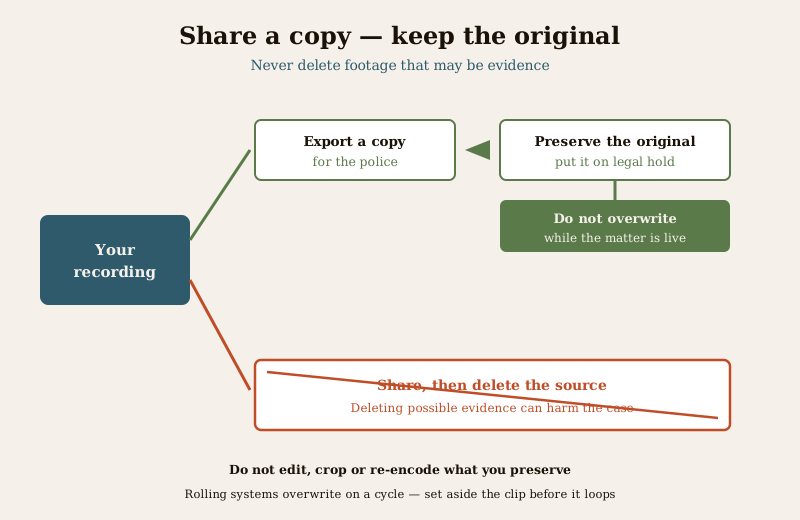
There is one mistake that can genuinely harm an investigation: sharing a clip and then wiping the source, or letting normal overwrite erase footage that might be evidence.
- Give a copy, keep the original. Export a copy for the police; leave the original recording untouched on your system.
- Preserve rather than delete. If footage may be evidence, adopt a preservation mindset — a "legal hold" — and do not let it be overwritten or cleared while a matter is live. Many systems overwrite on a rolling cycle, so preserving may mean actively exporting and setting aside the relevant recording before it loops.
- Do not tamper. Do not edit, crop for effect, re-encode or otherwise alter the footage you preserve. Its value depends on being an unaltered record.
How long you generally hold footage, and how overwrite cycles work, is covered in the footage retention guide — read it alongside this one, because a request often arrives close to the moment old footage would otherwise be gone.
Step four — keep a record of what you shared
Write it down. A short, honest log protects you, the investigation and the people in your footage, and it costs almost nothing.
- What you shared — which camera, which date, which time window.
- With whom — the officer's name, rank and station.
- When — the date you handed it over.
- Under what request — a reference to the written request, complaint or FIR context you were given, and how it reached you.
- How — the channel and format, for example a labelled USB handed over in person.
This record is your account of having behaved as a responsible custodian: you helped a lawful investigation, and you can show exactly what left your hands and why. It also matters if a question ever arises later about the footage. The same record-keeping discipline underpins the footage sharing guide and good privacy by design.
The RWA and small-business angle — decide who authorises release
For a home, the camera owner decides. For an RWA, an apartment complex or a small business, footage requests need a clear line of authority, or they end up being handled inconsistently by whoever is at the desk.
- Name a custodian. One accountable person or role — a designated committee member, a manager — through whom footage requests are handled, so a guard or receptionist is never left to decide alone.
- Have a short written policy. Who may authorise release, what verification is required, what gets shared, and that a record is kept every time. A page is enough.
- Brief the front line. Security staff should know that a request goes to the custodian, not straight to an export — and that "just send it over" is exactly the ask to escalate rather than fulfil.
- Coordinate, do not obstruct. The goal is a calm, documented handover to a verified, lawful request, not a wall. A clear policy makes cooperation faster, not slower.
For how footage handling connects to a broader plan for working with the police, see the police response integration guide.
Do and do not
| Do | Do not |
|---|---|
| Cooperate with a genuine, lawful request | Panic-dump your whole archive |
| Verify the officer, station and incident | Act on a vague or purely verbal ask |
| Ask for the request in writing | Forward footage to an unknown phone number |
| Share the specific relevant clip and window | Hand over the entire hard drive |
| Export a copy and keep the original intact | Delete or overwrite footage that may be evidence |
| Log what you shared, with whom and why | Edit, crop or re-encode the preserved footage |
| Route RWA requests through one custodian | Let a guard decide releases alone |
| Take legal advice when unsure | Assume you must obey any and every ask instantly |
When to get legal advice
Cooperating with a lawful request is normally straightforward, and you can generally do so while politely asking for it in writing. But some situations deserve a lawyer before you act:
- The request seems improper — vague, informal, pressuring, or from someone you cannot verify.
- You are genuinely unsure whether or how to comply, or how much to share.
- The matter carries real legal consequences — anything that might end up in court, a dispute involving a resident or employee, or footage you might one day rely on as evidence.
- A formal document is served that you do not understand.
A lawyer or, for an organisation, your data protection point of contact can tell you what a specific request actually requires and how to respond properly. Taking advice is not being uncooperative; it is how you cooperate correctly.
Legal and ethics caution (not legal advice). This guide describes a careful, cooperative way to handle a footage request; it does not state your legal obligations, which depend on your exact facts and the specific request. Nothing here is a definitive ruling, a procedure or a section of law. Cooperate with lawful requests, prefer them in writing, share proportionately, preserve the original, keep a record — and consult a qualified lawyer for anything with legal weight.
Key takeaways
- Hold both duties. Help a genuine investigation, and protect everyone in the clip. Proportionate cooperation beats both a panic dump and a stonewall.
- Verify first. Know who is asking, from which station, for which incident and window, and prefer the request in writing before you share.
- Share narrowly. Give the specific relevant clip, not your whole archive, and use an identifiable channel, not an unknown phone.
- Preserve the original. Give a copy, keep the source untouched, and do not let possible evidence be deleted or overwritten.
- Record it. Note what you shared, with whom, when and under what request.
- RWAs need a custodian and a one-page policy so releases are consistent and documented.
- Get legal advice whenever a request seems improper or carries real consequences — this is guidance, not legal advice.
References
- Digital Personal Data Protection Act, 2023 — footage that identifies a person is personal data; share it for a clear, legitimate purpose and no more than needed, and keep it secure. Verify the current text and rules before relying on it.
- General duty to cooperate with a lawful investigation — cooperation with genuine, verified police requests is the responsible default; the specifics depend on your facts, so seek qualified legal advice where it matters.
- Manufacturer and installer guidance — for how to export a specific clip, set a legal hold, and prevent overwrite on your recorder, follow your system documentation or ask a licensed installer.
This is an educational overview, not legal advice. Whether and how you must respond to a specific police request depends on your exact facts — cooperate with lawful requests, share proportionately, preserve originals, keep records, and consult a qualified lawyer for anything with legal weight.
Export this guide
Related Guides — Deep-dive reading
CCTV Footage Retention in India (2026): How Long to Keep It, and When to Delete
Footage of identifiable people is personal data, and the honest answer to how long to keep it is almost never forever. Here is how to set a sensible retention window for a home, an RWA or a small office, delete on schedule, and preserve only what a real incident needs.
SecurityCCTV Recording Failure in India (2026): Live View Works but Nothing Was Saved
You open the recorder to pull footage of an incident and there is nothing there, even though every camera shows a crisp live picture. A calm, ordered guide to why an Indian CCTV system records live but saves nothing, and how to fix it before the next incident.
SecuritySmart Security Privacy in India: The System That Watches You More Than Any Burglar
A smart security system spends every hour of every day watching your family, your staff and your routines — and that footage and data, not a burglar, is the long-term risk most buyers never think about. Where cameras belong and where they must never go, where your video actually goes, what a smart home learns about you, your rights under the DPDP Act 2023, and the honest practice for keeping it all yours.
SecurityRelated Tools — Try Free
CCTV Camera Coverage & Count Calculator
Estimate how many CCTV cameras you need, the NVR channels, storage in TB for your retention period, and an indicative all-in cost with GST.
CCTV CalculatorPrivacy Audit Tool
Is your CCTV setup privacy-respecting? Tick what is true — signage, no bedroom or bathroom cameras, masked public views, restricted access, limited retention, consent, secured storage, a lawful purpose — for a DPDP-aligned privacy score and the gaps to close. Indicative, not legal advice.
Privacy ScoreAI Privacy Compliance Assistant
Make your CCTV and security setup privacy-respecting and DPDP-Act-2023-aligned — signage, a clear purpose, no cameras in private spaces, masking, limited retention and restricted access, with extra care for domestic workers and children. Guidance, not legal advice; a DPO or lawyer advises.
AI Tool