
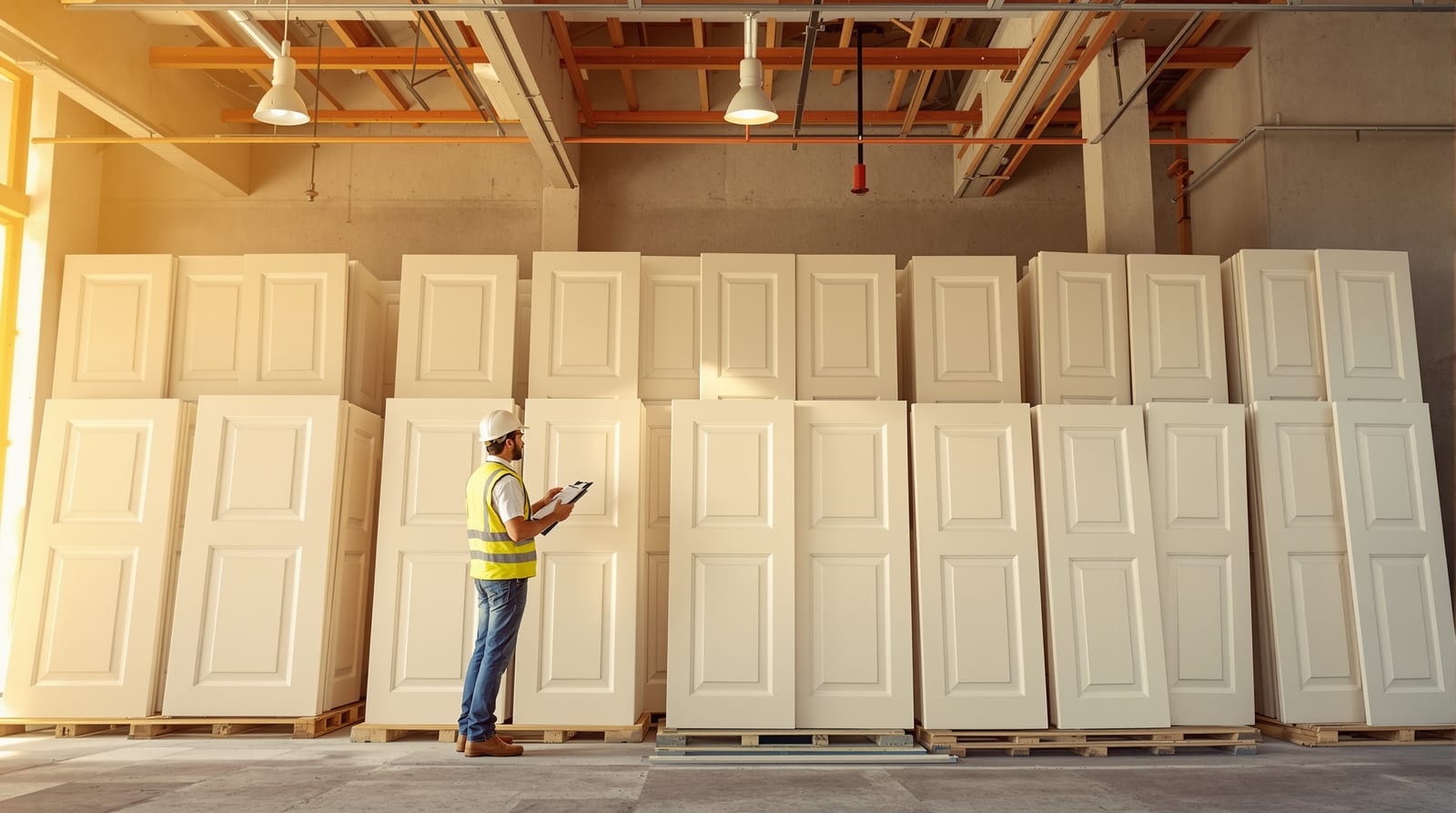
Bulk Door Buying for Builders & Contractors India 2026
How developers and contractors cut door costs 15-30% through volume tiers, direct manufacturer deals, GST input credit and staged delivery.
For a residential project, doors are rarely a headline cost line, yet they quietly consume lakhs and create endless coordination headaches. Done well, bulk door buying for builders turns a fragmented, retail-priced scatter of orders into a single negotiated contract that lands 15-30% below showroom rates, arrives on a delivery schedule that matches your finishing stages, and carries one accountable warranty. This guide is the procurement playbook: how volume discounting actually works in India, when to deal direct with manufacturers versus dealers, how to standardise a door schedule across a project, and how to use GST input credit, staged delivery and payment terms to protect both your margin and your timeline.
Throughout, prices are supply-only for a standard 7x3 ft (2.1 x 0.9 m) leaf before fitting, before the city multiplier, and before 18% GST. Treat every figure as an indicative range, not a quote — your final number depends on volume, spec, city and timing. Benchmark everything against the master 2026 door cost guide and adjust for location using door cost by city.
Why buying in bulk changes the price
At retail, you pay for a showroom, a salesperson, dealer margin, small-lot handling and transport on a single door. Buy 200 identical doors and most of that overhead spreads thin or disappears. A manufacturer would rather press one continuous run of one specification than retool repeatedly, so standardisation is itself a discount lever. The savings come from three places stacked together: lower per-unit price, better payment terms (which is real money at today's interest rates), and lower coordination cost because you are managing one supplier, not fifteen.
The trade-off is commitment. Volume pricing assumes you actually take the volume, on agreed dates, and pay on agreed terms. Walk into that without a firm door schedule and you will either over-order or trigger reorders at retail rates — wiping out the discount.
Volume discount tiers (indicative)
Discounts are quoted off list/MRP and vary by product, region and how hungry the manufacturer is that quarter. As a rule of thumb for flush and engineered doors:
| Order volume (leaves) | Typical discount off list | Who you deal with | Per-leaf example: solid-core flush (₹) |
|---|---|---|---|
| 1-10 (retail) | 0-8% | Showroom / retailer | 3,000-5,500 |
| 25-75 | 10-15% | Authorised dealer | 2,700-4,700 |
| 100-300 | 15-22% | Dealer + factory rate | 2,400-4,300 |
| 300-1,000 | 20-28% | Direct from manufacturer | 2,200-4,000 |
| 1,000+ (project tie-up) | 25-35%+ | Plant / OEM contract | negotiated |
These are flush-door numbers; commodity hollow-core doors discount harder, while premium teak and designer main doors discount far less because the material cost dominates. Use the bulk door order estimator to model a tier against your actual leaf count and spec before you negotiate.
Project pricing vs retail: where the money is
| Cost element | Retail (per door) | Bulk project rate | Notes |
|---|---|---|---|
| Door leaf (solid-core flush) | ₹4,000 | ₹3,200-3,500 | Volume + standardisation |
| Frame (sal, per door) | ₹2,000-3,500 | ₹1,800-2,800 | Bundle with leaf |
| Hardware set (basic) | ₹1,200-2,500 | ₹900-1,800 | Single hardware brand across project |
| Installation (per door) | ₹1,000-2,500 | ₹800-1,500 | Repeat-work labour rate |
| Transport | per-trip retail | folded into contract | Staged loads |
For a 100-flat tower at roughly 12 doors per 3BHK flat, that is ~1,200 leaves. A ₹600-800 saving per fully-fitted door is ₹7-10 lakh on doors alone — before the cash-flow benefit of credit terms. That is why door procurement deserves a real RFQ, not a quick WhatsApp to one dealer.
Direct from manufacturer vs dealer
Going direct to a plant (CenturyPly / Century Doors, Greenpanel, Greenply, Action Tesa, Alstone, Duroply and similar all run project desks) gets the keenest per-unit price and a documented warranty in the project's name. But the manufacturer expects volume, a clean PO, and often a minimum order quantity per SKU. You also own logistics and snag coordination.
A strong authorised dealer or distributor sits between you and the plant: slightly higher unit price, but they hold local stock, handle replacements quickly, extend you credit, and absorb the pain of split deliveries. For uPVC (Fenesta, Weatherseal, Aparna Venster, Encraft, Prominance), the manufacturer's own project team usually handles supply-and-install as a package, so "direct" and "dealer" blur. The honest answer: go direct above ~500 leaves on a standard SKU; use a committed distributor below that or where you need single-window accountability. Compare options in the door dealers & distributors guide and where to buy doors in India.
Standardising the door schedule
The single biggest lever — bigger than negotiation — is reducing the number of distinct door types. Every extra SKU shrinks the volume per line, weakens your discount, and multiplies snag risk.
A clean project schedule typically collapses to three or four lines: a main/entrance door, a standard internal flush door, a moisture-resistant bathroom door (WPC or PVC), and sometimes a utility/service door. Fix the sizes to standard door dimensions so frames, leaves and hardware are interchangeable across blocks. Lock the hardware to one brand and finish for the whole project — it slashes spares inventory and gives one warranty contact. Build the per-unit and per-SKU totals with the door cost calculator.
Logistics and staged delivery
Doors are bulky, prone to warping and edge damage, and you do not want 1,200 leaves arriving before your masonry openings are ready. Negotiate staged delivery tied to your construction sequence — typically block-wise or floor-wise — with the price locked at PO and call-offs against it. Key clauses to insist on:
- Blanket PO, phased call-offs: one negotiated rate, releases by date.
- Storage and damage liability: doors stored flat, off the floor, covered; damage-in-transit on the supplier until signed receipt.
- Acclimatisation: leaves delivered 48-72 hours before fitting so they stabilise to site humidity, critical in coastal and high-humidity zones — see the coastal-region door buying guide.
- Replacement SLA: defined turnaround for rejected leaves so a few bad doors do not stall a whole floor.
GST input credit on bulk doors
GST on wooden/flush doors is 18% (HSN 4418); uPVC and PVC doors fall under HSN 3925, also 18%. For a registered builder or contractor, that GST is generally available as input tax credit (ITC) against output GST — which makes the headline 18% a cash-flow timing issue, not a sunk cost, provided you buy on a proper tax invoice with your GSTIN.
Two disciplines protect the credit: insist on a compliant tax invoice (HSN, GSTIN, rate shown separately) for every call-off, and confirm the supplier actually files so the credit reflects in your returns. Note that for residential projects under the concessional GST scheme, ITC rules differ — check with your tax adviser before assuming full credit. The deeper mechanics are in the door GST & HSN guide, and you can split out the tax on any quote with the door GST calculator. A vague "all-inclusive" quote with no GST breakup is a red flag: it usually hides the rate and can cost you the credit.
Payment terms — the silent discount
| Term | Typical structure | Who it suits |
|---|---|---|
| Advance against PO | 30-50% advance, balance on delivery | New supplier, custom SKUs |
| Credit on delivery | Net 30-60 days, blanket PO | Established builder, good track record |
| Linked to call-offs | Pay per phased dispatch | Long projects, cash-flow control |
| Retention | 5-10% held till snag-free sign-off | Quality protection on large orders |
Genuine credit terms are worth real money — 45-60 days of float on a ₹50-80 lakh door order is a meaningful interest saving. A 5-10% retention until snag-free handover is the cleanest quality lever you have, far more effective than a warranty you may never enforce. If you need to spread payments differently, the door EMI & financing guide covers project-finance routes.
Quality consistency at scale
The risk in volume is that batch two does not match batch one — different veneer lot, thinner core, off-shade laminate. Protect yourself with: an approved sample/first-article signed by both parties and sealed as the reference; batch/lot stamping so you can trace any defective run; a documented rejection criterion (warp tolerance, edge-banding, ironmongery prep); and a small random inspection at each delivery rather than only at handover. For the technical baseline of what "good" looks like, see residential door standards in India and how to choose doors.
Warranty for projects
Project warranties differ from retail. Get the warranty issued in the project/firm's name, not a homeowner's, with the coverage period, what is covered (delamination, warping, borer for solid wood, hardware function), exclusions (water-logging, site mishandling), and a named service contact in writing. Broadly, flush and engineered doors carry warranties in the region of a few years; WPC and uPVC often longer against rot and termites; hardware varies by brand. Don't accept verbal assurances — tie it to the PO. The door warranty guide and door after-sales service guide cover what to negotiate and how to enforce it.
A practical bulk-buying checklist
1. Finalise the door schedule and collapse it to the fewest SKUs and standard sizes.
2. Issue a clear RFQ with quantities, specs, sizes, finish and delivery phasing.
3. Get 3+ quotes — direct manufacturer and committed distributor — on identical scope.
4. Negotiate tier price, payment terms and retention together, not separately — see negotiating door prices.
5. Lock the first-article sample, batch stamping and rejection criteria.
6. Sign a blanket PO with phased call-offs and staged delivery dates.
7. Demand a GST-compliant tax invoice per call-off to protect ITC.
8. Get the warranty in the firm's name with a named service contact.
Avoid the classic traps catalogued in common door buying mistakes — over-ordering, ignoring acclimatisation, accepting all-inclusive quotes, and skipping the retention clause.
Frequently asked questions
How many doors do I need to order to get a real bulk discount?
Meaningful project pricing usually starts around 25-75 leaves with a good dealer, and deepens past 100. Below ~500 leaves a committed distributor often beats going direct; above that, a manufacturer's project desk gives the best per-unit rate. Standardising your SKUs matters as much as raw quantity.
Is it always cheaper to buy direct from the manufacturer?
Not always. Direct gives the lowest unit price but you own logistics, storage and snag coordination, and there's usually a minimum order per SKU. A strong distributor charges slightly more but holds stock, replaces fast and extends credit. For standard SKUs above ~500 leaves, direct typically wins; otherwise the single-window dealer route is often the better total deal.
Can a builder claim GST input credit on bulk doors?
Generally yes — doors attract 18% GST and a GST-registered builder can usually claim it as input tax credit against output GST, provided you buy on a compliant tax invoice carrying your GSTIN and the supplier files correctly. Concessional-rate residential projects have different ITC rules, so confirm your specific case with a tax adviser.
How do I keep quality consistent across a large order?
Approve and seal a first-article sample as the reference, require batch/lot stamping for traceability, set written rejection tolerances (warp, edge-banding, finish shade), and inspect a random sample at every delivery. Hold a 5-10% retention until snag-free sign-off — it's the strongest practical quality lever.
What payment terms should I push for on a project order?
Aim for a blanket PO with phased call-offs and net 30-60 day credit, plus a 5-10% retention until handover. The credit float on a large order is a genuine saving at current interest rates, and the retention protects you far better than chasing a warranty later.
How should doors be delivered on a multi-block project?
Use staged, block- or floor-wise delivery tied to your construction sequence, with the price locked at PO. Insist leaves arrive 48-72 hours before fitting to acclimatise, are stored flat and covered, and that transit damage stays with the supplier until signed receipt — especially important in humid and coastal regions.
Export this guide
Related Guides — Deep-dive reading
Negotiating Door Prices in India: A Buyer's Guide 2026
Where door-price margin actually hides, how much discount is realistic by channel, and the tactics that work without compromising quality.
Home Doors & EntrancesDoor GST HSN India 2026: Codes, Rates, Invoice & Tax Guide
GST on doors is 18% across wood, uPVC and metal — here is the HSN code for every door type and why you must insist on a proper tax invoice.
Home Doors & EntrancesDoor Delivery & Storage on Site: A Fitter's Guide (India 2026)
Receive, check and store doors flat, dry and acclimatised on an Indian site so leaves never warp, swell or arrive damaged before fitting.
Home Doors & EntrancesRelated Tools — Try Free
Door Cost Calculator
Estimate the all-in cost of a door — leaf, frame, hardware, fitting and GST — by type, material and size.
Door CalculatorInterior Contract Clause Checklist
16 sections and 98 checkboxes covering scope, BOQ, milestones, penalties, warranty, and disputes.
Contract ChecklistWindow Hardware Cost Calculator
Estimate window hardware cost — hinges, handles, locks, rollers and multipoint gears.
Window Calculator