
Broken Key in Lock: How to Remove It Safely (India 2026)
Snapped a key off inside your door lock? Calm DIY extraction methods, the tools you need, and exactly when to call a locksmith.
A broken key in lock is one of those small disasters that feels enormous at the doorstep, usually at the worst possible time: late at night, in the monsoon, with arms full of shopping. The good news is that a snapped key very often comes out with patience and a couple of household tools, and the lock itself is usually fine. The bad news is that panic and force are exactly what turn a five-minute fix into a replaced lock body. This guide walks you through calm, step-by-step extraction methods, the tools that actually work in Indian homes, and the honest moment when you should stop and ring a locksmith.
Difficulty: easy to moderate. Time: 5-30 minutes for most extractions. First rule: do not insert another key or turn anything hard until the stub is out.
Why keys break (and why it matters before you pull)
Keys rarely snap out of nowhere. The usual culprits in India are a worn, thinning key (especially soft duplicate keys cut from cheap blanks), a stiff or rusty cylinder, hard-water and dust grime inside the keyway, or a door that has swollen in the monsoon so the bolt binds and you twist harder to compensate. Understanding the cause matters because the position of the cylinder when the key broke decides how easily the stub will slide out.
The critical thing: a lock plug only releases a key when it is rotated back to the neutral (vertical, fully-home) position. If your key broke mid-turn, the stub may be wedged because the plug is rotated. Before pulling, gently nudge the cylinder back towards the position where a key normally goes in and out. Never force it, but get it as close to neutral as you can.
Lubricate first, always
Nine out of ten failed extractions are dry extractions. A short squirt of a dry lubricant down the keyway dramatically improves your odds and protects the pins. Use a graphite-based lock lubricant or a silicone spray. Avoid thick oils and avoid WD-40 as a long-term fix; it attracts dust, though a tiny amount to free a stub in an emergency is acceptable. Give it a minute to creep in before you pull.
Tools and materials you'll need
Most of these are already in an Indian household drawer; the rest cost very little.
| Tool / material | Use | Indicative cost (₹) |
|---|---|---|
| Needle-nose (long-nose) pliers | Grip a protruding stub | 150-500 |
| Tweezers (fine, pointed) | Grip a slightly recessed stub | 50-200 |
| Two paperclips or hairpins / bobby pins | Hook behind the key teeth | 10-50 |
| Jigsaw / coping-saw / hacksaw blade (fine-tooth) | DIY key-extractor substitute | 50-150 |
| Proper broken-key extractor set | Best dedicated tool | 200-700 |
| Graphite or silicone lock spray | Lubricate the keyway | 100-300 |
| Superglue (cyanoacrylate) + matchstick | Last-resort stub trick (with caution) | 30-80 |
| Small flat screwdriver / pin | Nudge plug to neutral | 50-200 |
Step-by-step: removing a broken key in lock cylinders
Work in good light. A phone torch held by a helper is worth a lot here.
1. Stop and assess. Do not insert anything else into the lock yet. Look at how much of the key, if any, is sticking out. The more that protrudes, the easier this will be.
2. Get the cylinder to neutral. Gently rotate the plug back to the vertical, key-in position. If a sliver of stub shows, you can grip and turn it with pliers to align it. Easy does it.
3. Lubricate. Spray a short burst of graphite or silicone lube into the keyway. Wait about a minute.
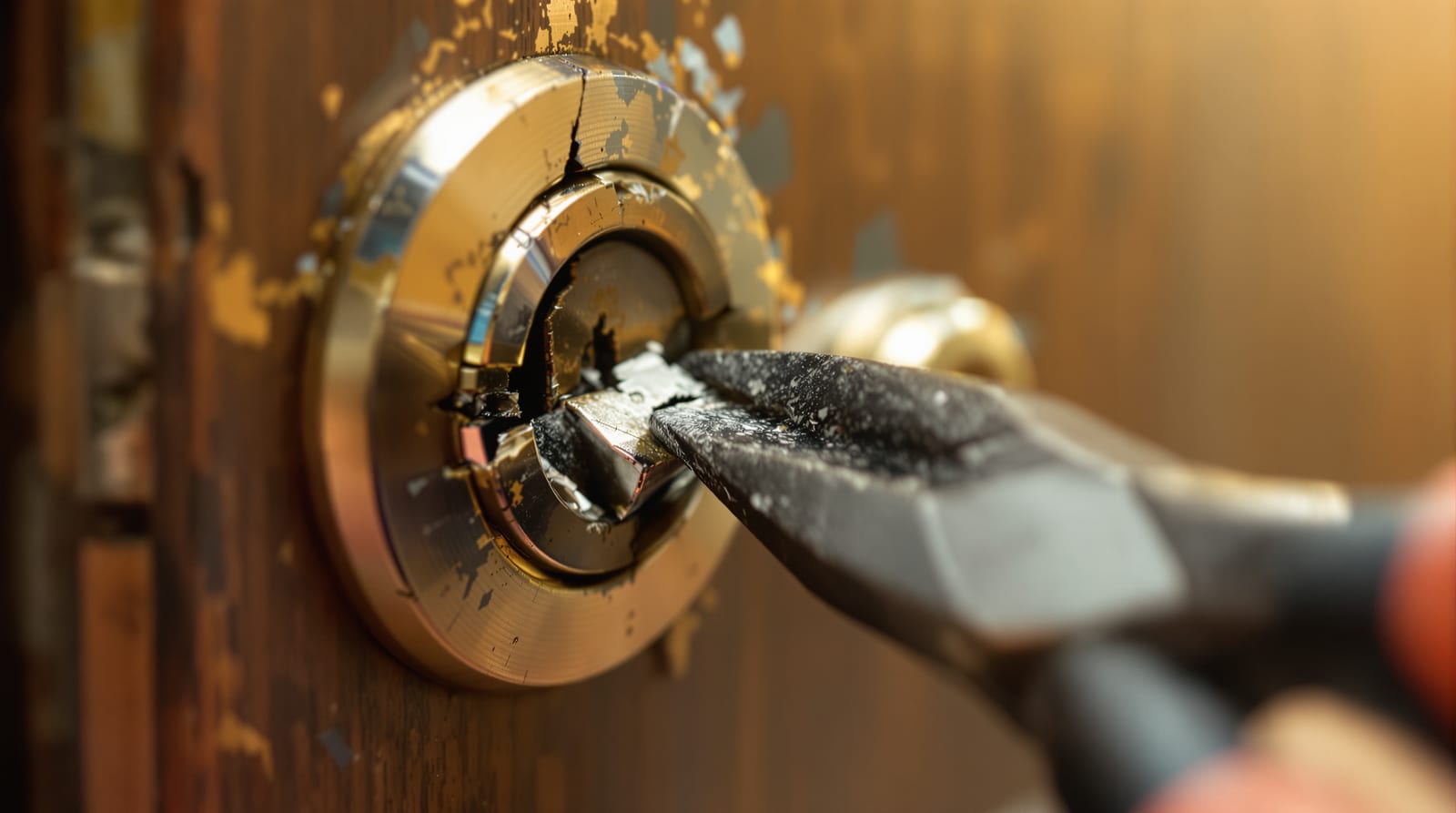
4. If the stub protrudes — pliers method. Grip the protruding end firmly with needle-nose pliers, keep the plug at neutral, and pull straight out with steady pressure. Do not wiggle side to side; keys are flat and snap further if flexed. Pull, don't yank.
5. If the stub is flush or slightly recessed — saw-blade method. Take a fine-tooth jigsaw, coping-saw or hacksaw blade. Slide it into the keyway alongside the broken key, teeth facing the key, hook the teeth into the cut grooves of the key, and pull both out together. Slim blades work; thick ones won't fit.
6. Two-pin / paperclip method. Straighten two paperclips or hairpins. Slide one down each side of the key blade, hook the tips behind the nearest tooth, and draw the key out evenly with both. This needs a little patience but works surprisingly well on pin-tumbler cylinders.
7. Dedicated extractor. If you have a broken-key extractor set, insert the barbed tool along the key, twist gently to bite, and withdraw. This is the cleanest method and worth keeping in the toolbox if it has happened once.
8. Superglue trick — last resort, with real caution. Only if a flat stub end is visible at the mouth of the keyway and nothing protrudes inward to grab. Put a tiny dab of superglue on the end of a matchstick or thin metal pin, touch it to the exposed broken end (not the surrounding lock), hold perfectly still for 30-60 seconds, then pull straight out. Risk: glue can bond the key to the pins and ruin the cylinder. Use a pinhead-sized amount, keep it off the lock face, and only try this when other methods have failed.
9. Test the lock. Once the stub is out, spray a little more lubricant, insert your spare key, and operate the lock a few times. If it turns smoothly, you're done.
Symptom, cause and fix at a glance
| Symptom | Likely cause | First fix to try |
|---|---|---|
| Stub sticking out of keyway | Clean snap, plug near neutral | Pliers, straight pull |
| Stub flush with lock face | Broke deep inside | Saw-blade or two-pin method |
| Stub won't budge at all | Plug rotated off neutral | Nudge plug to vertical, lubricate, retry |
| Key keeps breaking | Worn/soft duplicate key | Cut a fresh key from original; stop using worn one |
| Lock stiff even with spare | Rust, hard-water grime inside | Graphite lube; if still stiff, service the lock |
| Stub out but lock now jammed | Bent pin / damaged plug | Call a locksmith — internal repair |
DIY difficulty and what it costs
| Method | Difficulty | Typical time | Cost |
|---|---|---|---|
| Pliers (protruding stub) | Easy | 2-5 min | ₹0 if you own pliers |
| Saw-blade / paperclip | Moderate | 10-20 min | ₹10-150 for the blade |
| Dedicated extractor set | Easy-moderate | 5-10 min | ₹200-700 (one-time) |
| Superglue trick | Moderate (risky) | 10-15 min | ₹30-80 |
| Locksmith call-out | Pro | 15-45 min | ₹300-800 visit + parts |
| New cut key | n/a | same day | ₹40-200 per key |
Add 18% GST on goods. If the cylinder is damaged during a failed extraction, a replacement pin/cylinder lock runs ₹300-1,500 and a mortise lock body ₹800-4,000, plus locksmith labour.
When to stop and call a locksmith
DIY has a sensible limit. Call a professional locksmith if:
- The stub is deep, you cannot grip it, and two or three attempts have failed. Repeated probing can bend the pins.
- The lock is a high-security, smart, or branded cylinder you don't want to risk damaging. For electronic or motorised locks, isolate power first and treat them as a pro job.
- After extraction the lock no longer turns smoothly with a good key, which suggests internal damage.
- The key broke because the bolt was binding against a swollen or misaligned door, not because the key was weak. That's a door problem, not just a key problem.
A locksmith visit in India typically costs ₹300-800 plus parts, far less than the ₹800-4,000 of replacing a damaged mortise lock you've forced.
Preventing the next broken key
- Retire worn keys. If a key is thin, bent, or you've been jiggling it to make it work, get a fresh one cut from the original before it snaps.
- Cut keys from good blanks. Cheap, soft duplicate keys are the single biggest cause of breakage. Pay a little more for a quality blank.
- Lubricate twice a year. A puff of graphite or silicone into each lock, especially before and after the monsoon when humidity and hard-water grime build up, keeps cylinders free so you never have to force the turn.
- Fix binding doors. If you turn the key hard because the bolt is fighting a swollen door, sort the door. See our notes on a door not latching and aligning the strike plate.
- Keep a spare off-site. A spare with a trusted neighbour or family member saves a costly emergency call-out when a key does fail.
Getting a replacement key cut
Once the stub is out, take your remaining original key (not a copy of a copy) to a key-cutting shop or hardware store. A standard key costs roughly ₹40-200 depending on the blank. If you've lost all keys, a locksmith can decode the lock or, for security, rekey or replace the cylinder. For higher security going forward, you might consider upgrading; see smart door locks and the broader door security guide.
For related lock faults, our door lock repair and fix a stuck door lock guides go deeper, and if the cylinder itself is worn out, see door lock replacement. For the bigger picture, start at the complete door guide or the door troubleshooting hub. Not sure whether it's the key or the lock? Our door problem diagnoser and door repair cost estimator can help you decide and budget.
Frequently asked questions
Can I really get a broken key out with two paperclips?
Yes, surprisingly often on standard pin-tumbler cylinders. Straighten two paperclips or hairpins, slide one down each side of the broken blade, hook the tips behind a key tooth, and draw it out evenly. Lubricate the keyway first and pull straight, never sideways.
Will the superglue trick damage my lock?
It can, which is why it's a last resort. If glue seeps past the broken end onto the pins, it can bond the mechanism and ruin the cylinder. Use a pinhead-sized dab on a matchstick, keep it off the lock face, and only attempt it when the stub is visible at the mouth and other methods have failed.
Why does my key keep breaking in the same lock?
Usually a worn, soft duplicate key combined with a stiff cylinder. Hard water and dust grime, common across Indian cities, make plugs sticky, so you turn harder and the weakest key gives way. Cut a fresh key from the original and lubricate the lock with graphite.
The stub came out but now the lock won't turn. What happened?
Probing may have nudged or bent a pin, or the plug was forced off neutral. Try a little graphite lubricant and gentle operation. If it still won't turn smoothly, stop forcing it and call a locksmith before you damage the lock body further.
How much does a locksmith charge to remove a broken key in India?
A typical call-out is ₹300-800 in most cities, with metros at the higher end and tier-2 towns cheaper. That usually covers extraction and basic lubrication; a new cut key adds ₹40-200, and any cylinder or mortise lock replacement is extra.
Should I keep using the lock after a key snaps in it?
If, after extraction, a good key turns smoothly and the bolt throws cleanly, the lock is fine to keep using. If it feels gritty, sticky, or stiff, service or replace the cylinder. And replace any worn key that contributed to the break so it doesn't happen again.
Export this guide
Related Guides — Deep-dive reading
Door Lock Repair: Fix Stiff & Sticky Locks (India 2026)
A stiff, sticky or hard-to-turn lock is usually a clean, lubricate and realign job, not a replacement. Here is the full DIY fix-it guide.
Home Doors & EntrancesDoor Repair Guide India: Fix Holes, Dents, Swelling, Hinges & Locks (2026)
A fix-it reference for Indian homes: every common door problem with a quick fix, a proper repair, a replace verdict, the materials needed, and indicative rupee costs.
Home Doors & EntrancesDoor Troubleshooting Guide: Fix Any Door Fault (India 2026)
Symptom to cause to fix for every common door problem in Indian homes, with difficulty, time, cost and when to call a carpenter.
Home Doors & EntrancesRelated Tools — Try Free
Door Problem Diagnoser
Tell us the symptom and get the likely cause, the fix, DIY difficulty and indicative cost for any door fault.
Diagnostic ToolDoor Hardware Cost Estimator
Estimate the all-in hardware cost for a door — hinges, lock, handle, closer, bolts, stopper and fitting — with GST.
Door CalculatorDoor Lock Selector
Answer a few questions and get the right lock type — mortise, multipoint, deadbolt, privacy or smart — for any door.
Door Tool