
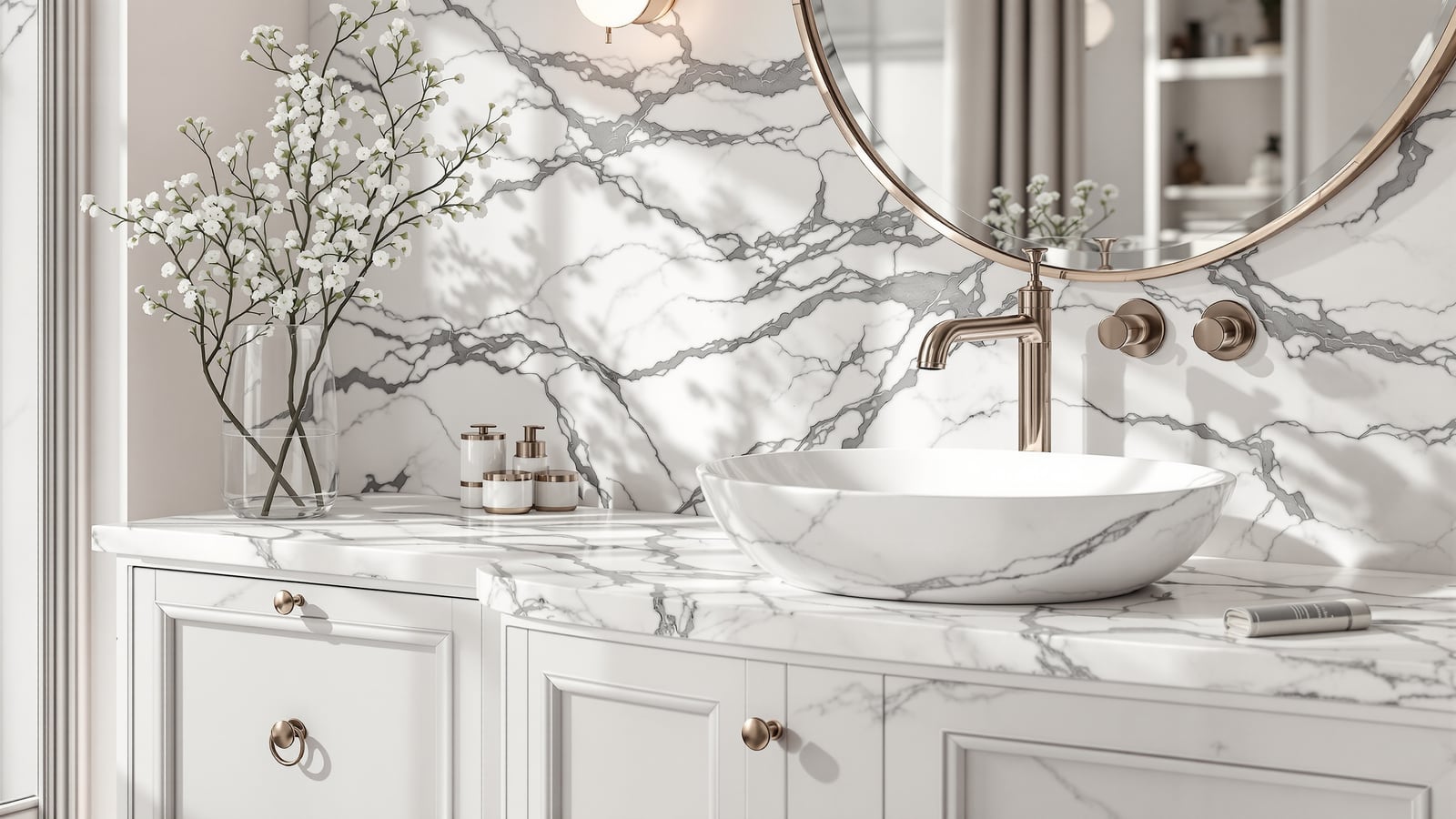
Marble Bathroom India: Countertops, Vanity Tops, Cladding & Floors — Beauty vs Maintenance
An honest, India-first guide to using marble in the bathroom — Makrana, Italian Carrara and Statuario on countertops, vanity tops, walls and floors. The luxury look, but also the real downsides: staining, etching, hard-water dulling, sealing regimes, honed vs polished, where to use it and where to avoid it, plus ₹ costs.
Nothing signals a luxury bathroom quite like marble. A slab of white Statuario behind the vanity, a Carrara counter under a countertop basin, a marble-clad shower niche — these are the images that fill design magazines and hotel suites. Marble is genuinely beautiful: every slab is unique, the veining reads as natural art, and it ages into a soft patina that manufactured surfaces cannot fake. India is also a marble superpower, with Makrana (the stone of the Taj Mahal) quarried in Rajasthan and Italian slabs imported through every major city, so the material is more attainable here than the price of the look suggests.
But marble in a bathroom is a commitment, not a default. It is porous, it stains, it etches on contact with acids, it is softer than granite, and India's hard water dulls its polish within months if you neglect it. This guide is the honest version: where marble earns its place, where it will make you miserable, and exactly how to seal and live with it. It sits in the Studio Matrx bathroom hub — read it alongside the bathroom vanity guide for the cabinet it usually sits on, the granite bathroom countertop guide for the tougher alternative, the bathroom stone cladding guide for marble on the walls, and the luxury bathroom design guide for how it fits a premium scheme.
Marble rewards the disciplined and punishes the casual. Choose it for the veining, but only if you will honestly seal it, dry it, and keep acids away from it. If you will not, choose granite or a marble-look porcelain and sleep easy.
Why marble, and which marble
Marble is metamorphosed limestone — calcium carbonate recrystallised under heat and pressure. That chemistry is the whole story: the same softness that lets it take a mirror polish also makes it porous and acid-sensitive. Before you decide where to use it, know what you are buying.
| Marble | Origin | Look | Character in a bathroom | Indicative ₹/sq ft (supplied) |
|---|---|---|---|---|
| Makrana | Rajasthan | Warm white, subtle veins | Classic, dense for a marble, ages beautifully | ₹120–400 |
| Indian white / Ambaji | Gujarat/Raj. | Bright white, grey veins | Affordable Statuario substitute | ₹90–300 |
| Carrara (Italian) | Italy | Soft white, feathery grey | The everyday luxury white | ₹250–700 |
| Statuario (Italian) | Italy | Bright white, bold grey veins | The showpiece; most premium | ₹500–1,800+ |
| Botticino / beige | Italy | Warm cream, fine grain | Forgiving — hides water spots | ₹200–600 |
| Green / Indian marbles | Rajasthan | Deep green, dramatic | Bold, but soft and streaky | ₹80–350 |
Add fabrication (cutting, edge polishing, cut-outs for the basin and tap) at roughly ₹150–500/sq ft, plus fixing. A single vanity top in imported Statuario, supplied and installed, realistically lands between ₹8,000 and ₹30,000+ depending on size and edge detail. Beige and Makrana are the value-and-forgiveness picks; Statuario is the splurge that shows every water mark.
Where marble belongs in the bathroom — and where it does not
The single most important decision is not which marble but where you put it. Exposure to water, acids and abrasion rises as you move from the dry wall to the shower floor.
- Vanity top / countertop — good, with care. A vanity top is marble's best bathroom home: mostly dry, wiped daily, away from the shower jet. Beware the two enemies that live here — cosmetics (perfume, nail polish remover, acidic toners, hair dye) and toiletries (oils that stain). Seal it well and wipe spills immediately.
- Feature wall / cladding — excellent. A dry marble feature wall behind the vanity is where book-matched Statuario earns its keep with almost no water exposure. See the stone cladding guide.
- Bathroom floor (dry zone) — good if honed. Marble underfoot is cool and luxurious, but polished marble is dangerously slippery when wet. Use a honed finish, and keep it to the dry zone away from the shower.
- Shower walls — only in dense stone, sealed hard. Constant hard-water spray dulls polish and etches soft marble. If you must, use a honed dense marble or, better, granite/quartzite here.
- Shower floor — avoid. Standing water, soap, and slip risk make marble a poor shower-floor choice. Choose anti-skid porcelain or stone instead.
- Around the WC / health-faucet splash zone — avoid. The jet spray plus acidic cleaners is the worst possible combination for calcareous stone.
The honest downsides you must plan for
Salespeople sell the veining; they rarely mention the four ways marble disappoints. Understand each before you commit.
- Porous — it stains. Marble drinks up oils, cosmetics, coffee, wine, hair dye and rust from a wet steel can left on the counter. A stain that soaks in is far harder to remove than a surface mark and may need a poultice to draw it out.
- Etches with acids. This is the one that surprises people. Acids — lemon, vinegar, toilet cleaner, lime descaler, even acidic toner or perfume — chemically eat the calcium carbonate, leaving a dull, slightly rough matte spot the sealer cannot prevent. Sealer stops staining; only avoidance stops etching.
- Hard-water dulling. India's calcium- and magnesium-rich water leaves chalky scale and, over months, dulls a polished surface into a hazy grey. Undried droplets are the culprit.
- Softer than granite. Marble scratches and chips more easily; a dropped bottle or dragged ceramic can leave a mark. Its Mohs hardness (~3) is well below granite (~6–7).
| Property | Marble | Granite |
|---|---|---|
| Hardness (Mohs) | ~3 (soft) | ~6–7 (hard) |
| Porosity | Medium–high | Low |
| Acid resistance | Poor — etches | Good |
| Stain resistance | Poor unless sealed | Good |
| Look | Soft veining, unique | Speckled, uniform |
| Sealing frequency | Every 6–18 months | Every 2–4 years |
| Best bathroom use | Dry vanity, walls, dry floor | Countertops, wet zones |
If that table makes you nervous, that is the point. Read the granite countertop guide — for a busy family bathroom, granite or marble-look porcelain is often the wiser choice, and no one will know from across the room.
Finish matters: honed vs polished
The same slab behaves very differently depending on how it is finished, and the choice is as important as the stone.
- Polished — a glossy, reflective surface that shows off veining and depth. It is the classic luxury look, but it is slippery when wet and shows every etch mark, water spot and scratch as a dull patch against the shine.
- Honed — a smooth matte finish with no gloss. It is far less slippery (essential for any marble floor), hides etching and water spots because there is no shine to disturb, and feels softer underfoot. The trade-off is that a honed surface is slightly more open and needs diligent sealing.
For an Indian bathroom the practical guidance is simple: honed for anything you walk on or that gets wet; polished only for dry vertical feature walls where the drama matters and the risk is low. A honed vanity top is more forgiving day to day than a polished one.
The sealing regime and daily care
Sealing is what makes marble survivable. A penetrating (impregnating) sealer soaks into the pores and repels liquids so spills sit on the surface long enough to wipe away. Note the limit clearly: sealer resists staining, but it does not stop etching — an acid will still dull the surface. Avoidance is the only defence against etching.
- Seal before fixing, and again on install. Coat all six faces and edges before the stone goes up, then a top coat after installation. Use a breathable impregnator, never a film-forming lacquer that clouds and peels in a wet room.
- Re-seal on the water-drop test. Every 6–18 months for a vanity top; when water stops beading, re-seal. Honed and heavily used surfaces need it more often.
- Clean with pH-neutral stone cleaner only. Never vinegar, lemon, CIF, hard-water descaler or acidic toilet cleaner on marble — they etch on contact.
- Wipe spills immediately. Cosmetics, oils, coffee and dye stain fast. Keep a soft cloth in the vanity.
- Squeegee and dry wet marble. Standing hard-water droplets are what dull the polish — dry them and the finish lasts.
- Use trays and coasters. Stand perfume, nail-polish remover and metal cans on a tray, not directly on the stone.
| Do | Don't |
|---|---|
| Seal all faces before fixing | Use acidic cleaners, ever |
| Choose honed for floors and wet areas | Put polished marble on a wet floor |
| Wipe spills and dry droplets immediately | Leave cosmetics or oils sitting on it |
| Re-seal when the water-drop test fails | Rely on sealer to stop etching |
| Use pH-neutral stone cleaner | Set hot tools or heavy cans down bare |
The verdict: beauty vs maintenance
Marble is not a mistake — it is a trade. You are buying a surface of genuine, one-of-a-kind beauty in exchange for a maintenance discipline that granite and porcelain do not demand. If your bathroom is a low-traffic master or powder room, if you will honestly seal and dry it, and if you love the veining enough to accept a soft patina of etch marks over the years, marble is worth it. If it is a busy family or children's bathroom, or you want a fit-and-forget surface, use granite, quartz or a high-quality marble-look porcelain instead and keep the marble to a dry feature wall. Match the material to how you actually live, and marble becomes a pleasure rather than a worry.
References
- IS 1130: Marble (blocks, slabs and tiles) — Bureau of Indian Standards specification for marble used in building work.
- NBC 2016 (National Building Code of India) — Part 6 Structural Design and finishes/cladding provisions relevant to stone fixing and floors.
- IS 14223 (Part 1): Polished building stones and cladding practice — stone selection, finish and fixing guidance.
- IS 15622: Ceramic / vitrified tiles — reference for marble-look porcelain as an alternative to natural marble.
- BIS and CPWD Specifications — schedules for stone flooring, cladding, pointing and finishing in buildings.
Export this guide
Related Guides — Deep-dive reading
How to Clean Bathroom Tiles (India): Shine, Hard-Water Film & Soap Scum
A practical, India-first routine for cleaning bathroom tiles and keeping them glossy — the daily squeegee habit, weekly wash, monthly deep clean, and the safe cleaner for each tile type, including the golden rule that natural stone must never meet acid.
BathroomsLimestone Flooring India: Honed Matte Stone, Colours, Cost and Care
The soft sedimentary stone family — beige, grey, blue and cream limestone with an elegant honed matte look, cool underfoot — plus its porosity, sealing needs, ₹/sq ft cost and where it suits Indian homes.
Flooring & SurfacesGranite Bathroom Countertop India: Vanity Tops, Sealing, Finishes & Cost
A practical, India-first guide to granite vanity countertops for the bathroom — why granite is the durable, heat- and scratch-resistant budget favourite, how to seal a porous stone against hard water and staining, polished versus leather and honed finishes, edge profiles, basin cut-outs, thickness, and honest ₹ per sq ft versus quartz, marble and solid surface.
BathroomsRelated Tools — Try Free
Material Schedule Generator
Generate a room-wise finish schedule — walls, floors, ceilings, trim, and joinery by location.
Material ScheduleFlooring Cost Calculator
Estimate the all-in cost of a floor — material, laying, wastage, skirting and GST — by area and material.
Flooring CalculatorTile Water Absorption Classifier
Classify a tile by its water-absorption percentage into its IS 15622 group and see where it can be used.
Flooring Tool