
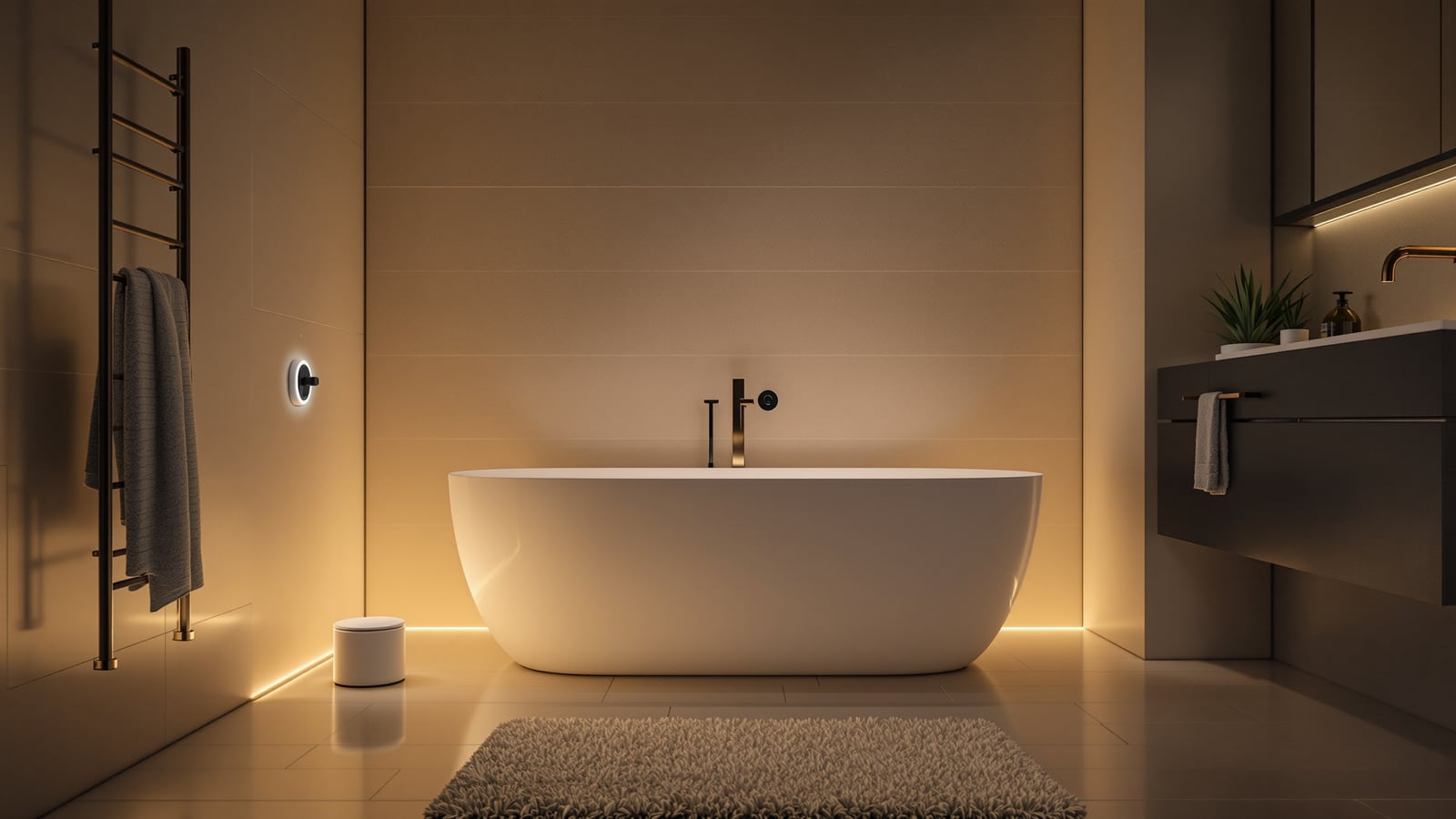
Motion Sensor Bathroom Light India: PIR & Occupancy Lighting Guide (2026)
Hands-free PIR and occupancy sensors that switch bathroom lights on when you walk in and off when you leave — how they save energy, a dim night-light mode for 3 a.m. trips, sensor placement, timeout, false triggers, ceiling vs switch sensors, wiring, LED compatibility and honest rupee ranges.
You walk into the bathroom with an armful of towels, or half-asleep at 3 a.m., and the light is simply on. You leave, and a minute later it goes off by itself. No switch to fumble for with wet or full hands, no light left burning all night because a child forgot it. That is the entire promise of a motion sensor bathroom light, and in a country where a single guest toilet can stay lit for hours because nobody wants to touch a switch twice, the payoff is real — in convenience, in hygiene, and on the electricity bill.
This guide is India-first: how PIR and occupancy sensors actually behave, the dim night-light mode that makes them genuinely kinder for elderly parents and small children, where to place the sensor and how to set its timeout, how to stop it triggering on nothing (or failing to see you sitting still), the choice between a ceiling sensor and a sensor switch, the wiring, and honest rupee ranges. Read it alongside the bathroom lighting guide for India for the full lighting plan, the elderly-friendly bathroom guide for safe night-time movement, and the smart bathroom lighting guide if this sensor is one piece of a larger automated bathroom.
A motion sensor light is not a smart-home luxury. It is the single cheapest automation in the house — a ₹500–₹2,500 part that pays for itself in switched-off hours and buys a fall-free path to the toilet at night.
PIR vs occupancy: what "motion sensing" really means
The workhorse of domestic sensor lighting is the PIR (passive infrared) sensor. It watches for the moving heat signature of a warm body against a cooler background. It is passive — it emits nothing, draws almost no power, and is cheap and reliable. Its one weakness matters in a bathroom: PIR sees motion, not presence. Sit still on the WC for two minutes and a plain PIR can decide the room is empty and cut the light while you are still in it.
That is the gap occupancy and presence sensors close:
- PIR occupancy sensor — the same infrared detection, but with a generous timeout and a wide lens tuned so ordinary small movements (a hand, a shoulder) keep resetting the timer. Good enough for most home bathrooms.
- Microwave / radar sensor — emits a low-power radio signal and reads the reflection, so it detects even tiny movement (breathing, a turning page) and sees through the flimsy partition of a WC cubicle. Better at "I'm still here", but more prone to false triggers through walls.
- Dual-tech sensor — needs both PIR and microwave to agree before switching on, killing false triggers, then holds on microwave alone. This is the premium, and the most bathroom-appropriate, option.
For a family bathroom where someone will sit still, choose an occupancy or dual-tech unit with a long, adjustable timeout — not the cheapest bare PIR sold for staircases.
The night-light mode that matters most
The feature that turns a gimmick into genuine care is a two-level or night mode. Instead of blasting 100% brightness the moment someone steps in, a good sensor runs a standby dim level — a soft 10–20% glow — during set night hours, and only jumps to full brightness on strong movement. Some units hold a permanent low ambient glow so the toilet is never in pitch dark.
For an elderly parent or a small child making a 3 a.m. trip, this is the difference between a safe walk and a fall:
- No fumbling for a switch in the dark with unsteady hands.
- No shock of full white light at 100% waking everyone and dazzling half-open eyes.
- A visible path — the low glow shows the door, the WC and the grab bar without glare.
Pair the sensor with warm 2700–3000K LEDs for night use; cool 6500K light at 3 a.m. suppresses melatonin and makes it harder to get back to sleep. This dovetails with the fall-prevention thinking in the elderly-friendly bathroom guide. A dedicated dim step-light or under-vanity strip on its own tiny PIR is often kinder than dimming the main ceiling light.
Placement, timeout and killing false triggers
Most disappointment with sensor lighting comes from where it is mounted and how it is set, not the sensor itself.
Placement
- A ceiling sensor looks straight down and should sit roughly central, covering the doorway and the WC — not tucked in a corner where the shower screen blocks its view.
- Keep the lens away from the exhaust fan and the shower plume; a PIR reads the warm draught of moving air as motion and can hold the light on. It should also not stare at a west window where evening sun sweeps the room.
- A wall sensor switch replaces the light switch at the door; aim its cone across the room, not at the floor immediately below it.
- Mind the detection cone — typically 110–360° and 3–7 m reach. A long, narrow bathroom may need a 360° ceiling unit rather than a doorway switch.
Timeout (hold time)
- Set the off-delay to at least 3–5 minutes for a bathroom. The staircase-default of 15–30 seconds is the classic mistake — it plunges you into darkness mid-shower.
- Use the lux / daylight threshold so the light never comes on when daylight already lights the room.
False triggers
- Isolate a microwave sensor from thin drywall to a bedroom or corridor — radar sees through it and lights up for a passer-by. PIR does not have this problem.
- Keep it clear of heat sources: a geyser, a heated towel rail, or the hot exhaust air of the fan.
- On dual-tech units, tune sensitivity down a step if the light flickers on to an empty room.
Ceiling sensor vs sensor switch, and the wiring
Two ways to add sensing, and the difference decides your rewiring effort.
| Ceiling occupancy sensor | Wall sensor switch (retrofit) | |
|---|---|---|
| Where it goes | In/on the ceiling, wired to the light | In the existing switch box at the door |
| Best for | New work, false ceilings, full coverage | Retrofit — swap one switch, no new cable |
| Coverage | 360°, sees the whole room | Cone from the wall; corners can hide |
| Neutral wire | Usually needs neutral at the fitting | Many need a neutral in the switch box |
| Manual override | Separate switch or app | Built-in button on the plate |
| Typical price | ₹700–₹2,500 | ₹600–₹1,800 |
Wiring realities in an Indian home:
- Neutral at the switch is the catch. Older homes often have only the live (switch) wire at the box, so a mains sensor switch that needs a neutral will not work without pulling a new conductor. Check before you buy.
- Wire and earth to IS 732; a bathroom is a wet, Zone-classified space, so keep the sensor and its terminals out of the shower splash zone and choose a unit with a sensible IP rating (IP20 is fine on a dry ceiling; near the shower go IP44+).
- Keep a manual override — a normal switch in series, or a sensor with a hold/off tap — so cleaners and painters can force the light without dancing under the sensor.
- Sensor + LED can flicker or glow when off because the sensor's tiny standby current leaks through the LED driver. Fix it with an LED-rated sensor, a bypass capacitor, or by confirming the sensor is marked LED-compatible with a low minimum load.
Energy, cost and the honest verdict
The saving is not glamorous but it is steady. A guest toilet lit 4 unnecessary hours a day at 24 W of LED wastes roughly 35 kWh a year — modest in rupees, but multiply across a home and a lifetime, and the sensor pays for itself while removing a daily nag. In a hostel, office or apartment common toilet the numbers are far larger, which is why occupancy sensing is standard in IGBC and GRIHA green-building credits and encouraged by ECBC for commercial washrooms.
| Item | Typical India cost (2026) |
|---|---|
| Basic PIR ceiling sensor | ₹500 – ₹1,200 |
| Occupancy / dual-tech ceiling sensor | ₹1,500 – ₹3,500 |
| Wall sensor switch (retrofit plate) | ₹600 – ₹1,800 |
| Sensor + integrated LED downlight combo | ₹900 – ₹2,500 |
| Electrician labour (per point) | ₹300 – ₹800 |
| New neutral cable pull (if needed) | ₹800 – ₹2,500 |
Do:
- Pick an occupancy/dual-tech unit with an adjustable timeout for any WC you sit in.
- Set a 3–5 minute delay and a night-glow mode; use warm LEDs.
- Confirm LED compatibility and a manual override before buying.
Don't:
- Reuse a staircase PIR with a 30-second timeout in a bathroom.
- Point a microwave sensor through a thin wall at a bedroom.
- Mount it in the shower plume or over the exhaust fan and then blame false triggers.
Used well, a motion sensor is the quiet backbone of a well-lit bathroom — and it slots neatly into the broader plan in the bathroom lighting guide for India and the smart bathroom lighting guide.
References
- National Building Code of India (NBC) 2016, Part 8 Building Services — lighting and electrical installations for wet areas.
- IS 732 — Code of Practice for Electrical Wiring Installations, including earthing and bathroom (special-location) requirements.
- Energy Conservation Building Code (ECBC), Bureau of Energy Efficiency (BEE) — occupancy-sensor controls for lighting in commercial buildings.
- IGBC Green Homes / GRIHA rating manuals — occupancy sensing and lighting-control credits.
- IS/IEC 60529 — IP (ingress protection) rating classification for enclosures used in wet locations.
Export this guide
Related Guides — Deep-dive reading
PIR vs Microwave Sensor (2026): Which Motion Sensor for Indian Homes?
A neutral head-to-head between passive-infrared (PIR) and microwave (radar) motion sensors for intruder detection in an Indian home — how each detects, where each false-triggers, how they cover a room, and why their opposite weaknesses make dual-technology the honest best-of-both.
SecurityLighting Controls & Dimming Design: Zones, Scenes & Switches (2026)
How to plan lighting control so an Indian home's light is flexible — split each room's layers onto separate switches, choose dimmers that actually work with LEDs, add two-way switching where you need it, and layer scenes on top. The design decisions you must settle before the electrician wires.
LightingVoice Controlled Bathroom India: Waterproof Smart Speaker, Hands-Free Lights, Shower & Geyser, Privacy & Cost
A practical India-first guide to voice control in the bathroom — a splash-rated smart speaker or voice-enabled mirror that turns lights, music, exhaust fan, geyser and even the shower on and off hands-free — plus the microphone and privacy questions, the humidity and IP durability the device must survive, whether your Wi-Fi even reaches the wet corner of the house, which tasks genuinely benefit, the real accessibility win for elderly and disabled users, and what it all costs.
BathroomsRelated Tools — Try Free
Cross-Ventilation Analyzer
Estimate airflow and air changes per hour (ACH) from room size, window areas, layout, and local wind — with NBC 2016 Part 8 compliance check.
Ventilation CalculatorFalse Ceiling Cost Estimator
Live ₹/sqft across 8 ceiling types — POP, gypsum, designer, metal, PVC, wooden — with cove and spot lighting for 20 Indian cities.
Cost CalculatorCircadian Light Meter
Patient-centric circadian lighting visualizer for Indian healthcare design — time-of-day × intensity → CCT, melanopic lux (EML / mEDI), melatonin suppression, and an alertness curve. Calibrated against WELL v2 L03 Circadian Lighting Design, CIE S 026:2018, Brainard 2001, and Lucas et al. 2014.
Circadian Tool