
Bank Door in India: Vault, Entrance and ATM Doors by Security Zone (2026)
A security-led, zone-by-zone guide to specifying doors for a bank or financial branch in India - from the access-controlled glass entrance to the RBI-grade strongroom vault door, ATM lobby, teller line and fire exits - with indicative per-door costs.
A bank branch is the rare building where two opposite instincts have to share the same address. The street face must read as open, dignified and welcoming so customers walk in; the heart of the building must be the most burglar-proof box you can legally construct. Every door in a bank sits somewhere on that line between invitation and defence, and the mistake that costs the most - in money, in compliance and occasionally in a court case after a robbery - is treating them all the same. The strongroom door and the customer entrance are not two versions of the same product; they are different machines that happen to be hinged. This guide walks the branch zone by zone, from the glass front to the vault, and tells you which door belongs at each threshold, the security driver that decides it, the Indian codes and RBI conventions that govern it, and what each costs in 2026. For the wider logic of matching a door to its space, read the master overview on choosing a door by space; this guide is the high-security application of that idea.
The five forces that shape every bank door
Before the zones, the drivers. A bank door is decided by where it sits on these five demands, and the weighting changes completely from the street to the vault:
- Security and burglary resistance. The defining force. It ranges from "deter a casual intruder" at a back-office door to "resist drilling, cutting and explosives for hours" at the strongroom. The vault door is the single most security-critical door in any commercial building in India.
- Access control and surveillance. Banks run on the audit trail. Who opened which door, when, and on whose authority - tellers' cash area, ATM lobby, back-office and server room all need electronic access logs tied to CCTV, not just a key.
- Public footfall and accessibility. The entrance and lobby serve hundreds of people a day, including elderly pensioners and wheelchair users. RPwD 2021 and NBC accessibility apply at the customer-facing doors.
- Fire and egress. A branch is an assembly-type occupancy. Fire exits, stairwell doors and escape routes must follow NBC 2016 and carry IS 3614 fire-rated assemblies where required - and crucially, the high-security regime must never trap people inside during a fire.
- Dignified, trusted image. A bank sells confidence. The entrance and customer hall must look solid and reassuring; institutional steel that says "government office, 1985" quietly erodes that trust.
No single door scores high on all five. The skill is reading each zone and specifying for its dominant force.
Bank zones and the door each one needs
Read the branch as three concentric rings of trust. The public ring (entrance, ATM lobby, customer hall) is open and welcoming but watched. The controlled ring (teller cash area, back-office, server room) is staff-only, access-logged and behind a secure line. The secure core (strongroom and vault) is the fortress. Doors get heavier, slower to open and harder to defeat as you move inward.
| Zone | Recommended door | Security / access driver | Indicative ₹ (per door, 2026) |
|---|---|---|---|
| Customer entrance | Automatic toughened-glass sliding door + rolling shutter behind for after-hours | Welcoming, accessible, fully secured when closed | Auto door 1,80,000-4,50,000+; shutter 35,000-1,20,000 |
| ATM lobby (offsite or attached) | Frameless toughened-glass door with 24x7 card-swipe access control + CCTV | Self-service round the clock, controlled entry, deters loiterers | Glass door 25,000-70,000; access control 30,000-1,00,000 |
| Cash / teller line | Solid-core or steel access-controlled door, vision panel, self-closing | Separates cash handling from public; logged, audited | 15,000-45,000 + access reader |
| Strongroom / vault | Engineered steel strongroom vault door - drill, torch and burglary resistant, time-lock, dual-key, day-gate | The defining high-security door; RBI / IS strongroom norms | 3,00,000-25,00,000+ (varies hugely by grade/size) |
| Back-office / records | Access-controlled solid steel or flush door, self-closing | Staff-only, document security, log trail | 12,000-40,000 + reader |
| Server / electrical room | Fire-rated steel door, gas-tight, access-controlled | Equipment protection, fire compartment, restricted entry | 18,000-50,000+ |
| Fire exit / stairwell | IS 3614 fire-rated steel door with panic / push bar, outward swing | NBC egress; must never be locked against escape | 14,000-45,000+ |
| Staff side / service entry | Steel security door, multi-point lock, access control | Controlled staff and cash-van movement | 10,000-30,000 |
The customer entrance: open by day, fortress by night
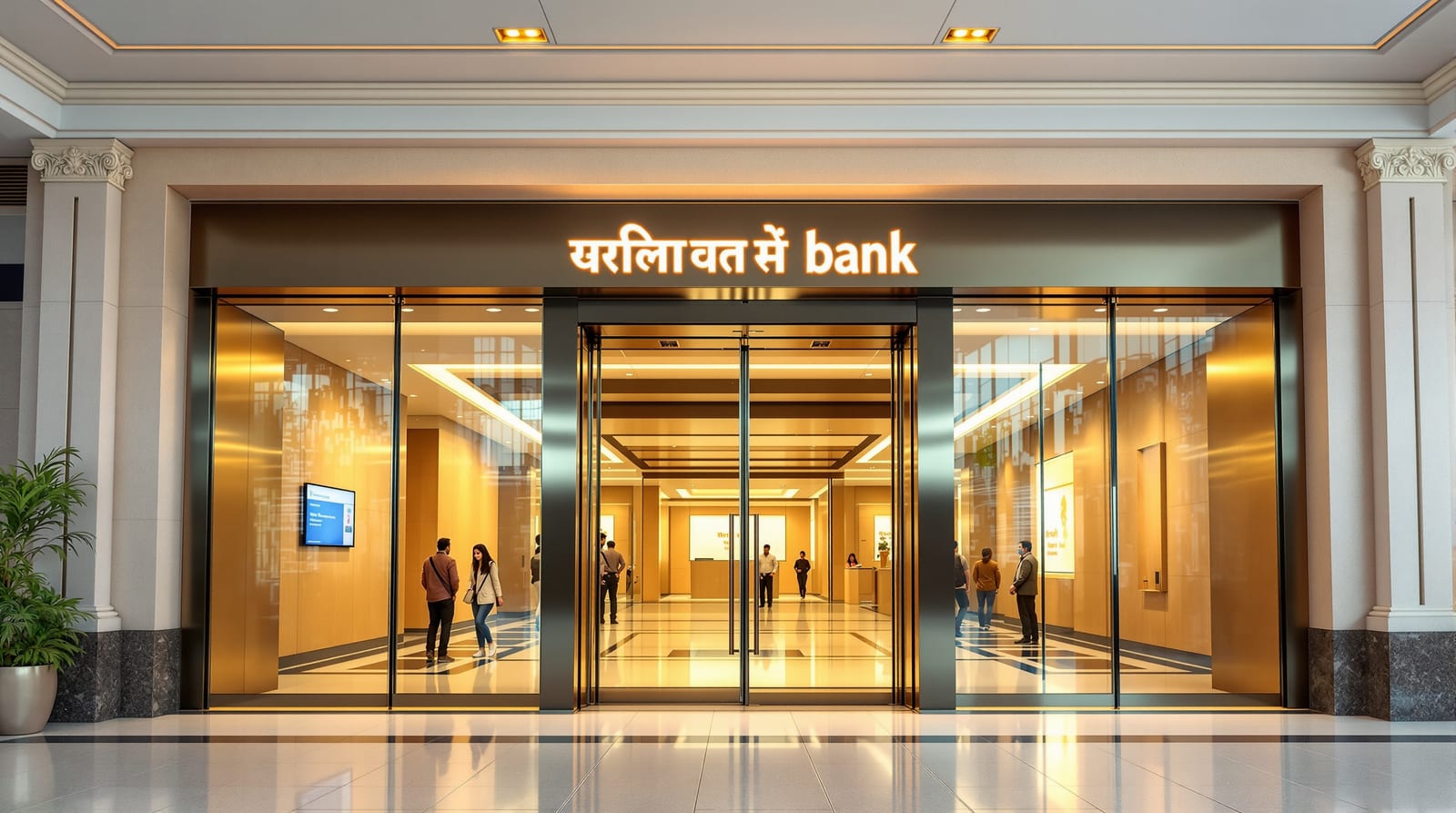
The front door does the marketing. Almost every modern Indian bank branch now runs an automatic toughened-glass sliding entrance - it reads as transparent and modern, lets the lobby and ATM signage show through, handles heavy footfall hands-free (which matters for hygiene and for customers carrying documents), and gives a wheelchair user a flush, sensor-opened path with no heavy leaf to wrestle. Specify it to the standards in the automatic glass doors guide: 10-12 mm toughened glass, redundant safety sensors, and a battery backup that fails to a manually openable state so a power cut never traps people.
The catch is that glass alone is hopeless after hours. Behind the automatic door, banks fit a rolling shutter that drops at closing to turn the welcoming glass front into a sealed, opaque, pry-resistant face overnight. Choose a perforated or grille shutter if you want the lit interior and ATM still visible (a deterrent in itself), or a solid insulated shutter for maximum closure. The mechanics of choosing and sizing one are covered in the shutter doors guide. Accessibility is non-negotiable at this threshold: clear width at least 900 mm (the auto door easily gives more), threshold under 12 mm, and a manual swing leaf alongside as the code-compliant egress route, because an automatic door is not, on its own, an acceptable means of escape.
The strongroom vault door: the one that defines the branch
This is the door the whole building is built around, and the one where you must not improvise. A bank strongroom vault door is an engineered security assembly, not a heavy steel door with a good lock. It is built to resist a determined, equipped attack - drilling, grinding, oxy and thermic-lance cutting, and in higher grades explosives - for a rated period long enough for response forces to arrive. In India these doors and the strongroom they close are governed by the relevant Bureau of Indian Standards strongroom specifications and by the Reserve Bank of India's currency-chest and branch security conventions, which set construction, locking and operating requirements for cash-handling premises. Treat the published grade and test certificate as the only meaningful proof; a vendor's word that a door is "vault grade" means nothing without it.
What a genuine vault door carries:
- A thick composite barrier body - layered steel plate with anti-drill hardplate and concrete/composite infill, far beyond any ordinary steel door. Even the door alone is commonly several hundred kilograms to over a tonne.
- Multiple massive boltwork throwing live bolts into the head, sill and both jambs, driven by a central mechanism so the whole perimeter locks at once.
- A time-lock and dual-control locking - two custodians with separate keys/combinations, plus a time delay that prevents opening outside set hours even under coercion. This is the operating heart of bank security, not an accessory.
- An inner day-gate - a grille gate inside the main door so the heavy vault can stay open during business hours while access is still controlled, and so no one can be shut inside the airtight strongroom.
- Anti-coercion and alarm tie-ins - relocking devices that trigger if the door is attacked, and duress signalling to the branch alarm and CCTV.
Because the vault door is custom-engineered to the strongroom opening and grade, its price spans a wide band - from a few lakh for a small branch unit to well over twenty-five lakh for a high-grade currency-chest door - and it is supplied and installed by specialist vault manufacturers, not a general door fabricator. Get the strongroom civil structure, the door grade and the locking regime designed together, and have the certifying authority and your insurer sign off on the grade before you order. For the language of security ratings that lets you compare grades like-for-like, read the security door grades guide; the strongroom door sits at the very top of that scale.
ATM lobby, teller line, back-office and fire exits
ATM lobby. An attached or offsite ATM kiosk runs 24x7, so its door has to admit a cardholder at 2 a.m. without a guard present, yet keep out loiterers and after-hours mischief. The standard answer is a frameless toughened-glass door on a card-swipe or contactless access reader, tied to interior CCTV - the customer's debit card opens the door, every entry is logged, and the transparency lets passers-by and cameras see in. Size it for accessibility and fit a closer with a hold-open in summer-heat regions only if it does not defeat the access control.
Teller / cash line. The door between the public hall and the cash-handling area is a solid-core or steel access-controlled door with a vision panel and self-closer. It is not about stopping a siege - the vault does that - but about a clean, logged separation of cash handling from the public, so only authorised tellers cross it and every crossing is recorded. Wire it into the branch access-control system covered in the door access control guide.
Back-office, records and server room. Staff-only doors take access-controlled solid flush or steel leaves; the server and electrical room takes a fire-rated steel door as covered in the steel doors guide, because it is both a fire compartment and a restricted, equipment-critical space. All of these should self-close and log entry.
Fire exits. A branch is an assembly occupancy, so escape routes and stairwell doors must be IS 3614 fire-rated steel doors fitted with panic / push bars, swinging outward in the direction of escape, per NBC 2016. The hard rule that overrides all the security instinct: a fire exit must let people out instantly from the inside even though it resists entry from the outside. Never let the burglary mindset produce a door that is locked against escape - it is illegal and lethal.
Costs in 2026 (indicative, varies by grade, size and city)
| Door / item | Indicative cost | Notes |
|---|---|---|
| Automatic glass entrance (sensor sliding) | ₹1,80,000-4,50,000+ | Toughened glass, sensors, battery backup |
| Rolling shutter behind entrance | ₹35,000-1,20,000+ | Grille/perforated or solid insulated, motorised |
| ATM lobby glass door + access control | ₹55,000-1,70,000 | Frameless glass + 24x7 card reader + CCTV link |
| Teller / back-office access-controlled door | ₹15,000-45,000 + reader | Solid/steel leaf, vision panel, self-closer |
| Server / electrical room fire door | ₹18,000-50,000+ | IS 3614 fire-rated steel, access-controlled |
| Fire exit / stairwell door (panic bar) | ₹14,000-45,000+ | IS 3614, outward swing, push bar |
| Strongroom / vault door | ₹3,00,000-25,00,000+ | Grade-rated, time-lock, dual control, day-gate; specialist supply |
| Branch access-control system (per door) | ₹30,000-1,00,000+ | Reader, controller, software, CCTV integration |
Add 18% GST on supply. The vault door alone can outweigh the entire rest of the branch's door budget, which is exactly as it should be - the spend is concentrated where the risk is. Use the door cost calculator for the lobby, office and fire doors, but price the vault door directly with specialist vault manufacturers against your required grade.
Do and don't for bank doors
- Do specify the strongroom door by a certified grade and operating regime (time-lock, dual control, day-gate), and get your insurer's sign-off before ordering.
- Do keep the customer-facing doors genuinely accessible - automatic entrance, manual egress leaf alongside, lever hardware, low threshold.
- Do tie every controlled-zone door into one access-control and CCTV system so the audit trail is complete.
- Don't confuse a "security door" from a hardware dealer with a vault door, or a decorative steel leaf with a fire-rated one - demand the test certificate.
- Don't ever lock a fire exit against escape, and don't let a rolling shutter or auto door become the only escape route.
- Don't prop fire and self-closing doors open for convenience; it voids the entire fire strategy.
For the residential and small-office equivalents of these access-controlled and steel doors, the steel doors guide and the door access control guide go deeper into hardware, and the doors-by-space master guide places this branch logic in the wider family of commercial spaces.
Frequently asked questions
What kind of door does a bank vault use?
A bank vault uses a purpose-engineered strongroom door: a thick composite steel barrier with anti-drill hardplate, massive multi-directional boltwork, a time-lock and dual-control locking, and an inner day-gate. It is graded and tested to resist drilling, cutting and (in higher grades) explosive attack for a rated period, and is supplied by specialist vault manufacturers, not a general door fabricator.
Are bank vault doors covered by an Indian standard?
Yes. Bank strongrooms and their doors are governed by the relevant Bureau of Indian Standards strongroom specifications and by the Reserve Bank of India's currency-chest and branch security conventions, which set construction, locking and operating requirements. Always buy a vault door with a grade certificate and have the grade approved by the certifying authority and your insurer.
Why do banks use automatic glass doors at the entrance?
Automatic toughened-glass doors look open and trustworthy, handle heavy footfall hands-free, and give wheelchair users a flush, sensor-opened path that meets accessibility rules. After hours a rolling shutter drops behind the glass to seal the front, so the branch gets a welcoming day face and a secure night face from the same opening.
How are bank fire exits kept secure without trapping people?
By using IS 3614 fire-rated doors fitted with panic / push bars: the door resists entry from outside but releases instantly from the inside under hand pressure, swinging outward in the direction of escape. NBC 2016 requires this. A fire exit may be alarmed and monitored, but it must never be locked or chained against escape.
What does a bank door package cost in India in 2026?
Indicatively: an automatic glass entrance ₹1,80,000-4,50,000+, ATM lobby door with access control ₹55,000-1,70,000, fire and server-room doors ₹14,000-50,000+ each, and the strongroom vault door anywhere from ₹3,00,000 to ₹25,00,000+ depending on grade and size. Add 18% GST. Figures are indicative and vary by grade, size, city and vendor.
Export this guide
Related Guides — Deep-dive reading
Library Door in India: Quiet, Access-Controlled and Anti-Theft Reading-Room Entrances (2026)
Doors for public, college and corporate libraries in India - acoustic silence, RFID security gates, controlled single entry and a calm scholarly look, with zone-by-zone choices and costs.
Home Doors & EntrancesUniversal Design Doors for Indian Homes: Inclusive Doors That Work for Everyone (2026)
How to design and specify doors that serve children, the elderly, pregnant women, the injured and wheelchair users by default - generous width, lever handles, near-flush thresholds, low-force closing, contrast and good lighting - without your home ever looking medical.
Home Doors & EntrancesFire Exit Doors in India: NBC 2016 Egress, Panic Bars & Costs (2026)
How fire exit and emergency egress doors must be sized, swung, hardware-fitted and signed to NBC 2016 Part 4 in Indian buildings, and what they cost.
Home Doors & EntrancesRelated Tools — Try Free
Access-Control Battery-Backup Calculator
Size the standby battery so an access system keeps running through a power cut, with an egress life-safety note.
Battery BackupDoor Cost Calculator
Estimate the all-in cost of a door — leaf, frame, hardware, fitting and GST — by type, material and size.
Door CalculatorWindow Hardware Cost Calculator
Estimate window hardware cost — hinges, handles, locks, rollers and multipoint gears.
Window Calculator