
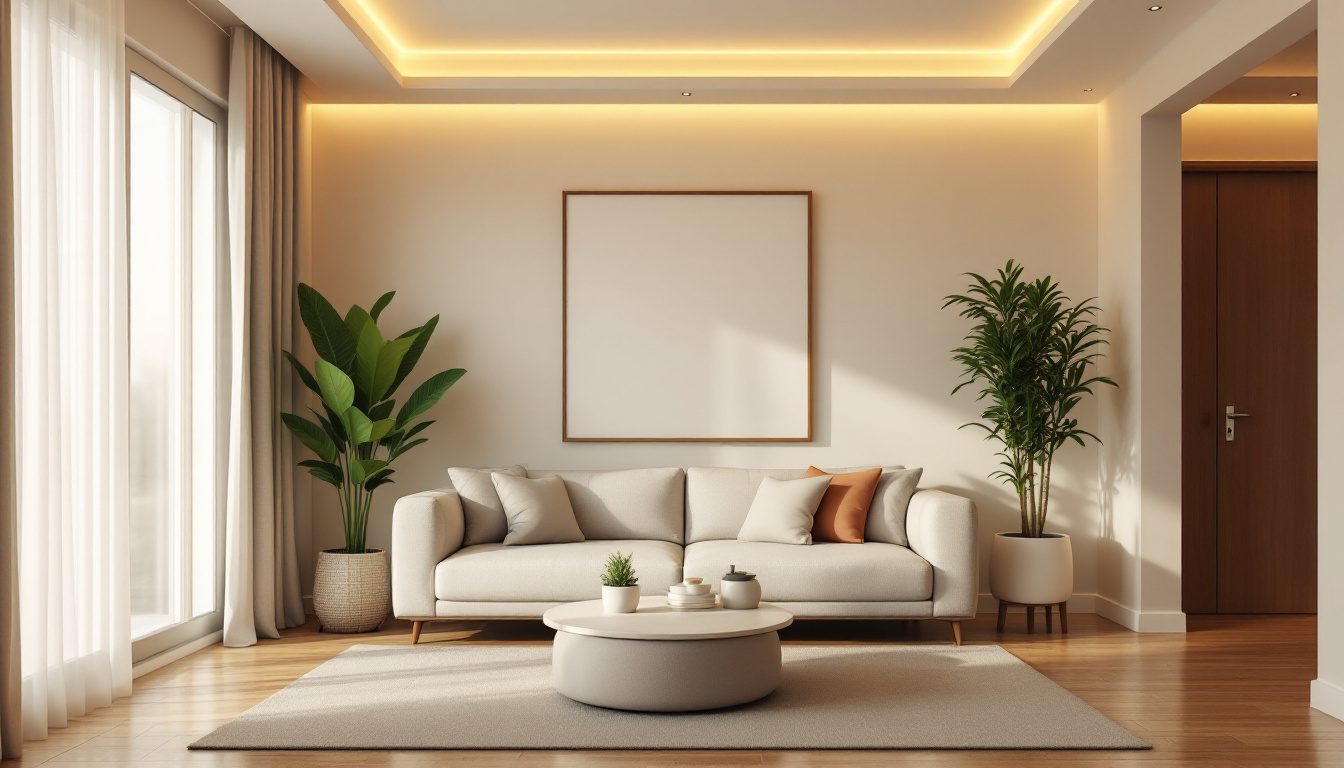
Getting the Most Bang for Your Buck in Interiors
The high-impact-per-rupee moves that make a modest Indian home look expensive
Two flats in the same building, two families, two interiors budgets within a few thousand rupees of each other — yet one home looks like it belongs in a magazine while the other looks like a furniture showroom got delivered to the wrong address. The difference is almost never how much they spent. It is what they spent it on, and in what order. Money in interiors does not buy beauty in a straight line; the rupee-to-impact curve is steep at the start and goes nearly flat surprisingly early.
This guide is about that curve — the small set of moves that deliver the most visible transformation per rupee, and the equally small set of places where saving money quietly wrecks the result. It is not about how to split your budget across rooms (that is smart budget allocation) or what you personally value enough to pay for (that is balancing and maximising your design priorities). It is the tactician's manual: given a fixed, modest budget, which levers do you pull first.
The most expensive-looking home is rarely the most expensive home — it is the most disciplined one. Layered light, a tight palette, ruthless editing and one good piece beat a roomful of mediocre purchases at a fraction of the cost, while a handful of things you must never cheapen quietly carry the whole illusion.
The rupee-for-rupee impact curve
Every design move sits somewhere on a curve of visual impact per rupee. A litre of good paint changes an entire room for a few hundred rupees per square metre; a ₹2.5 lakh sofa changes one corner. Both are legitimate, but they are not the same kind of spend — and confusing them is how budgets evaporate without anything looking better.
The single most useful mental model is to rank moves not by what they cost, but by transformation delivered divided by money spent. Do that and a clear hierarchy appears — almost the inverse of where most first-time homeowners start: big furniture and a TV unit.
| Move | Indicative cost (2026) | Impact per rupee | Why it ranks here |
|---|---|---|---|
| Layered lighting (lamps, warm bulbs, dimmers) | ₹8,000–₹40,000 / home | Very high | Changes mood of every room every evening; cheap relative to effect |
| Paint and colour discipline | ₹25–₹60 / sq ft labour+material | Very high | Resurfaces the largest visible surface — the walls |
| Decluttering and editing | ₹0 | Very high | Free; removes the single biggest cause of "cluttered, cheap" reads |
| Soft furnishings and textiles | ₹6,000–₹30,000 / room | High | Adds colour, texture and warmth; easy to layer over time |
| Mirrors, greenery, art | ₹3,000–₹25,000 / room | High | Light, depth and life for very little |
| Hardware and switch upgrades | ₹4,000–₹20,000 / home | High | The details your hand touches read as quality |
| One statement piece | ₹20,000–₹1,50,000 | Medium-high | A single anchor beats five forgettable buys |
| Mid-range furniture | ₹50,000–₹3,00,000 | Medium | Necessary, but diminishing returns above a point |
| Bespoke joinery / full modular | ₹1,200–₹3,500 / sq ft | Medium-low | High value where needed, ruinous when over-specified |
| Imported designer furniture | ₹2,00,000+ / piece | Low (per rupee) | Real but expensive impact; for the one room that earns it |
Costs are indicative for 2026 and run higher in metros than tier-2 cities; treat them as ranges, not quotes. The point is the ordering. The top half of this table can transform a home for under ₹1.5 lakh; the bottom half can consume ₹15 lakh and still leave a room that feels flat if the top half was skipped. Spend down the list, not up it.
Cheap interiors and expensive-looking interiors are not separated by money — they are separated by light, edit and palette. Get those three right and the budget you have left goes twice as far.
The cheap wins that read expensive
These are the moves at the top of the curve — low cost, high visible return. None of them require a contractor for more than a day, and most are rental-friendly.
Paint and colour. Walls are the largest surface in any room and the cheapest to change. A litre of Asian Paints Royale or Tractor Emulsion resets the entire backdrop for a fraction of what one cushion-cover set costs. The discipline that makes paint read expensive is restraint: one palette of two or three colours across the home, not a different accent wall per room. Deep, slightly muted tones (a warm clay, a soft sage, a greyed blue) read more sophisticated than builder-white or saturated primaries, and painting trims, doors and the ceiling in coordinated tones — rather than leaving white everywhere — is what makes ordinary rooms look considered.
Layered lighting — the single highest-ROI move. Indian homes are routinely lit by one harsh tube or a ring of cool-white downlights, which flattens every surface and makes even costly interiors look like an office. The fix is almost free by comparison: add table and floor lamps, warm-white bulbs (2700–3000K, not 6500K), and a dimmer or two. A ₹1,200 floor lamp with a warm bulb changes a corner more than a ₹40,000 console will. Light is the closest thing interiors have to a cheat code, which is why it sits at the top of the impact curve.
| Lighting layer | What it does | Indicative cost | Where to add it |
|---|---|---|---|
| Ambient (warm overhead) | General fill, sets the base mood | ₹300–₹1,500 / bulb | Replace cool-white with 2700–3000K |
| Task (lamps, under-cabinet) | Light where you read, cook, work | ₹800–₹4,000 / fixture | Desk, bedside, kitchen counter |
| Accent (uplight, spot, cove) | Drama, depth, draws the eye | ₹1,500–₹8,000 / fixture | Wash a wall, light art or a plant |
| Decorative (pendant, lamp) | The fitting is itself the object | ₹2,000–₹25,000 | Over dining, in a reading corner |
| Control (dimmers) | Lets one room be three moods | ₹400–₹2,500 / point | Living, bedroom, dining |
Decluttering and editing. The cheapest design move in existence is removal, and it is the one most homes need most. Visual clutter — too many small objects, mismatched plastic, exposed wires, a crowded fridge door — is the loudest signal of a "cheap" interior, and it costs nothing to fix. Edit down to fewer, better-placed objects and the room instantly reads calm and intentional — which is why a near-empty room often photographs more expensive than a fully furnished one.
Soft furnishings and textiles. Curtains, cushions, throws, rugs and bed linen add colour, texture and warmth that hard surfaces cannot. Floor-to-ceiling curtains hung high and wide (just under the ceiling, wider than the window) make a room read taller and grander for the price of a few metres of fabric. A good rug anchors and warms a seating zone; layered cushions in a tight palette make a basic sofa look styled.
Mirrors and greenery. A large mirror doubles the apparent light and depth of a room for ₹3,000–₹15,000 — one of the highest impact-per-rupee objects you can buy. Real or good faux plants add life and a sense of care no furniture conveys; a few large plants beat many small ones.
Hardware upgrades. Cabinet handles, drawer pulls, door levers, taps and switch plates are the parts your hand touches every day, and cheap ones telegraph "builder-grade" instantly. Swapping builder handles for solid brass or matte-black pulls, and basic plates for a cleaner modular range, costs a few thousand rupees and lifts the perceived quality of a whole kitchen or wardrobe run.
Cohesive palette discipline. The thread running through all of the above is restraint. A home that commits to one palette — say oak-tone wood, matte black metal, off-white and a single accent — reads as designed; a home with five wood finishes, three metals and a different scheme per room reads as accumulated, however much each item cost. Discipline is free, and it multiplies everything else.

One statement piece versus many mediocre ones
A persistent budget mistake is spreading money thinly — a passable sofa, a passable rug, a passable table, passable art, all at once, all mid-range, all forgettable. The room ends up uniformly mediocre. The opposite strategy almost always looks better for the same money: buy fewer things, let most be quiet and inexpensive, and put real money into one anchor per room.
One beautiful sofa, one striking light fixture, one handsome dining table — a single object of genuine quality gives the eye somewhere to land and lends its quality to everything around it. The basics can be modest precisely because the anchor carries the room. This is how a ₹1.2 lakh room can outshine a ₹3 lakh one: the cheaper room spent ₹70,000 on one memorable sofa and kept the rest plain, while the dearer room spent ₹3 lakh on nothing memorable. The skill is choosing the right anchor for the room's function — usually the sofa or lighting in a living room, the bed in a bedroom, the table or pendant in a dining room. Decide the anchor first, budget it generously, then keep everything else quiet.
Lighting over furniture: where to put the marginal rupee
If there is one reallocation that improves the most Indian homes, it is moving money from furniture to light. Builders deliver homes lit for inspection — bright, cool, even, flat — and most people never change it, then spend lakhs on furniture the lighting makes look cheap. A ₹3 lakh furniture budget with ₹5,000 of lighting almost always looks worse than a ₹2.5 lakh budget with ₹40,000 of layered, warm, dimmable lighting; the same teak looks richer under warm grazing light and dead under flat cool light. The practical rule: before adding the next piece of furniture, ask whether the same money on a lamp, a dimmer or an accent fixture would do more. Until the lighting is layered and warm, the answer is almost always yes — furniture past the basics has steep diminishing returns, while a home is rarely "over-lit" with layers.
Where NOT to cheapen out
The inverse of the impact curve matters just as much. Some savings are false economies — they cost more later, or undermine the expensive-looking illusion the cheap wins create. As a rule: never cheapen anything you touch daily, anything in a wet area, or anything hard to redo once installed.
| Category | Why not to cheapen | What happens if you do |
|---|---|---|
| Things you touch daily | Hardware, taps, switches, handles, door locks | Hands register quality instantly; cheap feels cheap every day, fails fast |
| Wet areas | Bathroom waterproofing, plumbing, kitchen counter | Leaks and seepage cost lakhs to redo; counters chip and stain |
| Hard-to-redo work | Flooring, electrical layout, plumbing routing | Buried or load-bearing; redoing means demolition |
| Mattress and seating | Sofa frame, mattress | Daily comfort and back health; sagging shows quickly |
| Core safety / utility | Modular switches, MCB, geyser, chimney | Cheap electricals are a fire and reliability risk |
The principle is leverage and exposure. A cheap cushion is replaced in a year for ₹600; cheap bathroom waterproofing can mean breaking tiles and re-laying plumbing for ₹1–₹3 lakh plus weeks of disruption, and cheap flooring is locked in under everything you own. So the budget logic is barbell-shaped: be aggressively frugal on the easy, surface, replaceable layer, and refuse to compromise on the buried, wet, daily-touch one. This split — cheap where it shows and is replaceable, never cheap where it is permanent or hidden — is the heart of budget versus premium interiors.
The low-budget room-refresh playbook
Here is the sequence to refresh a tired room on a small budget — roughly ₹15,000 to ₹60,000 for a typical living room or bedroom — in order of impact per rupee. Do them in this order and stop whenever the budget runs out; you will already have captured most of the gain.
| Step | Move | Indicative cost | What it buys |
|---|---|---|---|
| 1 | Declutter and edit ruthlessly | ₹0 | Instant calm; reveals the room you actually have |
| 2 | Deep clean, fix and patch | ₹0–₹3,000 | Cracks, marks and grime read as "cheap" |
| 3 | Repaint in a disciplined palette | ₹6,000–₹20,000 | Resets the largest surface; new backdrop |
| 4 | Layer the lighting, warm + dimmable | ₹6,000–₹20,000 | The single biggest mood change |
| 5 | Hang curtains high and wide | ₹3,000–₹12,000 | Room reads taller, softer, finished |
| 6 | Add a rug and cushions | ₹4,000–₹15,000 | Warmth, texture, an anchored zone |
| 7 | Add a mirror, plants, a little art | ₹3,000–₹15,000 | Light, depth, life |
| 8 | Invest in one statement piece | ₹15,000–₹60,000 | The anchor that ties it together |
| 9 | Style: edit again, arrange in groups | ₹0 | The final 10% that reads as "designed" |
Renting? Steps 1, 4, 5, 6, 7 and 8 are reversible and travel with you — peel-and-stick options, tension rods, freestanding lamps and unframed art transform a rental without touching the walls or losing your deposit. The expensive-looking home is overwhelmingly built from these reversible, frugal layers, not from permanent work tenants cannot do anyway.
Putting it together: a worked example
Consider a ₹1,00,000 budget to make a builder-standard living room look considered. The instinct is to spend it all on furniture; the high-impact-per-rupee allocation spends it very differently — and looks far better.
| Allocation | "Furniture-first" instinct | "Impact-per-rupee" plan |
|---|---|---|
| Editing and cleaning | ₹0 | ₹0 (done first, free) |
| Paint (DIY-assisted) | ₹0 | ₹12,000 |
| Layered lighting | ₹3,000 | ₹22,000 |
| Curtains (high and wide) | ₹6,000 | ₹10,000 |
| Rug + cushions + throw | ₹8,000 | ₹14,000 |
| Mirror + plants + art | ₹3,000 | ₹12,000 |
| Sofa / seating | ₹80,000 (one mid sofa) | ₹30,000 (modest sofa, restyled) |
| Result | One okay sofa in a flatly lit, plain room | A warm, layered, intentional room with one good anchor |
Same money, opposite outcome. The furniture-first plan buys one item and a room that still looks builder-standard; the impact-per-rupee plan buys a transformed room where every layer works. Order your spend by impact per rupee, protect the permanent and wet-area layers, and a modest budget looks like a generous one.
What this means for your home
1. Spend down the impact curve, not up it. Light, paint, edit and palette first; big furniture and joinery last. The top of the curve transforms a home for under ₹1.5 lakh.
2. Treat lighting as the highest-ROI move you can make. Warm bulbs, lamps and a dimmer change every evening for the cost of one forgettable side table.
3. Edit before you buy. Removal is free and fixes the commonest cause of a cheap-looking room — do it first, and again at the end.
4. Buy one anchor per room, keep the rest quiet. One good piece beats five mediocre ones at a fraction of the total cost.
5. Commit to one palette. Discipline across woods, metals and colours is free and multiplies the value of everything you own.
6. Never cheapen the daily-touch, wet, or hard-to-redo layer. Hardware, taps, waterproofing, flooring, mattress, electricals — false economies here cost lakhs.
7. If you rent, lean on the reversible layers. Lamps, curtains, rugs, mirrors and one statement piece transform a rental without touching a wall.
How Studio Matrx helps
The hardest part of spending for impact is seeing the result before the money is gone — knowing whether a warmer palette, layered lighting and one statement sofa will actually transform your room, or whether you are about to repeat the furniture-first mistake. DesignAI lets you test these high-impact moves on a photo of your own room — repaint the walls, change the lighting mood, swap the anchor piece — so you see the cheap-win transformation before committing a rupee. Pair it with the budget allocation tool to turn the impact curve into a real, room-by-room number, and with smart budget allocation and balancing your design priorities to decide how to split and what to value before you spend.
References
1. Asian Paints — emulsion product range and indicative coverage rates (Royale, Tractor Emulsion); used for paint cost-per-square-foot ranges.
2. IKEA India and local furnishing retailers — indicative 2026 price ranges for lamps, textiles, mirrors and modest furniture.
3. Bureau of Energy Efficiency / lighting industry guidance — colour-temperature ranges (2700–3000K warm versus 6500K cool) and their effect on perceived warmth.
4. National Building Code of India 2016 — bathroom waterproofing and wet-area construction requirements informing the "never cheapen" wet-area logic.
5. Christopher Alexander, Sara Ishikawa & Murray Silverstein, A Pattern Language (1977) — patterns on pools of light and the value of editing.
6. Studio Matrx internal cost surveys, 2026 — indicative metro versus tier-2 ranges for paint, lighting, furnishings, hardware and furniture.
Part of the Studio Matrx Cost & Money series. Continue with smart budget allocation, balancing your design priorities, and budget versus premium interiors.
Export this guide
Related Guides — Deep-dive reading
The Design Decisions With the Biggest Cost Consequences
A cost-leverage map of Indian home interiors — the handful of decisions that swing your total budget the most, so you spend your attention where a single choice has an outsized rupee impact.
Cost & MoneyThe Homeowner's Guide to Interior Design Budgets in India
Where the money really goes in an Indian fit-out — realistic 2026 ranges, cost-per-sqft truths, bang-for-buck upgrades, life-cycle costing and contracts
Home PlanningThe Homeowner's Guide to Lighting Your Home: Start to Finish (2026)
The warm, plain-English capstone for the whole Lighting hub - how to light an Indian home from empty to done, in the order things actually happen, with the one rule that saves you the most money: decide the whole scheme before the electrician wires.
LightingRelated Tools — Try Free
Home Building & Interior Cost Calculator — 20 Cities
Construction + interior costs for 20 Indian cities across kitchen, wardrobes, flooring, painting, ceiling.
Cost CalculatorElectrical Safety & Load Audit
Home electrical audit — 10 categories, 65+ checkpoints across earthing, RCCB, MCB, wiring, switchboards, appliance circuits, DG/inverter backup.
Safety AuditFull-Room BOQ — Living, Bedroom, Kitchen, Bath
Room-wise BOQ across living, bedrooms, kitchen, utility, and bathrooms with line-item pricing.
Full-Room BOQ