
Balancing and Maximizing Your Design Priorities
How to decide what matters most in your Indian home, pour your finite budget, space and attention into it, and consciously dial down the rest
Most people start a home project with a list, and the list is the problem. It reads like a wish: open kitchen, marble flooring, pooja room, home theatre, walk-in wardrobe, balcony garden, modular everything, study, guest room, smart lighting, a statement chandelier. Every item is reasonable. Together they are unaffordable, won't fit, and — the part nobody warns you about — even if you could afford them all, the result would feel oddly flat. A house where everything is a priority is a house where nothing is.
The skill that separates a home that feels right from one merely furnished is not taste or money. It is the discipline of ranking — knowing what matters most to you, pouring your finite budget, space and attention into those few things, and deliberately dialling the rest down. This guide is about that ranking: how to find your real priorities, how to maximise them, and how to make peace with the fact that a great home is a few things done beautifully rather than many done averagely.
A home does not become great by adding more; it becomes great by deciding what to maximise and what to let go. Your budget, your square footage and your own attention are all finite — pointed at three things they transform a home, spread across thirty they vanish.
Priorities are not trade-offs — know the difference
Before anything else, a distinction that will save you a great deal of confused thinking. Priorities and trade-offs are two sides of the same coin, but they are not the same thing, and conflating them is why so many homeowners feel paralysed.
A priority is something you choose to maximise — the thing you value most, the place you pour money, space and care so it turns out exceptional. A trade-off is what you give up to get there — the sacrifice, the thing you knowingly let be ordinary because budget and floor plan only stretch so far. You cannot maximise a priority without accepting a trade-off somewhere else; the two are bound together. But the mental act differs. Setting priorities is an act of desire — what do I want most? Accepting trade-offs is an act of release — what can I live without? This guide is about the first. Its sibling, the trade-offs every Indian homeowner faces, is about the second. Read them together for the whole picture.
The order matters. Start with trade-offs — "what can I cut?" — and you design from scarcity, which makes people timid and resentful. Start with priorities — "what do I want to be excellent?" — and you design from intention, which makes the cuts feel like choices rather than losses. Decide what you are maximising first; the sacrifices then become obvious and far less painful, because they serve something you actively want.
| Priority (this guide) | Trade-off (sibling guide) | |
|---|---|---|
| The question | What do I want to be exceptional? | What am I willing to let be ordinary? |
| The mental act | Desire, ranking, maximising | Release, compromise, accepting |
| Direction of energy | Pour money, space, attention in | Pull money, space, attention out |
| Emotional tone | Aspirational | Pragmatic |
| When you do it | First | Second, in service of the first |
Non-negotiables versus nice-to-haves
Every item on your wish list belongs in one of two buckets, and the most useful early move is to sort them honestly. A non-negotiable is something whose absence you would feel every day — something that, compromised, would make you quietly regret the whole project. A nice-to-have you would enjoy but not miss: a pleasant addition, not a load-bearing part of how you live.
The trouble is that almost everything feels non-negotiable when you are dreaming. The test is not "would I like this?" — you would like all of it. It is sharper: if I had to remove this to protect something else, would I genuinely grieve, or would I shrug? Run every wish through that question and the list sorts itself fast.
A few honesty checks that help Indian households in particular sort the two buckets:
- Separate daily life from once-a-year life. A formal dining table seating twelve is used at Diwali and ignored for the other 360 days; the breakfast counter where the family eats is used twice a day. Which deserves the better materials and the prime location?
- Separate what you want from what you imagine the neighbours expect. Much Indian home spending is status spending — the showpiece drawing-room, the imported marble entrance, the chandelier — aimed at visitors who come for ninety minutes a year. Be ruthless about whose home this is.
- Separate function from fantasy. A home theatre sounds wonderful; a good sofa and television in a room you actually relax in delivers ninety percent of the joy for ten percent of the cost. Keep the function, drop the fantasy if it is not really yours.
| Common wish-list item | Often a non-negotiable when... | Often only a nice-to-have when... |
|---|---|---|
| Modular kitchen | You cook daily, multiple meals | You eat out / order in most days |
| Formal drawing room | You host large gatherings monthly | Guests are rare and informal |
| Walk-in wardrobe | Two working adults, lots of clothes | Storage need is modest |
| Home office / study | You work from home regularly | Occasional laptop work at the table |
| Pooja room | Daily practice central to the household | Occasional, a niche or shelf suffices |
| Marble flooring | A specific aesthetic you deeply love | Chosen to impress, not to enjoy |
| Balcony garden | You will tend it weekly | A romantic idea you won't maintain |
Spend where you touch, see and use the most
Once the non-negotiables are clear, a single principle decides where money concentrates: spend where you touch, see and use the most. Every rupee put into something rarely touched is a rupee taken from something touched a hundred times a day. The places your hands, eyes and body meet constantly are exactly where Indian budgets are most often misallocated.
Think about contact frequency. You grip door handles, tap switches, lean on the kitchen counter, sit on the same sofa, sleep on the same mattress, stand on the bathroom floor barefoot every morning. These high-contact items reward quality with daily pleasure and punish cheapness with daily irritation. By contrast, the ceiling, the guest-room curtains, the formal-dining centrepiece — seen rarely, touched almost never. Quality spent there is largely invisible to your lived experience.
The cheapest thing you touch fifty times a day will cost you more in daily irritation than the most expensive thing you touch twice a year ever cost you in money. Spend accordingly.
This reframes the budget conversation. Instead of asking "what is expensive and what is cheap?", ask "what do I contact most, and is it good enough to deserve that contact?"
| High touch / use — spend here | Low touch / use — economise here |
|---|---|
| Mattress and bed (8 hours a night) | Guest-room furnishings |
| Kitchen counter, taps, drawer hardware | Formal dining centrepiece |
| The sofa you actually sit on | Showpiece chandelier |
| Bathroom flooring and daily fittings | Decorative wall mouldings, ceilings in low rooms |
| Door handles, light switches | Statement marble in transit zones |
A drawer slide that glides, a tap that doesn't wobble, a mattress that lets you sleep, a sofa that holds you well, switches and handles that feel good in the hand — these are the true luxuries, because luxury experienced daily compounds. The marble you cross on your way out does not. This is also where the trade-offs guide becomes your partner: every "spend here" implies an "economise there," and naming both turns vague anxiety into a clear, defensible plan.
Allocate budget, space AND effort — not just money
Most people think priorities are a money question. They are not. You have three finite resources, and a real priority deserves a share of all three: budget, space, and effort (your attention and time). A priority with money but no space is cramped; with space but no attention, half-baked; with attention but no budget, frustrating. Maximising means aligning all three behind the same few things.
Budget is the obvious one — but the discipline is concentration, not equal distribution. A weighted plan that puts forty percent of the interiors budget into the kitchen and living room, where the family lives, produces a far happier home than an even smear across every room.
Space is the one people forget. In an Indian flat, square footage is the scarcest resource of all, and giving a generous footprint to a priority means deliberately shrinking something else. If a spacious kitchen is non-negotiable, the formal dining gives way; if a home office is essential, the guest room becomes a convertible study. Space cannot be bought back once the plan is fixed, so it must be allocated with intention at the planning stage.
Effort — your attention and decision-making energy — is the most finite of all and least acknowledged. You can only agonise over so many decisions before fatigue sets in and you start saying yes to whatever the contractor suggests. Spend that attention on the priorities; for everything else, choose a sensible default and move on. A good designer or AI tool helps precisely here — it lets you reserve scarce attention for what matters and automates the rest.
Few things done well beats many done averagely
Every homeowner reaches a fork, usually without noticing. One path spreads the budget thin so everything is a little better than basic — every room a false ceiling, every floor a decent tile, every wall a feature. The other concentrates the budget so a few rooms are memorably good and the rest are honest and plain. The first feels safer. The second produces a better home almost every time.
The reason is psychological. A home is not experienced as an average but as a sequence of moments, and the strong moments are what you remember. A kitchen that is a joy to cook in, a living room that holds the family, a bedroom that is a genuine retreat — three rooms done well create three daily experiences of this is good. Thirteen rooms done averagely create a forgettable hum of this is fine. Nobody falls in love with fine.
This is doubly true in India, where the temptation to do a little of everything is strong — a little marble, a little teak, a little gold, a little of every trend — and the result is often a home that is busy without being beautiful. Restraint is not poverty; it is what lets the few good things breathe.
| The "everything average" home | The "few things excellent" home |
|---|---|
| Budget spread evenly across all rooms | Budget concentrated on 2–3 priorities |
| Every room slightly above basic | Most rooms honest and plain; a few exceptional |
| Feels "fine" everywhere, forgettable | Standout rooms anchor the home; memorable |
| Trend-chasing, busy | Restrained, intentional |
A plain corridor makes the room it leads to feel like an event; an ordinary guest bathroom makes the master bathroom feel like a reward. Contrast is the engine of richness, and you cannot have contrast if everything is dialled to maximum.
Room-by-room priority weighting
Abstract principles need a concrete method. The most useful is to assign each room a weight — a number for how much of your finite resources it deserves. The weights must add to a fixed total (a fixed budget of points), which forces the honest choices an open-ended wish list never does: the moment you give the kitchen more points, something else loses them. That constraint is the whole point.
Score each room on three things: how much time you spend there, how much it matters to your daily wellbeing, and how visible it is to the life you actually live (not to occasional visitors). Sum the scores and the rooms sort themselves into a clear hierarchy. The highest scorer is where money, space and attention flow first.
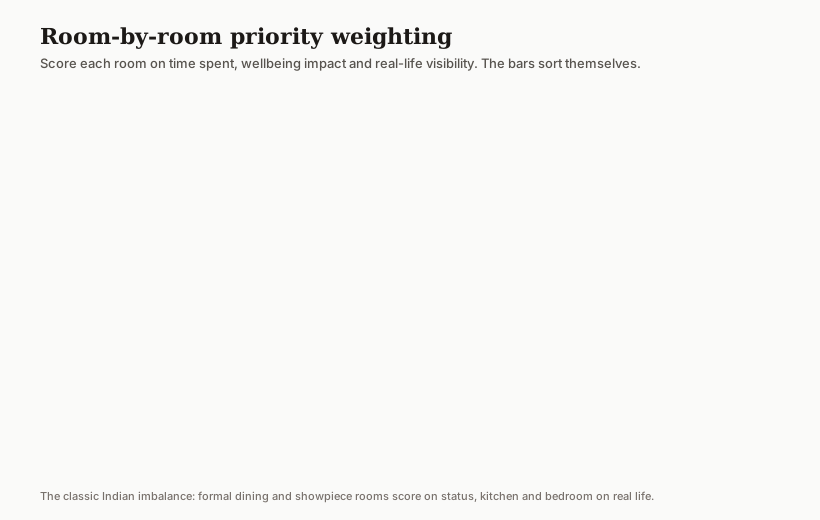
A worked example for a typical two-working-adults household in a metro flat — your numbers will differ, which is exactly the point:
| Room / category | Hours/day there | Wellbeing impact (1–5) | Real-life visibility (1–5) | Weighted priority |
|---|---|---|---|---|
| Kitchen | 2.5 | 5 | 5 | Highest |
| Living / family room | 4 | 5 | 5 | Highest |
| Master bedroom | 8 (sleep) | 5 | 3 | High |
| Main bathroom | 1 | 4 | 3 | Medium-high |
| Home office / study | 6 (WFH) | 4 | 2 | High (if WFH) |
| Kids' room | varies | 4 | 3 | Medium-high |
| Formal dining | 0.2 | 2 | 4 | Low |
| Guest room | rare | 1 | 1 | Lowest |
Notice how this exposes the classic Indian imbalance: the formal dining and showpiece drawing-room score low on real-life use but high on status visibility, while the kitchen and master bedroom — where life actually happens — quietly carry the household. A weighted method drags that imbalance into the open and lets you correct it on purpose. The priority-ranking tool does exactly this scoring for you: enter your rooms, rate them, and it returns a ranked, weighted list you can hand straight to a designer.
Resolving competing priorities in a household
So far this has assumed one decision-maker. Real Indian homes have several — a couple, often a joint family, sometimes three generations — and their priorities collide. He wants the home theatre; she wants the open kitchen. The parents want a large pooja room; the children want their own study. Everyone's list is reasonable, and there is not enough budget or space for all of it. This is where projects stall and many sour.
The failure mode is to argue item by item, which turns the home into a negotiation where someone wins, someone loses, and the loser nurses it for years. The better approach is to make each person's priorities explicit and ranked privately first, before any joint discussion. When each person arrives with their own top three — not the whole list, just what they would genuinely grieve to lose — the conversation changes. You are no longer fighting over thirty items but fitting together a handful, and the true top-threes usually overlap less than feared and conflict in only one or two places.
A method that works well for couples and families:
- Each person ranks privately first. No anchoring, no one dominating. Each lists their non-negotiables and single most-wanted nice-to-have.
- Pool the top non-negotiables. Often they are different rooms entirely — one cares most about the kitchen, the other the bedroom — and both can be honoured without conflict.
- Trade across categories, not within them. "You get the theatre corner, I get the open kitchen" resolves cleanly; fighting over the same square metre does not. Cross-category trades let everyone keep their number-one.
- Give the daily user the deciding vote. The person who cooks leads kitchen decisions; the person who works from home leads the study. Authority follows use.
- Name a shared priority everyone owns. A family room you all love creates common ground and softens the individual compromises elsewhere.
| Conflict | Item-by-item fight (poor) | Ranked, cross-category resolution (better) |
|---|---|---|
| Theatre vs open kitchen | Argue which is "more important" | Each takes their #1; trade across rooms |
| Big pooja vs kids' study | Compete for the same room | Convertible space, or shrink both slightly |
| In-laws' room vs guest room | One wins, one resents | Combine into one flexible room |
| His study vs her wardrobe | Split the difference, both unhappy | Daily-user leads; other leads elsewhere |
How a household actually lives — who cooks, who works from home, who hosts, how the generations share space — is the raw material for all of this, and it is worth mapping before you rank. Our guide on the questions to ask about how you really live is the natural first step; the ranking in this guide is what you do with those answers.
Maximising: getting the most from your top priorities
Setting priorities is half the work. The other half is maximising — making sure the things you chose to invest in deliver the most value possible, so the concentrated spending pays off. A priority that absorbs forty percent of the budget but is executed thoughtlessly is worse than a modest one done with care. Maximising is about full value, not full spending.
A few principles for squeezing the most from your top priorities:
- Invest in the bones, not the decoration. Put money into what is hard or expensive to change later — the layout, the plumbing and wiring, the natural light, the structural storage. Cushions, paint and accessories upgrade cheaply anytime; a badly placed kitchen sink does not.
- Buy quality once for high-use items. For true priorities, the cheapest long-term choice is usually the good one bought once. A quality mattress, a well-built sofa, solid kitchen hardware reward you daily for a decade and avoid the false economy of replacing cheap things twice.
- Protect the priority from scope creep. As budgets tighten mid-project, the temptation is to shave the priority to fund a sudden new want. Resist — the priority is the priority precisely so it survives the squeeze intact.
- Let the priority earn its space. A maximised kitchen is not just an expensive one; it is laid out around how you actually cook, with the work triangle, storage and light all working. Maximising is design intelligence applied to the thing you chose, not money piled on it.
The deepest form of maximising is making sure your priorities are genuinely yours — not inherited defaults, not status reflexes, not last year's trend. A priority that reflects how you truly live returns value every day for years; one chosen to impress returns value for the ninety minutes the guests are there. The whole exercise of ranking is ultimately a way of finding out what you actually value — and that, more than any budget, is what makes a home feel like yours. The pillar guide on choosing an architect, designer or AI walks through who can help once your priorities are clear.
How Studio Matrx helps
The hardest part of all this is honesty under pressure — seeing clearly what you value most before the showroom, the relatives and the trends pull you off course. That is where starting with AI is genuinely useful: it is low-risk and judgement-free. With DesignAI you can visualise your real rooms under different priority choices — a generous kitchen against a generous living room, a maximised master bedroom against a showpiece drawing-room — and feel the trade before you spend a rupee, so the ranking stops being abstract and becomes something you can see. Pair it with the priority-ranking tool to turn instinct into a clear, weighted list, then hand that plan to whoever builds it. You will arrive knowing exactly what to maximise and what to let go — the difference between a home that merely gets finished and one that feels, every day, made for the way you actually live.
References
1. Christensen, C. M., Hall, T., Dillon, K. & Duncan, D. S. (2016). Competing Against Luck: The Story of Innovation and Customer Choice. HarperBusiness — on the "jobs to be done" lens for deciding what a purchase is really for.
2. Kahneman, D. (2011). Thinking, Fast and Slow. Farrar, Straus and Giroux — on how experiences are remembered as moments and peaks rather than averages.
3. Alexander, C., Ishikawa, S. & Silverstein, M. (1977). A Pattern Language. Oxford University Press — on hierarchy of spaces and giving the most-used rooms primacy.
4. Bureau of Indian Standards. National Building Code of India 2016 (NBC 2016), Part 3 — habitable-space requirements that constrain how rooms can be sized and weighted.
5. Susanka, S. (1998). The Not So Big House. Taunton Press — on spending on quality and detail in the rooms you live in rather than on raw square footage.
Part of the Studio Matrx Planning Your Project series. Continue with the trade-offs every Indian homeowner faces, the questions to ask about how you really live, and the pillar guide on whether you need an architect, designer or AI.
Export this guide
Related Guides — Deep-dive reading
The Trade-Offs Every Homeowner Has to Make
No one gets everything — every home is a stack of compromises. This is about the sacrifices: the cost-quality-time triangle, the recurring homeowner trades, and how to make your cuts on purpose instead of having them forced by a blown budget.
Planning Your ProjectStorage Planning Before Interior Design
Why storage must be planned first — audited, budgeted and given its floor area — before a single layout, colour or sofa is chosen. The homeowner's plan-it-first master guide for Indian homes.
StorageThe Design Decisions With the Biggest Cost Consequences
A cost-leverage map of Indian home interiors — the handful of decisions that swing your total budget the most, so you spend your attention where a single choice has an outsized rupee impact.
Cost & MoneyRelated Tools — Try Free
False Ceiling Cost Estimator
Live ₹/sqft across 8 ceiling types — POP, gypsum, designer, metal, PVC, wooden — with cove and spot lighting for 20 Indian cities.
Cost CalculatorFull-Room BOQ — Living, Bedroom, Kitchen, Bath
Room-wise BOQ across living, bedrooms, kitchen, utility, and bathrooms with line-item pricing.
Full-Room BOQHome Building & Interior Cost Calculator — 20 Cities
Construction + interior costs for 20 Indian cities across kitchen, wardrobes, flooring, painting, ceiling.
Cost Calculator