
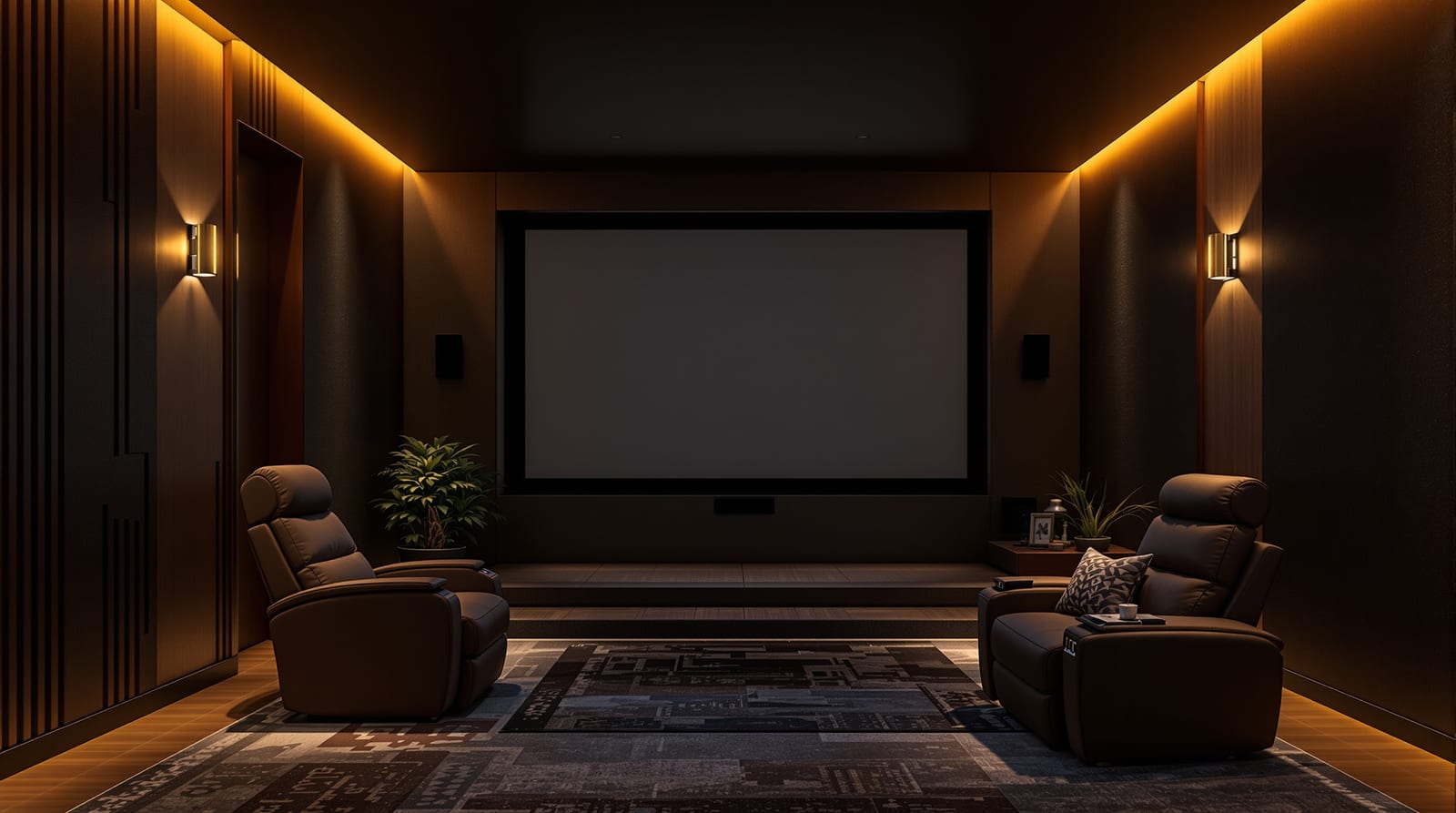
Home Theatre Door in India: Acoustic Sealing, STC Ratings and Costs (2026)
Why a normal door ruins a media room - and how to spec a heavy solid-core acoustic door with full perimeter seals, a drop-down bottom seal, light-tight finish and (for serious rooms) a double-door airlock.
You spent lakhs on a 7.1.4 Atmos system, acoustic panels and a calibrated projector - and then hung a hollow-core flush door on the room. That single door is now the weakest link in the whole build. Sound pours out of it into the bedrooms upstairs, hallway light leaks in around its edges and washes out your blacks, and the bass you paid so much for thins out because the door rattles and leaks. In a home theatre or media room, the door is not joinery. It is an acoustic and light barrier, and it has to be specified like one.
This guide is about that specific job: keeping sound IN and light OUT. We will cover what makes a door actually isolate sound (mass, perimeter seals and a drop-down bottom seal), what STC numbers to aim for, when a single sealed door is enough versus when you need a double-door airlock, how to keep the face dark and non-reflective, and what it all costs in India. For the underlying acoustics theory and wall treatment, pair this with our broader soundproof doors guide.
Why an ordinary door fails a theatre room
Sound isolation comes from three things, and a stock door fails all three.
Mass. A hollow-core flush door weighs almost nothing - the two laminate skins are mostly air and honeycomb cardboard inside. Sound passes straight through low-mass panels. Isolation roughly tracks weight per square metre, so the first move is always a heavy, dense, solid-core leaf. See our flush doors guide for solid-core versus hollow-core construction.
Seals. Even a heavy door leaks like a sieve if there are air gaps around it. A normal door has a 3-5 mm gap at the top and sides and a 10-15 mm undercut at the bottom for the floor finish. Sound (and light) is a fluid - it finds every gap. An unsealed perimeter can throw away 10-15 STC points of an otherwise good door. This is why door seals and weatherstripping matter more than the door itself in many real installs.
The bottom edge. That undercut at the floor is the single biggest leak. A permanent gasket there would scrape the floor when the door swings. The solution is an automatic drop-down bottom seal: a spring-loaded aluminium strip housed in a groove in the door bottom that drops down onto the floor only when the door closes, and lifts clear when it opens.
Get the mass, the perimeter and the bottom right together and the door starts performing as a system.
STC: the number that matters
STC (Sound Transmission Class) is the single rating you should ask every supplier for. Higher is better; each point is roughly one decibel of reduction across speech and music frequencies.
A bare hollow door is around STC 20 - useless. A solid-core door with no seals is maybe STC 27-30, still poor because of the gaps. A solid-core door with a full perimeter seal kit and a drop seal jumps to roughly STC 35-43. A purpose-built acoustic door assembly, or two doors in an airlock, reaches STC 45-55. For a home theatre, aim for STC 35 as a sensible minimum, STC 40-45 for a serious dedicated room, and STC 50+ only if the room shares a wall with a bedroom or you watch loud, late, and often.
One caution: STC is measured on the whole door-frame-seal assembly in a lab. A door rated STC 45 that is fitted into a sloppy frame with gaps and no drop seal will deliver far less. Specify the assembly, insist the frame and seals are part of the quote, and have it fitted by someone who understands acoustic gaskets.
The acoustic door system - illustrated
Recommended doors for an Indian home theatre
Rank by the three drivers that decide a theatre door, in order: sound isolation, light seal, then aesthetics. Cost rises with isolation.
| Door option | Typical STC (sealed assembly) | Seals needed | Indicative cost per door (incl. frame, seals, fitting) | Why / when |
|---|---|---|---|---|
| Solid-core flush, laminated, + full perimeter seal kit + drop seal | 35-40 | Head + jamb compression gaskets, auto drop-down bottom seal | 18,000 - 35,000 | Best value entry point for most home theatres; dark laminate face built in |
| Solid teak / engineered hardwood panel + seal kit | 38-43 | Same as above | 30,000 - 70,000+ | When the door also faces a living area and looks matter; mass + warmth |
| Purpose-built acoustic door (factory STC-rated, dense mineral/MDF core, integral seals) | 43-50 | Integral - factory fitted | 45,000 - 1,20,000+ | Dedicated rooms; certified single-leaf performance; specialist supply |
| Double-door airlock (two sealed solid-core or acoustic doors with a vestibule) | 48-55+ | Two full seal sets | 40,000 - 1,50,000+ (two doors + works) | Shared bedroom wall, loud/late use; the gold standard |
Costs are indicative for 2026 and vary by size, finish, core, brand and city; add 18% GST. A standard acoustic door is heavier and thicker (often 45-54 mm leaf) than a normal 35 mm door, so the frame and hinges must be upsized to suit. For the wider material comparison and pricing logic, see our energy-efficient doors guide, which covers the same sealing and core-density principles for thermal and acoustic gain.
The light seal - blacks matter as much as bass
A home theatre lives on contrast. A thin line of corridor light leaking around the door edges, or a glow under the bottom, lifts the black level of the whole screen and kills the cinematic look. The good news: the same perimeter compression gaskets and automatic drop-down bottom seal that stop sound also stop light. They go together. Just confirm two things: that the seals are continuous with no gaps at the corners, and that the door face and surrounds are a dark, matte, non-reflective finish - a deep charcoal, black or dark veneer with a matte laminate, never a glossy white that bounces projector spill back at the screen. Avoid any glazed vision panel on a theatre door; it leaks both light and sound. If you want a small viewer, use a sealed cover.
Hardware, swing and clearance
Spec the hardware around weight and silence. A heavy acoustic leaf needs three to four hinges (preferably ball-bearing) and a sturdy frame fixed solidly into the wall. Use a quiet, well-fitted mortise latch - rattly hardware buzzes during loud scenes. A discreet door closer helps the door close fully so the seals compress every time, which is essential because seals only work when the door is properly shut. Decide the swing early: it is usually best to swing the door OUT of the theatre so the heavy leaf does not eat into seating layout, but check it does not block a corridor or, in a basement room, an escape path. Keep a clear opening of at least 900 mm so a sofa and equipment can get in. If the room is in a basement or is the only exit, do not over-engineer it into a trap - the door must always open easily from inside without a key.
Do and do not
Do start with a genuinely heavy solid-core or purpose-built acoustic leaf - you cannot seal your way out of a light door. Do buy the door, frame and seals as one assembly with a stated STC. Do fit an automatic drop-down bottom seal; it is the highest-value single upgrade. Do go matte and dark on the face. Do upsize hinges and frame for the extra weight.
Do not hang a hollow-core door and expect panels on the walls to compensate. Do not leave the bottom undercut open. Do not put glazing in the door. Do not forget that a single thin gap anywhere undoes most of the door's rating. Do not block the only exit or fit a lock that cannot be opened instantly from inside.
Single sealed door or a double-door airlock?
For most Indian home theatres - a dedicated room with treated walls and a reasonable gap from bedrooms - one heavy solid-core door with a full seal kit and a drop seal (STC 35-43) is the right, cost-effective answer. Step up to a factory acoustic door (STC 43-50) if the room is serious and you want certified performance. Build a double-door airlock - two sealed doors with a small dead-air vestibule between them - only when the room shares a wall or floor with a bedroom, when you watch loud and late, or when you are also using the space as a recording studio, where the airlock is standard practice. The airlock is the most effective option by a wide margin, but it costs the most and consumes floor area for the vestibule.
To narrow the choice for your specific room and budget, run it through our acoustic door selector tool, and use the doors-by-space guide to coordinate the theatre with the rest of the home's doors.
Frequently asked questions
What STC rating do I need for a home theatre door in India?
Aim for STC 35 as a practical minimum, STC 40-45 for a serious dedicated room, and STC 50+ if the theatre shares a wall or floor with a bedroom. A bare hollow door is only about STC 20, so almost any sealed solid-core door is a big upgrade. Always ask for the rating of the full door-frame-seal assembly, not the leaf alone.
Can I just soundproof my existing flush door?
Only partially. If it is already solid-core, adding a full perimeter seal kit and an automatic drop-down bottom seal will help a lot and is the best-value upgrade. If it is hollow-core, no amount of sealing fixes the lack of mass - the panel itself leaks sound. In that case replace the leaf with a heavy solid-core or purpose-built acoustic door.
Why does light leaking around the door matter for a theatre?
A home theatre depends on deep black levels for a cinematic image. Even a thin line of light around the door edges or under the bottom raises the room's ambient light and washes out the picture. The same compression gaskets and drop-down bottom seal that stop sound also block light, and a dark matte face stops projector spill reflecting back at the screen.
What does a good home theatre door cost in India?
A solid-core door with a full seal kit and drop seal typically runs about 18,000 to 35,000 rupees fitted; a hardwood or factory acoustic door 45,000 to over 1,20,000; and a double-door airlock 40,000 to over 1,50,000 for the two doors and works. Figures are indicative for 2026, vary by size, core and city, and exclude 18% GST.
Do I need a double-door airlock at home?
Usually not. For a typical dedicated theatre with treated walls, one well-sealed heavy door is enough. Build an airlock only when the room adjoins a bedroom, when you watch loud and late, or when the space doubles as a recording or music room - then the two-door vestibule (STC 50+) is the reliable way to keep both sound and light contained.
Export this guide
Related Guides — Deep-dive reading
Soundproof Doors in India: How Doors Leak Sound, STC Ratings, Seals & Real Costs
A door is the weakest acoustic link in any wall - and it usually leaks through the gaps, not the panel - so here is how to actually quieten a bedroom, home theatre or street-facing room, from a 1,500-rupee seal kit to a proper acoustic door.
Home Doors & EntrancesRecording Studio Door in India: Sound-Lock Airlock, STC/Rw Ratings and Costs (2026)
The highest acoustic-isolation door in any building - a very heavy lead-loaded or solid acoustic leaf with full perimeter gaskets, an automatic drop seal, a multi-pane vision window and, for true isolation, the double-door sound-lock with a dead-air vestibule.
Home Doors & EntrancesGuest Room Door in India: Privacy, Quiet and Smart Picks Without Overspending (2026)
How to choose a guest bedroom door for an Indian home - privacy and acoustics so visitors feel comfortable, but budget-sensible for a room used only now and then: solid-core flush for quiet, panel or laminate for looks, the right privacy lock, simple soundproofing, and a finish that matches the rest of your doors - with picks ranked and indicative rupee costs.
Home Doors & EntrancesRelated Tools — Try Free
Acoustic Door Selector
Get the STC rating and door build you need for a quiet space — home theatre, studio, boardroom or hotel room.
Door ToolDoor Cost Calculator
Estimate the all-in cost of a door — leaf, frame, hardware, fitting and GST — by type, material and size.
Door CalculatorDoor Material Comparison Tool
Compare 2–4 door materials on cost, durability, maintenance, security and moisture resistance.
Comparison Tool