
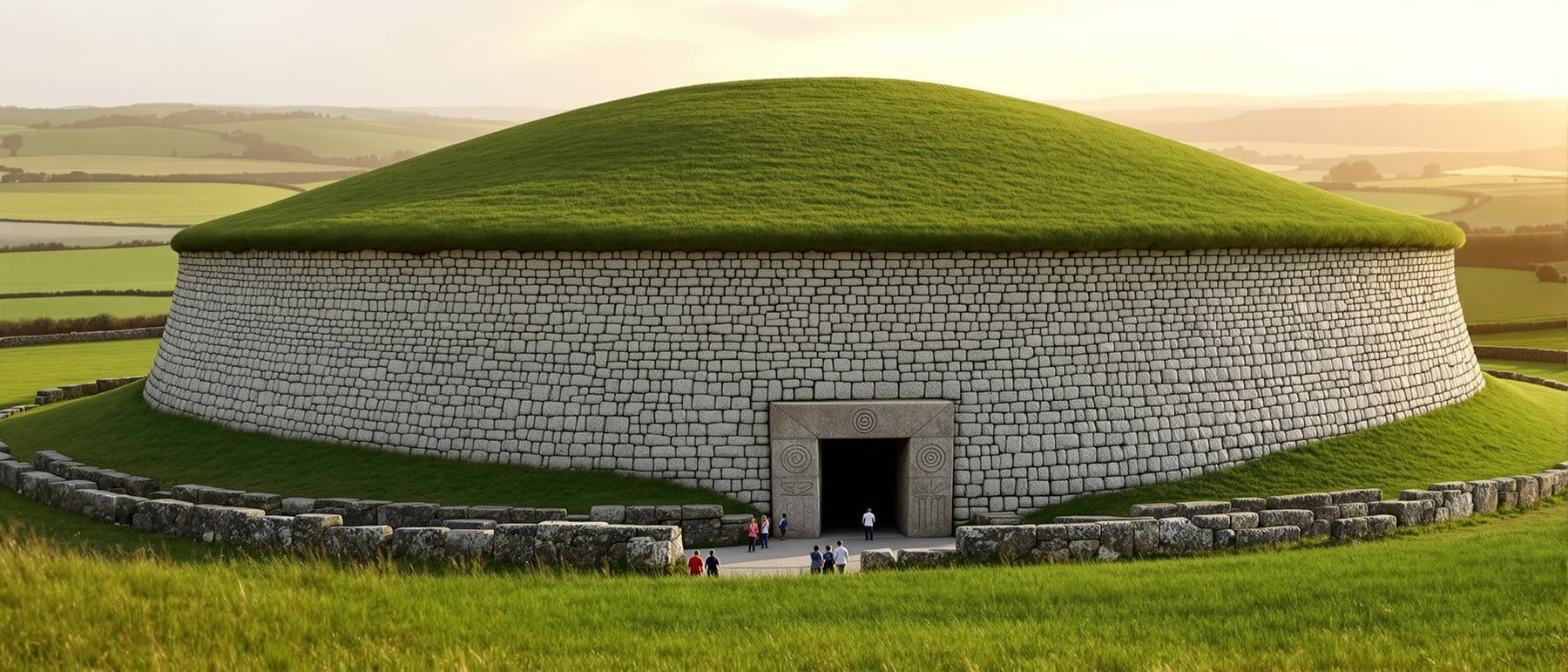
Newgrange: The Tomb That Catches the Sun
How Neolithic farmers in Ireland — with no metal, no wheel and no writing — raised a 200,000-tonne mound of turf and stone six centuries before the Great Pyramid, roofed a chamber that has stayed dry for 5,000 years, and aimed a stone box at the winter dawn so that once a year the sunrise reaches 19 metres into the dark and lights the heart of the tomb.
We turn now from the Seven Wonders to a longer, wider journey — through the great tombs of the world, the astonishing buildings that humanity, in every age and on every continent, has raised for its dead. And we begin at the very beginning, with a monument so old it makes the pyramids look modern: a grass-covered mound on a bend of the River Boyne in Ireland, built around 3200 BCE — some six centuries before the Great Pyramid of Giza, and older than the stone circle at Stonehenge.
Newgrange was built by Stone Age farmers who had no metal, no wheel, and no writing. Yet they raised a two-hundred-thousand-tonne mound, roofed a stone chamber that has stayed bone dry for five thousand years, and — most wondrous of all — engineered the whole vast structure so that, at the winter solstice, the rising sun would reach nineteen metres down a stone passage and light the tomb's dark heart. It is a tomb, a temple, and a calendar, all in one. It is where the story of the world's great tombs must start.
This is the thirty-eighth article in our Architectural Wonders series, and the first of a new chapter on great tombs.
1. Older than the pyramids
The first thing to grasp about Newgrange is simply when it was built — because it resets your whole sense of what "ancient" means.
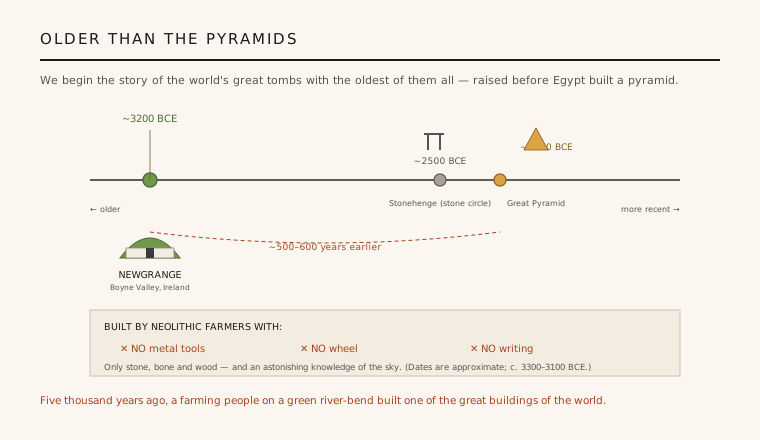
Newgrange dates to around 3200 BCE — roughly five to six centuries older than the Great Pyramid we met at the start of this series, and older than the great stone circle at Stonehenge. When the pharaohs' engineers began stacking the Pyramids of Giza, Newgrange had already been standing, and catching the solstice sun, for hundreds of years. And it was built by a society with none of the tools we assume you need for monumental architecture: no metal to cut or lift with, no wheel to roll loads, no writing to record a plan. Only stone, bone and wood — and a profound, patient knowledge of the land and the sky. That is the wonder that frames all the others here: greatness in building is not a gift of technology. These Neolithic farmers on a wet green river-bend were the equals, in ambition and skill, of any pharaoh.
2. A mountain raised by hand
Stand before it and Newgrange is, first, an act of sheer collective muscle — a small mountain, made by hand.
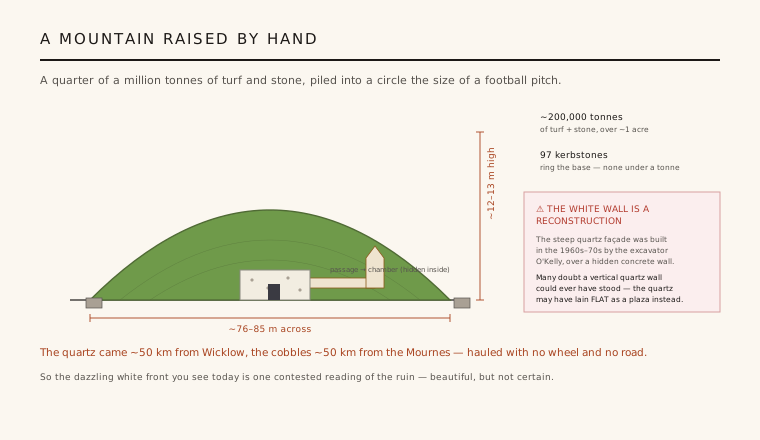
The mound is a circular cairn about 76 to 85 metres across (it is not a perfect circle) and twelve to thirteen metres high — roughly a football pitch in width — built of layer upon layer of turves and water-rolled stones, an estimated two hundred thousand tonnes of material, ringed at its base by ninety-seven massive kerbstones, none weighing less than a tonne. The white quartz that makes its front so dazzling was carried some fifty kilometres from the Wicklow Mountains, the grey cobbles a similar distance from the Mournes — hauled without a wheel or a road. But here honesty demands a flag: that striking vertical white wall is a modern reconstruction. It was built in the 1960s and 70s by the excavator Michael O'Kelly, over a hidden concrete retaining wall, from quartz he found collapsed outside the kerb. Many archaeologists doubt a steep dry-stone quartz wall could ever have stood, and think the quartz may originally have lain flat, as a bright plaza on the ground before the entrance. So the gleaming face in every photograph — the hero above included — is a beautiful, educated guess, not a certainty. It is a useful reminder that even our most famous ancient monuments are, in part, reconstructions of a ruin.
3. The roof that never leaked
Step through the low doorway and the real genius reveals itself — not in the mound, but in the engineering hidden inside it.
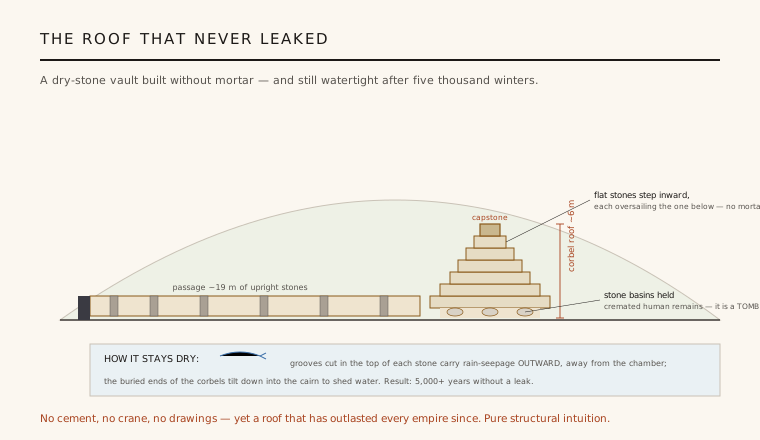
A stone passage about nineteen metres long, walled and roofed with great upright slabs, runs into the heart of the mound and opens into a cross-shaped chamber with three recesses. Above it rises the masterpiece: a corbelled roof, nearly six metres tall, built of flat stones each oversailing the course below, spiralling inward until a single capstone closes the peak — laid entirely without mortar. And it has stayed watertight for over five thousand years. That is no accident: the builders cut channels into the tops of the stones to lead rain-seepage outward, and buried the corbels' outer ends slightly tilted down into the cairn to shed water away. No cement, no crane, no drawings — just an intuitive mastery of how stone sheds water and carries load that would satisfy a modern engineer. In the recesses stood large stone basins holding cremated human remains: for all its cosmic ambition, Newgrange is, at its core, a tomb — a house built to keep the dead dry and safe forever. It is the same corbelling principle we meet again, scaled up and cut in fine ashlar, at the Treasury of Atreus in Mycenae, later in this chapter on great tombs.
4. Seventeen minutes of light
And now the thing that makes Newgrange not merely old, or well-built, but sublime.
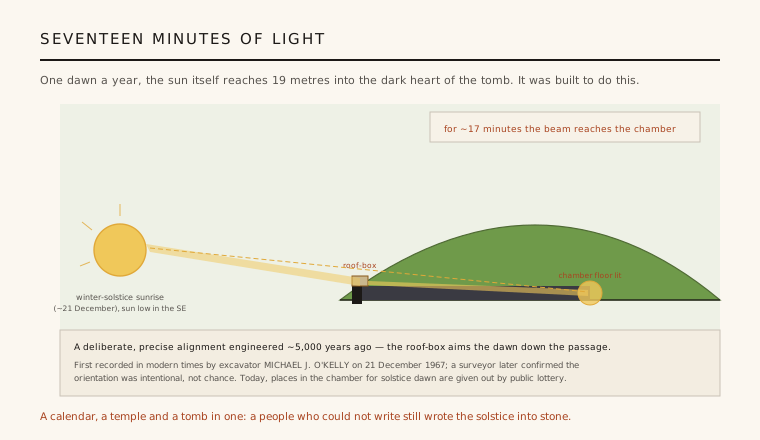
Above the entrance, the builders set a small, deliberate stone aperture — the roof-box. And for a few mornings each year, around the winter solstice (about 21 December), as the sun rises low in the south-east, a narrow beam of sunlight passes through that box, travels the entire nineteen-metre length of the passage, and lands on the floor of the inner chamber, lighting the darkness for about seventeen minutes. This is not chance. It is a precise astronomical alignment, engineered five thousand years ago by people who tracked the sun's yearly journey with such care that they could aim a building at a single sunrise. The excavator Michael O'Kelly was the first person in modern times to witness and record it, standing in the chamber at dawn on 21 December 1967; a surveyor later confirmed the orientation was intentional. On the shortest, darkest day of the year, when the old year dies, the sun is invited into the tomb of the dead — a promise of return written in stone. It is the same instinct that would later raise Konark as a chariot for the sun-god: architecture as a machine for meeting the heavens. So great is the modern longing to be there that places in the chamber for solstice dawn are now allotted by public lottery.
5. The spirals no one can read
Newgrange leaves us, finally, with a message we can see with perfect clarity — and still cannot understand.
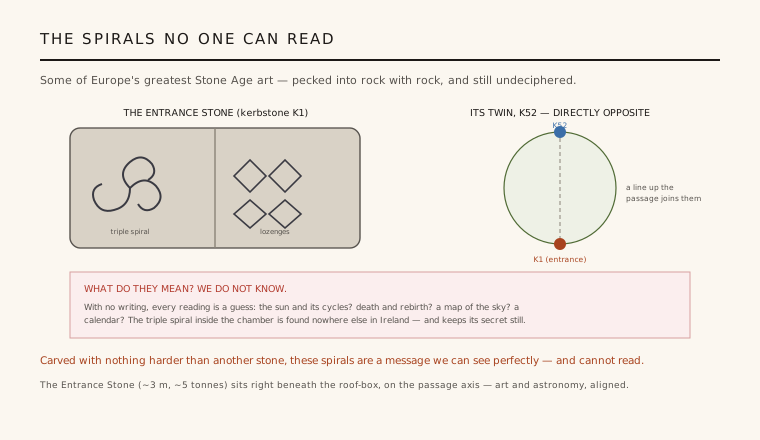
The stones of Newgrange carry some of the greatest Stone Age art in Europe — abstract designs pecked into the rock with nothing harder than another rock: spirals, lozenges, chevrons, concentric arcs. The great Entrance Stone (kerbstone K1), a five-tonne slab sitting directly beneath the roof-box on the passage axis, is carved with a famous triple spiral and interlocking lozenges; a richly decorated twin, K52, lies exactly opposite it across the mound. The triple spiral — the triskele — appears again deep inside the chamber, and is found on no other monument in Ireland. And what does any of it mean? We simply do not know. With no writing to guide us, every reading is a guess: the sun and its cycles, death and rebirth, a map of the sky, a calendar, a symbol of some forgotten faith. Five thousand years on, we can trace every groove with a fingertip and read nothing — the clearest possible proof that a building can carry meaning long after the meaning itself is lost. Which is, in the end, exactly what a great tomb is for.
6. What a modern architect can learn from Newgrange
- Great architecture is not a gift of technology. With no metal, wheel or writing, Neolithic farmers built for the ages. Ambition, organisation and deep observation matter more than tools — a humbling, liberating truth.
- Design with the cosmos, not just the site. Newgrange is aimed at a single sunrise. The most profound buildings relate not only to their ground but to the sun, the seasons, the sky. Ask what your building should do at a particular hour of a particular day.
- Detailing is what lasts. The chamber is dry after 5,000 years because someone cut grooves to shed water and tilted the corbels just so. Monuments survive on their humblest, most invisible details; get the water out and the rest endures.
- Build for meaning, and it will outlive the meaning. The spirals still move us though we cannot read them. Design can carry emotion and significance across millennia, even when the specific message is forgotten.
- Honesty about reconstruction is part of respect. The famous quartz wall is a contested modern guess. When we restore the past, we should say plainly what is evidence and what is interpretation — a discipline as important in conservation as in construction.
- A tomb can be an act of hope. Newgrange turns the darkest day into a meeting with the light. The greatest funerary architecture is not about death but about continuity — the refusal to let the dead, or the living who remember them, simply vanish.
References & further reading
1. UNESCO World Heritage Centre — Brú na Bóinne — Archaeological Ensemble of the Bend of the Boyne (inscribed 1993). https://whc.unesco.org/en/list/659/
2. World Heritage Ireland (OPW) — Brú na Bóinne. https://www.worldheritageireland.ie/bru-na-boinne/
3. Newgrange.com (Brú na Bóinne / OPW) — Newgrange and Winter Solstice. https://www.newgrange.com/winter-solstice-newgrange.htm
4. World History Encyclopedia — Newgrange. https://www.worldhistory.org/Newgrange/
5. Encyclopaedia Britannica — Newgrange. https://www.britannica.com/place/Newgrange
6. RTÉ Brainstorm — How Newgrange's solstice light show was rediscovered (O'Kelly, 1967). https://www.rte.ie/brainstorm/2025/1220/1549633-newgrange-winter-solstice-light-show-sunrise-discovery-michael-j-okelly/
Last verified 2026-07-04. Figures follow the OPW/UNESCO and standard archaeological record and are given as widely cited approximations that vary by source: Newgrange was built around 3200 BCE (c. 3300–3100 BCE), roughly 500–600 years before the Great Pyramid and older than Stonehenge's stone circle; the mound is about 76–85 m across (not a true circle) and ~12–13 m high, ~200,000 tonnes, ringed by 97 kerbstones; the passage is ~19 m long and the corbelled chamber roof rises to nearly 6 m and has remained watertight. The winter-solstice roof-box alignment lights the chamber for ~17 minutes at sunrise and was first recorded in modern times by Michael J. O'Kelly on 21 December 1967. IMPORTANT: the vertical white-quartz façade is a contested modern reconstruction (O'Kelly, 1960s–70s, over a concrete retaining wall); many scholars think the quartz may instead have formed a flat ground plaza, and a minority even question the roof-box reconstruction — the alignment itself, however, is well documented. The meaning of the megalithic art (spirals, triskele, lozenges) is unknown; symbolic readings are interpretation. Brú na Bóinne (Newgrange, Knowth and Dowth) is a UNESCO World Heritage Site (1993).
Export this guide
Related Guides — Deep-dive reading
Ġgantija: The Oldest Temple Standing, Built by 'Giants'
How a Neolithic island people on Malta — with no metal and no wheel — raised the oldest free-standing stone temples on Earth a thousand years before Stonehenge or the pyramids, moving fifty-tonne blocks on stone balls into clover-leaf sanctuaries for a faith we can trace but cannot read, then vanished, leaving stones so vast that later islanders swore only giants could have built them.
Architectural WondersStonehenge: The Stone Circle That Was Built Like Carpentry
How Neolithic Britons, over fifteen centuries and with nothing but antler picks and rope, dragged twenty-five-tonne sarsens and Welsh bluestones across an island to raise the only stone circle on Earth joined like woodwork — mortise, tenon, tongue and groove in solid stone — aligned it on the turning sun, filled it with the cremated dead, and left us a temple whose purpose we still cannot fully name.
Architectural WondersThe Pyramid of the Sun: A Mountain Raised Over a Cave by a People With No Name
In the Valley of Mexico, a civilisation we cannot name built one of the largest pyramids on Earth — a man-made mountain of a million cubic metres — and set it precisely over a sacred cave they believed was the womb of the world. They left no writing we can read; even the words 'Pyramid of the Sun' were given, a thousand years later, by the Aztecs, who found the city in ruins and called it the birthplace of the gods.
Architectural WondersRelated Tools — Try Free
Before & After Studio
Generate AI before-and-after renders to preview how your redesign could look.
DesignAIBrise-Soleil Visualizer
Interactive horizontal-louvre cut-off angle calculator — sun altitude, louvre depth, and spacing inputs with a live shadow preview. Computes θ = arctan(spacing/depth) for façade shading, ECBC envelope compliance, hospital daylight design, and tropical sun-control detailing.
Sun Shading ToolCircadian Light Meter
Patient-centric circadian lighting visualizer for Indian healthcare design — time-of-day × intensity → CCT, melanopic lux (EML / mEDI), melatonin suppression, and an alertness curve. Calibrated against WELL v2 L03 Circadian Lighting Design, CIE S 026:2018, Brainard 2001, and Lucas et al. 2014.
Circadian Tool