
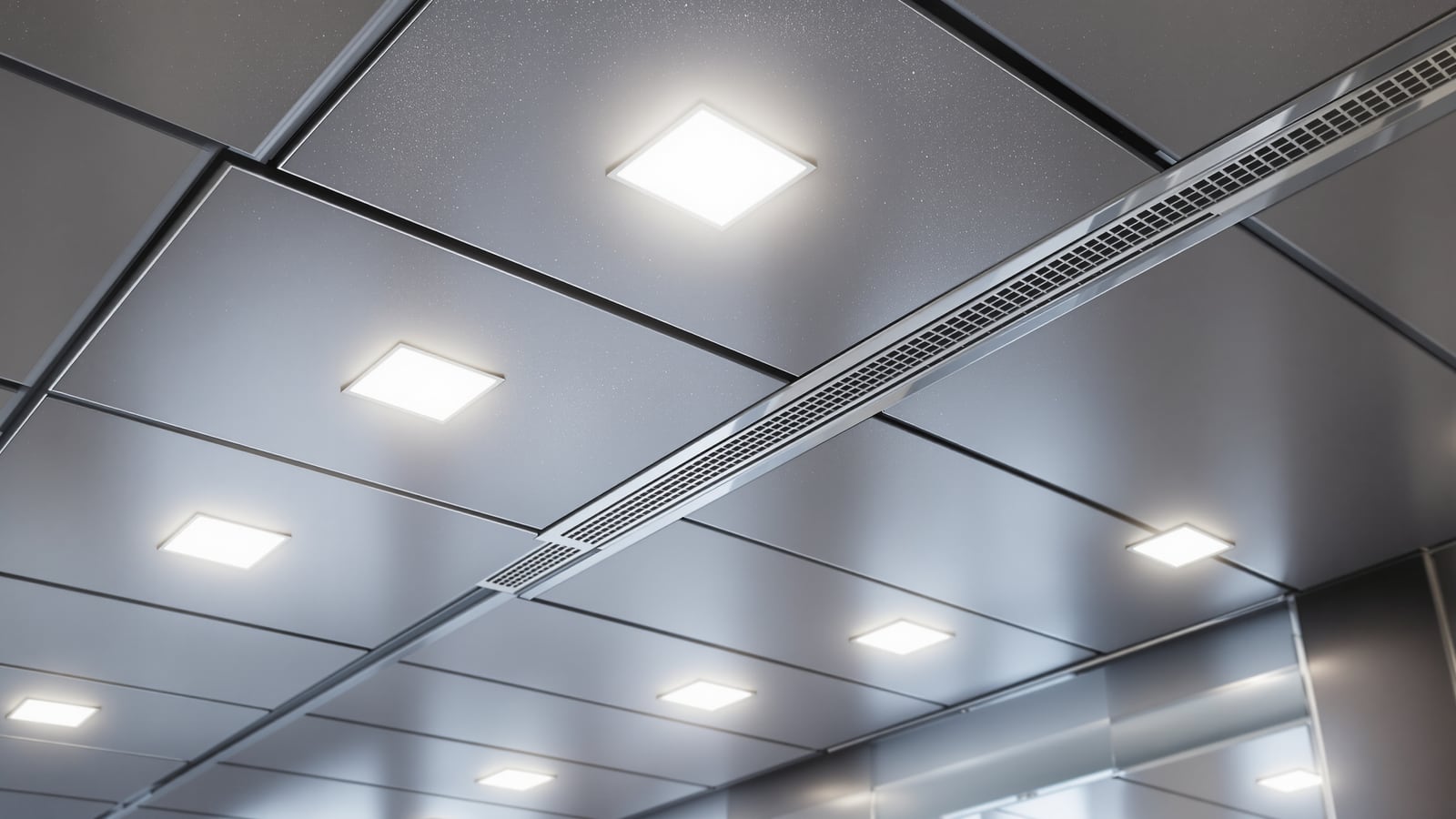
Aluminium False Ceiling for Bathroom India: Metal Panels, Cost & Rust-Proof Guide
Powder-coated aluminium and GI metal panel false ceilings for Indian bathrooms — fully rust and moisture proof, modular lay-in and clip-in tiles and linear strips, easy servicing access, integrated light and exhaust cutouts, and how the cost compares with PVC and gypsum.
A bathroom ceiling has the hardest job in the house. Steam rises to it, condenses on it and drips back down; the plumbing for the floor above often runs just behind it; and unlike a bedroom ceiling, nobody wants to repaint it every two years. Gypsum sags and stains when it stays damp, and even good PVC can warp and yellow over a long Indian summer. This is why more and more Indian architects specify a metal false ceiling — and for bathrooms specifically, a powder-coated aluminium or galvanised iron (GI) panel system is the most genuinely rust and moisture proof choice you can make.
This is the aluminium metal-ceiling guide in the Studio Matrx bathroom hub. Read it alongside the broader bathroom false ceiling guide for India, which covers every material and the drop-height and lighting basics. If you are weighing cheaper options, compare this with the PVC bathroom ceiling guide and the wider moisture-resistant ceiling guide. For the wet-zone detailing behind it all, keep the bathroom waterproofing guide open.
A metal ceiling is the only bathroom ceiling you can lift a tile out of with your fingers, fix a leaking joint above it, and drop back — with zero repainting and nothing thrown away.
What an aluminium metal ceiling actually is
A metal false ceiling is a suspended grid of thin metal panels hung below the structural slab. In a bathroom you will meet three panel materials and three panel formats. Get both right and the ceiling outlives the fittings below it.
The metal is almost always one of:
- Aluminium (0.5–0.7 mm) — light, will never rust because it forms its own oxide skin, and takes a durable powder coat or roll-coat finish. The default premium bathroom choice.
- Galvanised iron / steel (0.4–0.6 mm) — a zinc coat over steel; stronger and cheaper per panel, but the coating must be intact or cut edges can corrode over years of humidity. Good value if well finished.
- Aluminium composite / pre-coated — for continuous flat looks; less common in small bathrooms.
The suspension grid — hangers, main runners and cross-tees, or a carrier for strips — is itself galvanised or aluminium, so nothing in the assembly rusts.
The three panel formats
The format decides the look, the access and the price. This is the single most useful table in the guide.
| Format | How it sits | Access to services | Typical bathroom look | Relative cost |
|---|---|---|---|---|
| Lay-in tile (595×595 / 600×600 mm) | Drops into an exposed or semi-concealed T-grid | Best — lift any tile out by hand | Office-grid; fine for utility baths | Lowest |
| Clip-in / lay-on tile (300×300, 600×600 mm) | Clips up onto a concealed carrier, flush face | Good — special suction/clip tool pops a tile | Clean, seamless, premium | Medium |
| Linear strip / plank (100–200 mm wide, open or closed joint) | Runs in long lines on a carrier rail | Good — lift a strip along its run | Contemporary, directional, spa-like | Medium–high |
| Baffle / cell (open) | Open blades or grid, slab painted above | Full — nothing to remove | Loft / industrial | High |
For most Indian home bathrooms the sweet spot is a 300×300 mm clip-in or a 100–150 mm linear strip in a matte powder coat. Both give a flush, joint-controlled face that reads far more premium than a plain PVC sheet, while every panel still lifts out for servicing.
Why metal wins in a wet Indian bathroom
- Truly rust and moisture proof. Aluminium cannot rust at all; a good powder coat and galvanising protect steel panels. Steam, splash from the health-faucet, monsoon humidity — none of it swells, delaminates or stains the panel the way it does gypsum board.
- Dimensionally stable. Metal barely moves with heat and damp, so joints stay tight and panels stay flat over a long summer where PVC can bow.
- Easy servicing access. This is the quiet superpower. Concealed cistern plumbing, the shower mixer's back-end, geyser inlet lines and the exhaust duct often run in the ceiling void. Lift one tile, fix, and drop it back — no cutting, patching or repainting.
- Fire behaviour. Metal is non-combustible; it will not add fuel or drip flaming melt the way some plastics can. Sensible above a geyser.
- Finish and hygiene. Powder-coated surfaces are non-porous, wipe clean, resist mould at the joints and hold colour. Matte white, off-white, metallic grey, champagne, and wood-look roll coats are all standard.
- Fully demountable and reusable. At renovation you unclip the panels and reuse or recycle them — aluminium is one of the most recyclable materials there is, which helps on an IGBC or GRIHA scorecard.
Integrating lights, exhaust and services
A bathroom ceiling is never just a lid — it carries the lighting and the ventilation, and metal handles both cleanly because you cut and fit modules on a rigid, repeatable grid.
- Downlights. Recessed LED downlights drop into a cut hole in a clip-in tile, or into a purpose-made luminaire tile on the lay-in grid. Over the shower and the wet zone, insist on a fitting rated IP44 or higher (IP65 directly in the shower) per the zoning logic in NBC 2016 and IS 732; the metal panel itself is fine, but the fitting must suit the zone.
- Exhaust fan. The exhaust can sit in the void and vent through a slim grille tile, or a ceiling-mount fan can mount into a reinforced module. Keep the tile removable so the fan and duct stay serviceable. Size the fan per the ventilation guidance — roughly 6–10 air changes per hour.
- Access tile. Even with a clip-in system, mark one tile above the concealed cistern or the geyser union as your dedicated access panel.
Cost: aluminium vs PVC vs gypsum
Numbers move with brand, finish and city, but the relationship between the three materials is stable. Figures below are supply-and-fix, per square foot of ceiling, mid-2026.
| Ceiling type | Typical ₹/sq ft (fitted) | Life in a bathroom | Rust/moisture | Servicing access | Look |
|---|---|---|---|---|---|
| Aluminium panel (powder-coated) | ₹180–₹450 | 15–25+ years | Fully proof — cannot rust | Excellent (demountable) | Premium, crisp |
| GI / steel metal panel | ₹120–₹280 | 12–20 years | Very good if coating intact | Excellent | Premium |
| PVC panel / sheet | ₹60–₹150 | 7–12 years | Good; can warp/yellow | Panels prise off | Budget–mid |
| Gypsum board (moisture-resistant) | ₹90–₹180 | 8–15 years, needs repaint | Poor at joints; sags if wet | Poor — cut and patch | Seamless, paintable |
The honest read: aluminium costs roughly two to three times a PVC ceiling and a bit more than gypsum, but it is the only one you buy once. On a small 5×7 ft bathroom ceiling (~35 sq ft) that premium is a few thousand rupees over the life of the room — cheap insurance against sag, stains and repaint cycles. Where budgets are tight, GI panels give most of the metal benefit for less, and PVC remains the value pick covered in its own guide.
Installation and detailing that matters
- Set the drop. A 100–200 mm void below the slab is enough for the grid, a recessed downlight body and a slim duct. Do not steal more headroom than you need — Indian bathrooms are small, and NBC 2016 wants a usable clear height.
- Level and line up. Snap a laser line all round; a metal grid is unforgiving of a sloping wall, and mis-aligned strip joints show badly. Plan the panel layout so cut tiles fall at the least visible edge.
- Perimeter trim. Finish the edge with an L-angle or a shadow-gap trim in the matching coat, sealed to the wall so steam does not track behind it.
- Protect cut edges on GI/steel panels with the touch-up coat the supplier provides — a raw steel edge is the one place a metal ceiling can corrode.
- Coordinate first. Mark downlights, exhaust, speaker or sensor positions on the panel-layout drawing before ordering, so cutouts land on tile centres, not on a grid line.
Common mistakes to avoid
- Ordinary (non-IP) downlights over the shower — the panel is fine but a non-rated fitting will corrode and trip. Zone your fittings.
- No exhaust in the void — a sealed metal ceiling with poor ventilation just moves the condensation problem to the walls. Ceiling metal and good extraction go together; see the moisture-resistant ceiling guide.
- Skimping on the grid — a cheap, under-galvanised suspension system can rust even under aluminium panels. Specify the carrier as carefully as the face.
- Forgetting the access tile — clip-in systems need a plan for how you will actually reach the cistern or geyser union later.
Choose the panel material for the wet zone, the format for the look and the access you need, and the fitting IP rating for the zone — get those three right and an aluminium bathroom ceiling is genuinely a fit-and-forget decision. Continue with the bathroom false ceiling pillar for lighting and drop-height planning, and the bathroom renovation guide for phasing it into a refit.
References
- National Building Code of India (NBC) 2016, Bureau of Indian Standards — clear ceiling heights, ventilation and fire provisions for bathrooms and false ceilings.
- IS 737 — Wrought aluminium and aluminium alloy sheet and strip (panel material and thickness).
- IS 277 / IS 4759 — Galvanised (zinc-coated) steel sheet and hot-dip galvanising, relevant to GI panels and suspension components.
- IS 732 — Code of practice for electrical wiring installations (luminaire and exhaust circuits in wet areas).
- IEC / IS 60529 (IP code) — Ingress-protection ratings for the light fittings and fans set into the ceiling.
- IGBC Green Homes / GRIHA — credit for demountable, recyclable materials such as aluminium ceiling systems.
Export this guide
Related Guides — Deep-dive reading
Bathroom Planning for New Homes in India: Get It Right Before You Build
The bathroom decisions you cannot undo once the slab is cast — location and stacking, sunken vs non-sunken slabs, waterproofing, and the plumbing, electrical and ventilation you must coordinate with the civil work, stage by stage.
BathroomsBathroom False Ceiling India: PVC, Gypsum, Aluminium Panels, Cost & the #1 Moisture Rule
A complete guide to bathroom false ceilings for Indian homes — why you fit one, the material choices (PVC, moisture-resistant gypsum, aluminium and metal panels, ACP), access panels, integrating the exhaust fan and lights, and a rupee cost comparison — with the one rule that keeps a wet-zone ceiling from sagging.
BathroomsMoisture-Resistant Building Materials in India: The Right Material for Every Wet Zone (2026)
Moisture is the biggest enemy of Indian buildings - monsoon, rising damp, condensation, leaks and coastal humidity. This guide separates waterproofing (a system) from choosing inherently moisture-tolerant materials, then names the right material for bathrooms, exteriors, roofs, basements and finishes - with a zone-by-zone selector table. A specify-and-select guide.
Building MaterialsRelated Tools — Try Free
False Ceiling Cost Estimator
Live ₹/sqft across 8 ceiling types — POP, gypsum, designer, metal, PVC, wooden — with cove and spot lighting for 20 Indian cities.
Cost CalculatorBathroom Renovation Cost Calculator
Cost to renovate an existing bathroom with a replace-vs-keep model — demolition, re-waterproofing, tiles, fittings and the money saved by keeping items.
Bathroom CalculatorCross-Ventilation Analyzer
Estimate airflow and air changes per hour (ACH) from room size, window areas, layout, and local wind — with NBC 2016 Part 8 compliance check.
Ventilation Calculator