
PVC Ceiling for Bathroom in India: Panels, Cost & Fitting Guide
PVC panel false ceilings are India's most popular budget bathroom ceiling — fully waterproof, cheap and clipped into place in a day. What the panels are, how they span and frame, integrating lights and exhaust, lifespan, cleaning and ₹/sq ft cost.
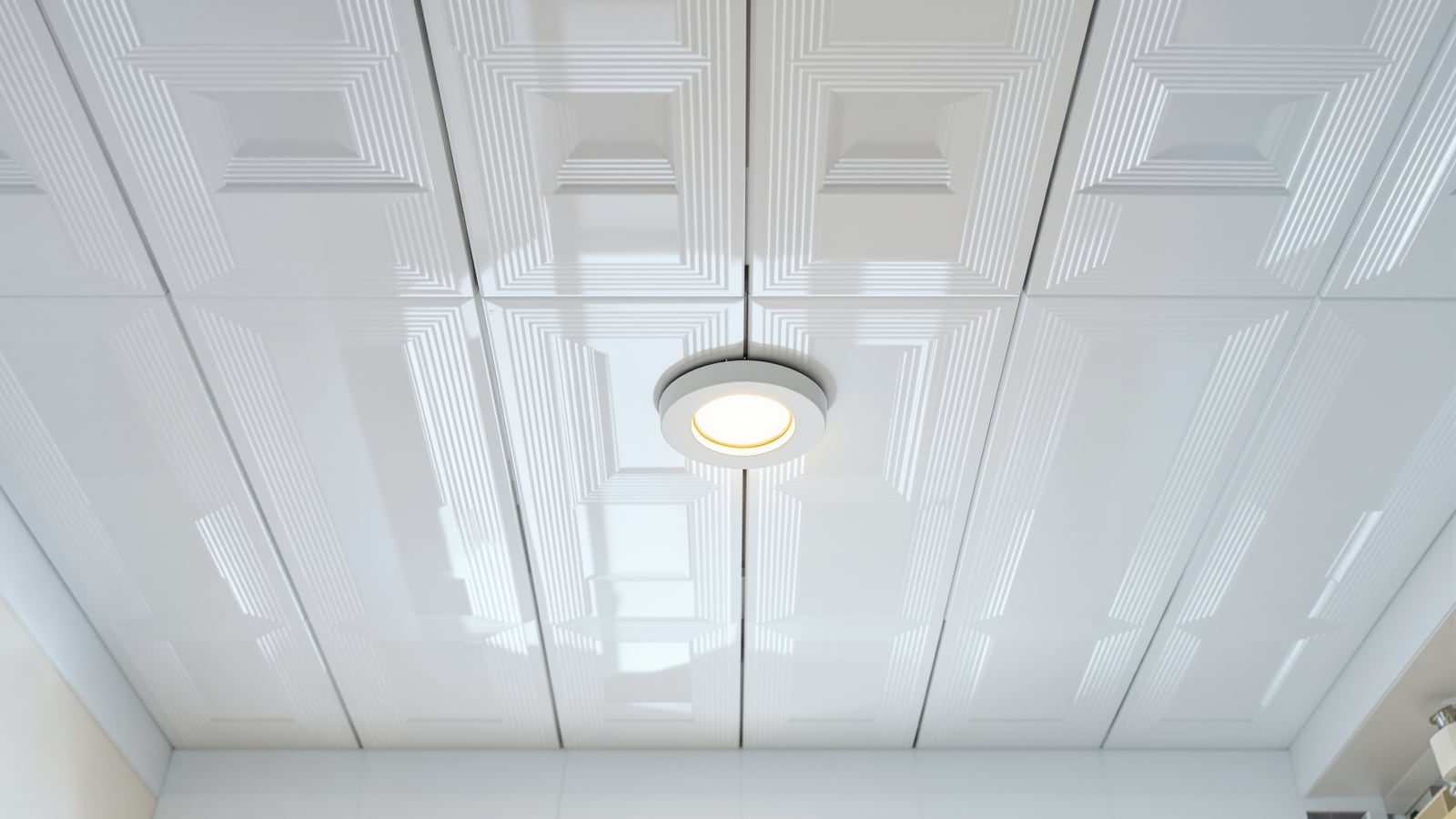
Walk into ten mid-budget Indian bathrooms and you will find the same ceiling in at least seven of them: long, glossy plastic planks locking edge to edge, hiding the slab and the wiring above. That is a PVC panel false ceiling, and it has become the default bathroom ceiling across India for one simple reason — it does the one thing a bathroom ceiling most needs. It ignores water completely.
Unlike gypsum board or plaster, PVC does not absorb moisture, does not feed mould, and does not stain when your neighbour's leaking floor drips onto it. It is also cheap, light, and clips into place in an afternoon with no wet trades, no curing and almost no mess. This guide covers the panels themselves, how they span and frame, how you cut in lights and an exhaust fan, how long they last, how to keep them clean, and — the question everyone actually asks — what they cost per square foot.
For the full menu of bathroom ceiling options, start at the pillar Bathroom False Ceiling (India). This page zooms into the PVC option; its siblings cover the aluminium bathroom ceiling and the gypsum bathroom ceiling.
What a PVC ceiling panel actually is
A PVC ceiling panel is an extruded plank of unplasticised polyvinyl chloride — the same rigid, non-absorbent plastic family as your uPVC window frames and drainage pipes. The plank is hollow, with thin internal ribs running its length like the cross-webs in corrugated cardboard. That hollow core is the whole trick: it makes the panel stiff enough to span a bathroom while staying light enough to hang off a slim frame, and it uses very little material, which keeps the price down.
Each plank has a tongue on one long edge and a groove on the other. You slide the tongue of a new plank into the groove of the last one, and the joint locks flush — a clean, near-invisible line with no fastener showing on the face. The panels arrive in long lengths (commonly 10 ft, cut on site) and standard widths, so a whole ceiling is really just a row of interlocked planks resting on a perimeter trim.
| Property | Typical PVC bathroom panel |
|---|---|
| Material | Rigid uPVC (unplasticised) |
| Panel width | 200–250 mm (some 300–600 mm wide "tile-look" sheets) |
| Panel thickness | 5–10 mm (8 mm is the common bathroom grade) |
| Panel length | Up to ~3 m (10 ft), trimmed on site |
| Weight | Very light — roughly 2–4 kg per sq m installed |
| Water behaviour | Non-absorbent, non-corroding, does not support mould |
| Finish | Glossy, matte, marble-look, wood-look, printed |
| Fire behaviour | Self-extinguishing / flame-retardant grade advisable |
PVC's superpower in an Indian bathroom is not looks or price — it is that a leak from the flat above lands on plastic that shrugs it off, instead of on gypsum that swells, sags and grows black mould.
Colours, finishes and looks
Early PVC ceilings were all shiny white and looked cheap, which is why the material still fights a downmarket reputation. Modern panels are far better. You can get matte finishes (much classier than gloss and far less prone to showing dust), marble and stone prints, wood-grain planks, soft greys and off-whites, and wider "tile effect" sheets that break up the plank lines. For a small, windowless Indian bathroom, a matte white or pale grey keeps the space bright without the plasticky glare of high gloss.
A practical tip: gloss white maximises the light thrown back from your fittings — useful in a dark internal bathroom — but it also reflects every LED as a hard hotspot and shows water spots. Matte hides both. Wood and marble prints look best in dry zones and powder rooms rather than directly over a jet-spray shower, where steam eventually dulls any printed film.
How PVC panels span and frame
A PVC ceiling is a two-part system: a hidden framework fixed to the structure, and the panels that clip onto it. Get the framework right and the ceiling stays flat and quiet for years; skimp on it and the panels bow and rattle.
- Perimeter trim (the F-section or U-trim): an L- or F-shaped PVC or aluminium channel screwed around all four walls at your ceiling height. The panels slide into and rest in this trim, which also hides the cut ends.
- Framework / battens: a grid of supports fixed below the slab that the panels screw or clip up to. This is where quality is decided. Cheap jobs use timber battens (reepers), which warp in bathroom humidity. Use a light galvanised-steel or aluminium framework — GI ceiling sections or aluminium tee-runners — so nothing rusts or twists in the wet.
- Suspension: the frame hangs from the RCC slab on GI cleats or rods. In a bathroom, keep at least 100–150 mm of gap above the panels so you can route the exhaust duct and wiring.
- Spanning rule of thumb: support the panels at no more than ~600 mm centres. An 8 mm hollow panel unsupported over a metre-plus will visibly bow, especially as it warms. Closer supports = flatter ceiling.
Because the panels are so light, the load on the structure is negligible — but the framework must still be anchored into sound concrete, not just into loose plaster, so it cannot pull away over time.
Integrating lights and the exhaust fan
The service gap above a PVC ceiling is where the electrics and the exhaust live, and cutting them in cleanly is what separates a neat ceiling from a botched one.
- Recessed LED downlights / panel lights: mark the centre, cut a circular or square hole with a hole-saw or knife, and clip the light's spring clips through the panel. Because PVC is thin and combustible, use cool-running LEDs, never hot halogens, and leave air space above. Choose IP-rated fittings if they sit in the shower's splash zone.
- Exhaust fan: cut the panel opening to the fan's collar, screw the fan body to the framework (not to the flimsy panel), and connect a flexible duct that runs through the service gap to an outside vent — never just into the ceiling void. Venting into the void traps warm, wet air against the slab and causes the exact dampness the ceiling was meant to hide. Size the fan to the room; see Bathroom False Ceiling (India) for the air-change maths.
- Access: leave one panel or a small hatch removable near the fan and any concealed plumbing, so a future repair does not mean dismantling the whole ceiling.
Coordinate all cut-outs before you close up the ceiling. Retrofitting a fan or a second light after the panels are locked in means pulling planks back out, and the reused tongue-and-groove joints never sit quite as tight the second time.
Lifespan, sagging and when PVC lets you down
A well-framed PVC ceiling lasts 10–15 years or more in a home bathroom. It will not rot or corrode, but it does have real weaknesses you should design around.
| Issue | Why it happens | How to avoid it |
|---|---|---|
| Sagging / bowing | Supports too far apart; thin panels; heat from lights | Support at ≤600 mm; use 8 mm panels; cool LEDs |
| Yellowing | UV and heat over years, cheap resin | Keep it out of direct sun; buy quality uPVC |
| Warped battens | Timber reepers swelling in humidity | Use GI / aluminium framework only |
| Rattling | Loose clips, thermal movement | Firm framework, correct expansion gaps |
| Damage on impact | Hollow plastic dents / cracks if knocked | Not for spots that take knocks; easy to swap one plank |
| Trapped damp above | Exhaust vented into void, not outside | Duct the fan fully to outside air |
PVC's honest limits are these: it is not a premium finish, high-gloss grades look cheap up close, and a hard knock can crack a hollow panel. The saving grace is repairability — a single damaged plank can be unclipped and replaced for a few hundred rupees without disturbing the rest.
Cleaning and upkeep
This is where PVC quietly earns its keep. The face is non-porous, so grime sits on top rather than soaking in.
- Wipe with a soft cloth and mild soapy water; a squeegee clears steam condensation.
- Avoid abrasive scourers and harsh solvents — they scratch the surface film and dull the finish, especially on gloss.
- Because it does not absorb water, PVC does not grow the black ceiling mould that plagues painted and gypsum bathroom ceilings — but still run the exhaust to clear steam, or condensation can bead and drip.
- Check the perimeter trim and joints once a year for any that have popped loose from thermal movement, and press them back.
What a PVC bathroom ceiling costs in India
PVC is the cheapest false-ceiling route for a bathroom, and the numbers are what make it the mass-market default. Prices vary by panel width, thickness, finish and city, but a realistic 2026 range:
| Item | Typical ₹ range (2026) |
|---|---|
| PVC ceiling panels (material only) | ₹40–120 per sq ft |
| Budget gloss-white 8 mm panel | ₹40–70 per sq ft |
| Matte / marble-look / wood-look panel | ₹80–150 per sq ft |
| Installation labour | ₹25–50 per sq ft |
| GI / aluminium framework + trim | ₹30–60 per sq ft |
| Installed, all-in (typical bathroom) | ₹90–200 per sq ft |
| A 40 sq ft bathroom ceiling, all-in | ~₹4,000–8,000 |
For comparison, a gypsum bathroom ceiling typically runs ₹120–250 per sq ft installed and an aluminium panel ceiling higher still, which is exactly why PVC dominates the budget and mid-range Indian bathroom. Weigh the full trade-offs in the Bathroom False Ceiling (India) pillar, and read the gypsum bathroom ceiling guide before you spend more for a seamless painted finish.
Bottom line: if you want a bathroom ceiling that laughs off water, goes up in a day, costs the least and can be repaired one plank at a time, PVC is the sensible default. Pay a little more for 8 mm panels, a matte finish and — above all — a galvanised-steel framework, and it will serve a decade or more without a complaint. Pair it with a properly ducted exhaust and sound waterproofing above, and the ceiling becomes the part of the bathroom you never have to think about again.
References
- NBC 2016 (National Building Code of India), Part 4 & Part 8 — non-structural elements, false ceilings and internal finishes.
- IS 875 (Part 1): Design Loads — Dead Loads — accounting for the (small) self-weight of a suspended false ceiling.
- IS 14862: PVC (Vinyl) Ceiling Tiles and general uPVC building-product specifications from BIS.
- CPWD General Specifications for Works — false-ceiling framework, suspension and workmanship norms.
- IGBC / GRIHA — guidance on low-VOC interior materials and healthy indoor finishes.
Export this guide
Related Guides — Deep-dive reading
Bathroom False Ceiling India: PVC, Gypsum, Aluminium Panels, Cost & the #1 Moisture Rule
A complete guide to bathroom false ceilings for Indian homes — why you fit one, the material choices (PVC, moisture-resistant gypsum, aluminium and metal panels, ACP), access panels, integrating the exhaust fan and lights, and a rupee cost comparison — with the one rule that keeps a wet-zone ceiling from sagging.
BathroomsBathroom Fire Safety India: NBC 2016 Part 4, Fire-Rated Materials & Electrical Ignition
The bathroom is rarely thought of as a fire risk, yet it hides several: a leaky geyser element, an over-run exhaust-fan motor, cheap flammable PVC panels overhead, and aerosol cans stored beside a heat source. This is an honest, practical reference to fire and life safety in the Indian bathroom — the NBC 2016 Part 4 context that actually applies to homes, the real ignition sources, self-extinguishing false-ceiling and PVC materials, earth-leakage protection as fire prevention, escape considerations, and the carbon-monoxide danger of gas geysers.
BathroomsFreestanding Bathtub India: Materials, Floor Load, Concealed Plumbing & Cost (2026)
The statement centrepiece tub that stands free of every wall — how acrylic, stone-resin and cast-iron differ, the floor load a filled tub imposes, the concealed rough-in you must set out before the flooring goes down, the clear space it needs all around, drainage, and honest 2026 rupee costs.
BathroomsRelated Tools — Try Free
False Ceiling Cost Estimator
Live ₹/sqft across 8 ceiling types — POP, gypsum, designer, metal, PVC, wooden — with cove and spot lighting for 20 Indian cities.
Cost CalculatorWindow Material Comparison Tool
Compare uPVC, aluminium, wood, steel and composite windows on cost, life, upkeep and insulation.
CompareWindow Maintenance Cost Calculator
Estimate annual window upkeep by frame material — yearly, per-window and 5-year cost.
Window Calculator