
FSI / FAR in Hyderabad (HMDA / GHMC) — A 2026 Architect's Working Reference
Floor Space Index under Telangana Building Rules 2012 + GO Ms 168 — baseline FSI by road width with the most aggressive arterial-corridor scaling among Indian metros, premium FSI mechanics, the HITEC City driver, and the TS-bPASS self-certification framework.
Governing framework: Telangana Building Rules 2012 + GO Ms No. 168
Working reference tables
Print or screenshot these for the studio wall. Cross-check against the current authority notification before any specific filing.
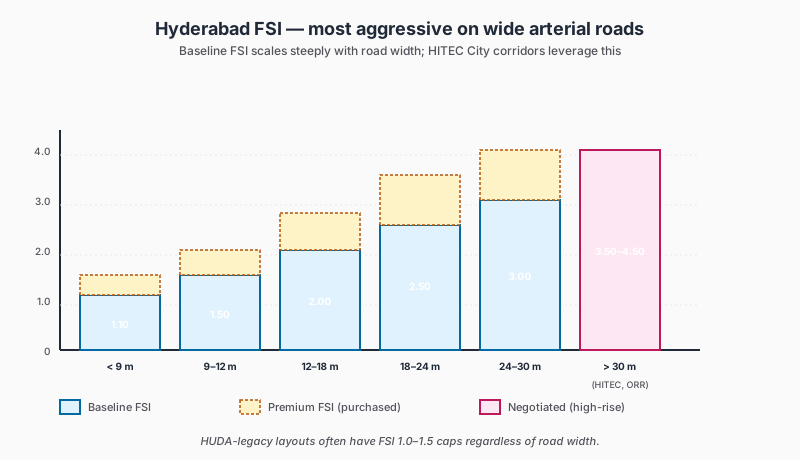
Residential FSI baseline (Telangana Building Rules 2012, indicative)
Hyderabad's FSI scales steeply with abutting road width — the most aggressive arterial-corridor scaling among major Indian metros.
| Plot Frontage Road | Baseline FSI | Max FSI with Premium | Building Height Cap |
|---|---|---|---|
| < 9 m | 1.10 | 1.50 | 10 m |
| 9–12 m | 1.50 | 2.00 | 15 m |
| 12–18 m | 2.00 | 2.75 | 18 m |
| 18–24 m | 2.50 | 3.50 | 30 m |
| 24–30 m | 3.00 | 4.00+ | Height-coupling |
| > 30 m | 3.50–4.50 | Negotiated | Height-coupling |
Indicative values from Telangana Building Rules 2012 + GO Ms 168. HUDA-legacy layouts may have lower caps; Cantonment areas have a separate framework. Verify against the current GO and HMDA / GHMC circulars at filing.
FSI exclusions (Telangana Building Rules 2012)
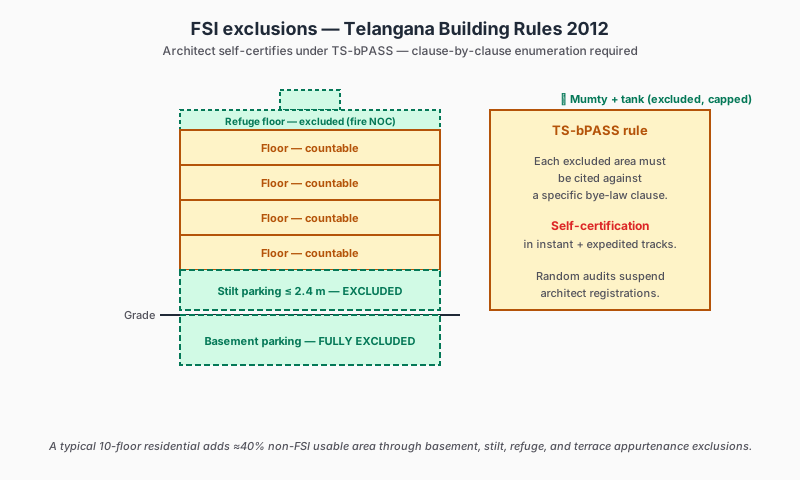
Categories of floor area excluded from countable FSI. Architect's TS-bPASS submission must enumerate exclusions clause-by-clause.
| Zone / Use | Treatment | Conditions |
|---|---|---|
| Basement parking | Fully excluded | Used solely for parking + services |
| Stilt parking | Excluded ≤ 2.4 m | Open on all sides |
| Service ducts / shafts | Excluded | Dedicated, continuous |
| Mumty, lift overrun, water tank | Excluded subject to area cap | Per Telangana schedule |
| Refuge area (high-rise) | Excluded | Per fire-NOC; one refuge floor every fourth occupied floor |
| Open balconies | Partially excluded | Per zone clause |
Implicit exclusion claims fail at audit. TS-bPASS instant-approval and expedited tracks rely on architect self-certification; errors carry professional consequences.
Special-zone FSI carve-outs
Three frameworks operate outside the standard Telangana Building Rules FSI matrix.
| Zone / Layout | FSI | Notes |
|---|---|---|
| Banjara Hills (HUDA-legacy) | 1.0–1.5 | Layout sanction caps below bye-laws default |
| Jubilee Hills (HUDA-legacy) | 1.0–1.5 | Layout sanction caps below bye-laws default |
| Begumpet (HUDA-legacy) | 1.5–2.0 | Layout-specific |
| HITEC City / Gachibowli / Madhapur | 3.0–4.5 (wide arterial) | Bye-laws baseline + premium + negotiated |
| Outer Ring Road extension (Kokapet, Tellapur) | 2.5–3.0 | HMDA layout-specific notifications |
| Secunderabad / Trimulgherry Cantonment | 1.0–1.5 | Cantonment Bye-laws (separate from Telangana Rules) |
| Heritage precincts (Charminar, Golconda) | Capped per heritage NOC | Below bye-laws baseline |
The architect's pre-design verification establishes the applicable framework — bye-laws, HUDA-legacy layout, Cantonment, or heritage — before committing FSI strategy.
TS-bPASS sanction tracks
Telangana State Building Permission Approval and Self-certification System. FSI compliance is self-certified under each track.
| Track | Plot size | Approval timeline | Self-cert burden |
|---|---|---|---|
| Instant | ≤ 75 sqm | 24 hours | Architect alone |
| Expedited | 75–500 sqm | ≈ 15 days | Architect + GHMC quick review |
| Standard | > 500 sqm | 30+ days | Full GHMC / HMDA scrutiny |
| Random audit | All tracks | Periodic | Spot-checks; suspension risk |
Errors on self-certified FSI declarations carry professional consequences including registration suspension on audit findings.
The working reference, in full
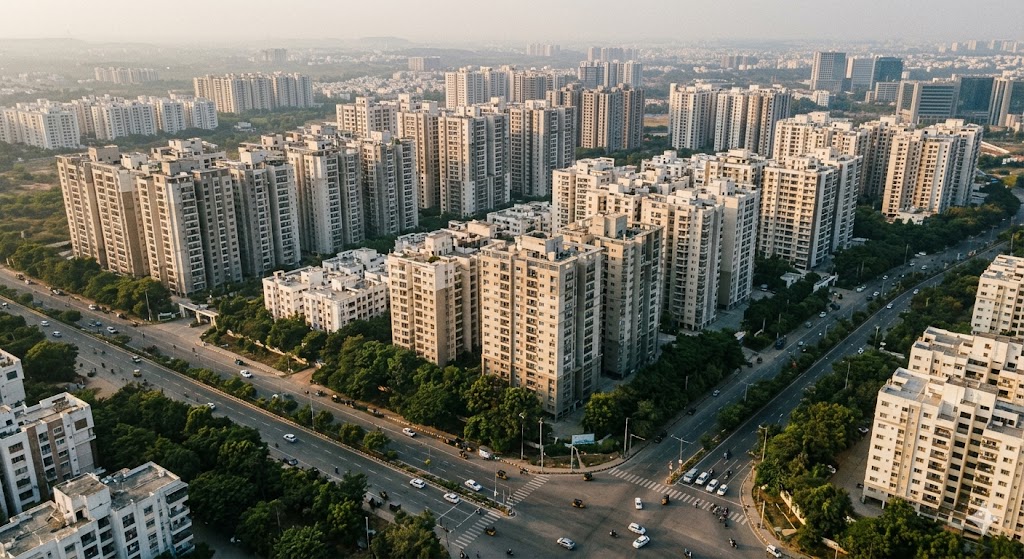
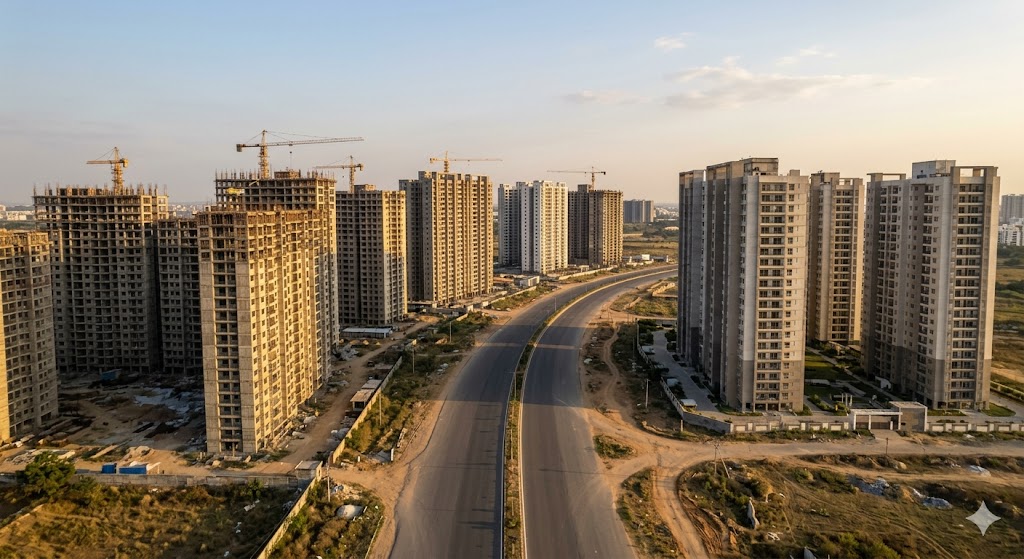
Hyderabad's FSI framework under Telangana Building Rules 2012 (as amended by GO Ms No. 168) ties FSI to abutting road width — narrow roads get FSI 1.10; wider arterial roads (over 30 m) get up to 4.5+. This road-width-driven framework is the most aggressive among major Indian cities for wide-road plots, reflecting the policy intent to concentrate density on infrastructure corridors. Hyderabad's HITEC City and IT-corridor zones leverage this provision substantially — Gachibowli, Madhapur, Kondapur, and Manikonda's high-rise residential boom is the visible result.
Premium FSI in the Telangana framework
GO Ms No. 168 introduced Premium FSI over the baseline against payment of a premium fee — typically allowing 30–50% additional FSI on plots above 12 m road width. Premium FSI rates and ceilings are notified by the State Government and revised periodically. For high-rise residential in Gachibowli, Madhapur, and Manikonda, premium FSI is the primary economic lever in the developer's pre-feasibility study; the architect's role is to verify zone eligibility and run the FSI-against-height-coupling iteration before the developer commits.

HITEC City — where the bulk is
HITEC City and the surrounding IT-corridor (Gachibowli, Madhapur, Kondapur, Manikonda, Kokapet, Tellapur) leverage the wide-arterial FSI provisions. Most plots along the Outer Ring Road and HITEC arterial roads sit in the 24–30 m+ road-width tier with baseline FSI 3.0–4.5. Combined with premium FSI and HMDA layout-specific bonuses for designated TOD-style nodes, the deliverable FSI on a typical HITEC plot can reach 4.5–5.0 — the highest residential FSI in any Indian metro. This is the structural reason Hyderabad's high-rise residential market exploded in 2018–2025.
FSI exclusions
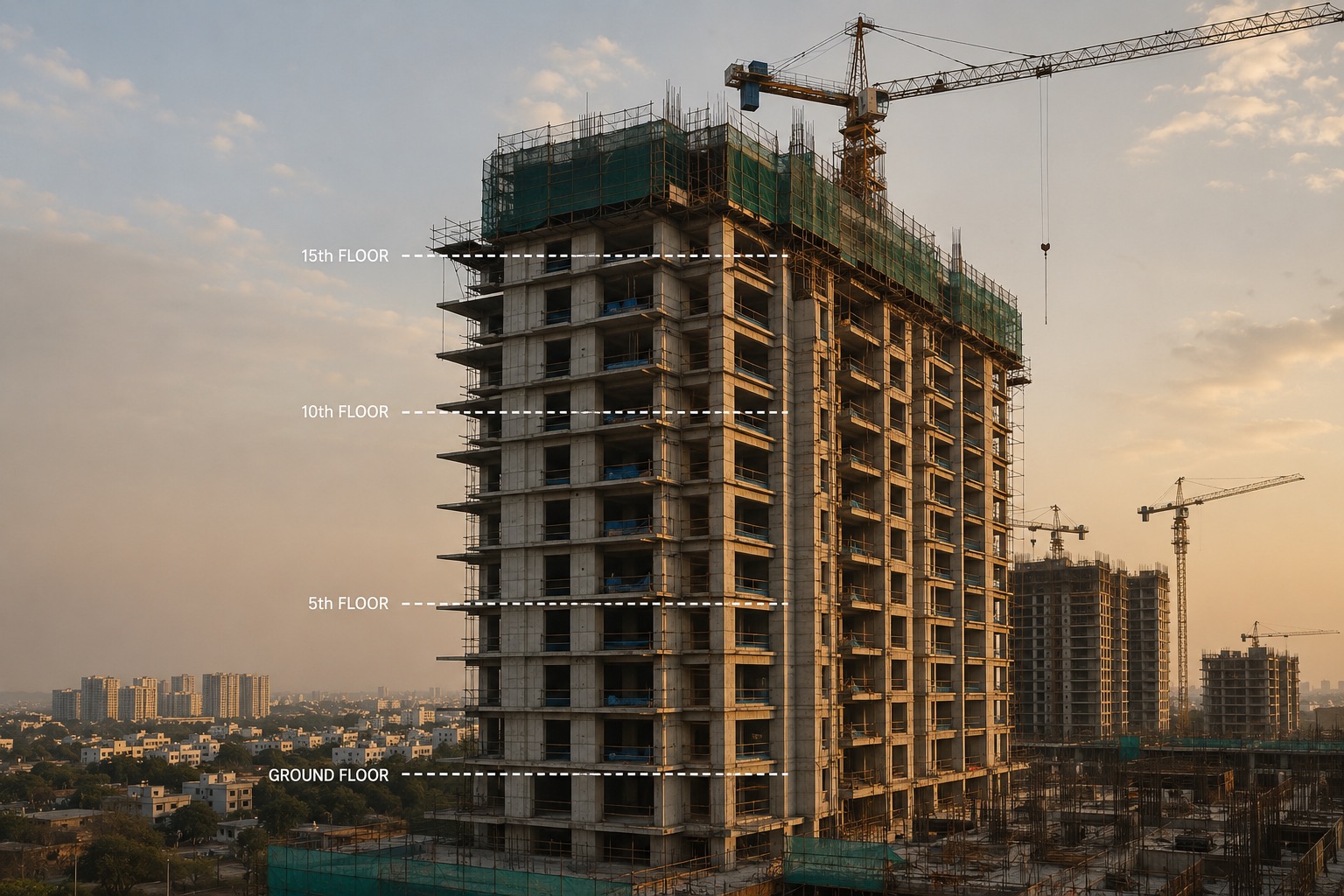
Telangana Building Rules 2012 exclusions: basement parking (fully excluded), stilt parking (excluded up to 2.4 m height), service ducts (excluded if dedicated), terrace appurtenances — lift overrun, water tank, mumty (excluded subject to area limits), refuge areas in high-rise (excluded per fire-NOC requirements). The architect's FSI statement under TS-bPASS self-certification must enumerate exclusions clause-by-clause. Errors on self-certified declarations have been the most common cause of audit-triggered registration suspensions in Telangana.
TS-bPASS and the self-certification model
Hyderabad's TS-bPASS sanction platform substantially shifts the FSI verification burden to the registered architect. Plots ≤ 75 sqm get instant approval against architect self-certification of FSI compliance; plots 75–500 sqm get expedited approval with rapid review; larger plots follow standard sanction. Under self-certification, errors in FSI computation are not just sanction queries but professional liabilities — architects' registrations have been suspended on incorrect TS-bPASS declarations following random audit. The architect's FSI statement under TS-bPASS carries the same legal weight as a statutory declaration; treating it casually has career-ending consequences in Telangana practice.
HUDA-legacy and Cantonment carve-outs
Plots in HUDA-legacy layouts (Banjara Hills, Jubilee Hills, Begumpet) typically have FSI caps of 1.0–1.5, well below the bye-laws default — the layout sanction plan governs. Plots in Secunderabad and Trimulgherry Cantonment areas follow Cantonment Building Bye-laws — typically with FSI 1.0–1.5 caps regardless of road width. The architect's pre-design verification must establish the applicable framework — bye-laws default, HUDA-legacy, or Cantonment — before committing the FSI strategy. A project assuming bye-laws default within a HUDA-legacy layout produces a non-financeable design that the developer cannot sell.
Common pitfalls
- Treating FSI as height-coupled directly — height couples to setbacks, which then constrain the FSI footprint indirectly.
- Relying on TS-bPASS instant-approval without verifying every FSI exclusion clause — random audit findings have suspended architect registrations.
- Applying bye-laws default within HUDA-legacy layouts — layout caps are typically lower and binding.
- Forgetting cantonment carve-outs in Secunderabad and Trimulgherry — Cantonment Bye-laws differ from Telangana Building Rules.
- Submitting an FSI strategy on HITEC corridor before verifying the abutting-road width gazette — wrong tier assumption misprices the entire feasibility.
- Ignoring lake-buffer overlays on plots near Hussain Sagar, Osman Sagar, or Himayat Sagar — these reduce baseline FSI within the notified zone.
Frequently asked questions
›What is the maximum residential FSI in Hyderabad?
›How does TS-bPASS affect the architect's FSI declarations?
›Do HUDA-legacy layouts in Banjara Hills follow the bye-laws FSI default?
›Is FSI in Secunderabad Cantonment different?
›What is Hyderabad's HITEC City FSI advantage?
›Is FSI height-coupled in Hyderabad?
Sources & references
Telangana Building Rules 2012
Government of Telangana, Building Rules 2012 — FSI matrix, exclusions, sanction framework
GO Ms No. 168 — Telangana Building Rules amendments
Telangana Government Order Ms 168 (2012) — Premium FSI framework, TS-bPASS introduction
Cantonment Act, 2006
Act No. 41 of 2006 — Cantonment FSI framework separate from Telangana Building Rules
TS-bPASS Portal
Telangana TS-bPASS — three-track sanction with architect self-certification of FSI compliance
HMDA Master Plan and Layout Notifications
Hyderabad Metropolitan Development Authority — HMDA layout sanction with HITEC corridor and ORR extension provisions
HUDA-Legacy Layout Sanction Records
Banjara Hills, Jubilee Hills, Begumpet original HUDA layout sanction plans — FSI caps below bye-laws default
National Building Code of India (NBC) 2016
Bureau of Indian Standards, NBC 2016 — Volume 1 Part 3 General Building Requirements
Disclaimer: Regulatory rates and dimensional rules change frequently and may be modified by mid-year notifications. Values reflect the framework as of 2026-05-10; verify against the current authority notification before any specific filing. This page is informational and is not legal or planning advice — engage a registered architect and a qualified planning consultant for project-specific compliance.
Related guides from the library
The companion deep-dives that practising architects keep alongside this reference.
Building Setbacks Across India
A State-by-State Guide to Development Control Regulations, Plot Setbacks, Ground Coverage, and FAR — for Architects, Planners, and Developers
42 min read · Open ConstructionBuilding Plan Approval Process in India
State-Wise Guide — BBMP, BMC, CMDA, GHMC, MCD, PMC & 14 More Cities
30 min read · Open SustainabilityPassive Design Strategies for Indian Climate Zones
A Climate-Zone-by-Zone Working Reference for Indian Architects
24 min read · Open ConstructionArchitect Fee Structures in India
Slab, Lump-Sum, Hourly, and Hybrid — A Working Reference for Indian Practice
21 min read · Open SustainabilityFacade Design for Indian Climates
Materials, Shading, and Ventilation Strategies — A Comprehensive Guide for Architects and Homeowners
30 min read · OpenCompare across cities
The same FAR / FSI topic, different regulatory frameworks, different city quirks. Architects practising across metros should bookmark the adjacent reference.
FAR / FSI in Bengaluru
BBMP Building Bye-laws 2003 + Revised Master Plan 2031 (RMP 2031)
Open MCGM · MaharashtraFAR / FSI in Mumbai
Development Control and Promotion Regulations 2034 (DCPR 2034)
Open DDA · Delhi (NCT)FAR / FSI in Delhi
Master Plan for Delhi 2021 (MPD 2021) + Unified Building Bye-laws 2016
Open CMDA · Tamil NaduFAR / FSI in Chennai
Tamil Nadu Combined Development & Building Rules 2019 (TNCDBR 2019)
Open