
FSI in Chennai (CMDA / GCC) — A 2026 Architect's Working Reference
Floor Space Index under TNCDBR 2019 — baseline by zone and road, premium FSI mechanics, the OSR-to-FSI trade, and the IT-corridor special FSI zones along OMR and Sholinganallur.
Governing framework: Tamil Nadu Combined Development & Building Rules 2019 (TNCDBR 2019)
Working reference tables
Print or screenshot these for the studio wall. Cross-check against the current authority notification before any specific filing.
Residential FSI baseline (TNCDBR 2019, indicative)
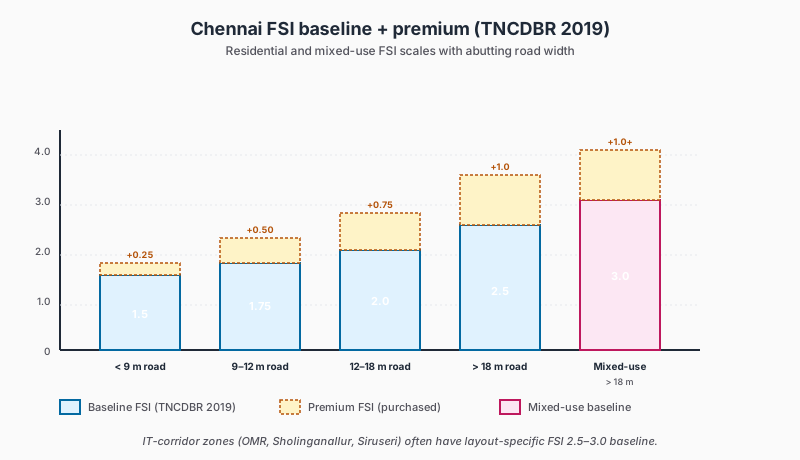
FSI scales with abutting road width. Premium FSI is purchasable over baseline subject to road-width and infrastructure-capacity caps.
| Zone Category | Plot Frontage Road | Baseline FSI | Max FSI with Premium |
|---|---|---|---|
| Residential — primary | < 9 m | 1.50 | 1.75 |
| Residential — primary | 9–12 m | 1.75 | 2.25 |
| Residential — primary | 12–18 m | 2.00 | 2.75 |
| Residential — primary | > 18 m | 2.50 | 3.50 |
| Mixed-use | 12–18 m | 2.50 | 3.25 |
| Mixed-use | > 18 m | 3.00 | 4.00+ |
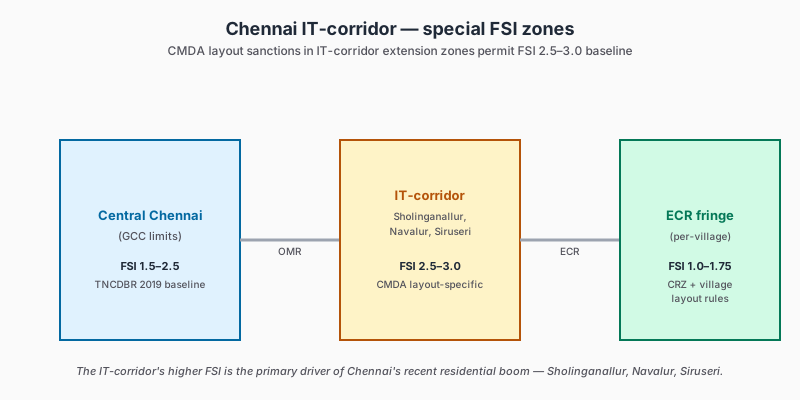
| IT-corridor (OMR / Sholinganallur) | Per layout sanction | 2.50–3.00 | 3.50+ (negotiated) |
Indicative TNCDBR 2019 values. CMDA layout sanctions for IT-corridor extension zones often supersede with higher baselines.
Premium FSI in Chennai
Premium FSI over baseline against payment of premium fee, calibrated by road width and infrastructure capacity.
| Plot Frontage Road | Premium FSI | Effective ceiling |
|---|---|---|
| < 9 m | +0.25 | ≈ 1.75 |
| 9–12 m | +0.50 | ≈ 2.25 |
| 12–18 m | +0.75 | ≈ 2.75 |
| > 18 m | +1.00 | ≈ 3.50 |
Premium FSI rates revised periodically. The architect's pre-design feasibility quantifies the cost-benefit per ₹/sqft of additional FSI.
FSI exclusions (TNCDBR 2019)
Categories of floor area excluded from countable FSI. Architect's FSI statement under CMDA / GCC sanction must enumerate these clause-by-clause.
| Zone / Use | Treatment | Conditions |
|---|---|---|
| Basement parking | Fully excluded | Used solely for parking + services |
| Stilt parking | Excluded ≤ 2.4 m | Open on all sides |
| Service ducts / shafts | Excluded | Dedicated, continuous |
| Terrace mumty / lift overrun / water tank | Excluded subject to area cap | Per TNCDBR schedule |
| Refuge area (high-rise) | Excluded | Per fire-NOC requirements |
| Open balconies | Partially excluded | Per zone clause |
Implicit exclusion claims fail at sanction. Each excluded area must be cited against the specific TNCDBR clause.
OSR-to-FSI trade (high-density CMDA layouts)
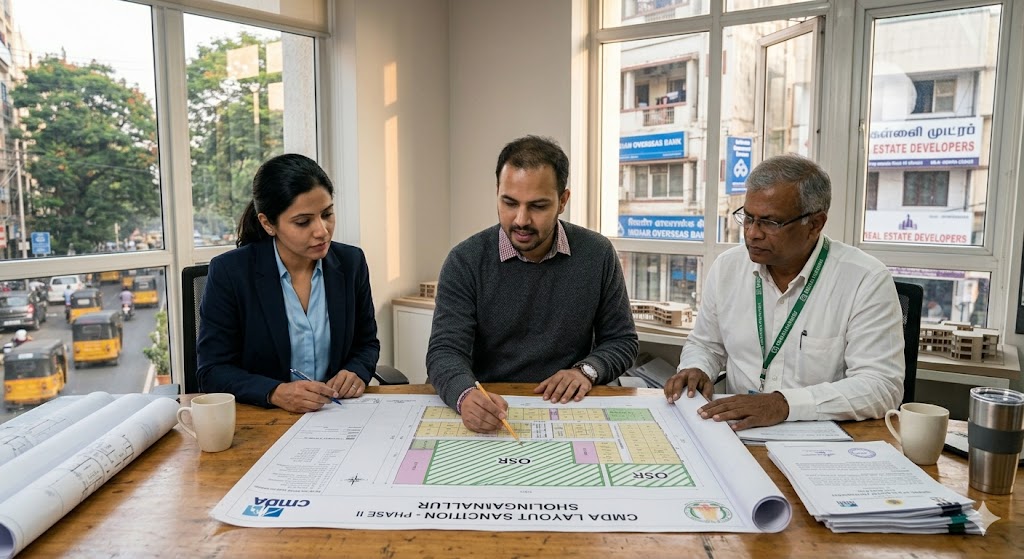
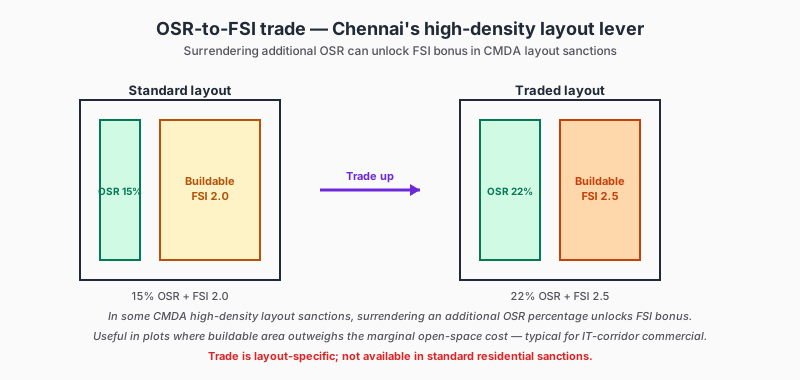
In some high-density CMDA layout sanctions, surrendering additional OSR can unlock FSI bonus.
| Standard | Traded (illustrative) | FSI gain |
|---|---|---|
| 15% OSR + FSI 2.0 | 22% OSR + FSI 2.5 | +0.5 FSI |
| 10% OSR + FSI 1.75 | 15% OSR + FSI 2.0 | +0.25 FSI |
| 20% OSR + FSI 2.5 (IT-corridor) | 25% OSR + FSI 3.0 | +0.5 FSI |
Trade is layout-specific and at CMDA's discretion. Useful when buildable area outweighs the marginal open-space cost — typical for IT-corridor commercial and high-density residential.
The working reference, in full
Chennai's FSI (Floor Space Index) framework under TNCDBR 2019 is calibrated by zone category and abutting road width. Residential plots in the primary zone get baseline FSI from 1.50 (narrow road) up to 2.50 (wide road). Mixed-use zones — common along Chennai's commercial-residential streets like Anna Salai, Mount Road, and OMR — get higher baselines, reflecting the city's traditional mixed-use street typology. The IT-corridor extension (Sholinganallur, Navalur, Siruseri) often gets layout-specific FSI 2.5–3.0 baseline through CMDA's layout sanction process — substantially above the standard residential matrix.
Premium FSI in the Chennai framework
TNCDBR 2019 permits Premium FSI over the baseline against payment of a premium fee to the local authority. Premium FSI is calibrated by road width and infrastructure capacity — narrower-road plots get smaller premium increments (typically 0.25 over baseline), wider-road plots get larger increments (up to 1.0+). The architect's pre-design feasibility computes the premium FSI cost as ₹/sqft of additional FSI consumed, and balances it against the buildable additional area. Premium FSI rates are revised periodically by the State Government.
Mixed-use FSI — Chennai's traditional density advantage
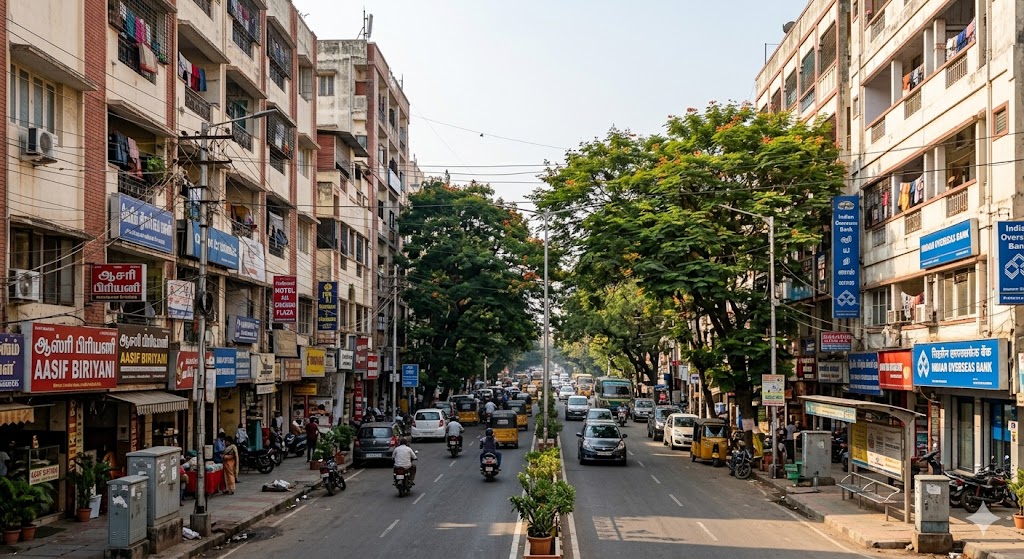
Mixed-use zones — common along Chennai's commercial-residential streets like Anna Salai (Mount Road), T. Nagar, Adyar, and OMR commercial — get higher FSI baselines (3.0+ on wide arterials) reflecting the city's traditional mixed-use street typology. The mixed-use designation under TNCDBR 2019 carries genuine density advantages over pure residential or pure commercial zoning, and Chennai's older commercial streets retain this character. For the architect, the mixed-use designation unlocks both higher FSI and more flexible exclusions on commercial-floor service spaces, but it requires the developer to commit to a mixed programme — losing the ground-floor commercial reverts to residential FSI.
OSR-to-FSI trade — a Chennai-specific lever
A distinctive Chennai feature: while the Open Space Reservation (OSR) requirement is independent of FSI, in some layouts the OSR area can be traded against FSI consumption — surrendering an additional OSR percentage to gain corresponding FSI bonus. This OSR-to-FSI trade is common in high-density CMDA layout sanctions where the developer prefers to deliver more built-up area against larger landscaped open space. Useful in IT-corridor commercial layouts where buildable revenue outweighs the marginal open-space cost; less common in standard residential sanctions.
FSI exclusions — what does not count
TNCDBR 2019 exclusions from FSI computation: basement parking (fully excluded if used for parking and services), stilt parking (excluded up to 2.4 m height), service ducts and shafts (excluded if dedicated and continuous), terrace mumty / lift overrun / water tank (excluded subject to area limits per TNCDBR schedule), refuge areas in high-rise (excluded per fire-NOC requirements), and open balconies (partially excluded per zone). The architect's FSI statement under CMDA / GCC sanction must enumerate exclusions clause-by-clause; implicit exclusions trigger sanction queries.
IT-corridor and special zones — where Chennai's bulk is
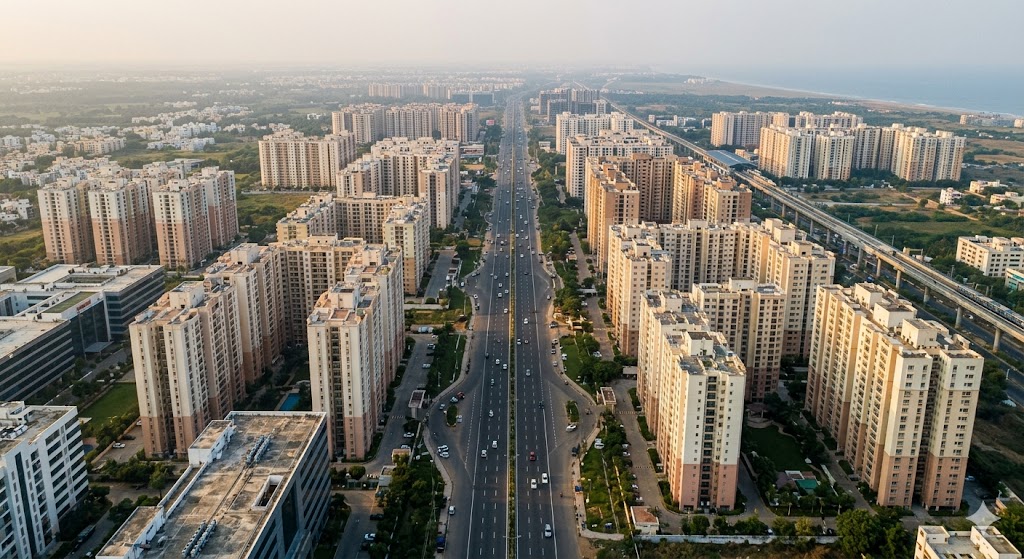
Chennai's IT-corridor — Old Mahabalipuram Road (OMR), GST Road extension, Sholinganallur, Siruseri, Navalur — has special FSI provisions under CMDA layout sanctions, often permitting baseline FSI 2.5–3.0 against the standard 1.5–2.0. These provisions are layout-specific (not TNCDBR-default) and require the architect to verify against the CMDA layout sanction plan and any special zone notification. The IT-corridor's higher FSI is the primary driver of Chennai's recent residential boom — Sholinganallur, Navalur, and Siruseri are the most active high-rise residential markets in the city.
CRZ and FSI restrictions
Coastal plots in Chennai (Marina, Besant Nagar, Thiruvanmiyur, Adyar, Royapuram) face CRZ FSI restrictions — CRZ-II permits redevelopment within existing FSI consumption only; CRZ-III restricts new construction beyond limited categories; CRZ-IA prohibits all construction. The architect's FSI strategy on coastal plots is constrained by the CRZ category before TNCDBR's FSI matrix applies. Madras HC directives in eco-sensitive zones (Pallikaranai marsh, riverine plots) may impose additional FSI caps beyond the TNCDBR baseline; the architect's environmental due diligence must check for plot-specific HC orders.

Common pitfalls
- Treating IT-corridor FSI as TNCDBR-default — the layout sanction plan governs and is often more permissive.
- Forgetting to enumerate FSI exclusions in the architect's FSI statement — implicit exclusions trigger sanction queries.
- Computing OSR within the FSI count — OSR is an open-space requirement, not an FSI deduction.
- Ignoring CRZ restrictions on coastal plots — CRZ supersedes FSI for plots within the notified zone.
- Missing Madras HC directive impacts in eco-sensitive zones — these can cap FSI below TNCDBR baseline.
- Treating OSR-to-FSI trade as a default — it is layout-specific and at CMDA's discretion.
Frequently asked questions
›What is the maximum residential FSI in Chennai?
›Does OSR reduce the buildable FSI in Chennai?
›Do IT-corridor plots get higher FSI than central Chennai?
›Is basement parking excluded from FSI in Chennai?
›Does CRZ permit higher FSI on Chennai coastal plots?
›Are Madras HC directives binding on FSI?
Sources & references
Tamil Nadu Town and Country Planning Act, 1971
Act No. 35 of 1972 — statutory authority for TNCDBR 2019 FSI rules
Tamil Nadu Combined Development and Building Rules 2019 (TNCDBR 2019)
TNCDBR 2019 — Rules 17–22 (FSI), Rule 27 (OSR), Rule 30 (Premium FSI)
Coastal Regulation Zone Notification 2019
MoEFCC CRZ Notification 2019 — FSI restrictions on Chennai coastal plots
Madras High Court — eco-sensitive directives
PIL judgments — Pallikaranai, Adyar, Cooum eco-sensitive constraints
CMDA Master Plan and IT-corridor notifications
Chennai Metropolitan Development Authority — IT-corridor layout sanction framework with special FSI provisions
CMDA OBPAS — Online Building Plan Approval System
OBPAS portal — FSI submission and dimensional auto-validation
National Building Code of India (NBC) 2016
Bureau of Indian Standards, NBC 2016 — Volume 1 Part 3 General Building Requirements
Disclaimer: Regulatory rates and dimensional rules change frequently and may be modified by mid-year notifications. Values reflect the framework as of 2026-05-10; verify against the current authority notification before any specific filing. This page is informational and is not legal or planning advice — engage a registered architect and a qualified planning consultant for project-specific compliance.
Related guides from the library
The companion deep-dives that practising architects keep alongside this reference.
Building Setbacks Across India
A State-by-State Guide to Development Control Regulations, Plot Setbacks, Ground Coverage, and FAR — for Architects, Planners, and Developers
42 min read · Open ConstructionBuilding Plan Approval Process in India
State-Wise Guide — BBMP, BMC, CMDA, GHMC, MCD, PMC & 14 More Cities
30 min read · Open SustainabilityPassive Design Strategies for Indian Climate Zones
A Climate-Zone-by-Zone Working Reference for Indian Architects
24 min read · Open ConstructionArchitect Fee Structures in India
Slab, Lump-Sum, Hourly, and Hybrid — A Working Reference for Indian Practice
21 min read · Open SustainabilityFacade Design for Indian Climates
Materials, Shading, and Ventilation Strategies — A Comprehensive Guide for Architects and Homeowners
30 min read · OpenCompare across cities
The same FAR / FSI topic, different regulatory frameworks, different city quirks. Architects practising across metros should bookmark the adjacent reference.
FAR / FSI in Bengaluru
BBMP Building Bye-laws 2003 + Revised Master Plan 2031 (RMP 2031)
Open MCGM · MaharashtraFAR / FSI in Mumbai
Development Control and Promotion Regulations 2034 (DCPR 2034)
Open DDA · Delhi (NCT)FAR / FSI in Delhi
Master Plan for Delhi 2021 (MPD 2021) + Unified Building Bye-laws 2016
Open HMDA · TelanganaFAR / FSI in Hyderabad
Telangana Building Rules 2012 + GO Ms No. 168
Open