
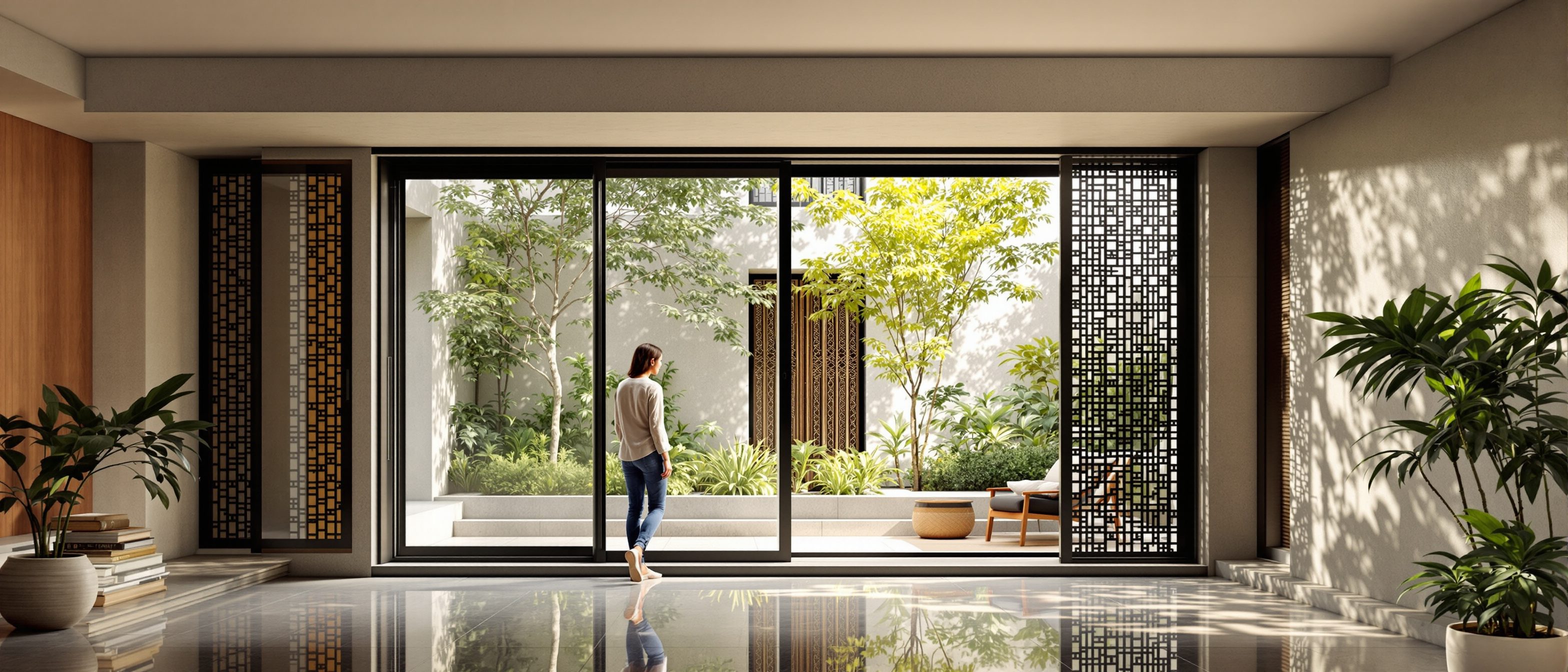
Contemporary Indian Window Designs
The fusion look — slim modern frames, jali accents, courtyard glazing and stone-and-teak detail tuned to the Indian sun
Contemporary Indian window design is a fusion language. It takes the slim sightlines, large glass and minimal grids of the modern window and weaves in the things that make a window feel Indian: a jali screen filtering the harsh afternoon, a deep chajja throwing shade, a stone sill cool under the palm, a teak reveal warming the glass edge. The result is a window that is unmistakably modern and unmistakably of this place.
This guide is the window-element view of that fusion. If you want the whole interior styled this way, read Indo-Contemporary Interiors; for what defines the building style across roof, plan and material, read Contemporary Indian Architecture: What Defines It. Here we stay strictly in the aperture: proportion, frame, screen, sill and reveal. For the umbrella of the modern aesthetic, see the pillar, Modern Window Design Ideas.
Contemporary Indian glazing is modernism with a memory. The frame is slim, the glass is generous, but the climate and the craft are never forgotten.
What makes a window "contemporary Indian"
The contemporary Indian window is not just a modern window installed in India. It is a deliberate marriage of a minimal modern frame with one or more heritage moves, tuned to the sun.
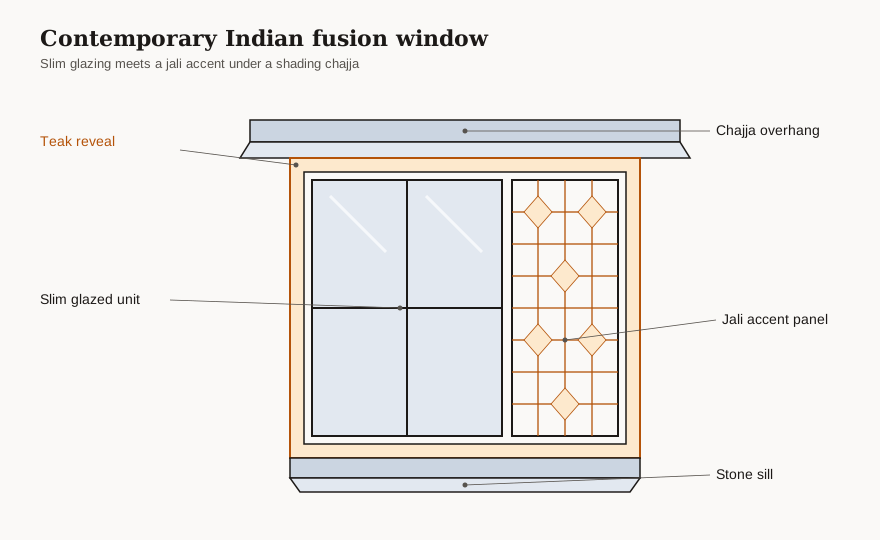
| Fusion trait | Modern half | Indian half |
|---|---|---|
| Frame | Slim aluminium or steel-look, black or bronze | Teak or sal reveal lining the opening |
| Light control | Low-E or solar-control glass | Jali / perforated screen accent filtering glare |
| Shading | Recessed, clean reveal | Projecting chajja or pergola fin overhead |
| Threshold | Floor-to-floor glazing | Kota or granite stone sill, slim and honed |
| Privacy | Sheer or none | Carved screen or louvre panel as the "second skin" |
| Connection | Indoor-outdoor flow | Courtyard, verandah or balcony as the destination |
The discipline is restraint: pick one or two heritage accents per opening, not all of them. A wall of glass with a single jali side-panel reads contemporary; the same glass with carved brackets, coloured panes and a fanlight reads pastiche.
The jali accent: a screen, not a window
The jali is the signature move. In contemporary work it rarely replaces the whole window; it sits beside or in front of the glazing as a filtering accent, casting moving shadow patterns through the day while the glass behind stays clear for the view.
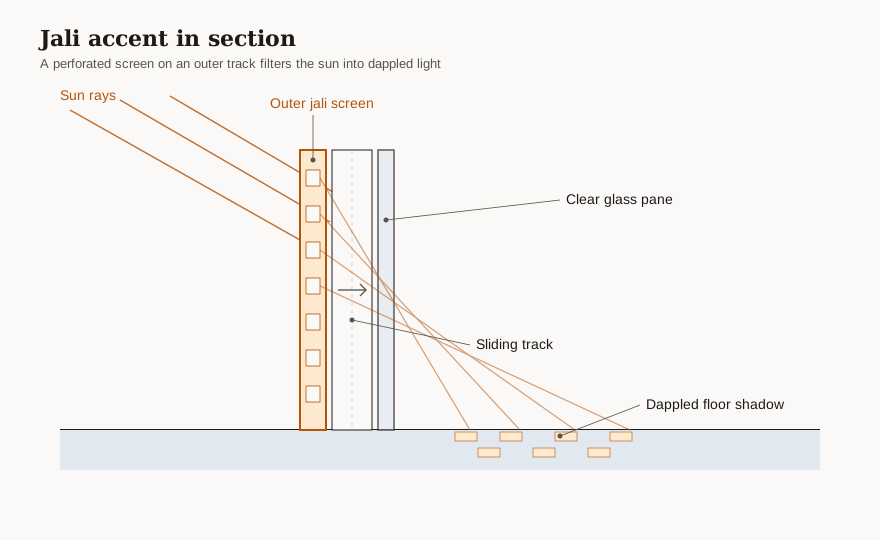
Keep the jali itself in its own lane: the deep dive on the perforated screen as a window element is Jali Windows (porosity, material, how it ventilates). The contemporary styling rule is that the jali should be plain in pattern and generous in opening so it reads modern. Tight floral fretwork pulls it toward traditional; a clean geometric perforation in CNC-cut MDF, GFRC, corten or aluminium keeps it contemporary.
- Geometric, not floral — hexagons, slim verticals, square grids
- One material, one tone — matching or contrasting the frame, never busy
- Mounted as a layer — on an outer sliding track, a fixed fin, or a pivoting shutter so the glass behind stays operable
Courtyard and verandah glazing
The other fusion heart is where the glass meets outdoor space. The traditional Indian courtyard (the Kerala nadumuttam, the north-Indian aangan) becomes, in contemporary homes, a glazed core: full-height sliding or fixed glass wrapping a planted court so the house breathes around green.
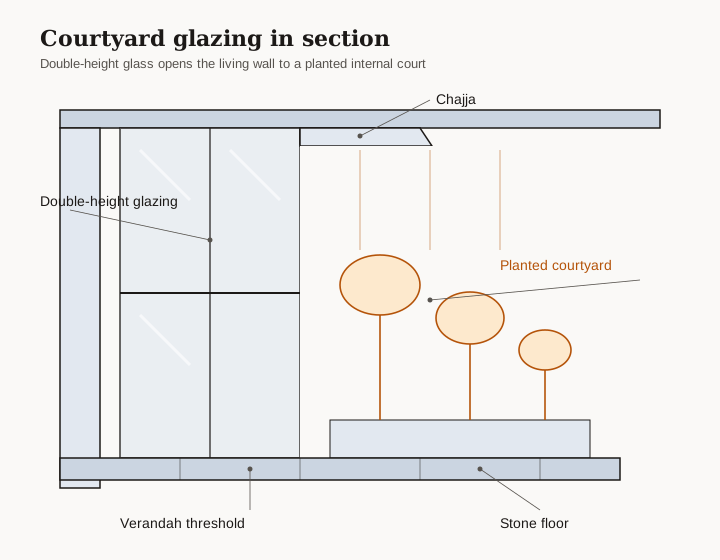
| Glazing-to-outside move | What it does | Watch-out |
|---|---|---|
| Full-height court glass | Pulls daylight deep, frames the planting | Needs external shade or it overheats by 11am |
| Sliding verandah wall | Dissolves the indoor-outdoor line | Track must drain in monsoon |
| Corner glazing (frameless join) | Modern dissolve of the box | Pair with chajja; corners cook in west sun |
| Clerestory band above jali | Light without glare or privacy loss | Keep the band slim and high |
The verandah glazing keeps the deep-shaded thinnai / otla threshold of the traditional house, then sets glass at the inner edge — you get the cool transitional zone and the sealed, dust-free interior.
Regional materials in a modern idiom
Fusion gets its warmth from material. The contemporary frame stays slim and neutral; the reveal, sill and screen carry the regional craft.
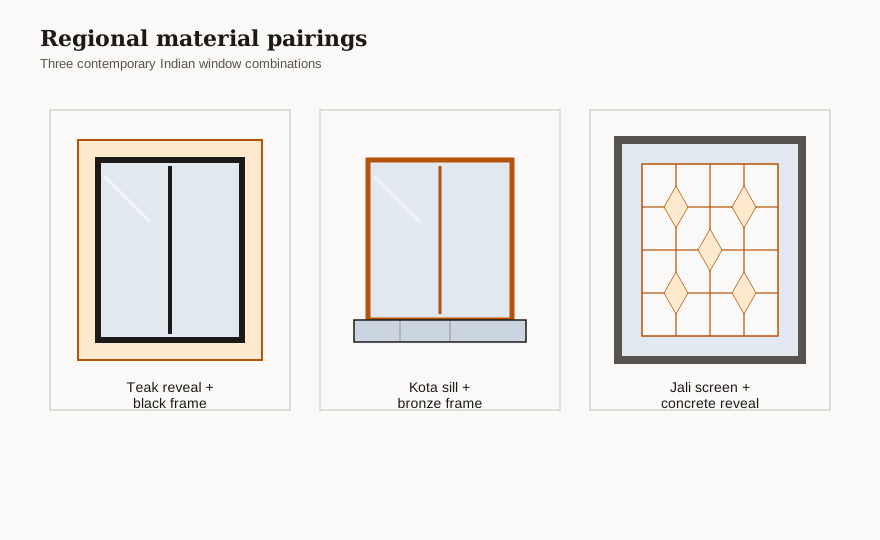
| Region / craft | Material as accent | Pair with |
|---|---|---|
| Kerala / coastal | Reclaimed teak or anjili (jackfruit) reveal | Slim black or bronze frame, louvre shutter |
| Rajasthan / west | Carved sandstone jali, honed sill | Neutral aluminium, clerestory above |
| Deccan / south | Kota or Tandur stone sill, grey-green | Steel-look frame, corner glazing |
| Tropical / monsoon | Louvred timber outer shutter | Low-E glass behind, deep chajja |
A craft note: rosewood is now restricted (CITES-listed), so the honest contemporary choice is reclaimed timber, teak or anjili rather than new rosewood. The look — a warm carved reveal against cool glass — is what matters, not the rarest species.
Climate-smart and minimal
Contemporary Indian glazing earns its slimness by managing heat, not ignoring it. The black-frame trend in particular needs care: dark frames absorb heat, so in hot zones pair them with Low-E or solar-control glass and real external shading rather than relying on the glass alone. For the glass side of this decision, see Types of Glass for Windows.
The chajja is the hero here — a clean projecting fin that cuts high summer sun while letting low winter light in, sized roughly to the window height and orientation. It is the most contemporary way to keep glass big and rooms cool.
Get the look
| Element | Choose | Avoid |
|---|---|---|
| Frame | Slim aluminium/steel-look, matte black or bronze | Fat white uPVC sections, gloss |
| Glass | Single large pane, Low-E in hot west/south | Many small panes with heavy grids |
| Heritage accent | ONE jali or louvre or stone move per opening | Stacking carving + colour + fanlight |
| Reveal | Teak / anjili / honed stone lining | Plastic trims, mismatched timbers |
| Shade | Projecting chajja or pergola fin | Big glass with no external shade |
| Connection | Court, verandah or balcony as the view | Glazing onto a blank compound wall |
For how the window actually operates behind all this styling — casement, sliding, louvre, fixed — start from Types of Home Windows, which is the functional companion to this aesthetic guide. And to see where contemporary sits among minimalist, luxury and industrial window looks, the Modern Window Design Ideas pillar maps the whole style family.
One slim frame, one heritage accent, one outdoor view, and one piece of shade. Get those four right and the window will read contemporary Indian without a single carved bracket.
References
Export this guide
Related Guides — Deep-dive reading
Floor-to-Ceiling Windows (India): Maximum Light, and the Heat Trade-Off
Full-height glazing for Indian homes — how to win the daylight and view without losing the energy code, comfort or safety.
Windows & GlazingMinimalist Window Designs for Indian Homes
The slimline, near-frameless look — hidden frames, single large panes, no grids, monochrome detail, and how to get it without the heat and cleaning traps.
Windows & GlazingModern Window Design Ideas for Indian Homes
The umbrella of the modern window aesthetic — large glazing, slim frames, black and neutral profiles, and a style map to eleven looks
Windows & GlazingRelated Tools — Try Free
Brise-Soleil Visualizer
Interactive horizontal-louvre cut-off angle calculator — sun altitude, louvre depth, and spacing inputs with a live shadow preview. Computes θ = arctan(spacing/depth) for façade shading, ECBC envelope compliance, hospital daylight design, and tropical sun-control detailing.
Sun Shading ToolCross-Ventilation Analyzer
Estimate airflow and air changes per hour (ACH) from room size, window areas, layout, and local wind — with NBC 2016 Part 8 compliance check.
Ventilation CalculatorWindow Orientation Planner
Pick the best window type, glass and shading by wall direction — north, east, south and west.
Window Tool