
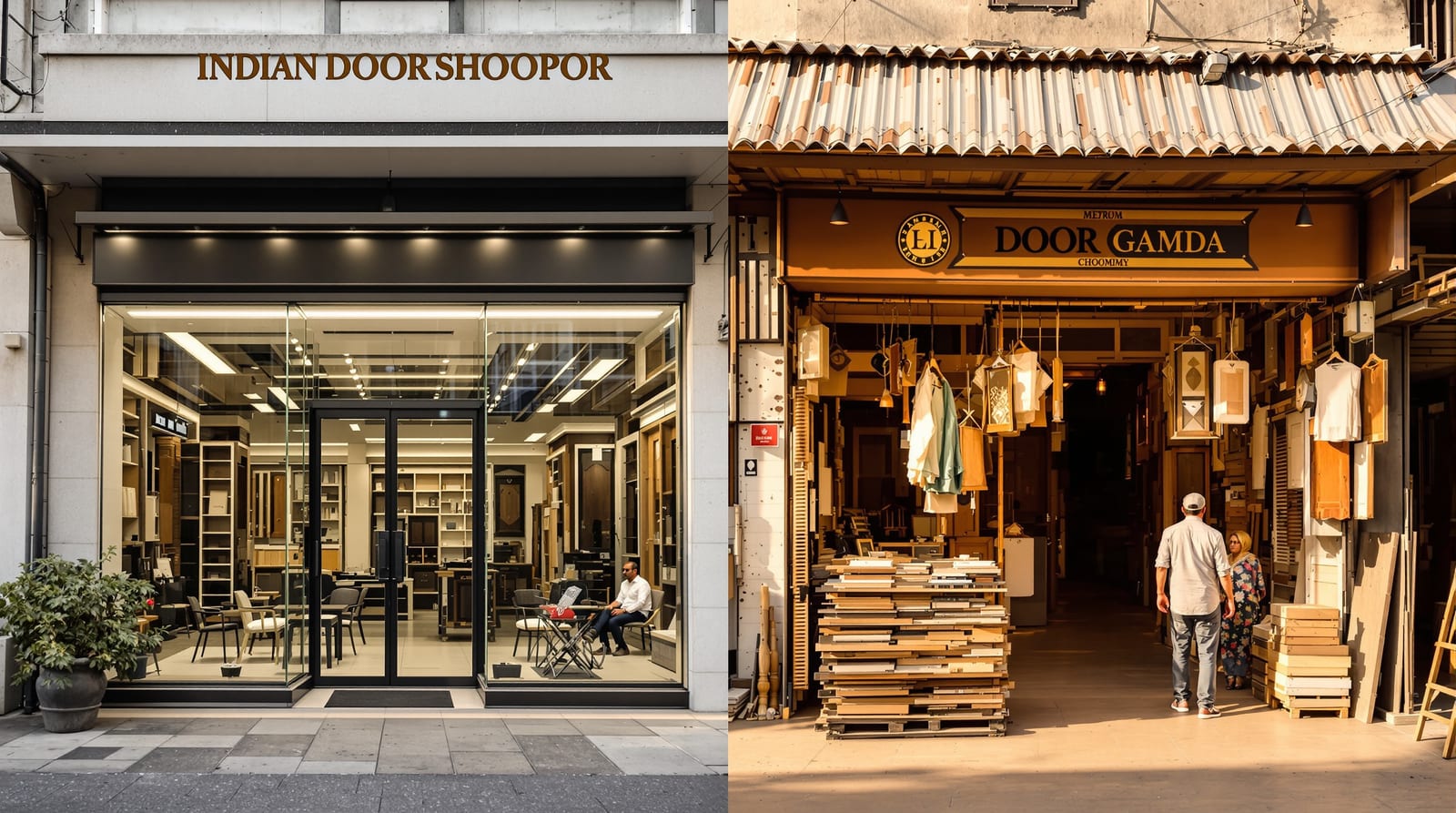
Why Door Prices Vary by City Across India 2026
The real economics behind why the same flush door costs more in Mumbai than in Indore — labour, overheads, transport and timber.
Buy a plain solid-core flush door in Mumbai and you might pay ₹4,800. The exact same door, same brand, same size, costs around ₹3,700 in Indore. Nothing about the product changed — only the city did. Understanding why door prices vary by city helps you read a quotation honestly, judge whether you are being overcharged, and budget realistically for your own town. The short answer: it is almost never the door itself. It is everything that wraps around it — labour, rent, transport and competition.
This is the explainer companion to our door cost by city pillar and the master 2026 door cost guide. If you want the headline number for your town, those have the tables; this page explains the why so the numbers make sense.
The five things that actually move the price
A door's final installed price is built up in layers. The slab (the leaf) itself is made in a handful of large factories — Yamunanagar in Haryana, the Gujarat belt, parts of Kerala and Tamil Nadu — and the ex-factory price is broadly the same nationwide. What changes city to city is the cost of getting it to you and putting it on the wall.
| Cost driver | Why it differs by city | Rough share of city gap |
|---|---|---|
| Labour / fitting rates | A carpenter's day-rate in Mumbai is 2–3× one in a Tier-2 town | Largest single factor |
| Showroom & real-estate overhead | High-street rent in metros is baked into the sticker | Large |
| Transport & logistics | Distance from factory hubs, octroi-style local levies, last-mile | Moderate |
| Local timber availability | Coastal/forest-adjacent cities get hardwood cheaper | Moderate (solid wood only) |
| Demand, competition & dealer reach | More dealers = keener pricing; thin markets = mark-ups | Variable |
1. Labour is the biggest swing
Fitting a single door — frame, leaf, hinges, lock, finishing — is a half-day to a full day of skilled carpentry. In Mumbai or Bengaluru a good carpenter commands ₹1,200–₹2,500 a day; in Lucknow or Indore the same skill is ₹500–₹900. Multiply that across 10–14 doors in a 3BHK and the labour line alone can differ by ₹15,000–₹25,000 between a metro and a smaller city. This is why our door installation cost figures are quoted as ranges, not fixed numbers — and why a supply-only price travels much better between cities than an installed one.
2. Showroom rent rides on every door
A door showroom on a Mumbai arterial road pays rent that a dealer in a Tier-2 town simply does not. That overhead is recovered through margin on every leaf, hinge and lock sold. Online and warehouse-format dealers cut this — one reason metro buyers increasingly compare a showroom quote against an online price. See door showroom vs online for how that trade-off plays out.
3. Transport and the distance from the factory
Doors are bulky and easily damaged, so freight is meaningful. Cities far from the manufacturing belts — or with difficult last-mile access — carry a transport premium. A door travelling from Yamunanagar to a North Indian city is cheaper to land than one trucked to Kochi or Coimbatore. Damaged-in-transit replacements and the dealer's insurance against them also fold quietly into the price.
4. Local timber availability (solid wood only)
For factory-made flush, WPC and uPVC doors, local timber is irrelevant — they are engineered products. But for solid teak, sal or other hardwood panel doors, proximity to timber markets matters. Cities near forest belts or major timber mandis often price teak doors and wooden doors keener, while inland cities far from timber sources pay a premium. This is why a city's index can look high for engineered doors yet feel reasonable for solid wood, or vice versa.
5. Demand, competition and dealer reach
A city thick with dealers and brand showrooms is competitive — buyers can play quotes off each other, and brands keep prices sharp to hold market share. A city with only one or two serious dealers has thin competition and weaker dealer reach, which lets mark-ups creep up. Big metros usually have the deepest brand presence (every major name stocked); smaller cities may carry fewer brands, sometimes pushing buyers toward whatever the local dealer happens to stock.
The one thing that does NOT vary by city: GST
It is worth being blunt here, because buyers often assume tax explains the gap. It does not. GST on doors is a flat 18% across all of India — wooden and flush doors under HSN 4418, uPVC and PVC doors under HSN 3925. The rate is identical in Mumbai, Indore and everywhere in between; GST is a central rate, not a state or city one. So when a Mumbai quote is higher, it is the pre-tax price that is higher — the 18% simply sits on top of a bigger base. For the full tax picture see our door GST and HSN guide.
| Factor | Varies by city? | Notes |
|---|---|---|
| Carpenter / fitting labour | Yes — strongly | Day-rates differ 2–3× metro vs Tier-2 |
| Showroom / real-estate overhead | Yes | High-street metro rent baked into margin |
| Transport from factory | Yes | Distance + last-mile + damage risk |
| Local hardwood price | Yes (solid wood only) | Engineered doors unaffected |
| Competition / dealer reach | Yes | Thin markets carry higher mark-ups |
| GST | No — flat 18% everywhere | HSN 4418 / 3925, central rate |
| Ex-factory door price | Barely | Made in a few national hubs |
The city cost index — evidence, not guesswork
Putting these forces together, Studio Matrx uses a single city cost index (national average = 1.00). Apply the multiplier to any supply price in our master tables and you get an indicative local figure. These are ranges, not quotes — the only true price is a written quotation for your exact door and site.
| City | Index | City | Index |
|---|---|---|---|
| Mumbai | 1.20 | Kolkata | 1.02 |
| Delhi-NCR | 1.12 | Ahmedabad | 0.98 |
| Bengaluru | 1.15 | Jaipur | 0.95 |
| Hyderabad | 1.05 | Lucknow | 0.92 |
| Chennai | 1.08 | Chandigarh | 1.00 |
| Pune | 1.10 | Kochi | 1.05 |
| Surat | 0.97 | Indore | 0.93 |
| Nagpur | 0.94 | Coimbatore | 1.00 |
A worked example
Take a solid-core BWR flush door that averages ₹4,000 nationally (supply only, before GST):
- In Mumbai (index 1.20): ~₹4,800, then +18% GST ≈ ₹5,664
- In Indore (index 0.93): ~₹3,720, then +18% GST ≈ ₹4,390
Same door, a ₹1,270 swing before you even add fitting — and fitting widens the gap further because Mumbai labour is dearer too. Across a whole 3BHK that compounds into a five-figure difference. This is the core reason metro vs Tier-2 door pricing deserves a guide of its own.
How to use this when you buy
- Compare like with like. Always check whether a quote is supply-only or installed. A Tier-2 supply price plus metro fitting is a meaningless mix.
- Separate the door from the labour. The leaf price barely moves between cities; the labour does. If your quote looks high, it is usually the fitting line, not the door.
- Don't blame GST. It is 18% everywhere. A higher final number means a higher base price.
- Run your own city number. Use the door cost by city calculator to apply your city's index to any spec, or the city door price comparison tool to see two cities side by side.
- Negotiate the controllables. Labour, bundling multiple doors, and dealer margin are negotiable; the factory price and GST are not. See negotiating door prices.
If you are buying for a specific town, jump straight to that city's breakdown via the door cost by city hub, or compare regions with the north India and south India buying guides.
Frequently asked questions
Why does the same door cost more in Mumbai than in a smaller city?
Mostly because of labour and rent. A Mumbai carpenter's day-rate is two to three times that in a Tier-2 town, and high-street showroom rent is baked into the sticker. Transport and thinner negotiation room add a little more. The door slab itself costs roughly the same — it is made in a few national factory hubs.
Is GST higher in expensive cities?
No. GST on doors is a flat 18% across all of India (HSN 4418 for wooden/flush, 3925 for uPVC/PVC). It is a central rate, identical in every city. When a metro quote is higher, it is the pre-tax price that is higher; the 18% simply sits on a larger base.
How much can door prices realistically vary between cities?
Around ±15–30% versus the national average for supply, and more once you add labour. On our index Mumbai sits at 1.20 and Indore at 0.93 — about a 25–27% gap on the same door before fitting and GST.
Does local timber availability affect all doors?
Only solid-wood ones. Teak, sal and hardwood panel doors are cheaper in cities near timber mandis or forest belts. Engineered doors — flush, WPC, uPVC — are factory-made and largely unaffected by local timber, so their city differences come almost entirely from labour, rent and transport.
Can I get a metro-quality door at Tier-2 prices?
Partly. The leaf price is similar everywhere, so buying supply-only from a competitive dealer (or online) gets you most of the way. The labour gap is harder to close because it reflects local wages — but bundling all your doors into one fitting job and negotiating the labour line helps.
Are the index figures actual quotes?
No. They are indicative multipliers to estimate a realistic range from the national average. The only true price is a written quotation for your exact door, size, hardware and site. Treat the index as a sanity-check, then get quotes in writing — see our door quotation guide.
Export this guide
Related Guides — Deep-dive reading
Door Cost by City: Full India Price Index Guide India 2026
What doors actually cost across 16 Indian cities, with the exact cost-index multipliers, worked examples and where to buy.
Home Doors & EntrancesDoor Cost in Hyderabad: Prices, Markets, GST Guide 2026
What doors really cost in Hyderabad in 2026 — city index 1.05, worked examples with 18% GST, and the markets where people actually buy.
Home Doors & EntrancesDoor Cost in Jaipur (2026): Prices, Markets & Buying Guide
What doors really cost in Jaipur in 2026 — city index 0.95, worked examples with 18% GST, real timber markets and the carved-wood heritage premium.
Home Doors & EntrancesRelated Tools — Try Free
Door Cost Calculator
Estimate the all-in cost of a door — leaf, frame, hardware, fitting and GST — by type, material and size.
Door CalculatorDoor Material Comparison Tool
Compare 2–4 door materials on cost, durability, maintenance, security and moisture resistance.
Comparison ToolProperty Tax Calculator — 10 Indian Cities
Estimate annual municipal property tax across BBMP / MCD / MCGM / GHMC / GCC / KMC / PMC / AMC / TMC / PCMC — with self-occupied, tenanted, and age-rebate adjustments.
Property Tax