
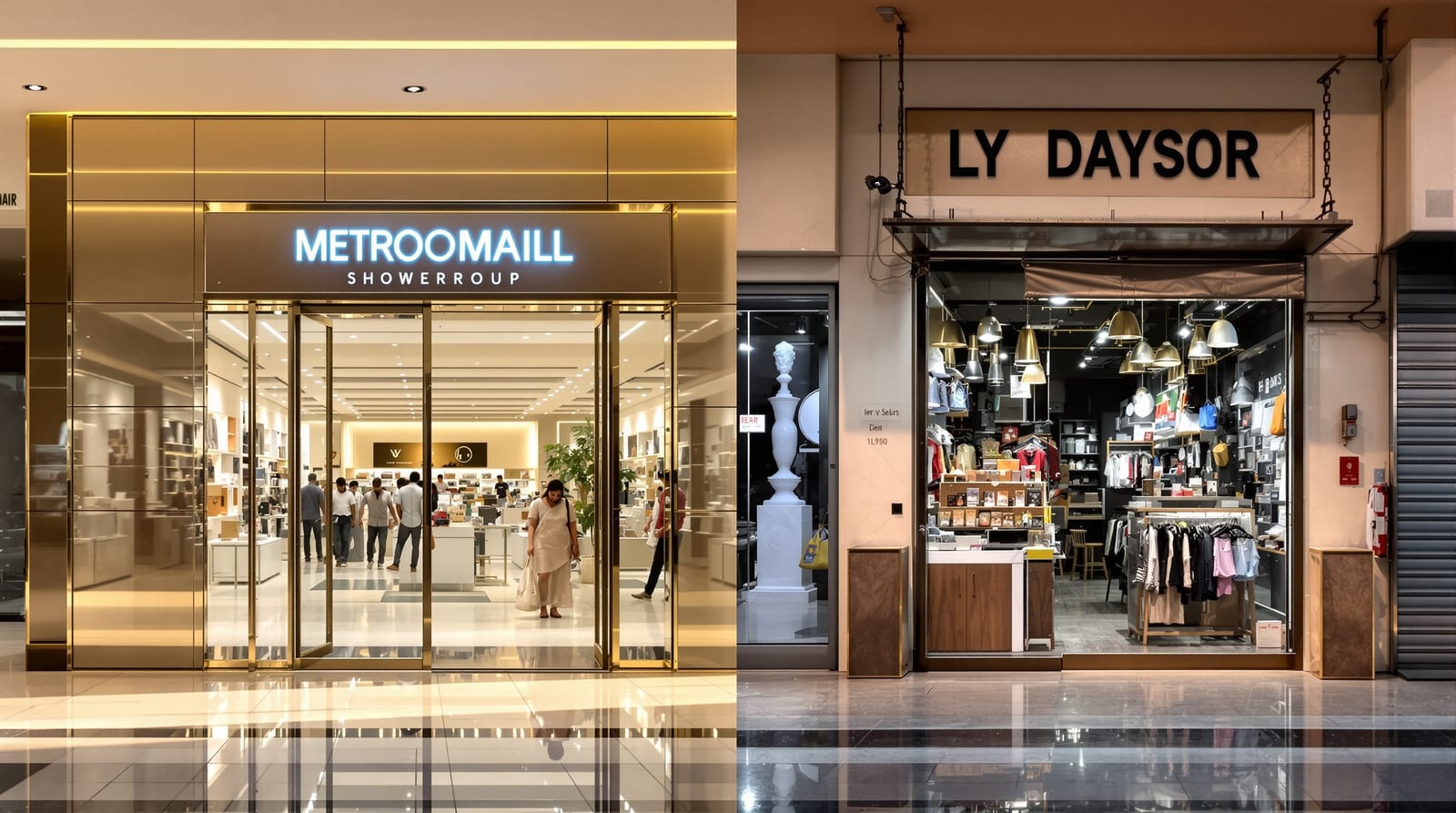
Metro vs Tier-2 Door Pricing in India 2026
Why the same door costs more in Mumbai than Indore — and how to legally exploit the gap by buying smart and transporting in.
The gap is real and it is large. A plain solid-core flush door that lands around ₹3,720 in Indore costs roughly ₹4,800 for the identical product in Mumbai — before fitting, before GST. Multiply that across the 10–14 doors in a typical 3BHK and the metro vs tier-2 door pricing gap can reach ₹40,000–₹80,000 on the whole home. The product is the same; the city is not. This guide explains exactly what drives that gap and, more usefully, how an ordinary homeowner can legally exploit it — by buying in a cheaper hub, timing the purchase, and dealing closer to the factory.
This sits alongside the master 2026 door cost guide and the door cost by city pillar. If you want the headline number for a single town, those have the tables; this page is about the arbitrage between an expensive city and a cheaper one.
How big is the metro vs tier-2 door pricing gap?
Studio Matrx uses a single city cost index (national average = 1.00). Apply the multiplier to any supply price and you get an indicative local figure. The spread between the priciest metros and the keenest Tier-2 cities is roughly 25–30%.
| City (metro) | Index | City (Tier-2/3) | Index |
|---|---|---|---|
| Mumbai | 1.20 | Indore | 0.93 |
| Bengaluru | 1.15 | Nagpur | 0.94 |
| Delhi-NCR | 1.12 | Jaipur | 0.95 |
| Pune | 1.10 | Surat | 0.97 |
| Chennai | 1.08 | Ahmedabad | 0.98 |
| Hyderabad | 1.05 | Lucknow | 0.92 |
On a ₹4,000 national-average solid-core flush door (supply only, before GST):
- Mumbai (1.20): ~₹4,800
- Indore (0.93): ~₹3,720
- Difference: ~₹1,080 per door, about 29%
That is before the labour gap — and a metro carpenter's day-rate is 2–3× a Tier-2 one — and before the 18% GST that sits on top of whichever base price you start from.
What you are really paying extra for in a metro
The door slab itself is made in a handful of national hubs — Yamunanagar in Haryana, the Gujarat plywood belt, parts of Kerala and Tamil Nadu — and leaves the factory at broadly the same price nationwide. The metro premium is built up from everything that wraps around the leaf.
| Cost layer | Tier-2 city | Metro | Why it differs |
|---|---|---|---|
| Ex-factory leaf | ₹3,000 | ₹3,000 | Same factory hubs nationwide |
| Transport / last-mile | + ₹150 | + ₹250 | Metro congestion, octroi-style levies, handling |
| Showroom / real-estate margin | + ₹300 | + ₹900 | High-street metro rent baked into the sticker |
| Dealer / brand mark-up | + ₹270 | + ₹650 | Thinner metro discounting, higher overheads |
| Supply price (before GST) | ~₹3,720 | ~₹4,800 | ~29% gap |
| Fitting labour (per door) | + ₹800 | + ₹1,800 | Day-rate ₹500–900 vs ₹1,200–2,500 |
Two layers do the heavy lifting: showroom rent (a Mumbai arterial-road showroom recovers its rent through margin on every leaf) and labour (covered in our door installation cost guide). Notice what does not change — the ex-factory leaf. That is the whole basis of the arbitrage: if you can buy closer to the leaf price and supply the labour locally, you capture most of the gap.
Tactics to exploit the gap
The metro premium is mostly overhead, not value. Here is how homeowners legitimately arbitrage it.
1. Buy the leaf and frame in a Tier-2 hub, transport it in
The single biggest lever. Door leaves and frames are bulky but tough, and freight on a few doors is modest relative to the saving. If you have family, a builder contact, or a project in a cheaper city near a factory hub — Yamunanagar belt for the North, the Gujarat plywood cluster (Surat/Ahmedabad), or a Kerala/Coimbatore timber market for the South — buying there and trucking the doors to your metro home can save 20–25% on the supply side. Do the maths honestly:
| Item (per door) | Buy in metro | Buy in Tier-2 + transport |
|---|---|---|
| Supply price | ₹4,800 | ₹3,720 |
| Inter-city freight (shared load) | — | + ₹250–500 |
| Local fitting | ₹1,800 | ₹1,800 |
| Total (before GST) | ₹6,600 | ₹5,770–6,020 |
The gap narrows but stays positive — typically ₹600–₹900 a door, which compounds across a whole home. It only works at volume (a full home of doors, not one), and you must inspect for transit damage on arrival before signing off. See where to buy doors for sourcing.
2. Deal direct with the manufacturer or a Tier-2 distributor
Cut the metro showroom margin entirely by dealing with a dealer or distributor closer to the factory, or directly with a manufacturer for a whole-home order. Many flush and WPC door makers sell ex-factory or through warehouse-format dealers at materially lower margins than a high-street metro showroom. You lose the showroom hand-holding, so this suits buyers who already know their spec.
3. Buy supply-only, hire labour locally
Labour is the one layer you cannot transport — a metro carpenter charges metro rates wherever the door came from. So separate the two lines: source the leaf cheaply (Tier-2 or online), and negotiate the fitting locally. Never let a quote blend a Tier-2 supply price with metro fitting and present one number — itemise it. The door quotation guide shows how to read a split quote.
4. Compare online against the metro showroom
Online door shopping bypasses high-street rent and often prices closer to Tier-2 levels even when delivered to a metro. Use it as a price anchor before you negotiate face to face — see door showroom vs online.
5. Time the purchase
Prices soften around year-end clearances, the pre-Diwali festive offers, and the slower monsoon months when dealers chase volume. If your project timeline is flexible, buying off-peak in a Tier-2 hub stacks two discounts at once.
When the metro is actually the smarter buy
Arbitrage is not free, and sometimes the metro wins:
- Single door or small order. Freight and a trip to another city are not worth saving on one or two doors.
- Warranty and after-sales. A local metro dealer is easier to chase for a replacement than a distributor four cities away. Read door warranty and after-sales service before deciding.
- Custom or designer doors. A custom main door needs measurement, sampling and rework access — local is safer than long-distance.
- Transit-fragile finishes. High-gloss laminate and glass doors damage easily in transport; the saving can vanish in one chipped leaf.
How to run your own numbers
The index lets you estimate before you commit, but the only true price is a written quotation for your exact door and site. Treat the multipliers as a sanity-check, then get quotes in writing.
- Apply your city's multiplier to any spec with the door cost by city calculator.
- See two cities side by side — your metro and a nearby Tier-2 hub — with the city door price comparison tool.
- Stack the labour, hardware and GST on top with the door total cost calculator.
If you are buying for a specific region, jump to the north India or south India buying guides, and sharpen your face-to-face position with negotiating door prices.
Frequently asked questions
How much can I really save buying doors in a Tier-2 city?
On supply, the gap between a top metro (index 1.20) and a keen Tier-2 city (0.93) is about 25–29% — roughly ₹1,000 a door on a ₹4,000 flush leaf. After inter-city freight and identical local fitting, the net saving is usually ₹600–₹900 a door, which adds up to ₹40,000–₹80,000 across a full 3BHK. It only makes sense at whole-home volume.
Is it legal to buy doors in one city and use them in another?
Yes — entirely. There is no restriction on buying goods in one Indian city and transporting them to another. GST is a flat 18% nationwide (HSN 4418 for wooden/flush, 3925 for uPVC/PVC), so you pay the same tax rate wherever you buy; just keep the tax invoice for warranty and records.
Won't transport damage eat up the saving?
It can if you are careless. Door leaves are tough but corners and laminate/glass finishes chip. Use a shared full load, insist on edge protection, and inspect every door on arrival before signing off. Plain flush and solid-wood doors travel well; high-gloss and glass doors are riskier.
Does dealing direct with a manufacturer really cost less?
Usually yes for a whole-home order, because you skip the metro showroom's rent-loaded margin. The trade-off is less hand-holding and you must know your exact spec. For one or two doors the minimum-order and logistics rarely justify it.
Why is metro fitting so much more expensive?
Labour is local and cannot be transported. A skilled carpenter charges ₹1,200–₹2,500 a day in Mumbai or Bengaluru versus ₹500–₹900 in a Tier-2 town. You can buy the leaf anywhere, but the fitting will always be billed at your city's wage rate — so itemise supply and labour separately in every quote.
Is the metro premium ever worth paying?
For single doors, custom or designer work, fragile finishes, and easy warranty access — yes. The arbitrage rewards volume and standard products. If you are buying a full home of plain flush, WPC or solid-wood doors and have a sourcing route to a cheaper hub, the gap is worth chasing; for a one-off, stay local.
Export this guide
Related Guides — Deep-dive reading
Why Door Prices Vary by City Across India 2026
The real economics behind why the same flush door costs more in Mumbai than in Indore — labour, overheads, transport and timber.
Home Doors & EntrancesDoor Cost by City: Full India Price Index Guide India 2026
What doors actually cost across 16 Indian cities, with the exact cost-index multipliers, worked examples and where to buy.
Home Doors & EntrancesDoor Cost in Jaipur (2026): Prices, Markets & Buying Guide
What doors really cost in Jaipur in 2026 — city index 0.95, worked examples with 18% GST, real timber markets and the carved-wood heritage premium.
Home Doors & EntrancesRelated Tools — Try Free
Door Cost Calculator
Estimate the all-in cost of a door — leaf, frame, hardware, fitting and GST — by type, material and size.
Door CalculatorProperty Tax Calculator — 10 Indian Cities
Estimate annual municipal property tax across BBMP / MCD / MCGM / GHMC / GCC / KMC / PMC / AMC / TMC / PCMC — with self-occupied, tenanted, and age-rebate adjustments.
Property TaxDoor Material Comparison Tool
Compare 2–4 door materials on cost, durability, maintenance, security and moisture resistance.
Comparison Tool