

Why Building Plans Get Rejected in India
The logic of plan scrutiny and the most common reasons a sanction is refused or returned, with a plain-language fix for each
You finally have your dream house on paper. You submit the drawings for sanction, wait a few weeks, and then a message lands: plan returned. Or worse, rejected. Did you do something wrong? Is the plot a dud? Are months of work and money gone?
Take a breath. In India, a rejected building plan is almost never the end of the road. It is a formal, reasoned step in a back-and-forth process. The authority is required to tell you exactly why it said no, and for the large majority of homeowners the reasons are fixable. You modify the drawing or supply the missing paper, your architect resubmits, and the file moves forward.
This guide explains the logic the sanctioning office uses when it scrutinises your plan, and the most common reasons a sanction is refused or returned, with plain-language fixes for each. It is the companion to our walk-through of the building plan approval process and our checklist of common approval mistakes that delay projects. That sibling guide is about behaviour and process slip-ups; this one is about the scrutiny decision itself, what the officer is actually checking and why a "no" happens.
One honest caveat up front: India has no single national building code that everyone follows to the letter. The National Building Code (NBC) 2016 and the Model Building Bye-Laws 2016 from the central government are templates. The rules that actually bind you are your own city or state Development Control Regulations. So treat every threshold here as the general picture and verify the exact numbers with your local authority. Our building bye-law checker and the India Regulatory Atlas can help you find what applies where you are.
1. How plan scrutiny actually works
Before the reasons, understand the machinery, because it shapes what gets flagged.
There are two broad ways your plan gets checked. The older way is manual scrutiny: a municipal engineer opens your drawings and measures setbacks, adds up floor areas, and compares everything against the bye-law tables by hand, often with a site visit. It is thorough but slow, and small human errors creep in.
The newer way is automated scrutiny. Many cities now run online portals, generically called OBPAS (Online Building Plan Approval System) or OBPS, with a rule engine inside, often branded auto-DCR or e-DCR. Think of it this way: the portal is the website where you submit and pay; the rule engine is the brain that grades your drawing; and your CAD file is the language that brain reads.
For the engine to read your design, your architect cannot just draw lines. The drawing must be built on standardised, named layers, plot boundary on one layer, each setback on its own, the floor-area polygon as a closed shape with a name label inside it. A companion tool (often a plug-in called PreDCR) sets up these layers. The engine then does arithmetic on those polygons: it works out ground coverage as footprint divided by plot, FAR as total floor area divided by plot, measures each setback gap, and flags anything outside the limits, often within minutes.
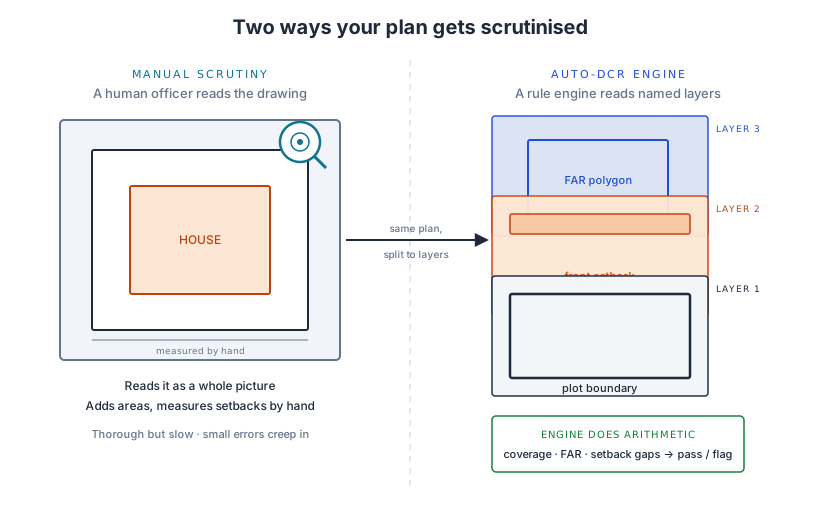
Why does this matter to you? Because under an automated system, a drawing that is not drawn to the layer convention gets bounced at upload, before a human ever sees the design. And a design that genuinely breaks a numeric rule gets caught with no room for a sympathetic eye. The flip side: a clean, correctly drawn plan can move very fast.
2. Bye-law violations: the envelope rules
By far the most common substantive rejections are violations of the "building envelope", the set of rules that decide how big and how positioned your house may be. There are four main controls, and here is the crucial point: they are separate ceilings. Passing one does not mean you pass the others.
- Setbacks are the mandatory open gaps between your outer walls and each plot boundary, front, rear and the two sides. They exist for light, air, fire access and street width. A frequent trap on a corner plot: you may owe a front setback on both road-facing sides, and the front gap often grows when the abutting road is wider.
- FAR or FSI (Floor Area Ratio / Floor Space Index, two names for the same thing) caps your total floor area across all floors as a multiple of plot area. An over-floored design blows this cap even with a compliant footprint.
- Ground coverage caps the percentage of the plot your ground-floor footprint may occupy. A squat, wide house can satisfy FAR yet still fail coverage.
- Building height is rarely a single number. It is usually derived from the abutting road width, the front setback, plot size and zone, and near airports it is capped separately (see the NOC section).
Alongside these sit the interior bye-laws: minimum room sizes (every habitable room has a smallest legal floor area, width and ceiling height), and ventilation and natural-light rules (each habitable room needs a window to outside air, usually a minimum fraction of the floor area; interior toilets must vent into a properly sized shaft; courtyards and open spaces have minimum dimensions). Draw a "bedroom" below the minimum and the scrutiny will simply not accept it as a bedroom.
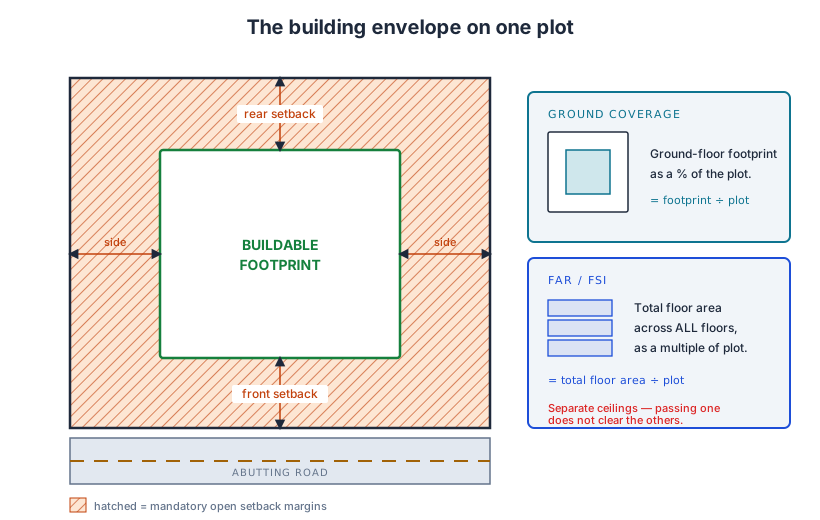
How to fix envelope rejections: pull the walls in to honour every setback, drop a floor or shrink floor plates to get under FAR, reduce the footprint for coverage, enlarge any undersized room (both area and width must clear the minimum), and add or widen windows and shafts for light and ventilation. Your architect redraws and resubmits. In some states, small as-built deviations can later be compounded or regularised on payment of a fee, but do not bank on that, design within the limits from the start.
3. Land-use and zoning mismatch
This is a deeper problem than a wall in the wrong place, because it is about whether you may build a house here at all.
Two separate checks must both pass. First, the land's revenue classification: if your plot is recorded as agricultural land, you generally cannot build a home on it until it is converted to non-agricultural (NA) use. Second, the Master Plan or Development Plan zone: even after NA conversion, the zone must permit residential use. A nasty trap is land that has been converted but sits inside an industrial or green-belt zone, the zoning still blocks approval.
How to fix it: apply for land-use or NA conversion with your revenue or planning authority (the office differs by state, Collector or Sub-Divisional Officer in Maharashtra, Deputy Commissioner in Karnataka, Tahsildar or District Collector in Tamil Nadu, and so on). The usual path is to verify records, get the revenue NOC, file the conversion application, pass a site inspection, pay the conversion fee, receive the conversion order, mutate the records, and only then apply for the building plan. If the Master Plan zone itself forbids residential use, conversion alone will not help and you may need a discretionary change of zone, harder, and some protected zones (forest, coastal, green belt) may not be convertible at all. Check the specific plot before you buy, not after.
4. Title, ownership and encumbrance problems
The authority must be satisfied you have the legal right to build before it sanctions anything. Title gaps break that chain.
The common sub-issues:
- Unclear or defective title: any dispute, charge, or break in the ownership chain means the title is not "marketable." A title search going back many years is standard diligence.
- Missing or unregistered sale deed: the registered sale deed is your core proof of ownership.
- Encumbrance Certificate (EC) problems: the EC lists registered transactions and charges; one showing a subsisting mortgage or dispute is a red flag.
- Records not in your name: registering the sale deed makes you the owner, but mutation (khata transfer, or dakhil-kharij) updates the municipal and revenue records into your name. Until you mutate, the tax bills still name the previous owner, so the applicant on the plan does not match the record holder.
- Co-owner consent: where a plot has several owners, the written consent of all of them is generally needed; one co-owner cannot act alone.
How to fix it: get a proper title verification and clear any disputes or charges, obtain or rectify the sale deed, close any loan and pull a fresh clean EC, pay all property-tax arrears and complete mutation, and collect written consent from every co-owner. These are paperwork fixes, tedious but solvable.
5. The plot is hit by a road line or public reservation
Sometimes part of your land is not really yours to build on, because the Development Plan has earmarked it for the public.
Two ideas to know. The building line is the line up to which your building may extend toward the street; the gap in front of it is your front setback. The regular line of road (and a future road-widening alignment) is a line the authority fixes for a widened street; you generally cannot build beyond it. Separately, a Development Plan can reserve part of a plot for a public purpose, a proposed road, a park, or a utility, and that reserved strip is frozen.
A classic returned plan: setbacks and height are measured from the proposed widened road, not the present narrow one, so a plan drawn to the existing road gets sent back.
How to fix it: the standard resolution is to surrender the affected strip to the authority and set your building behind the new line. In several states this is formalised by a registered deed handing over the affected portion before sanction. You are usually compensated not in cash but through Transferable Development Rights (TDR), a certificate for the development potential of the surrendered land that you can use on another plot or sell. Some states also offer setback or FSI relaxations to offset the loss. The mechanism varies a lot, confirm the route with your local planning office.
6. Incomplete or inconsistent drawings and area statements
A very large share of returns are not about a bad design at all, just an incomplete or self-contradictory submission.
The drawing set has required pieces: a location or key plan, site plan, layout plan, the building plan (which itself bundles floor plans of every floor, at least one section, and all elevations), a services plan, specifications and certificates. Sections and elevations are not optional. The drawings must be at the correct scale for your plot size (a small home drawn too coarsely is non-conforming), and they must mark dimensions, setbacks, room sizes, the north point and a floor-by-floor coverage calculation.
Then there is the area statement, a formal "permissible versus proposed" table covering coverage, per-floor area, total floor area, FAR, dwelling units, height and each setback. Two failure modes here: the numbers in the table do not match what the drawings actually show, or the "proposed" column exceeds the "permissible" column. Either gets the file returned.
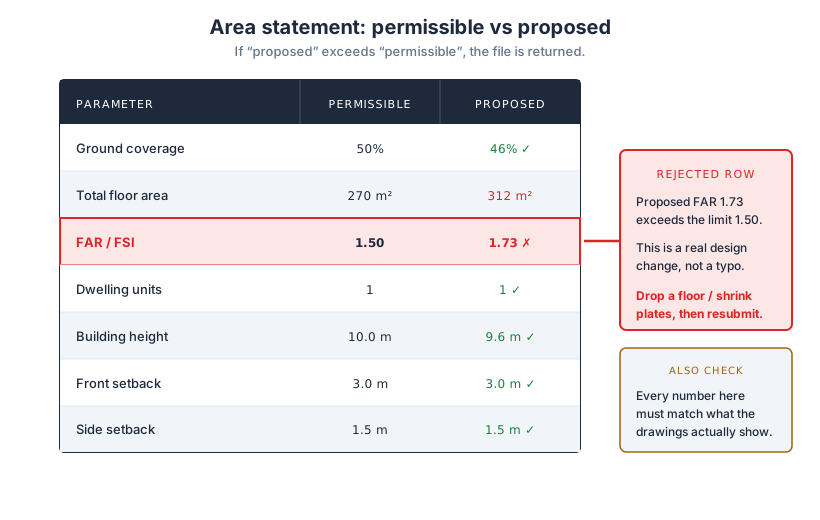
How to fix it: supply every missing sheet, redraw to the correct scale, mark all dimensions, and reconcile the area statement so it both matches the drawings and stays within permitted limits. If "proposed" exceeds "permissible," that is a real design change, not a typo, so you and your architect will need to revise the building before resubmitting.
7. Missing NOCs, structural papers and an unsigned plan
These three causes get bundled together because they are all about required certification rather than the shape of the house.
No Objection Certificates (NOCs) are clearances from other departments, and the key reassurance is that most are triggered by what or where you build, not by building at all. A typical small, low-rise home on ordinary inland land needs almost none of these. The common ones and their rough triggers:
| Rejection reason | What it means | When it bites | How to fix and resubmit |
|---|---|---|---|
| Missing fire NOC | Chief Fire Officer must clear escape routes and fire access | Mainly taller buildings (commonly from around 15 m) and large special uses; most low homes are outside it | Authority refers plans to the fire office; mark escape routes, clear objections, attach the NOC |
| Missing airport (AAI) height NOC | Your top height must not obstruct flight paths | Only near an airport (within the safeguarding radius) or for very tall structures | Apply on the AAI NOCAS portal with accurate site coordinates and ground elevation; attach the NOC |
| Missing environment clearance | Central green permission for large projects | Only very large built-up areas; a single home is nowhere near the threshold | Developer applies via the environment portal; not relevant to ordinary homes |
| Missing heritage or coastal or forest NOC | Construction near a protected monument, the coast, or on forest land is restricted | Only if your plot is near a monument, near the high tide line, or recorded as forest land | Apply to the relevant authority (monuments, coastal zone, or forest department); attach the clearance |
| Structural inadequacy | Load-bearing design not certified or not code-compliant | Scales with size: small low-rise needs only a design-basis report; taller buildings need proof-checking | Engage a registered structural engineer; submit the structural design basis report and required drawings |
| Plan not signed by a licensed professional | Drawings lack a registered architect's or eligible engineer's stamp | Always; only the smallest standard-plan plots can be owner-signed | Get a Council-of-Architecture-registered architect (or an eligible engineer for smaller plots) to prepare, stamp and sign |
| Unpaid fees or charges | Sanction, scrutiny, development or labour-cess dues not paid | Always, the file stays invalid until paid | Pay the assessed fees and the labour cess on the portal or counter; attach the receipts |
A few specifics worth knowing. On structural papers: the structural design must be done by a registered structural engineer, and the depth of scrutiny scales with height, a small load-bearing home needs only a design-basis report, while taller framed buildings get proof-checked. On signatures: under the model rules an eligible engineer may sign for smaller plots, but above a size threshold a Council-of-Architecture-registered architect is required; an owner can self-submit only the smallest standard pre-approved plans. (Note one common myth: the law protects the title "architect", it does not say only architects may design, eligible engineers may sign smaller buildings.) On fees: the spine principle is simple, no sanction until the assessed fees are paid, so non-payment quietly leaves your file pending or returned.
8. So is rejection really fixable?
Almost always, yes. The bye-laws themselves build in a cure-and-resubmit loop: the authority points out objections, you modify the plan to comply, and your architect resubmits, after which it is sanctioned. There is no penalty for fixing and resubmitting.
The rejections that take longest are the structural ones, land-use or zoning, title, and a road or reservation line, because they involve other offices or real design changes. The quickest are the drawing, signature and fee rejections, which are paperwork.
What this means for you
If your plan comes back, do not panic and do not assume the worst about your plot. Read the objection memo, it will list the exact reasons.
Practical steps:
- Sort the objections into two buckets: paperwork (missing sheet, unsigned plan, unpaid fee, area statement mismatch) and substantive (setback, FAR, coverage, height, zoning, title, road line). Paperwork is fast; substantive needs design or legal work.
- Lean on your architect. A registered professional who knows your city's Development Control Regulations is the single biggest factor in a clean resubmission.
- Check the envelope before you fall in love with a design. Run the plot through our building bye-law checker and read why setbacks matter and our plain-English understanding building bye-laws so the four ceilings, setback, FAR, coverage and height, are in your head from day one.
- Verify the boring stuff early: land-use classification, clear title with mutation in your name, and whether any road-widening line or reservation crosses the plot. These are far cheaper to catch before you draw than after you are rejected.
- Remember the wider process. This guide is about the scrutiny decision; for the full journey from application to occupancy, see the building plan approval process, and to avoid the procedural slip-ups that cause delays, see common approval mistakes that delay projects. For state-by-state rules, the India Regulatory Atlas is your map.
A returned plan is feedback, not a verdict. Fix what is listed, resubmit, and your house gets built.
Sources
- Ministry of Housing and Urban Affairs, Model Building Bye-Laws 2016 (template for setbacks, FAR, drawing set, area statement, signature and risk-based scrutiny): https://mohua.gov.in/cms/Model-Building-Bye-Laws.php
- National Building Code of India 2016, Bureau of Indian Standards (technical standards referenced by bye-laws): https://www.bis.gov.in/
- Delhi Building Bye-Laws (illustrative room sizes, ventilation and shaft requirements): http://www.naredco.in/notification/pdfs/building_bye_laws_Delhi.pdf
- Airports Authority of India, NOCAS (height clearance near airports): https://nocas2.aai.aero/nocas/
- National Monuments Authority, NOC portal (heritage prohibited and regulated zones): https://nmanoc.nic.in/
- Coastal Regulation Zone Notification 2019 (coastal construction limits): https://crz.elaw.in/crz2019.html
- Architects Act 1972 (registration and the protected title "architect"): https://www.indiacode.nic.in/bitstream/123456789/1690/1/197220.pdf
- NIUA OBPAS / e-DCR overview (online plan scrutiny systems): https://smartnet.niua.org/content/ee74d416-ab49-440f-9139-ca63408b257e
- West Bengal OBPS / pre-check guidance (how CAD layers are auto-scrutinised): https://obpsudma.wb.gov.in/
Information here is general and varies by city and state. Always confirm the rules and figures for your plot with your local municipal or development authority before you build.
Export this guide
Related Guides — Deep-dive reading
Common Approval Mistakes That Delay Projects in India
The avoidable errors that stall building-plan sanction and possession, and how first-time builders can sidestep each one
Building Regulations & ComplianceUnderstanding Building Height Restrictions in India
Why your city caps how tall you can build, how road width, fire-ladder reach and airport zones decide your real height limit, and how to find your plot's number before you design
Building Regulations & CompliancePlot Due Diligence in India: The Complete Pre-Purchase Check (2026)
Before you pay a rupee for a plot, run the full pre-purchase check with your lawyer and a licensed surveyor - legal title, revenue records, planning approvals, physical survey and financial dues. This guide walks through each pillar, gives you a checklist and tells you when to walk away.
Buying LandRelated Tools — Try Free
Cross-Ventilation Analyzer
Estimate airflow and air changes per hour (ACH) from room size, window areas, layout, and local wind — with NBC 2016 Part 8 compliance check.
Ventilation CalculatorConstruction Approval Checklist — 24-Stage Tracker
Track every approval, permit, and NOC from land title to occupancy certificate across 24 stages.
ApprovalsStamp Duty Calculator — All Indian States
Stamp duty + registration charges for all 28 states and 8 UTs — gender concessions, urban/rural variants, metro cess built in.
Stamp Duty