

Common Approval Mistakes That Delay Projects in India
The avoidable errors that stall building-plan sanction and possession, and how first-time builders can sidestep each one
You have bought the plot, saved for years, and you are ready to build. Then the file sits. A week becomes a month, the monsoon arrives, the contractor moves to another job, and your sanction is still "under scrutiny." Most of these delays are not bad luck and they are not the system being slow for the sake of it. They are avoidable mistakes made before the file was ever submitted.
This guide walks you through the most common errors that stall building-plan sanction and, later, possession across Indian cities. The exact rules, fees, and timelines vary by state, city, and even by zone within a city, so treat every number here as illustrative and verify with your local authority. The pattern of mistakes, though, is remarkably consistent everywhere. For the full step-by-step picture, read the companion guide on the building plan approval process. To see what an outright "no" looks like, read why building plans get rejected.
For each mistake below the format is the same: what the mistake is, why it delays your project, and how to avoid it.
1. Submitting incomplete or inconsistent documents
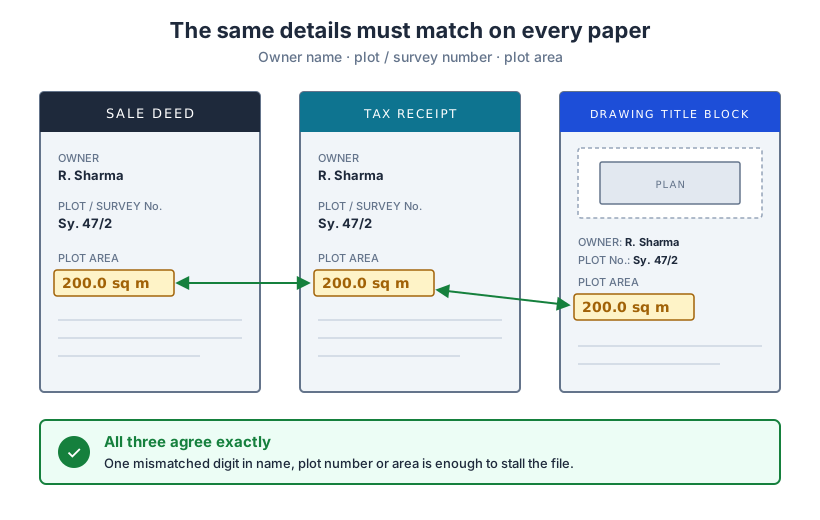
This is the single most common cause of a file going nowhere. The application is short of one document, or the documents contradict each other: the name on the sale deed does not match the property-tax receipt, the plot area on the survey record differs from the area written on the drawing, or a signature is missing on one sheet.
Why it delays you: a scrutiny clerk cannot approve a file with a gap. In most cities the file is either returned for "compliance" or kept pending while you are asked, in slow rounds of correspondence, to supply each missing item. Every round can cost days or weeks, and online portals (OBPAS) often will not even let you submit until mandatory uploads are attached.
How to avoid it: build a single checklist of every required document for your city and tick each one before you submit. Make sure the owner name, plot number, survey number, and plot area read exactly the same on the sale deed, the title document, the tax receipt, and every drawing sheet. One mismatched digit is enough to stall a file. The free construction approval checklist tool helps you assemble this.
2. Title, ownership, and encumbrance problems
Approval authorities will not sanction a plan on land whose ownership is unclear. Common traps include a property still in a deceased parent's name with no mutation done, a joint-family plot without consent from all co-owners, an unconverted agricultural plot, or a property carrying a registered charge (a loan or mortgage) that you did not clear in the records.
Why it delays you: if the title is not clean the file simply cannot proceed, and these are the hardest delays to fix because they may need a fresh registration, a mutation entry, a No Objection from co-owners, or a court matter, none of which the building department controls.
How to avoid it: before you spend on drawings, get an up-to-date Encumbrance Certificate (an EC, or a Nil EC) and confirm the mutation/khata is in your name. If the plot was farmland, complete the land-use conversion first (see mistake 7). If others share the title, get their written consent on record early.
3. Drawings that quietly break the building bye-laws
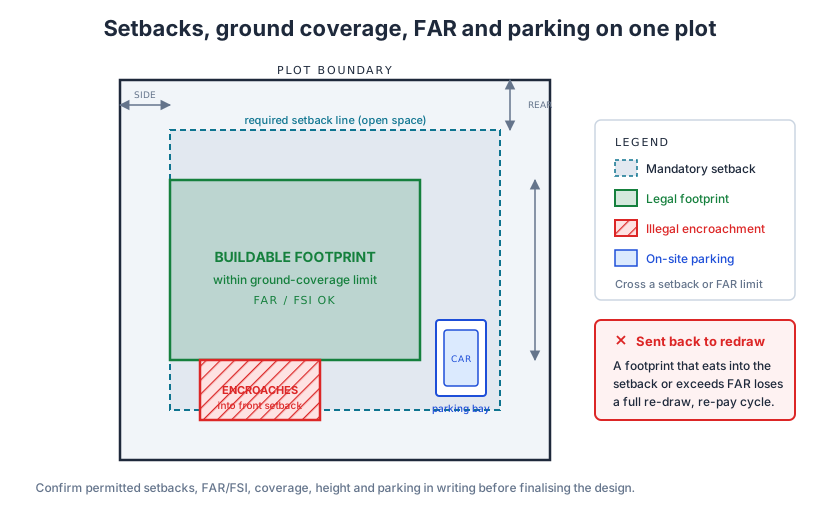
The drawing may look beautiful and still be illegal. The usual culprits are encroaching on the mandatory setback (the open space you must leave on each side), exceeding the permitted FAR/FSI (how much total floor area you may build), crossing the ground-coverage limit (how much of the plot the building footprint may occupy), going over the height limit, or not providing the required car/two-wheeler parking on-site.
Why it delays you: these are core compliance rules. A drawing that exceeds FAR or eats into a setback is sent back for redrawing, and you lose the full cycle of re-drawing, re-paying, and re-submitting. Squeezing in extra area is the fastest way to a rejection.
How to avoid it: ask your architect to confirm, in writing, the permitted FAR, ground coverage, setbacks, height, and parking for your specific plot and zone before finalising the design. These limits change by plot size, road width, and land use. Do not chase "one extra room" past the limit; it rarely survives scrutiny and never survives the completion stage. Our guide to understanding building bye-laws explains each of these terms in plain language.
4. Missing the NOCs your plot actually needs
Beyond the building department, certain plots need a No Objection Certificate (NOC) or clearance from other agencies. Which ones apply depends entirely on where and what you are building. Typical examples include a Fire NOC for tall buildings (commonly triggered above a height threshold set by your state, often around 15 metres, but verify locally), an Airports Authority of India (AAI) height NOC if your plot lies near an airport's approach funnel, environmental clearance for large projects, and tree-cutting permission if existing trees must be removed.
Why it delays you: these clearances are issued by separate departments on their own timelines, and several can run only after the building department raises them. A Fire or AAI NOC alone can become the bottleneck for an otherwise clean file. If you discover the requirement late, you have already lost weeks.
How to avoid it: ask your architect, at the design stage, exactly which NOCs your plot triggers, and apply for them in parallel rather than one after another. Single-window portals route many of these through one application form, but the underlying departments still take their own time, so start early.
5. Not engaging a licensed architect and registered structural engineer
In most municipal systems, building plans for anything beyond a very small structure must be signed and submitted by a licensed/empanelled architect, and the structural design must be certified by a qualified registered structural engineer. Some homeowners try to save money with an unregistered draftsman.
Why it delays you: a file submitted by an unrecognised person, or without the required structural certification, is not accepted. You then have to find a licensed professional and effectively start over. Worse, a poorly drafted plan attracts more scrutiny queries even if it is eventually accepted.
How to avoid it: engage a licensed architect (and, for the structure, a registered structural engineer) from the start. Their professional licence is part of what makes the submission valid, and a good professional knows the local bye-laws and the scrutiny officer's expectations, which prevents most of the other mistakes on this list.
6. Deviating from the sanctioned plan during construction
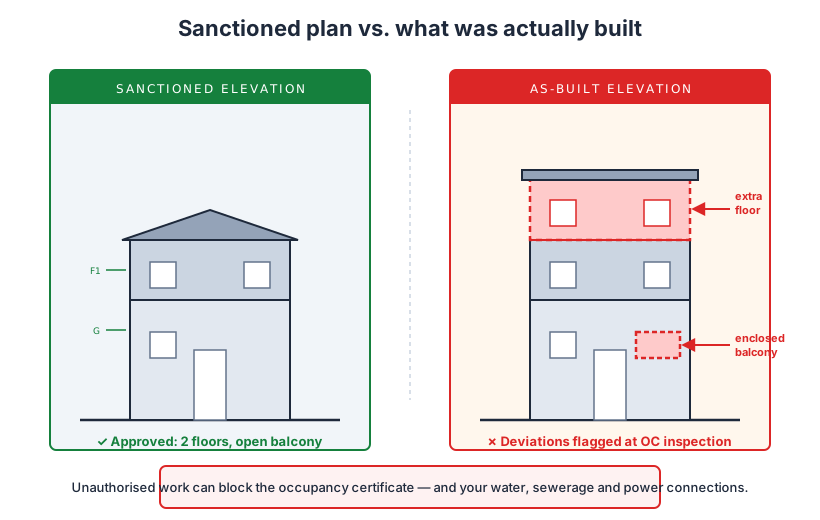
You got the sanction, then on site you "adjusted" things: an extra floor, a covered balcony, a room pushed into the setback, a bigger footprint. This is one of the most damaging mistakes because the cost lands at the very end, when you apply for the occupancy/completion certificate and want to move in.
Why it delays you: at completion, the authority physically checks whether the built structure matches the sanctioned plan. Deviations can block your occupancy certificate, which in turn can hold up water, sewerage, and electricity connections and your legal right to occupy. Under the Model Building Bye-Laws 2016 framework, construction that differs from the sanctioned plan is treated as unauthorised; some minor deviations may be "compounded" (regularised with a penalty) where local rules allow, but serious ones cannot be, and can lead to demolition of the offending portion.
How to avoid it: build exactly what was sanctioned. If you genuinely need a change, get a revised/amended plan approved before you build that part, not after. Keep the sanctioned drawing on site and check it against the work as it rises. See occupancy certificates explained for what the final inspection looks for.
7. Ignoring land use and zoning
Every plot sits in a zone in the city's master/development plan: residential, commercial, mixed, industrial, agricultural, or a restricted category. Building a use the zone does not permit, or building on land still classified as agricultural, is a fundamental error.
Why it delays you: the building department cannot sanction a use that conflicts with the zone. If the plot is agricultural, you usually need a land-use conversion first, which is a separate process with its own time and fees. Restricted zones (near water bodies, defence land, heritage precincts, coastal regulation areas) carry extra conditions or outright bars.
How to avoid it: confirm the zoning and land-use classification of your plot before you buy, or at least before you design. Your architect or the local planning authority can tell you the permitted use and whether conversion is needed.
8. Dimension errors, scale mistakes, and mismatched area statements
Drawings carry an area statement: plot area, built-up area, FAR achieved, coverage, setbacks. A surprising number of files stumble because the numbers in the area statement do not add up to the dimensions actually drawn, the drawing is not to a recognised scale, or the plot dimensions on paper differ from the registered/survey dimensions.
Why it delays you: scrutiny (increasingly automated in OBPAS systems that auto-check the CAD drawing) flags the inconsistency, and the file is returned for correction. Auto-scrutiny is unforgiving about a drawing whose stated areas do not match its geometry.
How to avoid it: have the architect reconcile the area statement against the actual drawn dimensions and against the registered plot area before submission. Use the exact plot dimensions from your survey/sale document, not rounded figures.
9. Underestimating time and over-trusting "instant" online portals
Many homeowners plan as if sanction takes a few days because the portal is online. OBPAS and single-window systems have genuinely sped things up and added transparency, with SMS/email status updates, but "online" is not "instant." Timelines still vary widely by city and by how many other departments are involved.
Why it delays you: if you have already paid an advance to a contractor, booked labour, or committed a move-in date around an optimistic estimate, every week of real-world processing becomes a costly problem, and people are tempted to start building before sanction, which is illegal and risks demolition.
How to avoid it: budget a realistic window for approval and do not start any construction until the sanction is in hand. Treat the portal as a faster, more transparent channel, not a same-day service. Build buffer time for NOCs and possible re-submission cycles.
10. Not keeping fee receipts and records
The quiet final mistake: paying the scrutiny fee, development charges, or other dues and not keeping clean proof, or losing track of which payment covered what.
Why it delays you: when a query arises, or at the completion/occupancy stage, you may be asked to show that dues were paid. Missing receipts mean re-establishing payments, which wastes time, and an unrecorded payment can look like an unpaid one.
How to avoid it: keep every payment receipt, challan, and acknowledgement (digital and printed) in one folder, organised by date. In online systems, download and save the payment confirmation immediately. Keep your stamped sanctioned plan safely too; you will need it for the occupancy certificate, for utility connections, and if you ever sell.
Quick reference: mistakes, consequences, fixes
| The mistake | Why it delays the project | How to avoid it |
|---|---|---|
| Incomplete or inconsistent documents | File returned or kept pending in slow query rounds | One checklist; make names, plot/survey number and area match everywhere |
| Title / ownership / encumbrance issues | Cannot sanction on unclear land; slowest to fix | Get current EC, complete mutation/khata and co-owner consent early |
| Drawing breaks bye-laws (setback, FAR, coverage, height, parking) | Sent back for full redraw, or rejected | Confirm permitted limits in writing before designing |
| Missing applicable NOCs (Fire, AAI, environment, tree) | Other departments bottleneck the file | Identify needed NOCs at design stage; apply in parallel |
| No licensed architect / registered structural engineer | Submission not accepted as valid | Engage licensed professionals from the start |
| Deviating from the sanctioned plan | Occupancy certificate and utility connections blocked at the end | Build exactly as sanctioned; get revised plan before any change |
| Ignoring zoning / land use | Use conflicts with zone; conversion needed | Verify zoning before buying or designing |
| Dimension / scale / area-statement errors | Auto-scrutiny flags mismatch, file returned | Reconcile area statement with drawn dimensions and survey figures |
| Underestimating time; expecting instant online sanction | Optimistic move-in dates collapse; tempts illegal early start | Budget a realistic window; never build before sanction |
| Losing fee receipts and records | Re-proving payments delays completion | Keep all receipts and the stamped plan in one folder |
A pre-submission checklist
Run through this before you hand over the file. Verify the exact list with your local authority, since cities differ.
- Title clear: sale deed, current EC/Nil EC, mutation/khata in your name
- Owner name, plot/survey number and plot area identical on all documents and drawings
- Latest property-tax receipt
- Land-use/zoning confirmed and (if farmland) conversion done
- Drawings checked against bye-laws: setbacks, FAR/FSI, ground coverage, height, parking
- Area statement reconciled with drawn dimensions and survey area
- Drawings to the correct scale, signed by a licensed architect
- Structural certification by a registered structural engineer
- Applicable NOCs identified (Fire, AAI, environment, tree-cutting) and applied for
- Required fees ready; receipts to be saved on payment
What this means for you
Almost every approval delay in India traces back to something that could have been caught before the file was submitted, or before the first brick was laid. The expensive ones are the ones you discover late: a title gap found mid-process, a deviation found at the occupancy inspection, an NOC nobody applied for. The cure is unglamorous but reliable: clean title, honest drawings that respect the bye-laws, the right professionals, every applicable NOC started early, and a realistic timeline with buffer. Build exactly what is sanctioned, keep your paperwork, and resist the urge to start before the stamp is on the plan. Do that and you remove the great majority of the things that make Indian building projects stall.
Because the details vary so much from city to city, always confirm the specific requirements, fees, and timelines with your own municipal authority or planning body. Explore the India Regulatory Atlas for state-level pointers, and use the construction approval checklist tool to track your own file.
Sources
- Town and Country Planning Organisation, Ministry of Urban Development, Government of India: Model Building Bye-Laws, 2016 (compliance, deviation, and unauthorised construction framework). Hosted reference: NIUA SmartNet, https://smartnet.niua.org/content/498286ad-1f8b-4c41-88d8-f58e98ed20fa
- Bureau of Indian Standards: National Building Code of India (NBC) 2016 (technical and safety provisions referenced by local bye-laws).
- DIGIT / NIUA: Online Building Plan Approval System (OBPAS) documentation on electronic submission, auto-scrutiny, online payment and status alerts. https://docs.digit.org/local-governance/v2.8/products/modules/online-building-plan-approval-system-obpas/obpas-user-manual
- Real Estate (Regulation and Development) Act, 2016 (RERA): sanction, completion and possession obligations for registered projects.
- General guidance on encumbrance certificates and their role in property approvals (illustrative procedural references): https://www.ezylegal.in/blogs/ensure-a-clear-property-title-with-encumbrance-certificate-in-india
Fees, height thresholds, timelines and section numbers vary by state and city and are described here in typical, illustrative terms only. Verify all specifics with your local building/planning authority.
Export this guide
Related Guides — Deep-dive reading
Building Plan Sanction Process, Step by Step (India) (2026)
Before a single brick is laid, your house plan must be approved by the local authority. Here is who prepares it, what documents it needs, how it is submitted and scrutinised, and what a sanctioned plan actually buys you.
Building RegulationsUnderstanding Building Bye-Laws in India: A Homeowner's Guide
What municipal building bye-laws are, who makes them, and how to find and read the ones that actually govern your plot
Building Regulations & ComplianceApprovals and NOCs You Need Before Construction in India: The Full Checklist (2026)
A plain-language master list of the permissions and no-objection certificates a home may need before building - and, honestly, how few most small homes actually require.
Building RegulationsRelated Tools — Try Free
Construction Approval Checklist — 24-Stage Tracker
Track every approval, permit, and NOC from land title to occupancy certificate across 24 stages.
ApprovalsPre-Possession Inspection Checklist
Inspect your flat before registration — 10 categories, 70+ checkpoints across legal, carpet area, structure, finishes, and deviations.
Homebuyer ChecklistStamp Duty Calculator — All Indian States
Stamp duty + registration charges for all 28 states and 8 UTs — gender concessions, urban/rural variants, metro cess built in.
Stamp Duty