
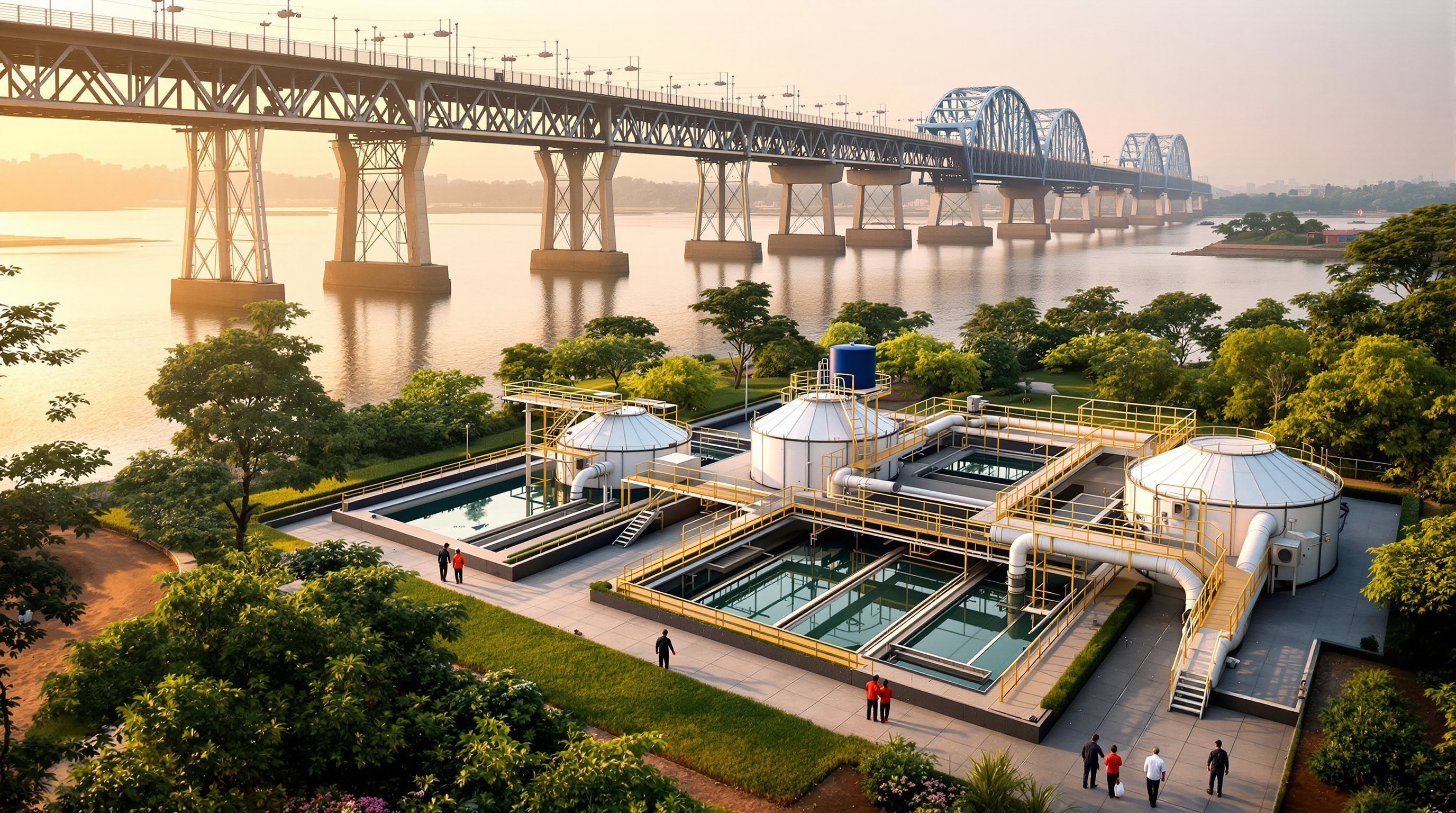
West Bengal STP Regulations & WBPCB Norms: The 2026 Compliance Guide
When a sewage treatment plant is mandatory in West Bengal, how the WBPCB consent process works, the discharge and reuse norms your STP must meet, and the practical compliance steps for builders, owners and RWAs across Kolkata, Howrah, Durgapur and Siliguri.
West Bengal sits at the mouth of the Ganga, and that geography defines everything about how the state treats its sewage. Kolkata alone generates over 700 million litres of wastewater a day, yet for decades only a small fraction passed through engineered treatment — the rest was absorbed by the East Kolkata Wetlands, a Ramsar-listed natural filter that quietly became the largest organic sewage-management system on earth. That legacy of "letting nature do it" is exactly what the West Bengal Pollution Control Board (WBPCB) and the National Green Tribunal are now trying to modernise, one building-scale STP at a time.
If you are a developer, a facility manager or an apartment association in West Bengal, this guide explains what the state actually requires: when a Sewage Treatment Plant becomes mandatory, how the WBPCB consent process works, what your treated water must achieve, and how to stay on the right side of enforcement.
West Bengal does not publish a radically different rulebook from the rest of India. It applies the national CPCB framework — but administers it through its own consent portal, its own building rules, and under unusually close NGT scrutiny of the Ganga. Knowing how the state runs the national norms is the whole game.
Is an STP mandatory in West Bengal?
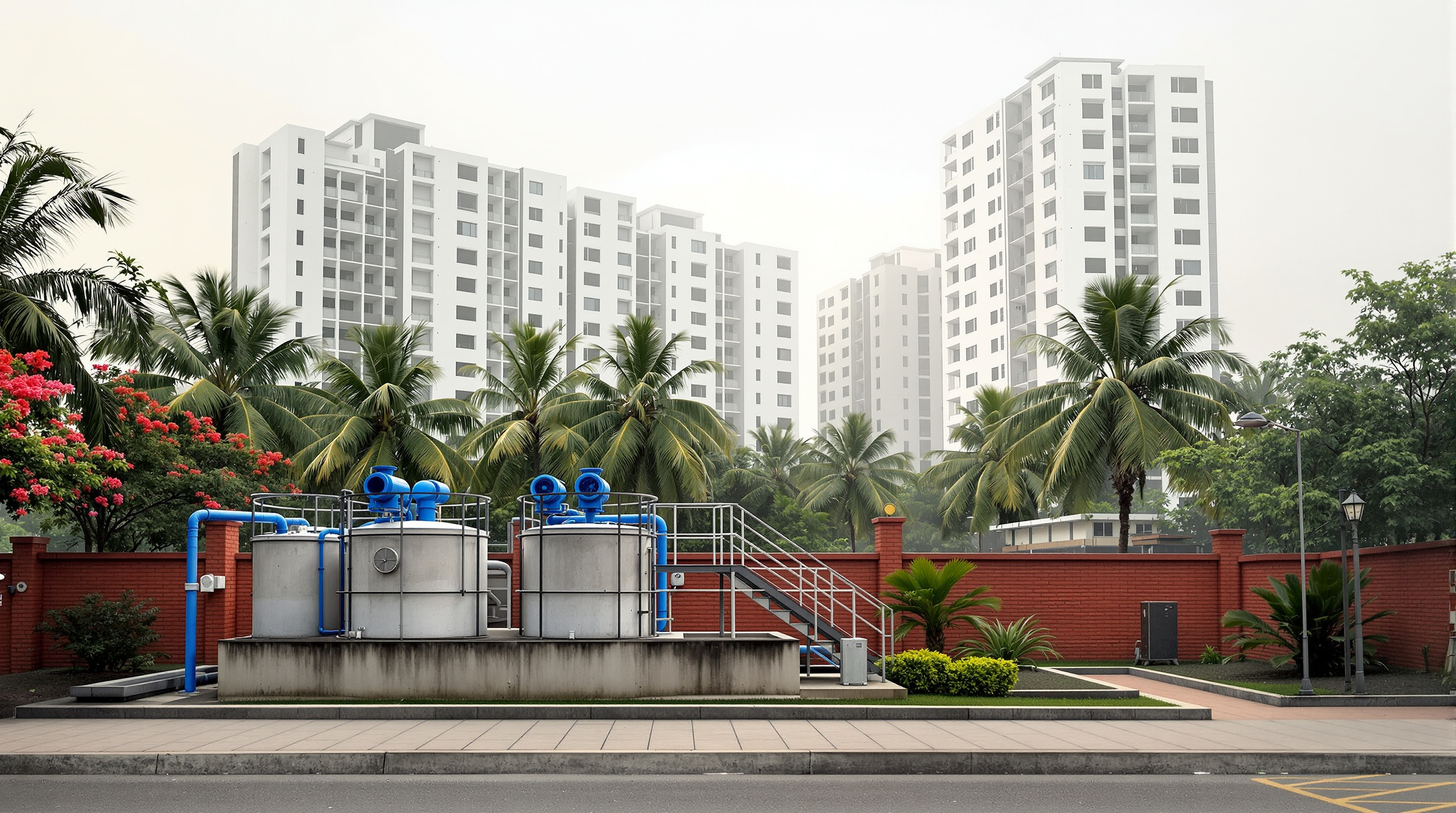
Yes — for most medium and large developments, an on-site STP is a legal precondition of approval, not an optional green feature. The requirement is triggered by several overlapping layers of law rather than a single number, and you have to satisfy all that apply to you.
- Environmental Clearance (national). Under the EIA Notification, 2006, building and construction projects with a built-up area of 20,000 sq m or more require prior Environmental Clearance, and treating sewage on site is a standard condition of that clearance.
- WBPCB consent (state). Independently of size-based EC, any project that generates trade or sewage effluent must obtain WBPCB consent under the Water Act, 1974 — and the Board will not consent to a project that has no adequate treatment provision.
- State building rules. The West Bengal Municipal (Building) Rules, 2007 require that when a "mother plot" exceeding 25,000 sq m is sub-divided, at least seven per cent of the area is reserved for common facilities — sewage treatment among them. The Kolkata Municipal Corporation and development authorities such as KMDA and HIDCO (New Town) attach their own sanitation conditions to building sanction.
Industry practice and WBPCB consultants commonly cite a working threshold of around 50 KLD (kilolitres per day) of sewage generation as the point at which a dedicated STP is expected, but this is a rule of thumb rather than a single codified statute — the actual trigger is whichever of the layers above catches your project first. Because these figures move, always confirm the current position for your specific plot with the WBPCB and your local municipal or development authority before you design. See our national overview of STP regulations in India and the state-wise approval comparison for how West Bengal sits against other states.
The WBPCB consent process: CTE and CTO
West Bengal, like every state, runs the two-stage consent mechanism common to all SPCB approvals for STPs. You clear the first gate before you build, and the second before you operate.
Consent to Establish (CTE) — often called the NOC — is granted before construction, once the Board is satisfied your design and pollution-control provisions (including the STP) are adequate. Consent to Operate (CTO) is granted after the plant is built and inspected, and it is the licence that actually lets you run the building; it is renewed periodically. Our dedicated guides on Consent to Establish and Consent to Operate walk through the paperwork in detail.
Two things are distinctly West Bengal here:
1. Everything goes through Silpa Sathi. Since 1 January 2023, all WBPCB services — CTE, CTO, hazardous-waste authorisation and renewals — must be filed through the state's single-window Silpa Sathi portal, not a separate Board website. It integrates with the national OCMMS backend.
2. Timelines are tied to your pollution category. Projects are classified White / Green / Orange / Red, and the Board commits to service windows accordingly.
| Category | Typical CTE timeline | Where residential/STP projects usually sit |
|---|---|---|
| Green | ~15 working days | Small, low-impact developments |
| Orange | ~30 working days | Most residential complexes and townships with STPs |
| Red | ~60 working days | Large or higher-impact / mixed-use projects |
Core documents include land papers, the detailed project report, building sanction, and the technical report of the STP/ETP — its capacity, technology and design discharge quality. Consent carries fees scaled to project cost and capacity; confirm the current schedule on Silpa Sathi rather than relying on older figures.
Discharge and reuse norms your STP must meet

West Bengal broadly adopts the CPCB discharge standards rather than publishing a separate, looser set — so the numbers your treated water must hit are the national ones, applied and enforced by the WBPCB. The exact limit depends on where the water goes (inland surface water, land for irrigation, or reuse) and the sensitivity of the receiving body. Indicative targets commonly applied to a domestic STP are:
| Parameter | Indicative treated-water target | Note |
|---|---|---|
| pH | 6.5 – 9.0 | Near-neutral band |
| BOD | ≤ 30 mg/L (tighter where discharge is to a sensitive body) | Headline organic-strength measure |
| COD | ≤ 250 mg/L | Flags hard-to-digest load |
| TSS | ≤ 100 mg/L | Cloudiness / solids |
| Faecal coliform | ≤ 1,000 MPN/100 ml (lower for reuse) | Disinfection performance |
Treat these as indicative, not gospel: the applicable limits are set case-by-case in your consent conditions, and CPCB's STP standards have been repeatedly revised and litigated. Our guide to treated-water quality standards and the CPCB guidelines for STPs explain the parameter set in full — and both stress that the number written into your CTO is the number that binds you.
On reuse, the state's own history is instructive. The East Kolkata Wetlands demonstrate at civic scale what your building should do at plot scale: keep treated water in productive use rather than dumping it. WBPCB permits reuse of compliant treated sewage for gardening, landscaping, flushing, construction and industrial process water. A well-run STP recovers roughly 80% of a building's water — genuinely valuable in a state where urban groundwater is stressed and, in several districts, arsenic-affected.
Monitoring, records and enforcement
A CTO is a continuing obligation, not a one-time certificate. Operators are expected to:
- Test and log treated-water quality (BOD, COD, TSS, pH, coliform) at the frequency set in the consent, and retain the records.
- Submit periodic compliance reports to the WBPCB on effluent quality and plant performance.
- Fit online monitoring (continuous effluent-quality sensors linked to the Board/CPCB servers) where capacity crosses the prescribed limit for real-time monitoring.
- Manage sludge and keep the plant genuinely running — an STP that exists on paper but sits idle is a frequent audit failure.
Enforcement in West Bengal has sharpened under NGT pressure over Ganga pollution. The Tribunal has repeatedly pulled up the state over its wastewater-treatment gap and, in a high-profile 2024 order, imposed a penalty running into thousands of crores for solid- and liquid-waste mismanagement, as reported by national media. That top-down pressure flows downward: the Board can refuse CTO renewal, order closure, disconnect utilities and levy environmental compensation on individual buildings whose STPs under-perform. Non-compliance is no longer a paperwork risk — it is an operational and financial one.
Practical compliance tips for owners and RWAs
For a builder the STP is a project condition; for the resident association that inherits it, it is a decades-long duty. If you manage a complex in Kolkata, Howrah, Durgapur, Asansol or Siliguri:
- Get the STP sized right at design stage. Under-sizing to save basement space is the most common and least fixable mistake. Use our STP Capacity Calculator to convert occupancy into the litres-per-day figure every design starts from.
- Confirm the consent chain transferred to you. When a builder hands over, verify the CTO is valid, in the association's name, and note its renewal date. Read our guide to apartment-association STP compliance.
- Budget for operation, not just installation. Power, blowers, chemicals, desludging and a trained operator are the recurring costs that decide whether the plant actually works.
- Keep a compliance file. Consents, test reports, AMC records and sludge-disposal logs — this is exactly what a WBPCB inspector asks for. Work through our STP compliance checklist.
- Design reuse in from day one. A dual-plumbing line for flushing and gardening turns a compliance cost into a running-cost saving.
The bottom line
West Bengal's rules are the national CPCB framework, administered with a local accent: consent through Silpa Sathi, triggers layered across EIA clearance, the WBPCB and the West Bengal Municipal (Building) Rules, and enforcement energised by NGT scrutiny of the Ganga. Get the STP sized and consented correctly, keep it genuinely running, and reuse what it produces — that is compliance and good sense in one.
Norms, thresholds and fees in this space change regularly, so treat this as an orientation, not legal advice: always confirm the current requirements for your project directly with the West Bengal Pollution Control Board and your local municipal or development authority before you commit a design. To go deeper, start with the Sewage Treatment Plants guide library or the beginner-friendly what is a sewage treatment plant explainer.
Sources: West Bengal Pollution Control Board, Silpa Sathi e-Services portal, West Bengal Municipal (Building) Rules, 2007 (WBDMA), East Kolkata Wetlands (overview), NGT penalty on West Bengal for waste mismanagement (Republic World). Always verify against the latest WBPCB notifications.
Export this guide
Related Guides — Deep-dive reading
Apartment Association STP Compliance Guide: CTO, Monitoring, Records & Penalties
A practical, honest compliance playbook for RWAs and facility managers running a sewage treatment plant — how to keep your Consent to Operate valid, what to monitor and record, the notices that catch associations out, and how to stay on the right side of the CPCB, your SPCB and the NGT.
Sewage Treatment PlantsState-Wise STP Approval Process Comparison: How Consent Rules Differ Across India
Every Indian state runs the same national CTE/CTO consent framework under the Water Act — but the board names, portals, thresholds and effluent limits change as you cross state lines. Here is how the STP approval process actually compares, state by state, and how to find the rule that binds your project.
Sewage Treatment PlantsKarnataka STP Regulations & KSPCB Norms: The Complete 2026 Compliance Guide
When an STP is mandatory in Karnataka, how the KSPCB consent process works, the discharge and reuse standards your treated water must meet, and what apartment owners and RWAs in Bengaluru must do to stay compliant — explained plainly.
Sewage Treatment PlantsRelated Tools — Try Free
Construction Approval Checklist — 24-Stage Tracker
Track every approval, permit, and NOC from land title to occupancy certificate across 24 stages.
ApprovalsCPCB Compliance Checklist for STPs
Tick off CPCB/SPCB outlet standards, monitoring duties and record-keeping to score your sewage treatment plant's compliance readiness.
ChecklistSociety Handover & NOC Checklist
Builder-to-RWA handover audit — 9 categories, 65+ checkpoints across legal docs, drawings, utilities, STP/WTP, fire safety, finances, warranties.
RWA Handover