
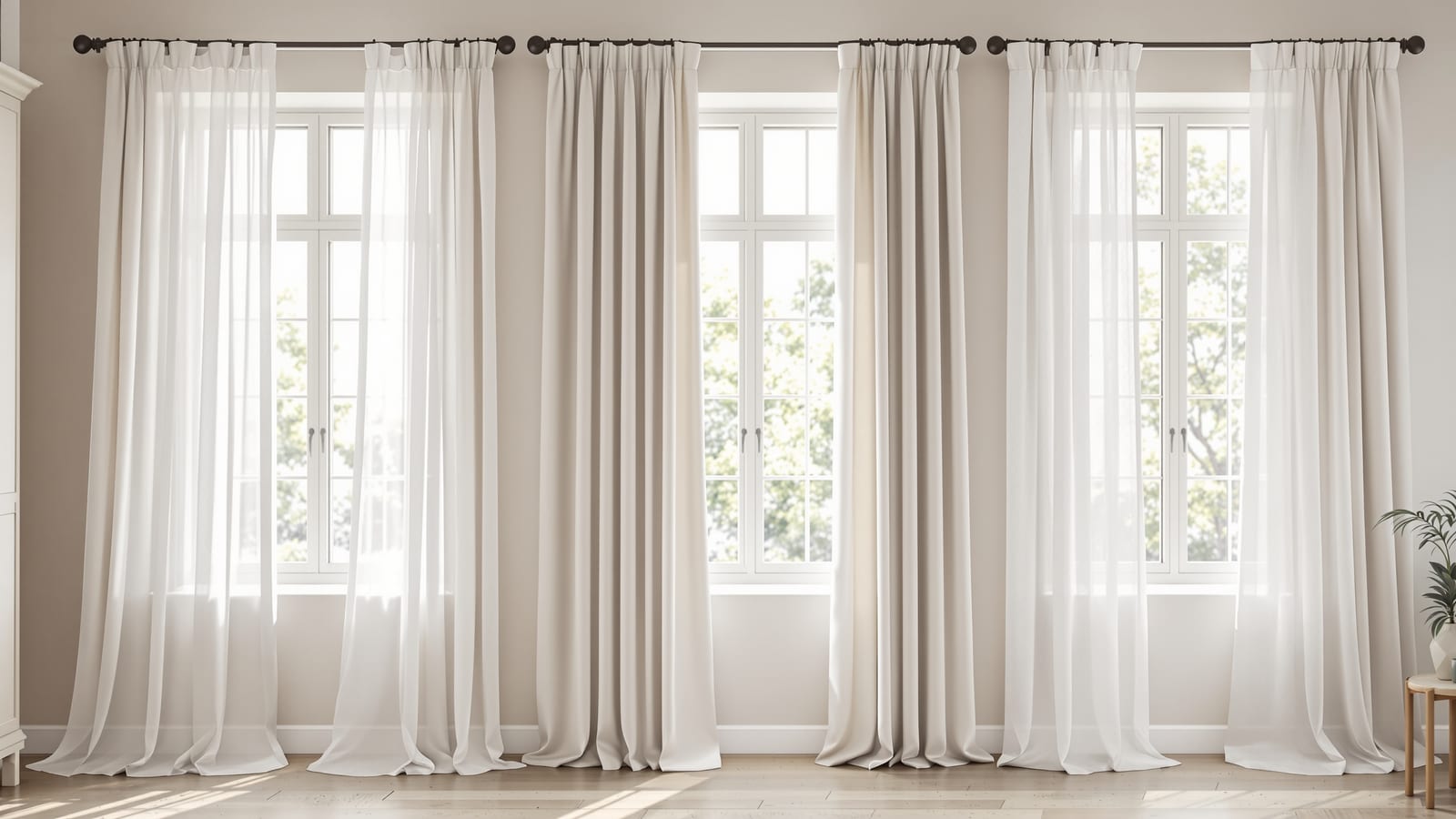
Types of Curtains for Homes: The Complete Comparison (India, 2026)
Sheer, dim-out, blackout — and eyelet, pencil, pinch, goblet, wave, tab-top — every curtain type compared on privacy, light and real Indian cost, and how to layer them into one system.
Walk into any curtain showroom in India and you are shown colours and prints. That is the wrong question first. The two decisions that actually decide whether a curtain works are its opacity — how much light and privacy the cloth itself gives — and its heading — how it pleats at the top, which sets the look, the fabric you need and the cost. Get those two right and the colour becomes the easy, last, fun choice.
This is the definitive comparison. We will rate every common type on the three things you really buy a curtain for — privacy, light control and cost — then show you how to combine them into the one arrangement that suits most Indian rooms: a layered, two-curtain system.
Stop asking "what colour curtain." Ask "what opacity, what heading, how many layers." Those three answers do ninety per cent of the work; the print does the last ten.
The two questions hiding inside "type"
When someone says "what type of curtain," they are tangling two separate questions:
- Opacity — is the cloth see-through (sheer), softly light-blocking (dim-out / lined), or near-total dark (blackout)? This decides privacy and how much light the window lets in.
- Heading / pleat — eyelet, pencil, pinch, goblet, wave or tab-top? This is the pleated top, and it decides the look, how much fabric you need (the "fullness"), and a surprising amount of the cost.
A single curtain has one opacity and one heading. A well-dressed window usually has two curtains — and that is the punchline of this guide. Hold that thought while we compare the parts.
Opacity types: sheer, dim-out, blackout
Sheer curtains are light, gauzy fabrics — voile, net, polyester chiffon. By day they filter harsh Indian sun into a soft glow and screen you from the street. The catch every homeowner discovers at night: the moment your lights are on and it is dark outside, a sheer turns the window into a lit stage. Sheers give privacy by day only. Budget roughly ₹150–₹500 per metre of fabric.
Dim-out (lined) curtains are a medium-weight fabric, often with a backing lining, that darkens a room well without going pitch black. They are the comfortable middle — good privacy day and night, soft light control, a bit of heat and sound insulation, and they hang beautifully. Expect ₹400–₹1,200 per metre depending on fabric.
Blackout curtains use a tightly woven or coated fabric (or a separate blackout lining) to block almost all light. They are non-negotiable in bedrooms — especially for shift workers, babies and anyone facing a streetlight — and they double as the best thermal and acoustic option. The trade-off is bulk and a higher price, typically ₹500–₹1,500+ per metre. The dedicated blackout curtains guide goes deep on linings and true-blackout fabrics; the sheer curtains guide covers the daytime layer.
Heading / pleat types, decoded
The heading is the engineering at the top of the curtain. It decides how the fabric folds, how "full" it looks, and how much cloth you buy.
- Eyelet (grommet) — metal rings slide straight onto a rod. Casual, quick, cheap, modern. Folds are soft and slightly uneven. Great for ready-made panels.
- Pencil pleat — a gathered tape sewn across the top. The all-rounder: works on rod or track, forgiving, economical, suits almost any room.
- Pinch pleat — stitched groups of folds (double or triple). Crisp, tailored, the designer default for living rooms and bedrooms. Needs more fabric.
- Goblet pleat — rounded, cup-shaped folds. Formal and traditional, made for tall, grand rooms with high ceilings.
- Tab-top / rod-pocket — fabric loops, or a sewn channel the rod threads through. Relaxed and casual, but they drag when you slide them — best for curtains you rarely open and close.
- Wave / ripple fold — a continuous, even S-curve on a track. The cleanest contemporary look and the natural partner for motorisation, because the uniform fold glides perfectly. Premium.
Two rules worth memorising: tracks give crisper, more uniform folds than rods (and are required for wave fold and most motors); and the heading drives fullness — pinch and wave want about 2× to 2.5× the window width in fabric, while eyelet is happy at 1.5×, which is exactly why pinch and wave cost more. The pleats and headings guide is the full visual deep-dive.
The big comparison table
Here is every common type rated on the three things you actually pay for. Costs are indicative fabric-driven ranges for India in 2026 — verify locally, because city, lining and stitching swing them hard.
| Type | Privacy | Light control | Relative cost |
|---|---|---|---|
| Sheer | Low (day only) | Filters light, no darkening | Low (₹150–₹500/m) |
| Dim-out / lined | Medium–High | Good, soft darkening | Medium (₹400–₹1,200/m) |
| Blackout | High | Excellent (near-total dark) | Medium–High (₹500–₹1,500+/m) |
| Eyelet (heading) | Medium | Medium | Low |
| Pencil pleat | Medium–High | Good | Low–Medium |
| Pinch pleat | High | Excellent | Medium |
| Goblet pleat | High | Excellent | Medium–High |
| Tab-top / rod-pocket | Medium | Medium | Low |
| Wave / ripple fold | High | Excellent | Premium |
The honest reading of this table: no single curtain wins every column. A sheer is unbeatable for daytime glow but useless at night; a blackout is unbeatable for sleep but oppressive in a living room you actually want to feel bright. Which is why the right answer is almost never one curtain.
The layered system: why two curtains beat one
The arrangement that suits most Indian homes is a double track carrying two curtains on the same window:
- Front layer — a sheer. Daytime privacy and that soft, filtered light. Drawn most of the day; pushed aside at night when you want the view or open at dawn.
- Back layer — a dim-out or blackout. Pulled across for night privacy, sleep, heat control against the afternoon west sun, and a quieter room.
One layer forces a daily compromise; two layers let the window do the right job at the right time of day. For a bedroom, pair a washable sheer with a true blackout. For a living room, pair a sheer with a dim-out so the room never goes cave-dark. This single idea — layer, do not compromise — is the most useful thing in this entire guide, and the pillar curtain guide builds your whole window plan around it.
You will also choose a heading for each layer. A common, good-looking combination is a pencil-pleat or wave sheer in front with a pinch-pleat blackout behind — or matching wave folds on both if you plan to motorise, which the motorised curtains guide covers in full.
Matching type to room
- Living room — sheer + dim-out, floor-length, pinch or wave heading. Bright by day, cosy by night. See the living room curtains guide.
- Bedroom — sheer + blackout, lined and overlapping at the centre so no light leaks down the middle.
- Kitchen — easy-clean, short-drop fabrics; avoid long curtains near flames. Often a blind beats a curtain here — weigh it in the curtains vs blinds guide.
- Home office — glare control on the screen wall matters more than darkness; a dim-out or a good sheer usually wins.
- Pooja / formal room — goblet or pinch pleat in a richer fabric reads ceremonial and grand.
Fabric and climate, the quick version
Fabric decides drape, durability and cost. Cotton and linen breathe and look natural but crease and can fade; polyester blends resist UV and dust and wash easily; velvet and heavy weaves give the best blackout, heat and sound but trap dust and need vacuuming. On bright, west-facing windows choose fade-resistant fabrics, because direct Indian UV yellows and weakens sheers and lightweight cloth fast. The fabric guide is the full material-by-material breakdown.
Two honest caveats. Costs here are indicative — fullness, lining, stitching labour and your city move them more than the print does, so price your own fabrics locally. And Vastu colour and direction preferences are cultural guidance, not physics: follow them if they matter to you, but never let a Vastu rule make you block light or skip heat control on a hot window.
How to choose, in four moves
1. Name the window's two priorities — privacy, light, heat, or looks. Bedroom leans privacy and dark; living room leans light and looks.
2. Pick the opacity layers — almost always a sheer plus a dim-out or blackout, on a double track.
3. Pick the heading for each layer — pinch or wave for a tailored finish, pencil or eyelet to save money, wave if you will motorise.
4. Set fullness (2× is standard) and drop — floor-length almost always looks more expensive than sill-length. Then price it with the Curtain Cost Calculator.
Not sure which type fits a specific window? The Window Treatment Selector walks you from room and orientation to a recommended layer-and-heading combination in under a minute, and the decorative window treatments guide covers the finishing touches once the system is set.
Plan your windows with Studio Matrx. Start with the complete curtain guide to build the whole window plan, then size the fabric and get a per-window price with the Curtain Cost Calculator.
Export this guide
Related Guides — Deep-dive reading
The Complete Home Curtain & Window Treatment Guide for Indian Homes (2026)
Types, fabrics, pleats, tracks, motorisation and real Indian costs — the one guide that turns a confusing purchase into a confident decision.
Window TreatmentsCurtain Pleats & Headings: Eyelet, Pencil, Pinch, Goblet, Wave Explained (India, 2026)
The heading is the pleated top of a curtain — and it quietly decides the look, the hardware and the bill. A plain-language reference to every style and how to pick the right one.
Window TreatmentsPencil Pleat Curtains: The Versatile All-Rounder (India 2026)
Gathered three-cord tape, adjustable fullness, works on rod or track — the forgiving, economical heading that quietly dresses most Indian windows. Here is exactly when it is the right call.
Window TreatmentsRelated Tools — Try Free
Curtain Cost Calculator
Get the fabric metres you need plus the total curtain cost by window size, fabric, pleat, lining and hardware.
Curtain CalculatorWindow Treatment Selector
Curtains, blinds or a layered system? Answer five questions about your room and get a specific recommendation.
SelectorCross-Ventilation Analyzer
Estimate airflow and air changes per hour (ACH) from room size, window areas, layout, and local wind — with NBC 2016 Part 8 compliance check.
Ventilation Calculator