
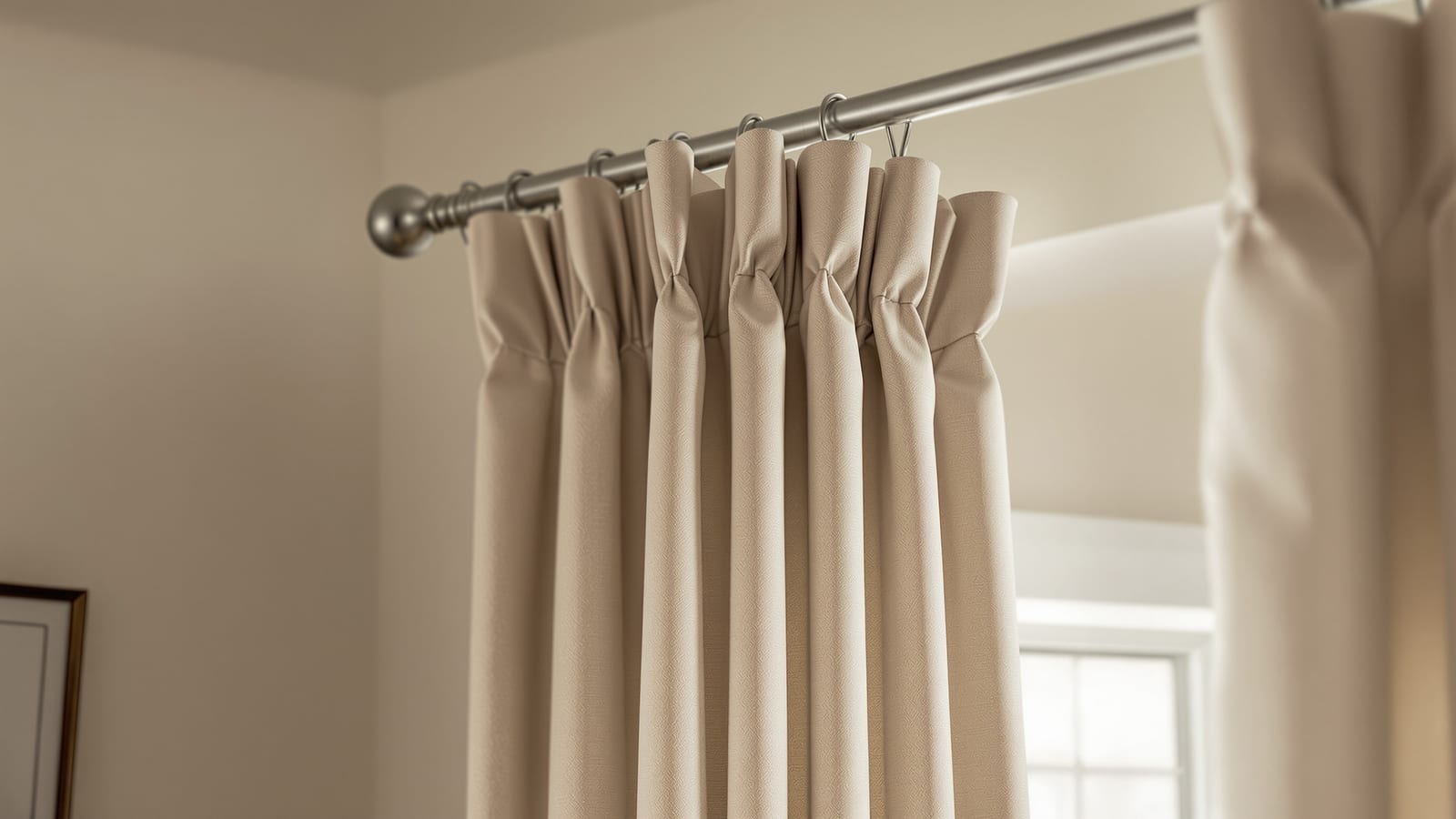
Pencil Pleat Curtains: The Versatile All-Rounder (India 2026)
Gathered three-cord tape, adjustable fullness, works on rod or track — the forgiving, economical heading that quietly dresses most Indian windows. Here is exactly when it is the right call.
If you walked into ten well-dressed Indian homes and looked at the tops of the curtains, the heading you would see most often is the pencil pleat. It is not the flashiest, not the most architectural, not the one designers photograph for magazines — and that is exactly the point. The pencil pleat is the all-rounder: a gathered tape that draws plain fabric into tight, even, pencil-thin folds, costs little, forgives a lot, and hangs happily on either a rod or a track. It is the default ready-made heading and the bread-and-butter of every Indian tailor for good reason. This guide explains how it works, what it costs, where it wins and where it loses.
The pencil pleat is the curtain heading that never gets you into trouble. It is rarely the perfect answer for a formal living room and almost never the wrong answer for everything else.
For the full system — opacity, layers, tracks, motors and room-by-room — start with the complete curtain guide for Indian homes. This page zooms into one dependable heading.
How a pencil pleat actually works
The mechanism is simple, which is half of why it is cheap. A strip of heading tape — usually a three-cord tape with woven pockets — is sewn across the top of the flat fabric. The tape carries three parallel draw-cords. When you pull those cords, the fabric gathers and bunches into a row of tight, upright, even folds that look like a line of pencils stood side by side — hence the name.
Two features make it the forgiving choice:
- Adjustable gather. Because you pull the cords yourself, you control how tightly the fabric bunches. Pull harder for a fuller, denser look; ease off for a flatter, more economical one. The same panel can be re-gathered later.
- Three rows of hook pockets. The tape's woven pockets sit at different heights, so you slot the hooks high or low to raise or drop the curtain by a few centimetres. This rescues a panel that is slightly too long or too short without re-stitching — a genuinely useful margin of error in a country where window sizes are rarely standard.
Once gathered, the hooks clip into rings on a rod or gliders on a track. That is the whole system: tape, cords, hooks. No hand-stitched pleats, no grommets to match to a rod diameter.
Fullness: aim for about 2x
Fullness is the multiplier between your track (or window) width and the flat width of fabric you buy. A pencil pleat looks right at roughly 2x fullness — so a 1.5 metre track wants about 3 metres of gathered cloth to hang in proper, deep folds rather than a thin, mean sheet.
Because the gather is adjustable, pencil pleat tolerates a working range:
- 1.8x — leaner and a touch more economical; fine for back-of-house windows.
- 2x — the standard that looks properly full and is what most tailors default to.
- 2.2x–2.5x — denser, more luxurious, the right call for sheers and for fabric you want to read as rich.
Fabric is usually the biggest single line in a custom curtain, so this multiplier — not the price per metre of the cloth — is what really sets the bill. Do not guess it: the Curtain Fullness Calculator turns your track width and chosen multiplier straight into the flat fabric width you need to order, and the Curtain Cost Calculator carries that through to fabric metres and a per-window price.
What pencil pleat curtains cost in India
The heading itself is cheap — a three-cord pencil-pleat tape and the hooks add very little to a custom curtain, far less than the hand-stitching a pinch or goblet pleat demands. The cost lives almost entirely in the fabric (driven by that 2x fullness), the lining and the drop. As honest, indicative ranges:
| Route | What you get | Indicative cost |
|---|---|---|
| Ready-made panel | Fixed sizes, single fabric, basic lining | Low (a few hundred to ~₹1,500 a panel) |
| Custom, unlined | Your fabric and exact size, tape + stitching | Fabric × 2x + modest labour |
| Custom, lined / dim-out | Adds lining or blackout backing | Fabric × 2x + lining + labour |
A single well-made custom pencil-pleat window commonly lands in the low thousands of rupees; large windows, premium fabric or blackout lining climb from there. The point worth remembering: pencil pleat is the cheapest custom heading that still looks tidy and traditional — you pay for cloth, not for clever pleating. The curtain cost guide path is covered in the pillar, and the Curtain Cost Calculator gives you a per-window number in seconds.
Pencil pleat vs eyelet vs pinch pleat
The three headings most Indian homeowners actually choose between, compared honestly:
| Pencil pleat | Eyelet (grommet) | Pinch pleat | |
|---|---|---|---|
| Look | Tidy, traditional, even small folds | Modern, casual, wide soft waves | Crisp, tailored, designed |
| Fullness | ~2x | 1.5x–1.8x | 2x–2.5x |
| Hangs on | Rod or track | Rod only | Rod or track |
| Adjustable height | Yes (3 hook rows) | No (fixed) | Limited |
| Relative cost | Low–Medium | Low | Medium–High |
| Best for | Almost anything | Studies, kids', rentals | Living, master bedroom |
- Versus eyelet — pencil pleat looks more finished and traditional, gives you the height adjustment eyelet lacks, and works on a track (eyelet cannot). Eyelet is leaner on fabric and reads more modern and casual. For the full eyelet picture, see eyelet curtains in India.
- Versus pinch pleat — pinch pleat is crisper, more architectural and the designer default for rooms you show off, but it costs more in stitching labour and is less forgiving once made. Pencil pleat is the value choice that still looks intentional. Compare directly in pinch pleat curtains in India.
The honest summary: pencil pleat sits in the sensible middle — more dressed than eyelet, cheaper and more forgiving than pinch.
Rod or track? It does both
This flexibility is the pencil pleat's quiet superpower. The hooks clip into rings on a decorative rod or gliders on a slim track, so the same curtain can hang on whichever hardware your room and budget call for:
- On a rod — easy to fit, decorative, fine for lighter and medium curtains; the rod stays visible above the folds.
- On a track — crisper, more uniform folds, takes heavier cloth, can bend around a bay or recess into a ceiling pocket, and hides the hardware.
Two rules hold regardless. Mount it wider than the window — about 15–20 cm past the glass on each side — so the open curtain clears the pane and lets full daylight in. And if a false ceiling or pelmet is in your plans, design the curtain pocket in now; retrofitting a hidden track later is the most common avoidable regret in this whole category. The one place pencil pleat does not reach is full motorisation with the cleanest contemporary stack — that is wave-fold territory on a track.
Best rooms for pencil pleat
Because it is forgiving and economical, pencil pleat earns its keep across the house:
- Bedrooms — pairs perfectly with a dim-out or blackout lining; the height adjustment helps you sit the hem exactly at the floor. A reliable, restful choice.
- Kids' rooms and studies — cheap, tidy, easy to wash and rehang; the adjustable gather means you can refresh the look without buying new fabric.
- Guest rooms and utility windows — the value heading for windows you do not want to overspend on; save the pinch pleat for the rooms you show.
- Sheers — gather a lightweight sheer to 2.2x–2.5x on a pencil tape for a soft, full daytime layer behind a heavier night curtain.
- Whole-house consistency — when you want every window to read the same on a modest budget, pencil pleat gives you one calm, coherent heading throughout.
Where it is not the first pick: a formal, high-ceilinged living room you want to look distinctly tailored (choose pinch or goblet there), or a minimal motorised window (choose wave). For the layered living-room treatment, the pillar covers the two-layer rule.
The honest caveats
- It can look ordinary at low fullness. Skimp below 1.8x and a pencil pleat reads flat and cheap. Spend the fabric — the heading is only as good as the gather.
- Heavy fabric can bunch. A stiff, thick jacquard crammed into tight pencil folds can look bulky; lighter and medium fabrics gather most gracefully. Match the heading to the cloth weight.
- The cords need tying off neatly. After gathering, the draw-cords must be tied and tucked, not left dangling or cut (you will want to re-flatten the curtain for washing). A good tailor does this as standard.
- It is not the "premium" look. If your goal is a clearly designer-grade window, pencil pleat is the wrong tool — that is by design. Read ready-made vs custom curtains in India to decide how much to invest per window.
- Numbers here are indicative. Fullness, prices and metre estimates are working guidance — measure your own windows and price your own fabric and stitching locally before ordering.
In one line
The pencil pleat is the heading you reach for when you want a tidy, traditional, properly full curtain that hangs on whatever hardware you have, costs no more than the cloth, and forgives a measuring slip. It is the all-rounder for a reason.
Plan it with Studio Matrx. Size your fabric for a 2x gather with the Curtain Fullness Calculator, get a per-window price from the Curtain Cost Calculator, and read the complete curtain guide for Indian homes for the full system — opacity, layers, tracks, motors and room-by-room. Compare headings directly in the eyelet and pinch pleat guides, and see the whole Window Treatments cluster.
Export this guide
Related Guides — Deep-dive reading
The Complete Home Curtain & Window Treatment Guide for Indian Homes (2026)
Types, fabrics, pleats, tracks, motorisation and real Indian costs — the one guide that turns a confusing purchase into a confident decision.
Window TreatmentsPinch Pleat Curtains: The Tailored Designer Default (India 2026)
Stitched groups of folds, crisp tailored hang, 2–2.5× fullness — why interior designers reach for the pinch pleat first, what it costs in India, and exactly when to specify double, triple or French.
Window TreatmentsCurtain Pleats & Headings: Eyelet, Pencil, Pinch, Goblet, Wave Explained (India, 2026)
The heading is the pleated top of a curtain — and it quietly decides the look, the hardware and the bill. A plain-language reference to every style and how to pick the right one.
Window TreatmentsRelated Tools — Try Free
Curtain Cost Calculator
Get the fabric metres you need plus the total curtain cost by window size, fabric, pleat, lining and hardware.
Curtain CalculatorCurtain Fullness Calculator
Work out the fabric width and number of widths you need for a chosen heading and fullness.
Curtain CalculatorFalse Ceiling Cost Estimator
Live ₹/sqft across 8 ceiling types — POP, gypsum, designer, metal, PVC, wooden — with cove and spot lighting for 20 Indian cities.
Cost Calculator