
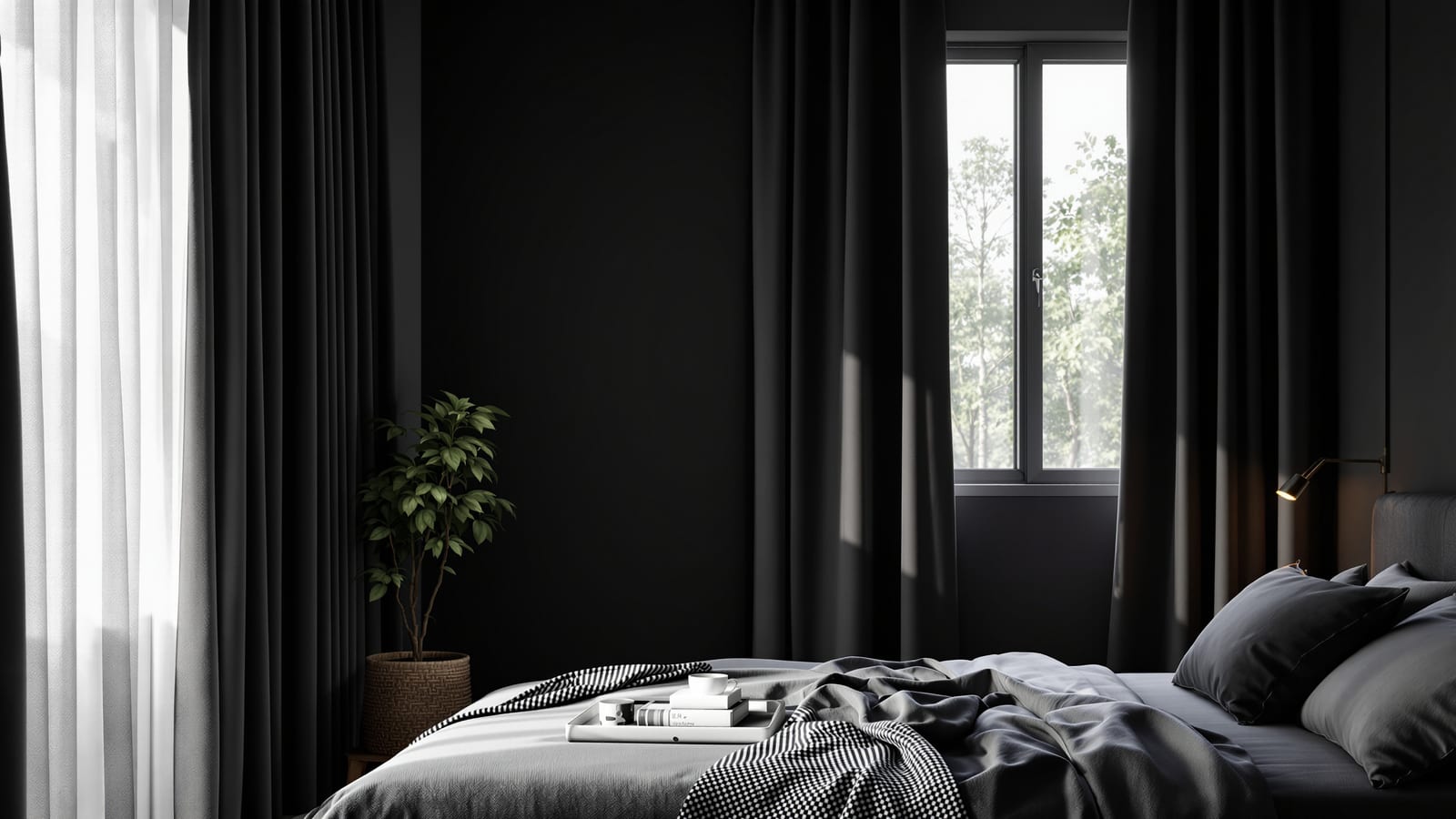
Blackout Curtains: The Complete Guide for Indian Homes (2026)
What “blackout” really means, how dark you actually get, the light-gap problem nobody warns you about, and how to choose, seal and care for them in Indian conditions.
Walk into any curtain showroom in India and ask for blackout, and you will be shown half a dozen fabrics, all promising total darkness. Most of them are lying — not because the cloth is bad, but because the word "blackout" describes the fabric, and the fabric is only one part of why a room stays dark. The biggest reason an "blackout" curtain still lets dawn flood your bedroom is not the cloth at all. It is the gaps around it.
This guide separates the marketing from the physics. By the end you will know exactly what blackout fabric does, what it does not do, how dark your room will actually get, and the small installation moves that decide whether you sleep past sunrise or not.
Blackout is a system, not a fabric. The cloth blocks the light that hits it — the curtain's edges decide everything else. A great fabric badly hung is worse than an ordinary one hung well.
Blackout, dim-out, lined: three words people use as one
The single most common confusion in this whole category is treating three different things as the same. They are not.
| Term | What it is | Darkness it gives | Typical use |
|---|---|---|---|
| Blackout fabric | A tightly woven or coated cloth that blocks ~99–100% of light passing through it | Near-total — fabric stops the light | Bedrooms, nurseries, home theatres |
| Blackout lining | A separate backing layer (often a 2- or 3-pass coated lining) stitched behind any decorative fabric | High — turns a pretty curtain into a darkening one | When you love a fabric that isn't blackout |
| Dim-out / room-darkening | A denser-than-normal fabric that reduces light a lot, but not fully | Strong shade, not pitch dark | Living rooms, where some glow is fine |
The practical takeaways: blackout fabric is the cloth itself — buy it and you are done in one layer. Blackout lining is the clever route when you have fallen for a sheer-ish or printed fabric that could never block light on its own; the tailor adds a coated backing and the front fabric keeps its look. Dim-out is a real category too, often mislabelled "blackout" by salespeople — it makes a room beautifully dim for afternoon naps or films, but at 6 a.m. in May it will not stop a Bengaluru or Delhi sunrise.
If your goal is genuine sleep-in darkness, ask one direct question in the shop: "Is this a true blackout-rated fabric, or a dim-out?" The price and the weave usually tell you anyway.
How dark you actually get (and why it is never total)
Here is the honest part no brochure prints. Even a perfect blackout fabric, sealed perfectly, rarely gives you a fully black room — and that is fine, because you do not need black, you need dark enough to sleep and to let melatonin do its job. What ruins blackout in practice, in order of how much light each leaks:
- The sides — the biggest culprit. A curtain hung flush to the window frame lets a bright vertical stripe of light down each edge. This single gap leaks more light than the fabric ever blocks.
- The top — light spills over the heading if the curtain hangs below the ceiling or off a thin rod with a gap above it.
- The bottom — a curtain that stops at the sill, or floats above the floor, lets a glow pool underneath.
- Pinholes — eyelet rings, stitch holes and loose weaves let tiny beams through; minor, but visible in a fully dark room.
So "blackout fabric" without sealing the perimeter is like a watertight bucket with the rim cut off. The cloth was never the weak point.
Sealing the light gaps — the part that actually matters
This is where a ₹2,000 curtain beats a ₹8,000 one. Four moves, roughly in order of payoff:
1. Overhang the sides generously. Mount the track or rod 15–20 cm wider than the window on each side, and use enough fullness that the closed curtain wraps past the frame, not just to it. This kills the side-stripe — the single most important fix.
2. Go floor-to-ceiling, or close to it. A curtain mounted high (near the ceiling) and dropping to the floor removes the top and bottom gaps in one decision. Floor-length also simply looks more expensive — a happy bonus.
3. Overlap the centre. Where two panels meet, they should overlap by a few centimetres, not just touch. A centre overlap (some tracks have an overlap arm built in) stops the seam of light down the middle.
4. Close the perimeter where it counts. For a nursery or a shift-worker's room, a pelmet or boxed valance over the top, and curtains that pool slightly on the floor, seal the last gaps. Wraparound or returned tracks (the curtain bends back to the wall at each end) finish the sides.
Do moves 1 and 2 and most bedrooms reach "wake up not knowing it is morning". Add 3 and 4 for a true cave — a nursery, a night-shift bedroom, or a media room.
Who actually needs blackout — and who only thinks they do
Blackout earns its premium for specific people and rooms. Be honest about which you are:
- Shift workers and new parents — anyone sleeping through daylight needs the real thing, fully sealed. This is the strongest case for blackout; light leaking onto the eyelids genuinely fragments sleep.
- Light-sensitive sleepers — Indian summers bring early, fierce sunrises; a properly dark bedroom adds real, measurable sleep, especially April–June.
- Nurseries — babies and toddlers nap by day and settle earlier when the room is dark; this is the room to over-engineer the seal.
- Home theatres and projector rooms — here you want maximum black, plus you are also fighting reflected light, so dark walls help too.
- Hot, sun-blasted windows — blackout fabrics, especially thermal-backed ones, block radiant heat as well as light, easing the load on a west- or south-facing room.
Who does not need full blackout: most living rooms (a layered sheer + dim-out is usually nicer there), guest rooms, studies and kitchens. For the living room especially, total dark is the wrong goal — see the living-room curtains guide for the layered approach that suits a daytime room better.
Heat, sleep and the quiet benefits
The light-blocking is the headline, but blackout curtains do two more useful things in Indian homes.
Heat. Many true blackout fabrics are thick, and thermal-backed versions add an insulating layer. On a hot west-facing bedroom, a closed blackout curtain measurably cuts the radiant heat coming through the glass in the afternoon — your AC works less, and the room is cooler by evening. It is not as effective as shading the glass from outside, but it is the cheapest, most reversible thermal help you can buy. Pair it with the window-treatment selector to see whether your window's orientation makes thermal blackout worth it.
Sleep and acoustics. Heavy, full blackout curtains also soften street noise a little — not soundproofing, but the difference between a thin and a thick curtain on a noisy road is real. Combined with darkness, the effect on sleep quality is the reason hotels use them everywhere.
If you only fix one thing for better sleep this year, a properly sealed blackout in the bedroom beats almost any gadget — and costs less than a single smartwatch.
Fabrics: what blackout is actually made of
Blackout comes in three broad constructions, and the look varies wildly:
- Coated blackout — a normal-looking face fabric with a foam or acrylic coating on the back. Affordable, very effective, but the coating can crack over years and the back looks utilitarian. The workhorse of the category.
- Triple-weave / yarn-dyed blackout — black yarns woven into the core of the cloth so it blocks light without any coating. Drapes more naturally, breathes better, lasts longer, costs more. The premium, designer-friendly choice.
- Blackout lining — a separate coated lining behind your chosen face fabric. The most flexible route: any look you like, made dark. Adds tailoring cost but opens up every fabric in the shop.
A note on heading style: eyelet (grommet) headings leak light over the top because they sit on a rod below the ceiling and the rings create gaps. For serious blackout, prefer a pinch or pencil pleat on a ceiling-mounted track, which closes the top gap. The curtain pleats and headings guide walks through which heading seals best, and the fabric guide covers how each cloth wears in Indian sun and damp.
What blackout curtains cost in India
Blackout carries a premium over ordinary curtains, but it is smaller than people fear. Treat these as honest ranges, not quotes — fabric, fullness, drop and city move them a lot:
- Ready-made blackout panels — the cheapest entry, commonly a few hundred to a couple of thousand rupees per panel; limited sizes and usually coated fabric, with the side-gap problem baked in unless you mount them wide.
- Custom blackout curtains — priced by fabric per metre × fullness × drop, plus stitching. A single well-made custom blackout window typically lands in the low-to-mid thousands of rupees; triple-weave or premium fabrics climb from there.
- Blackout lining add-on — adding a coated lining behind a face fabric you already chose adds a per-metre lining cost plus a little extra tailoring — often the most cost-effective way to get both the look and the darkness.
The cost driver people underestimate is fullness and drop, not the blackout rating itself — a floor-to-ceiling, 2× curtain uses far more cloth than a sill-length one. Run your own numbers with the curtain cost calculator; for the full ready-made-versus-custom breakdown and hidden costs, see the curtain cost guide. And if you are still weighing curtains against roller or honeycomb shades for darkening, the curtains vs blinds guide compares them head to head.
Care, climate and the honest caveats
Blackout fabric, especially coated kinds, needs a little respect in Indian conditions:
- Cleaning — most coated blackouts should be spot-cleaned or gently hand-washed, not machine-thrashed; aggressive washing and wringing crack the coating. Triple-weave fabrics are more forgiving. Check the label before the first wash.
- Damp and monsoon — keep the back ventilated; a coated curtain pressed against a cold, damp wall can grow mildew. Air the room and the curtain periodically.
- Sun — even blackout fabric fades on a bright window over years; the coated side faces in, so the face fabric still takes UV. Fade-resistant face fabrics last longer on west windows.
Two caveats to state plainly. First, no curtain alone makes a room pitch black — if you need true theatre-grade dark, combine blackout curtains with a pelmet, a centre overlap and dark surfaces. Second, every price and dimension here is indicative; measure your own windows and price your own fabrics locally before committing.
How to get blackout right, in five moves
1. Confirm it is a true blackout (or a blackout-lined fabric), not a dim-out — ask directly.
2. Mount the track wide (15–20 cm past each side) and high (near the ceiling), dropping to the floor.
3. Use a pleated heading on a track, not eyelets on a rod, and overlap the centre.
4. Choose thermal-backed fabric for hot, sun-facing bedrooms — light and heat in one move.
5. Seal the perimeter (pelmet, returns, slight floor pool) for nurseries and shift-work rooms.
Do those in order and the fabric — the part everyone obsesses over — becomes the least important decision.
Plan your blackout windows with Studio Matrx. Size the fabric and price each window with the Curtain Cost Calculator, check whether your window's orientation makes blackout worth the premium with the Window Treatment Selector, and read the full picture in the Complete Curtain & Window Treatment Guide. For the wider cluster — types, fabrics, sheers, motorisation and room-by-room advice — browse the Window Treatments hub.
Export this guide
Related Guides — Deep-dive reading
The Complete Home Curtain & Window Treatment Guide for Indian Homes (2026)
Types, fabrics, pleats, tracks, motorisation and real Indian costs — the one guide that turns a confusing purchase into a confident decision.
Window TreatmentsHome Theatre Curtains: Total Blackout and Better Sound (India 2026)
How to dress a media-room window and wall for cinema dark and cleaner sound — sealing every light gap, choosing heavy non-reflective fabric for acoustics, and motorising the whole thing for scenes, with honest Indian costs.
Window TreatmentsLayering Curtains Like a Designer: Sheer, Heavy & Blinds (India 2026)
The layered window done right — the sheer-plus-opaque base, a blind hidden behind, dress curtains that never close, and the exact order to specify the tracks, hardware and budget.
Window TreatmentsRelated Tools — Try Free
Curtain Cost Calculator
Get the fabric metres you need plus the total curtain cost by window size, fabric, pleat, lining and hardware.
Curtain CalculatorCross-Ventilation Analyzer
Estimate airflow and air changes per hour (ACH) from room size, window areas, layout, and local wind — with NBC 2016 Part 8 compliance check.
Ventilation CalculatorWindow Treatment Selector
Curtains, blinds or a layered system? Answer five questions about your room and get a specific recommendation.
Selector