
Curtains vs Blinds: The Complete Comparison for Indian Homes (2026)
Light, privacy, heat, noise, cleaning, cost and looks — a head-to-head verdict on curtains and blinds, plus the under-rated answer most good designers actually use: both.
It is the question almost every Indian home runs into at handover: curtains or blinds? The showroom will push whatever it stocks most of, your neighbour swears by one, your cousin by the other, and the honest truth is that neither wins outright. They are different tools for the same five jobs — light, privacy, heat, noise and looks — and which one is right depends entirely on the window in front of you.
This guide settles it the way a designer would: a clean head-to-head on every job that matters, a quick tour of the blind types worth knowing, and the answer most well-dressed rooms quietly land on — using both. For the full curtain-side story, the complete curtain guide is the pillar; this piece is the fork in the road that gets you there.
Curtains and blinds are not rivals. A blind is engineering — precise light and a tidy stack. A curtain is softness — warmth, scale and acoustic comfort. The best windows borrow from both.
The head-to-head, job by job
Here is the honest scorecard. No single column wins every row, which is exactly the point.
| Job | Curtains | Blinds |
|---|---|---|
| Light control | Layered (sheer + blackout) for total range | Precise, slat-by-slat or graded; cleaner daytime control |
| Privacy | Excellent at night with a lined panel; sheers leak after dark | Strong and adjustable; venetian/zebra let you see out while screening in |
| Heat | Heavy lined curtains are real thermal insulation on hot windows | Honeycomb blinds insulate best; metal venetians can radiate heat |
| Acoustics | Soft, full fabric measurably softens traffic and echo | Hard slats reflect sound; little acoustic benefit |
| Cleaning | Vacuum + occasional wash or dry-clean; dust holds in folds | Wipe-down slats; easier near kitchens and bathrooms |
| Cost | Wide range; fullness + lining drive price up | Roller/zebra cheap; honeycomb/motorised climb fast |
| Look | Warm, tall, finished, "soft" rooms | Crisp, minimal, architectural, "clean" rooms |
Read down your own priorities, not the whole table. If you wrote "heat and night privacy" for a west bedroom, lined curtains or honeycomb blinds win. If you wrote "daytime glare on a screen" for a study, a blind wins. Name the window's two real priorities first — everything else follows.
Light: blinds for precision, curtains for range
Blinds give you graded, mechanical control — tilt a venetian to bounce light at the ceiling, drop a zebra to dim by degrees, half-lower a roller to kill afternoon glare without going dark. That precision is their signature strength, and it is why studies and screen-walls love them.
Curtains play a different game. A single sheer filters daylight beautifully but cannot darken a room; a blackout panel darkens completely but kills the day. The curtain answer is layering — sheer by day, blackout behind it for sleep — which gives the widest total range of any treatment but needs two layers to do it. For the deep dive on either end of that range, see blackout curtains and sheer curtains.
Privacy: the day-versus-night trap
This is where most people get caught. A sheer curtain or a translucent roller blind hides you perfectly in daylight — and then, the moment you switch the lights on at night, becomes a lit stage to the street. Privacy by day and privacy by night are two different problems.
- Blinds handle the tricky middle ground best: a venetian or zebra blind lets you angle the slats to see out while screening the inside, and a blackout roller shuts the window completely after dark.
- Curtains win on absolute night privacy when lined — a dim-out or blackout panel leaks nothing — but a lone sheer needs a second layer behind it to be safe after sunset.
For a street-facing ground-floor window, this single issue often decides the whole choice.
Heat: India's deciding factor
On west- and south-facing windows across most of Indian cities, heat gain is not a footnote — it is the main event. Here the materials matter more than the category:
- Honeycomb (cellular) blinds are the heat champions: their air-pocket cells trap a layer of still air against the glass and are the single most insulating treatment you can buy.
- Heavy, lined curtains are genuine thermal protection too — a dense blackout drape on a hot window measurably cuts the heat coming in.
- Metal venetian blinds are the trap: they look crisp but a sun-struck aluminium slat heats up and re-radiates that warmth straight into the room. On a hot window, choose fabric or honeycomb over metal.
If your priority sentence said "heat," lean honeycomb blind or lined curtain — and price the room with the curtain cost calculator before you commit to fabric metres.
Acoustics, cleaning and cost
Acoustics. Soft, full fabric absorbs sound; hard slats reflect it. If a room faces a noisy road or echoes badly, curtains win clearly — a full-fullness lined curtain is the only one of the two that does meaningful acoustic work. Blinds do almost nothing here.
Cleaning. Blinds are easier to keep clean and far more forgiving near moisture and grease — a quick wipe of the slats versus taking curtains down to wash. This is why kitchens and bathrooms so often go to blinds (or wipeable rollers), while curtains hold dust in their folds and need periodic vacuuming and the occasional professional clean.
Cost. Both span a huge range, so treat these as honest brackets, not quotes:
- Roller and zebra blinds are usually the cheapest tidy option per window.
- Venetian and roman blinds sit in the middle.
- Honeycomb and motorised blinds climb fast — often above a comparable custom curtain.
- Curtains are priced by fabric per metre times fullness times drop, plus lining and stitching; the cost driver people underestimate is fullness and lining, not the print.
For a like-for-like rupee comparison on the curtain side, the curtain cost guide breaks down ready-made versus custom and the hidden costs, and the curtain cost calculator turns your window size into fabric metres and a per-window price in seconds.
The blind types worth knowing
You do not need to memorise a catalogue — just these five, and what each is good at:
- Roller blind — a single sheet of fabric that rolls up neatly; the cheapest, cleanest, most minimal option. Comes in light-filter, dim-out and blackout cloths. The default for kitchens, bathrooms and clean modern rooms.
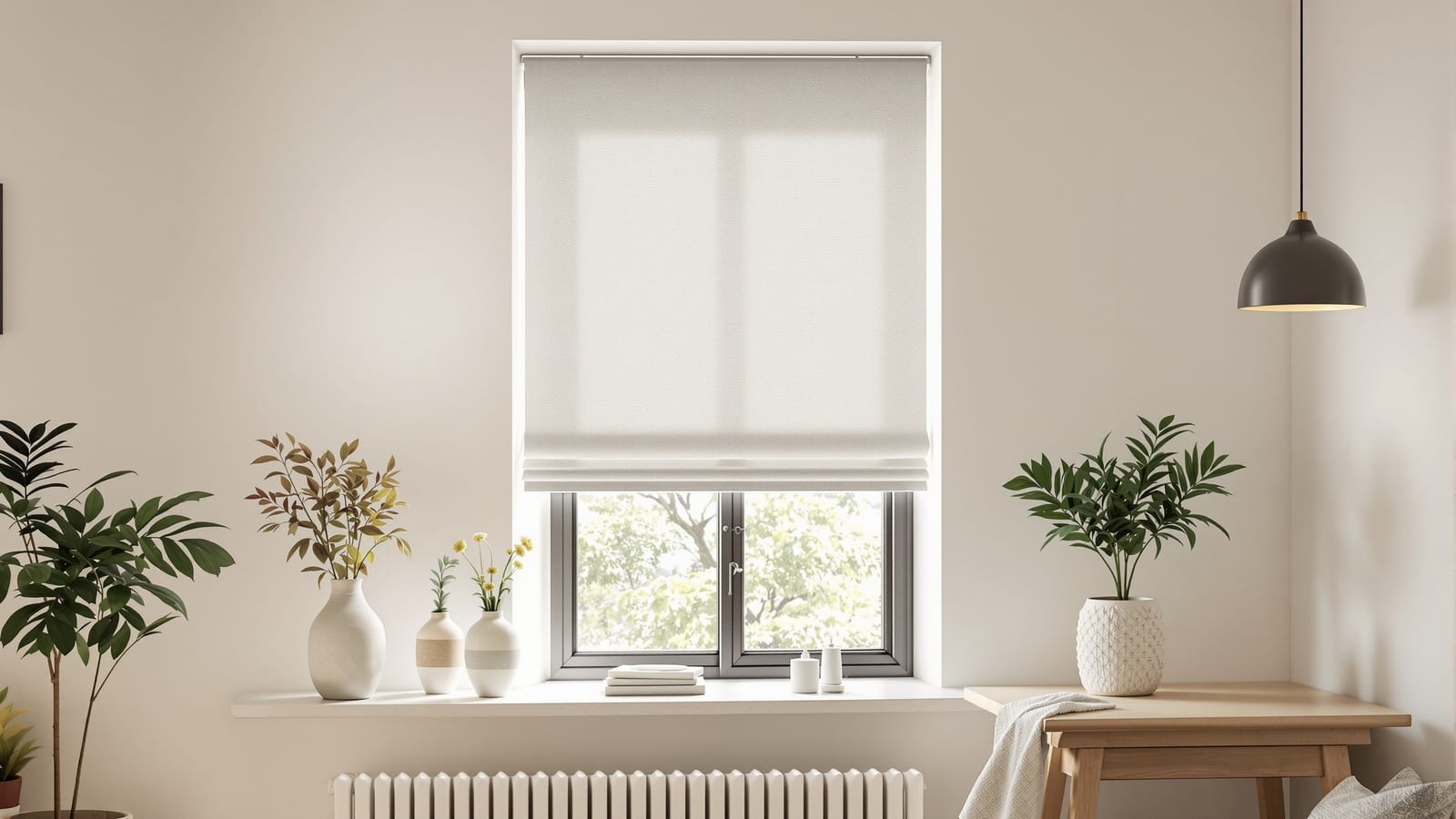
- Roman blind — fabric that folds up into soft horizontal pleats; the "softest" blind, closest in feel to a curtain, and the one that reads as warm and tailored. Good for living rooms and bedrooms that want fabric warmth without floor-length drapes.
- Venetian blind — horizontal slats (aluminium, wood or faux-wood) you tilt for graded light and see-out privacy. Brilliant light control; the metal version radiates heat, so prefer wood or faux-wood on sunny windows.
- Zebra (day-night) blind — alternating sheer and opaque bands that slide over each other, so you can fade smoothly from clear view to full screen. A popular modern all-rounder for living rooms and balconies.
- Honeycomb (cellular) blind — pleated cells that trap insulating air; the premium choice when heat or cold is the priority, and the quietest, most energy-smart blind. The priciest of the five.
The real answer: use both
Here is what most genuinely well-dressed Indian windows actually do — and what the showroom rarely tells you. They do not choose. They run a functional blind at the glass and a dress curtain beside it:
1. A roller or honeycomb blind sits inside the recess, doing the real work — precise light, blackout, heat control, easy cleaning.
2. A floor-length curtain (often a "dress curtain" that mostly stays open) frames the window, adds height, softens the acoustics and finishes the room.
You get the blind's engineering and the curtain's warmth, the room reads taller and more expensive, and each layer covers the other's weakness — the blind handles glare and heat, the curtain handles night privacy, scale and sound. It costs more than one treatment and less than over-specifying either, and on the rooms you live in most — living room and main bedroom — it is almost always worth it. The living-room curtains guide shows this layering in practice, and decorative window treatments covers the dress-curtain styling.
Room by room, in one line
- Living room — blind behind a dress curtain; the room to do properly.
- Bedroom — blackout matters most; a blackout roller, or lined blackout curtains, or both for total dark.
- Kitchen — wipeable roller blind; keep fabric away from flames.
- Bathroom / balcony — moisture-tolerant roller or zebra blind over fabric.
- Home office — venetian or zebra blind to kill screen glare without going dark.
For the full opacity, pleat and heading vocabulary on the curtain side, types of curtains is the companion read.
How to decide, honestly
There is no universal winner — there is the right tool for your window. Work it in this order:
1. Name the two priorities for this window (light, privacy, heat, acoustics, looks).
2. If "heat," "noise" or "warmth" lead — lean curtains, or a honeycomb blind.
3. If "glare," "easy cleaning" or "minimal look" lead — lean blinds, by type.
4. If "night privacy" leads — a lined curtain or a blackout roller, never a lone sheer.
5. If it is a room you live in daily — seriously consider both: blind at the glass, curtain beside it.
Two honest caveats. Every cost and dimension here is indicative — measure your own windows and price fabrics and blinds locally before committing. And Vastu colour or direction preferences are cultural guidance, not physics; follow them if they matter to you, but never at the cost of light or heat control.
Not sure which way to go? Let Studio Matrx decide it for you. Answer a few questions in the window treatment selector for a treatment matched to your room, orientation and priorities — then read the complete curtain and window-treatment guide and explore the rest of the Window Treatments cluster.
Export this guide
Related Guides — Deep-dive reading
Curtains vs Venetian Blinds: Precision vs Softness (India 2026)
Tilt-precise venetians or warm, quiet curtains? A room-by-room, rupee-by-rupee verdict for Indian homes — including the dust and wind caveats nobody mentions, and the combo that beats both.
Window TreatmentsVenetian Blinds Explained: Slats, Materials & Light Control (India 2026)
Horizontal-slat blinds decoded for Indian homes — aluminium, real wood and faux-wood, the 25/35/50 mm slat sizes, the tilt mechanism that gives precise light and privacy, honest pros and cons, real rupee costs and dust-smart care.
Window TreatmentsHome Office Curtains: Screen Glare & Light Control (India 2026)
The WFH window done right — kill screen glare and video-call backlight without going dark, with a sheer-plus-roller combo, the orientation rules that decide everything, and honest Indian costs.
Window TreatmentsRelated Tools — Try Free
Window Treatment Selector
Curtains, blinds or a layered system? Answer five questions about your room and get a specific recommendation.
SelectorCurtain Cost Calculator
Get the fabric metres you need plus the total curtain cost by window size, fabric, pleat, lining and hardware.
Curtain CalculatorCross-Ventilation Analyzer
Estimate airflow and air changes per hour (ACH) from room size, window areas, layout, and local wind — with NBC 2016 Part 8 compliance check.
Ventilation Calculator