
Chan Chan: The Vast City of Mud Where Every King Built His Own Palace
On the desert coast of Peru sprawl the ruins of the largest city ever built of mud — a thousand-year-old capital of adobe walls three storeys high, carved with fish and seabirds, that survived only because it almost never rains. It was a city of ten royal palaces, one for each king, driven by a strange rule of inheritance; and today, an earthen city in a warming world, it is racing the rain to survive. The ninth article in our chapter on the palaces and pleasures of worldly power.
For the second-to-last stop in our chapter on the seats of worldly power, we cross to the Americas — to a royal capital utterly unlike the stone and brick we have seen, and to one of the most extraordinary, and most fragile, wonders in this whole series. It is a great city built almost entirely of mud — and it is the largest such city that has ever existed. This is Chan Chan, capital of the Chimú, on the desert coast of Peru.
This is the seventy-second article in our Architectural Wonders series, and the ninth in our chapter on the great palaces and pleasures of worldly power.
Chan Chan holds two ideas that make it perfect for this chapter's close-but-one. First, it is a wonder of material — proof that a civilisation with almost no stone could raise a metropolis, palaces and all, out of the very earth beneath its feet. And second, it is a wonder of social design: a city whose whole strange shape — a sprawl of ten separate royal palaces — was dictated by a single rule about what happens to a king's property when he dies. Architecture here is the direct fossil of a society's deepest habits.
1. The city of earth
Begin with the sheer, improbable fact of the place: a city of mud, the size of a modern town.
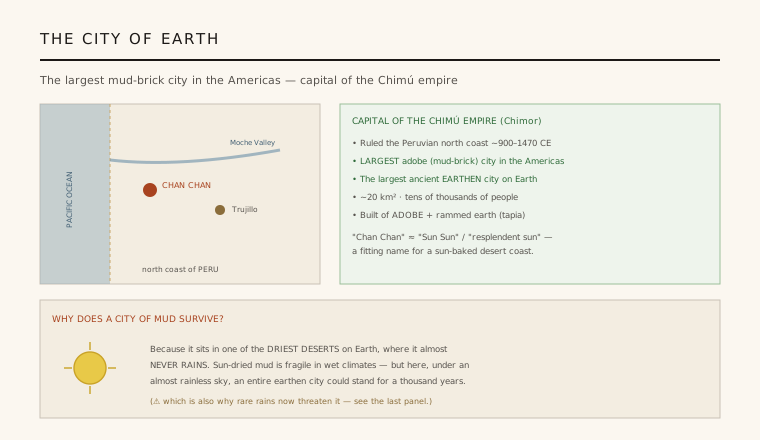
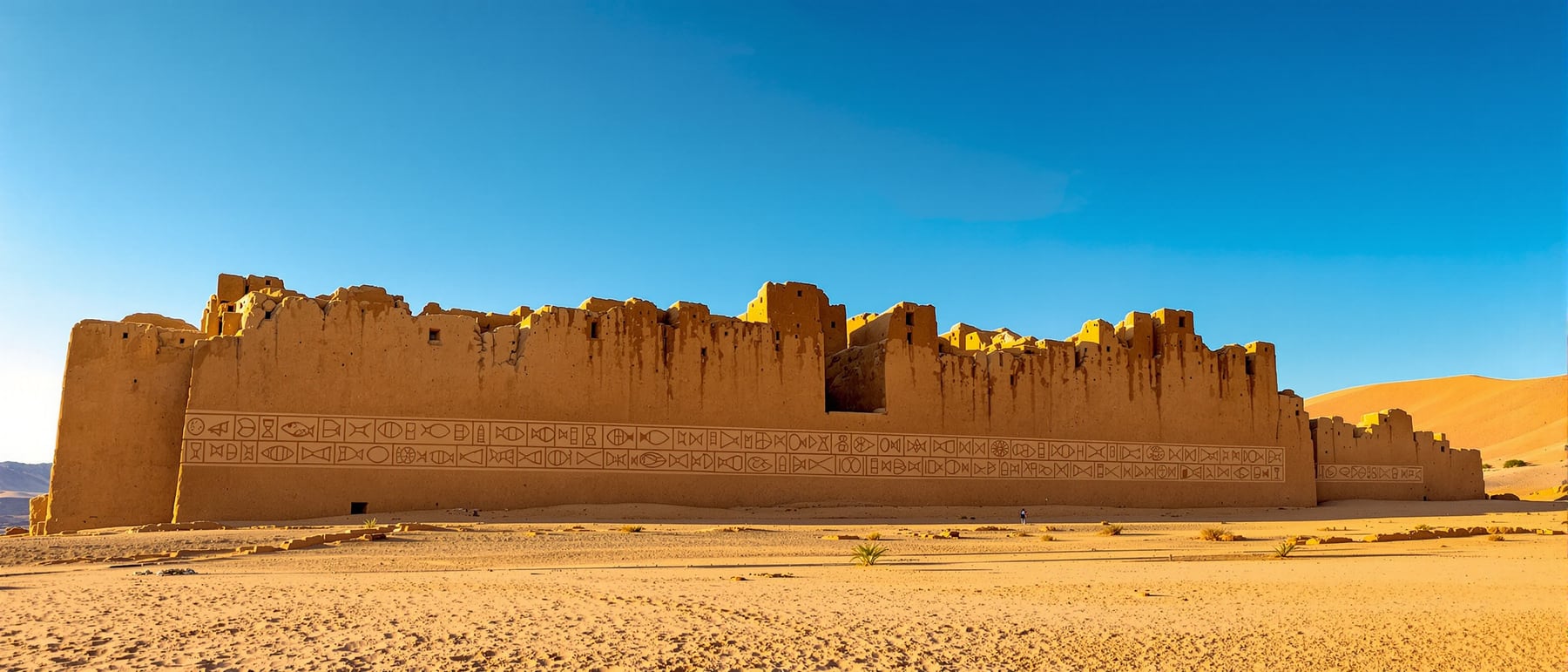
Chan Chan stands on the arid north coast of Peru, near the modern city of Trujillo, in the Moche Valley just back from the Pacific. It was the capital of the Chimú empire (Chimor), which dominated the Peruvian north coast from about 900 to 1470 CE. And it is, quite simply, the largest city ever built of adobe — sun-dried mud brick — in the Americas, and the largest ancient earthen city on Earth: some 20 square kilometres, home at its height to tens of thousands of people. Every wall, every palace, every storeroom was made of the earth itself — mud brick and rammed earth (tapia), plastered smooth and, in the grand compounds, carved — the same humble, universal building material that raised the mud mosques of Timbuktu on the far side of the world. And here is the reason such a city could survive a thousand years: it sits in one of the driest deserts on the planet, where it almost never rains. Sun-dried mud dissolves in wet climates; but under this rainless sky, an entire city of earth could stand, and stand, and stand. The name Chan Chan is thought to mean something like "Sun Sun" or "resplendent sun" — exactly right for this blazing, rainless coast. (That same dryness, we will see, is the key to both its survival and its present peril.)
2. Ten palaces for ten kings
Now the idea that gives Chan Chan its unforgettable shape — and it is one of the best "architecture-follows-society" stories anywhere.
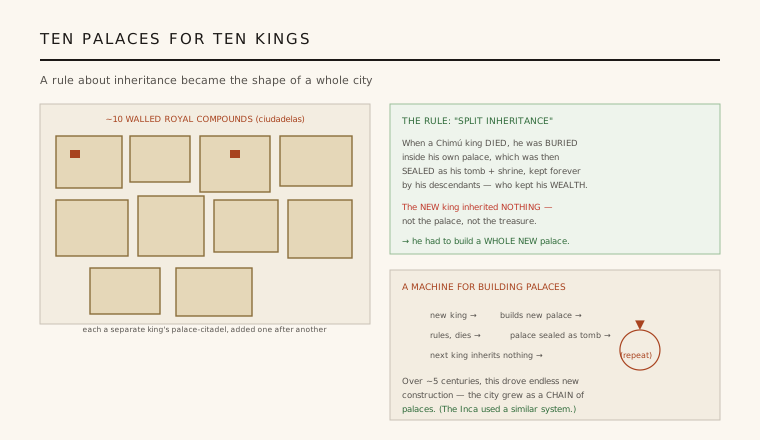
At the heart of Chan Chan stand about ten enormous walled royal compounds, called ciudadelas — and there are ten of them because of a remarkable rule that scholars call "split inheritance." When a Chimú king died, he was buried inside his own palace, which was then sealed shut and preserved forever as his tomb and shrine — maintained by his descendants, who continued to own his estate and all its wealth, and to serve his cult. The crucial twist: the new king inherited none of it. He could not move into the old palace, and he could not touch the old treasure. He had to start again from nothing and build a brand-new palace-compound of his own, and generate his own fortune to fill it. So every reign added another vast ciudadela to the city, and Chan Chan grew, across five centuries, as a chain of royal palaces — a townscape of great sealed mortuary-palaces of dead kings, with the living king's new compound rising at the edge. It is one of the purest examples in all of architecture of a social rule becoming physical form: the whole plan of the largest mud city on Earth is the fossilised print of a single idea about inheritance. (The Inca, who would later conquer the Chimú, ran their royal estates on a strikingly similar principle.)
3. Inside a royal compound
Step through the single guarded gate of one ciudadela, and you enter a complete, self-sufficient world.
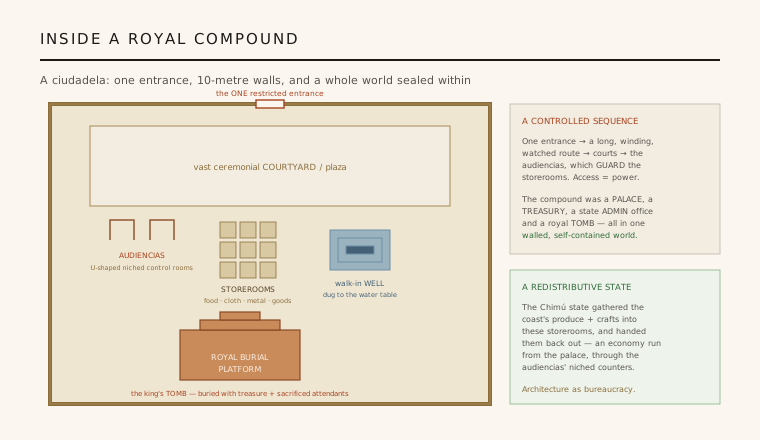
Each ciudadela was ringed by colossal adobe walls up to nine or ten metres high, pierced by just one restricted entrance — a single controllable point of access to everything within. From it, a long, winding, watched route led into vast open ceremonial courtyards. Deeper inside came the compound's administrative heart: the audiencias — small, distinctive U-shaped rooms with niched walls, from which officials sat and controlled access to the wealth behind them. And that wealth filled rows upon rows of storerooms — food, fine cloth, worked metal, craft goods — the treasury of a redistributive economy, in which the state gathered the coast's produce and handed it back out. To water all this in a desert, engineers sank a walk-in well — a great stepped pit dug straight down to the water table. And at the compound's sacred core rose the royal burial platform: a stepped adobe mound that was the king's tomb, where he was interred with treasure and, grimly, sacrificed attendants to accompany him. Palace, treasury, government office, and tomb — one walled, self-contained universe per king. The audiencias are especially telling: this was a state run not by written law but by architecture, by the physical control of who could reach the storerooms. The building was the bureaucracy.
4. The sea in the walls
For all their mass, the walls of Chan Chan are not blank — they are covered in some of the most charming relief decoration in the ancient Americas, and it tells you exactly what this civilisation lived by.
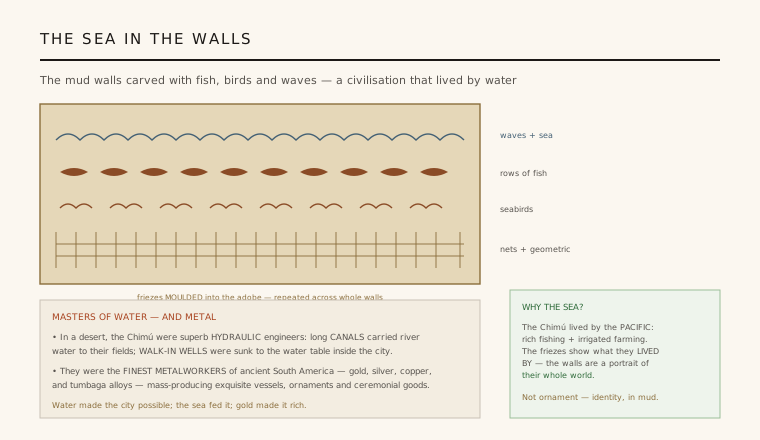
The great compound walls are moulded, over vast stretches, with friezes pressed and carved into the adobe: rows of repeating geometric patterns and, above all, motifs of the sea — fish in ranks, seabirds, rolling waves, fishing nets, and stylised sea creatures. This is no accident of taste. The sea was the foundation of Chimú life: their economy rested on the astonishingly rich fishing of the cold Pacific current, alongside irrigated farming. So the friezes are, in effect, a portrait of the world that fed the city — identity written into the walls in mud. And behind that identity lay two more Chimú masteries. Living in a desert, they were superb water engineers, cutting long canals to carry river water to their fields (including great inter-valley canals) and sinking those walk-in wells to the water table within the city. And they were the finest metalworkers of ancient South America — working gold, silver, copper and tumbaga alloys into exquisite vessels and ornaments on a near-industrial scale. Water made the city possible; the sea fed it; gold made it rich — and all three swim across its walls. (The Chimú built on the shoulders of an older north-coast civilisation of pyramid-builders, the Moche, who had farmed and worshipped in these same valleys a thousand years before.)
5. Conquest, loot — and the rain
Every wonder in this series has its ending; Chan Chan has three, and the last of them has not finished yet.
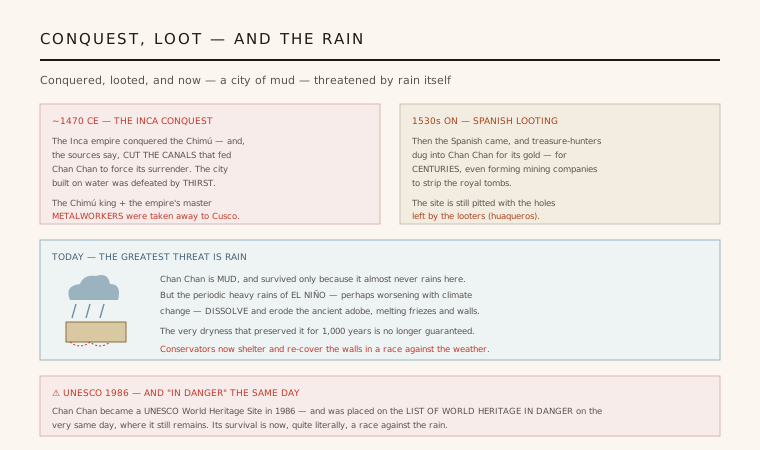
Around 1470 CE, the expanding Inca empire conquered the Chimú — and did it with terrible aptness. The sources say the Inca cut the canals that carried water to Chan Chan, and the great city built on water was brought down by thirst. They carried the Chimú king off to the Inca capital, Cusco, and — recognising genius when they saw it — deported the kingdom's master metalworkers to Cusco to work their gold for the Inca instead. Then, from the 1530s, came the Spanish, and with them centuries of looting: treasure-hunters (huaqueros) dug into Chan Chan for its gold for generations — even forming companies to mine the royal tombs — and left the whole site pitted with their holes. But the gravest threat is the newest, and it is the cruel inverse of the city's own secret. Chan Chan is made of mud, and it survived only because it almost never rains here. Now, the periodic torrential rains of the El Niño weather pattern — very possibly worsening with climate change — fall on the bare adobe and dissolve it, melting friezes and slumping thousand-year-old walls. The very dryness that preserved the city is no longer guaranteed. Fittingly and heartbreakingly, Chan Chan was inscribed as a UNESCO World Heritage Site in 1986 — and placed on the List of World Heritage in Danger on the very same day, where it remains, as conservators shelter and re-cover the walls in a slow race against the weather. It is the perfect, sobering emblem for this whole series' meditation on loss: a wonder that outlived conquest and looting, only to be threatened, in our own century, by the rain — and by us. From this fragile city of earth we go, to close the chapter, to a mighty city of stone at the far south of Africa — the walls of Great Zimbabwe.
6. What a modern architect can learn from Chan Chan
- Build with what the ground gives you. With almost no stone, the Chimú raised the largest earthen city on Earth from mud alone. Mastery of a humble local material — understood completely, used at scale — can achieve what imported grandeur never could. The most sustainable architecture is usually the most local.
- Form follows the society, not just the function. Chan Chan's whole plan — ten separate palaces — is the direct print of one social rule about inheritance. Buildings and cities are fossils of how people organise their lives; design honestly for the real social structure, and read old buildings to recover it.
- Control is spatial. The single gate, the winding watched route, the audiencias guarding the storerooms — Chimú power worked through the physical control of access. How a plan lets people move, and stops them, is never neutral: circulation is politics. Design it consciously.
- Let the walls say what you live by. The fish and seabirds moulded across Chan Chan are the civilisation's own self-portrait. Ornament, at its best, is not applied prettiness but meaning — a building telling the truth about the world that made it. Decoration can be identity.
- The strength that saves you can also doom you. The desert dryness that preserved Chan Chan for a thousand years is exactly what leaves it defenceless against rain. Every design rests on assumptions about its environment — and when the climate shifts, those assumptions become vulnerabilities. Build, now more than ever, for a changing world, not a fixed one.
- Fragile things need us to choose them. Chan Chan has survived conquest and centuries of looting, but it may not survive the coming rains without deliberate, sustained human care. Some wonders endure by their own strength; others endure only because a society decides they are worth protecting. Preservation is not passive — it is an active, ongoing act of will.
References & further reading
1. UNESCO World Heritage Centre — Chan Chan Archaeological Zone (inscribed 1986; on the List of World Heritage in Danger). https://whc.unesco.org/en/list/366/
2. World History Encyclopedia — Chan Chan and Chimú Civilization. https://www.worldhistory.org/Chan_Chan/
3. Encyclopaedia Britannica — Chan Chan and Chimú. https://www.britannica.com/place/Chan-Chan
4. The Metropolitan Museum of Art — Chimú (art and metalwork of the north coast). https://www.metmuseum.org/toah/hd/chim/hd_chim.htm
5. Smarthistory — Chan Chan (the Chimú capital). https://smarthistory.org/chan-chan/
6. Michael E. Moseley & Kent C. Day (eds.) — Chan Chan: Andean Desert City (the classic scholarly volume). https://www.worldcat.org/title/chan-chan-andean-desert-city/oclc/7169884
*Last verified 2026-07-05. Figures follow UNESCO, the World History Encyclopedia, Britannica, the Metropolitan Museum of Art and standard scholarship (incl. Moseley & Day), and are given as widely cited approximations that vary by source. Chan Chan, on the arid north coast of Peru near Trujillo (Moche Valley), was the capital of the Chimú empire (Chimor), c. 900–1470 CE. It is the largest adobe (sun-dried mud-brick) city in the Americas and the largest ancient earthen city in the world (~20 km²; population estimates range widely, into the tens of thousands). It is famous for ~9–10 monumental walled royal compounds ("ciudadelas") with adobe walls up to ~9–10 m high; their number reflects "split inheritance" — a dead king's compound was sealed as his tomb/mortuary shrine and his estate retained by his descendants, so each new king built a new compound and accrued new wealth. A ciudadela typically had a single restricted entrance, large plazas, U-shaped niched "audiencias" (administrative/control rooms), extensive storerooms (a redistributive economy), walk-in wells (to the water table), and a royal burial platform (king's tomb, with treasure and sacrificed retainers). Walls carry moulded adobe friezes of geometric and marine motifs (fish, seabirds, waves, nets), reflecting the Chimú's Pacific-fishing and irrigation economy; the Chimú were master hydraulic engineers (canals, incl. inter-valley canals) and the pre-eminent metalworkers of ancient South America (gold, silver, copper, tumbaga). The Chimú built on the earlier Moche culture of the same coast. The Inca conquered the Chimú c. 1470 (reportedly cutting Chan Chan's canals; the king and metalworkers were taken to Cusco); after the 1530s the Spanish and later treasure-hunters (huaqueros) extensively looted the site. Chan Chan is critically threatened by erosion from rain, especially El Niño events (likely worsened by climate change), since its adobe survived chiefly due to the near-rainless desert; it was inscribed by UNESCO in 1986 and simultaneously placed on the List of World Heritage in Danger. This is the ninth article in the "palaces and pleasures of worldly power" chapter of the Architectural Wonders series.
Export this guide
Related Guides — Deep-dive reading
Cahokia and Monks Mound: The Great City America Forgot
A thousand years ago, across the river from where St Louis now stands, Native Americans built a city of perhaps twenty thousand people — larger than London at the time — with a hundred and twenty earthen mounds, a plaza the size of dozens of football fields, and a solar calendar of cedar posts. At its heart rose Monks Mound, the largest earthwork in the Americas, with a footprint to rival the Great Pyramid. Then, before Europeans ever arrived, it vanished — and almost no one remembers it.
Architectural WondersGreat Zimbabwe: The Stone City Europe Refused to Believe Africans Built
In the hills of southern Africa stand the largest ancient stone ruins south of the Sahara — a whole city of massive granite walls built without a drop of mortar, the wealthy capital of a gold-trading kingdom. For a century, colonists refused to accept that Africans had raised it, and invented every other builder they could. This is the story of that architecture, and of the lie it outlived. The article that closes our chapter on the palaces and pleasures of worldly power.
Architectural WondersThe Moche Pyramids: Mountains of Mud, Gods of Blood
How a writing-less people on Peru's desert coast raised the largest mud-brick structure in the Americas from 130 million hand-made bricks, buried temple within painted temple beneath the face of a fanged god who demanded human blood, hid a king in gold no looter found for 1,700 years — and were undone at last by the very floods they had killed to appease.
Architectural WondersRelated Tools — Try Free
Cross-Ventilation Analyzer
Estimate airflow and air changes per hour (ACH) from room size, window areas, layout, and local wind — with NBC 2016 Part 8 compliance check.
Ventilation CalculatorBefore & After Studio
Generate AI before-and-after renders to preview how your redesign could look.
DesignAIVisitor Access Planner
Size visitor handling at a gate or reception — lanes needed at peak and the temporary-pass pool.
Visitor Flow