
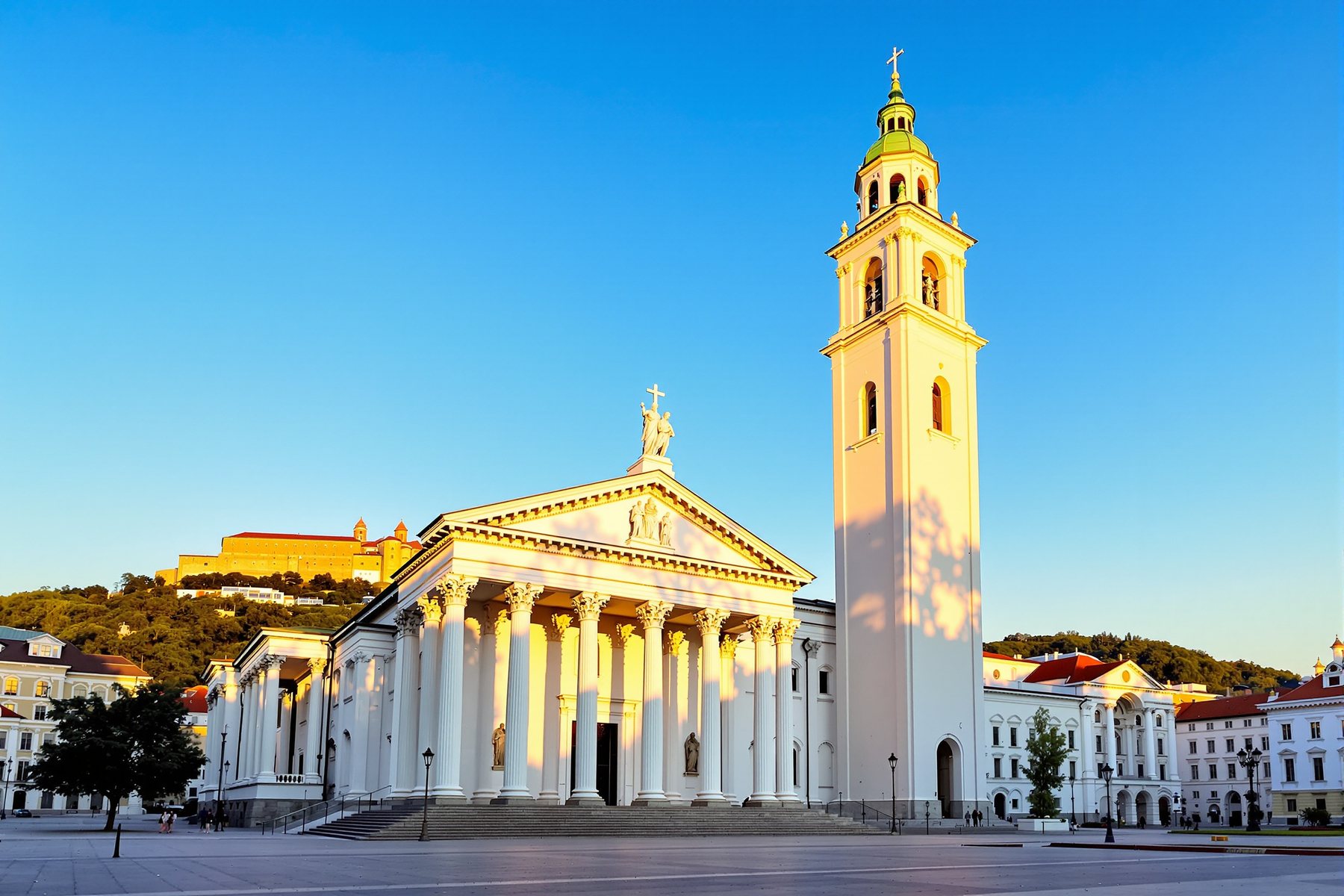
Vilnius Cathedral: The Building Rebuilt a Thousand Years
How one sacred spot in Lithuania carried a pagan altar, a medieval cathedral and finally a serene Neoclassical temple — a palimpsest whose whole history lies stacked in the crypt beneath your feet, and whose square became the heart of a nation's return.
In the last article we crossed to Lithuania for Trakai, a castle that turned a lake into a wall. Stay in Lithuania, travel to its capital, Vilnius, and stand on its great Cathedral Square, and you meet a building that looks, at first glance, almost too calm to be a wonder: a white, serene, columned temple, more like something from ancient Athens than a northern cathedral. That serenity hides the most extraordinary biography of any building in this series. Vilnius Cathedral is not one building. It is a dozen buildings, stacked across a thousand years, on a single unmoving sacred spot — and one of them was a pagan temple.
It is, in the truest sense, a palimpsest: a page written over and over, where each new text is laid on the faint marks of the last. And everything it has ever been still lies beneath the floor you walk on.
This is the tenth article in our Architectural Wonders series, and a companion to Trakai — the same nation, the same long fight to remember itself.
1. A temple, a tower, and a tile
The cathedral stands on Cathedral Square in the old town of Vilnius, at the foot of Gediminas Hill with its medieval castle tower. Three things share the square, and you should know them before you read the building.
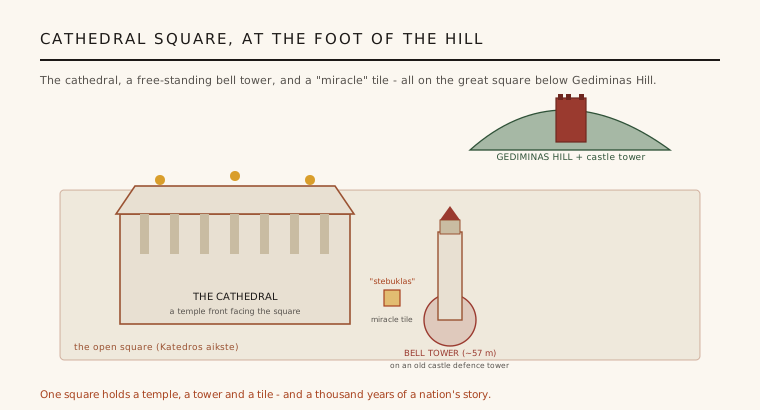
There is the cathedral itself, with its temple front. There is a tall free-standing bell tower (about 57 metres) set apart on the square — and tellingly, it was built on the round base of a tower from the old castle's defensive wall: a fortification turned into a campanile, exactly the kind of thrifty reuse we saw at Trakai. And set in the pavement between them is a single tile reading "stebuklas" — "miracle" — whose meaning we will come to at the end.
2. One sacred spot, many buildings
Here is the heart of the matter, and there is nothing else quite like it in this series. Almost every wonder we have visited is one act of building. Vilnius Cathedral is the same holy ground rebuilt again and again, through total changes of form and even of faith.
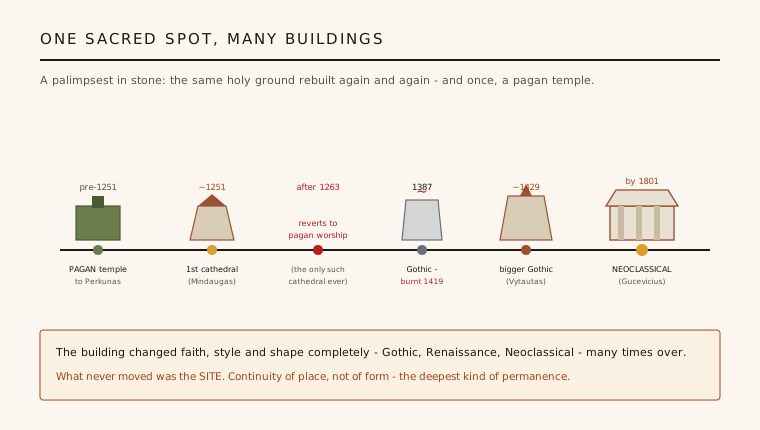
The layers run like this. Before Christianity, tradition holds that a stone temple to Perkūnas, the Baltic thunder god, stood on this spot. When King Mindaugas — the only crowned King of Lithuania — converted, he is said to have raised the first cathedral here around 1251. After his death in 1263 the site reverted to pagan worship, which makes Vilnius Cathedral very probably the only Catholic cathedral in the world that has also served as a working pagan temple. With Lithuania's official conversion in 1387 came a Gothic cathedral; it burned in 1419; Vytautas the Great built a larger Gothic cathedral in its place around 1429; the Renaissance rebuilt it again. And finally, at the end of the 18th century, it was remade one last time — into the calm classical temple you see today.
The lesson sits right on the surface. What endured at Vilnius was never the building — every brick of it has been replaced, more than once, in utterly different styles. What endured was the site. This is continuity of _place_, not of _form_ — and it is one of the deepest kinds of permanence architecture can offer. A meaningful spot can outlive every structure ever raised on it.
3. A Greek temple in the north
The final rebuild, the one that gives the cathedral its face today, was the work of the Lithuanian architect Laurynas Gucevičius, carried out between about 1779 and 1801 in the Neoclassical style. And it is a startling, deliberate choice.
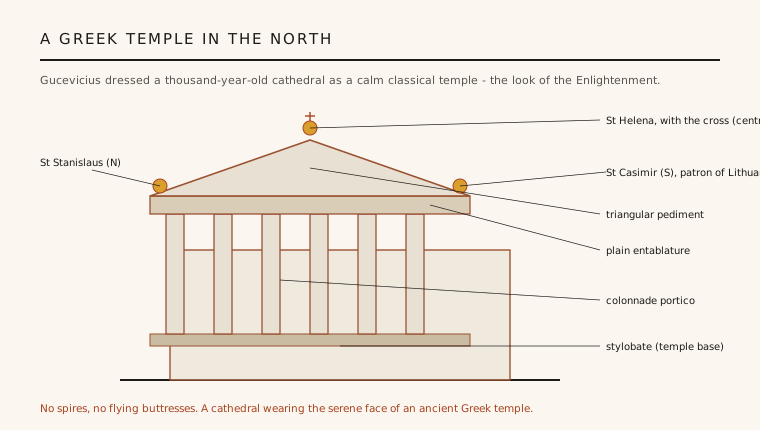
Gucevičius did not give Vilnius a Gothic cathedral of spires and flying buttresses. He gave it a Greek temple: a severe rectangular box fronted by a colonnaded portico, a plain entablature and a calm triangular pediment, crowned along the roofline by three statues — St Stanislaus to the north, St Helena holding the cross at the centre, and St Casimir, the patron saint of Lithuania, to the south. This was the language of the Enlightenment — reason, order, antiquity — and to dress a thousand-year-old Christian sanctuary in the robes of pagan Athens was a confident intellectual statement about the age that built it. Form, here, is an argument: the building announces _when_ it was made by _what_ it chose to look like.
4. A jewel embedded, a history buried
For all its outward calm, the cathedral holds two treasures that belong to entirely different worlds from the cool Neoclassical shell — and finding them is half the wonder.
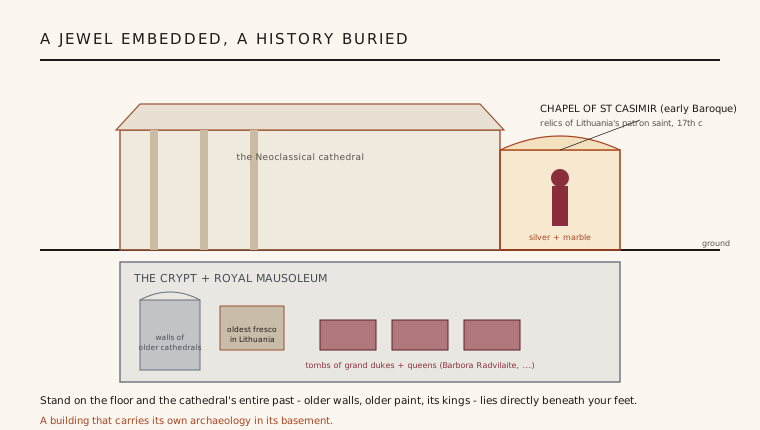
Embedded in one flank is the Chapel of St Casimir, an early-17th-century Baroque masterpiece of marble and silver, holding the relics of Lithuania's patron saint — a hot, ornate jewel set into the cool classical box around it. And beneath the floor lies the crypt and royal mausoleum, the real treasure-house of the nation's memory. Down there, in the dark, you find the surviving Gothic walls of the earlier cathedrals, the oldest known fresco in Lithuania, and the tombs of grand dukes and queens — among them Barbora Radvilaitė (Barbara Radziwiłł), and the resting place once meant for Vytautas himself.
It is the perfect physical expression of the palimpsest. Stand in the bright Neoclassical nave, and the cathedral's entire deep past — its older walls, its older paint, its buried kings — lies directly beneath your feet. It is a building that carries its own archaeology in its basement.
5. Taken, and taken back
The cathedral's last great chapter is the one that makes it, like Trakai, far more than a beautiful object. Under Soviet occupation the building was closed as a place of worship in 1949 and put to use as a warehouse and gallery; its three rooftop saints were torn down in 1950. The most sacred building in Lithuania was emptied of its meaning on purpose.
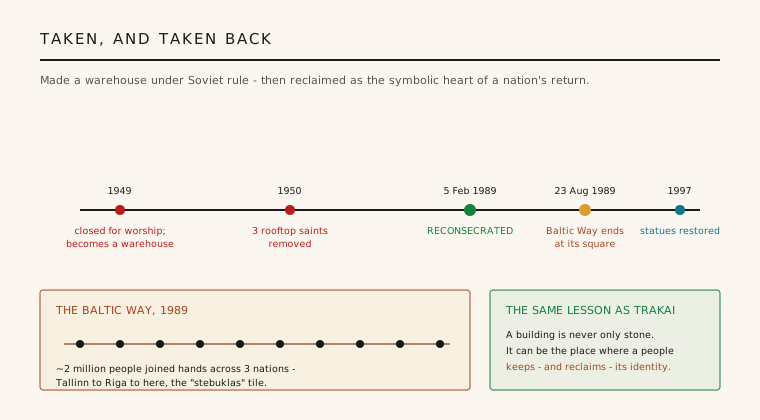
And then it was taken back. On 5 February 1989, as Soviet power waned, the cathedral was reconsecrated. And that same year the square outside became the stage for one of the most moving acts of the 20th century. On 23 August 1989, around two million people joined hands in a single human chain — the Baltic Way — stretching some 600 kilometres across Estonia, Latvia and Lithuania to protest Soviet rule. The chain ran from Tallinn through Riga and ended right here, on Cathedral Square, at that one pavement tile reading "stebuklas" — "miracle." The statues went back up on the roof in 1997.
This is the same truth Trakai taught, told in a different key: a building is never only stone. It can become the very place where a people keeps, loses and reclaims its identity — and where, sometimes, a miracle is marked by a single tile in the ground.
6. What a modern architect can learn from Vilnius Cathedral
- The site can outlast every building on it. Vilnius is a thousand-year argument that the most durable thing in architecture is not the structure but the meaningful place. Honour the spot; the building is only its latest sentence. Continuity of place is a kind of permanence no single design can buy.
- Form is an argument about its age. Gucevičius's Greek temple says, unmistakably, "this is the Enlightenment." What a building chooses to _look_ like is a statement about the ideas of the moment that made it. Choose that language consciously, because everyone reads it.
- Let a building keep its own history. The crypt that holds the older cathedrals is not an inconvenience to be cleared; it is the building's memory. The richest places are legible in section — you can read their whole past by going down. (It is the layered thinking our structural safety and heritage writing keeps returning to.)
- Reuse what stands. The bell tower is an old defence tower given a new life. Adaptive reuse is older and wiser than we pretend; the greenest, most rooted building is often the one already there, repurposed.
- Architecture carries identity — guard it. This cathedral was emptied to break a nation's spirit and reconsecrated to restore it. The buildings a people most love are never neutral; they are where memory lives, and they are worth defending.
References & further reading
1. Vilnius Cathedral / Church Heritage Museum — The Cathedral Basilica of St Stanislaus and St Ladislaus. https://gidas.bpmuziejus.lt/products/tours/the-cathedral-basilica-of-st-stanislaus-and-st-ladislaus-in-vilnius/
2. Go Vilnius (official city tourism) — Vilnius Cathedral. https://www.govilnius.lt/visit-vilnius/places/vilnius-cathedral-basilica
3. Encyclopaedia Britannica — Vilnius and the Grand Duchy of Lithuania. https://www.britannica.com/place/Vilnius
4. History Hit — Vilnius Cathedral: History and Facts. https://www.historyhit.com/locations/vilnius-cathedral/
Last verified 2026-06-30. Dates, attributions and the sequence of earlier buildings follow standard historical and museum reference sources and are given as widely accepted approximations; the pagan-temple tradition, the Gucevičius reconstruction, the 1949–1989 Soviet closure and reconsecration, and the 1989 Baltic Way follow the established historical record.
Export this guide
Related Guides — Deep-dive reading
Trakai: The Castle That Made a Wall of Water
How the Grand Dukes of Lithuania built a red-brick Gothic fortress on an island in a lake — using the water itself as its outermost wall — and how a 20th-century nation chose to rebuild it from ruin. The defensive idea, the Brick Gothic, and the reconstruction debate.
Architectural WondersChan Chan: The Vast City of Mud Where Every King Built His Own Palace
On the desert coast of Peru sprawl the ruins of the largest city ever built of mud — a thousand-year-old capital of adobe walls three storeys high, carved with fish and seabirds, that survived only because it almost never rains. It was a city of ten royal palaces, one for each king, driven by a strange rule of inheritance; and today, an earthen city in a warming world, it is racing the rain to survive. The ninth article in our chapter on the palaces and pleasures of worldly power.
Architectural WondersGediminas' Tower: The Hill Where a City Was Dreamed
How a single red-brick tower on a Vilnius hilltop — the last fragment of a vanished castle, born of a legend about an iron wolf — became the flag-tower of a nation, and what it teaches about height, survival and the meaning of a site.
Architectural WondersRelated Tools — Try Free
Before & After Studio
Generate AI before-and-after renders to preview how your redesign could look.
DesignAIAI BOQ Generator
AI generates detailed Bill of Quantities with city-specific rates and labour breakdown.
ArchitectAIConcept Generator
Get 3 AI-generated design concepts for any room with style, materials, and cost estimate.
DesignAI