
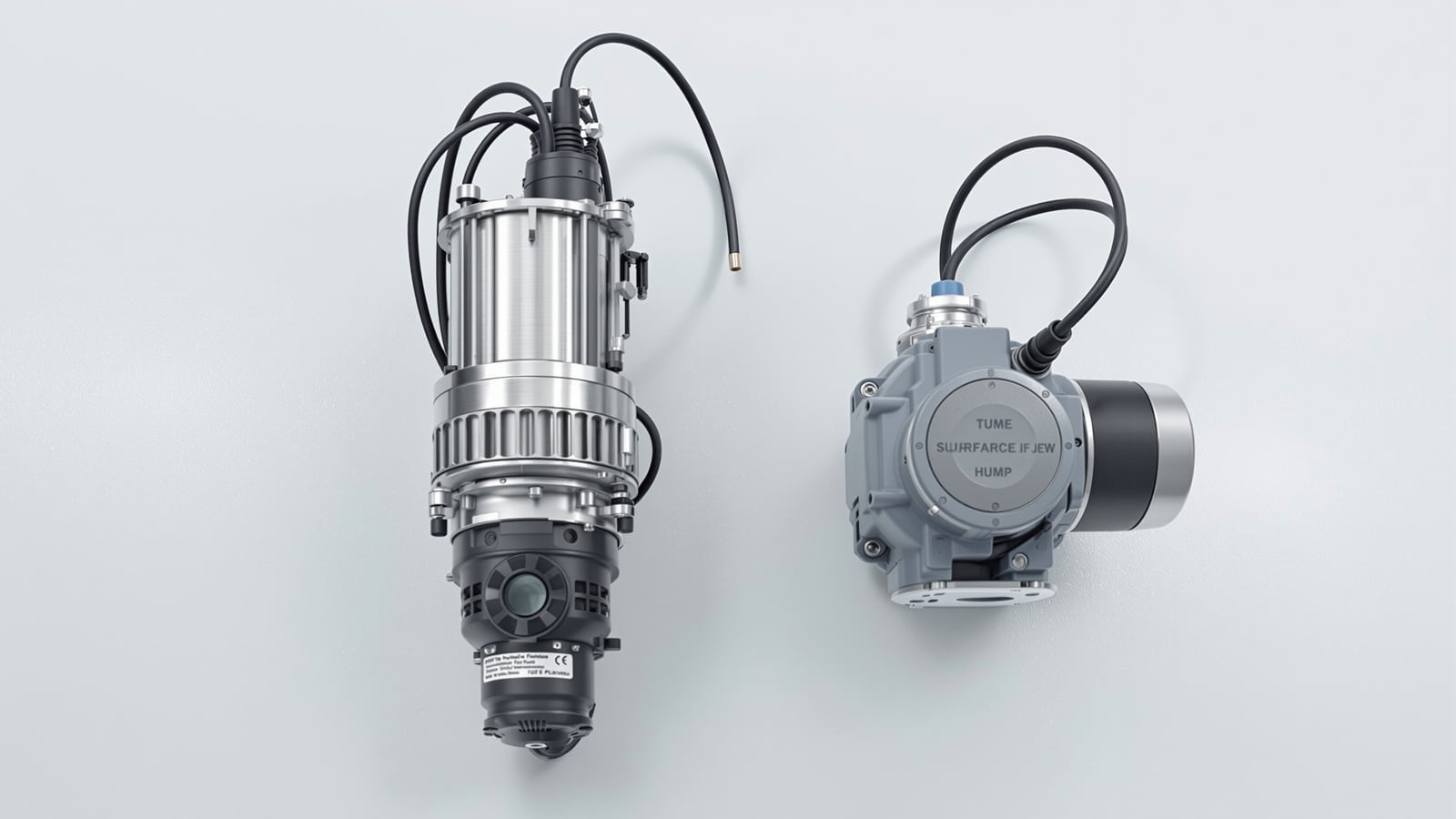
Submersible vs Jet Pump: Which to Use in India
The decision comes down to one question — how deep is your water. A submersible pump sits inside the borewell or sump and pushes water up; a jet (self-priming surface) pump stands above ground and sucks water up but only from ~7-8 m. This guide compares suction limits, efficiency, noise, servicing, priming, cost and lifespan, and gives a clear verdict by depth.
Both of these pumps exist to do the same job — get water out of your borewell, well or sump and up into the tank. But they attack the problem from opposite ends. A submersible pump goes down into the water and pushes it up. A jet (self-priming surface) pump stays up top and tries to suck the water to itself. That single difference in position decides almost everything else — and the deciding factor for you is simply how deep your water sits. Go deep, go submersible; stay shallow, a jet pump is cheaper and easier to live with.
This is a comparison guide in the Studio Matrx Plumbing Knowledge Hub. Each pump has its own full technical guide — the submersible pumps guide for India and the jet pumps guide for India — so this article stays on the head-to-head decision. For the whole pump family, see the water pumps guide for India.
The rule of thumb: if your water level is more than about 7-8 metres below where the pump would sit, a surface jet pump physically cannot reach it. That is not a brand or power problem — it is atmospheric physics.
The one difference that drives everything: position
A submersible is a sealed, water-cooled motor-and-pump unit that you lower on the delivery pipe right into the borewell casing or sump, fully underwater. It never sucks. It pushes — and pushing water up a pipe has no natural depth limit beyond the pump's head rating, so it happily works at 60, 100 or 200+ metres.
A jet pump is a surface pump: it sits dry above ground and uses an ejector (nozzle and venturi) to draw water up a suction pipe to itself. Because it relies on creating a partial vacuum and letting atmospheric pressure push the water up, its suction lift is capped. In theory that limit is about 10.3 m at sea level; in a real Indian installation, with pipe friction, foot-valve losses, heat and altitude, the honest practical ceiling is around 7-8 m for a single-stage shallow-well jet.

Suction and lift: the deal-breaker
This is where most homeowners go wrong. They buy a bigger, more powerful jet pump expecting it to reach deeper — but raising the horsepower does not raise the suction ceiling. Suction lift is limited by atmospheric pressure, not motor power. A 1 HP jet and a 2 HP jet both stall out at roughly the same 7-8 m of vertical lift on the suction side; the extra power only buys more flow and more delivery head after the water reaches the pump.
- Submersible — the water level can be 20, 50 or 150 m down and it makes no difference to whether the pump can lift it; you simply pick a pump with enough head. This is why every deep borewell in India runs a submersible.
- Jet pump — works only when the water sits within about 7-8 m of the pump: open wells, sumps, shallow borewells and overhead-tank-to-house boosting. A deep-well jet (with the ejector placed down in the bore) stretches this to roughly 25-30 m, but it is niche and less efficient than a submersible for the same depth.
For a full walk-through of matching a pump to a borewell's water table, see the borewell pumps guide for India.
Efficiency, noise and servicing
Beyond depth, three day-to-day differences separate these pumps.
Efficiency. A submersible is water-cooled and pushes rather than sucks, so at depth it moves more water per unit of electricity — no energy is wasted fighting a vacuum or recirculating water through an ejector. A jet pump inherently sends a share of its output back down to drive the venturi, so its wire-to-water efficiency is lower. On a deep source the submersible wins clearly; on a shallow source the gap narrows and rarely justifies the extra cost.
Noise. This is a real quality-of-life factor in dense Indian homes. A submersible runs underwater, so it is almost silent at the surface — you hear nothing but water arriving in the tank. A surface jet pump sits in the open and can be genuinely loud, which is why it usually ends up in a pump room, a shed or a corner of the yard, ideally on a rubber anti-vibration mount.
Servicing. This is the jet pump's biggest advantage. It sits at arm's length: open it, clear the impeller, replace a mechanical seal or a capacitor, re-prime, done — often without a technician. A submersible is the opposite. When it fails you must pull the entire pipe column and cable out of the borewell to reach it, which usually means calling a crew with a tripod or rig. Underground, it is out of sight and out of reach until something goes wrong.
Priming. A submersible is always underwater, so priming is a non-issue. A jet pump must be primed on first start (and re-primed after any air leak on the suction side), though its self-priming ejector means it holds prime far better than a plain centrifugal monoblock once charged. A well-seated foot valve at the bottom of the suction pipe is what keeps a jet pump primed between runs.
Submersible vs jet pump: side by side
| Factor | Submersible pump | Jet (self-priming surface) pump |
|---|---|---|
| Where it sits | Inside the borewell / sump, underwater | Above ground, dry |
| How it moves water | Pushes water up | Sucks water up |
| Practical depth reach | Effectively unlimited (pick the head) | Suction lift ~7-8 m; deep-well jet ~25-30 m |
| Efficiency at depth | Higher — water-cooled, no recirculation | Lower — recirculates water through the ejector |
| Noise | Near silent (runs underwater) | Noticeably loud; wants a pump room |
| Priming | None needed (always submerged) | Prime on first start; needs a foot valve |
| Servicing | Must pull the whole column out; technician + rig | Easy, at arm's length, often DIY |
| Purchase cost | Higher for the pump + cable + column | Lower, simpler kit |
| Best for | Deep borewells, deep water tables | Open wells, sumps, shallow bores, tank boosting |
Cost and lifespan
For an apples-to-apples domestic setup, a jet pump is the cheaper buy — a simpler surface unit with no down-hole cable or long column pipe. A submersible costs more at purchase once you add the special submersible cable, riser pipe and the control panel, and more again to install because it must be lowered and, later, extracted. But on a genuinely deep source it is the only option, so the comparison stops being about price.
Prices move constantly by HP, brand and depth, so treat any figure as indicative and check the live pump installation cost guide for India and the choosing a water pump guide before you buy. As a rough frame only, a domestic surface jet pump starts well below a comparable borewell submersible set, and the submersible's installation premium (the pull-out for future servicing) is the hidden cost people forget.
On lifespan, a quality submersible sitting in clean water and protected by a dry-run cutout can run reliably for many years with almost no attention — but a burnout means a full extraction. A jet pump may need a seal or capacitor sooner, yet each of those fixes is quick and cheap. Neither is inherently short-lived; the difference is how painful each repair is.
| Money & upkeep | Submersible pump | Jet (surface) pump |
|---|---|---|
| Pump purchase | Higher (needs cable + column pipe) | Lower (simple surface kit) |
| Install effort | High — lowered into the bore | Low — bolted to a plinth |
| Typical repair | Seal or motor rewind | Seal, capacitor, impeller |
| Repair hassle | High — pull the whole column | Low — often DIY at the surface |
| Running efficiency | Better at depth | Lower (recirculates water) |
The verdict
Let the depth of your water decide, then let the secondary factors settle any tie.
- For a deep borewell (water table more than ~8 m down), pick a submersible. A jet pump simply cannot reach that water, and the submersible's silence and efficiency are bonuses. Accept that servicing means pulling the column.
- For an open well, a sump, a shallow borewell, or boosting from an overhead tank — water within ~7-8 m — pick a jet pump. It is cheaper, self-priming, and you can service it yourself. Put it in a pump room to tame the noise.
- For a deep source where you specifically want a surface-mounted, easy-to-service pump, a deep-well jet (ejector down the bore) can reach ~25-30 m — but for most Indian homes at that depth a submersible is quieter and more efficient.
- If noise and low maintenance-hassle matter most and depth allows either, lean submersible for silence, jet for cheap, quick repairs.
Still unsure how to size head and flow once you have chosen the type? Work through the choosing a water pump guide for India, and see the rest of these head-to-heads in the plumbing comparisons guide.
Bottom line: measure how far below the pump your water sits — deeper than about 8 metres means a submersible, shallower means a jet pump wins on cost and easy servicing.
Export this guide
Related Guides — Deep-dive reading
Jet Pumps in India: Self-Priming Shallow-Well Pumps, Suction Lift and How to Choose
The self-priming jet pump is the workhorse for homes that must draw water up from an open well, a sump or a shallow borewell sitting below the pump — how the ejector and venturi make it self-prime, what suction lift it can really manage, shallow-well versus deep-well jet, and how it stacks up against submersible and plain centrifugal pumps.
PlumbingBorewell Pumps in India: How to Size HP by Depth, V3/V4/V6 Types, Stages and Running Cost
The deep-well submersible pump is the heart of a private borewell — a slim multi-stage unit that sits underwater and pushes your supply up to the tank. This guide explains how to pick horsepower by borewell depth, water level and yield, which body diameter (V3/V4/V6) fits your bore, why more stages mean more head, and how oversizing wastes electricity and can dewater the bore.
PlumbingWater Pumps Guide for India: Types, How to Choose & Size (Head, Flow, Phase)
The master overview of domestic and building water pumps — what a pump actually does (lift plus pressure), the two numbers that decide everything (HEAD in metres and FLOW in LPM), a pump-type-to-use table, single vs three phase, priming, foot valve and NRV needs, dry-run protection, and BEE star rating with running cost at a glance for an Indian home.
PlumbingRelated Tools — Try Free
Rainwater Tank Sizer
How big should your rainwater tank be? Computes annual harvest, recommended tank capacity in litres, water-bill savings, and payback — for 10 Indian cities.
RWH CalculatorBefore & After Studio
Generate AI before-and-after renders to preview how your redesign could look.
DesignAIBefore vs After — Cost Reality Check
Compare what you expected to pay vs what you actually paid, category by category.
Reality Check