
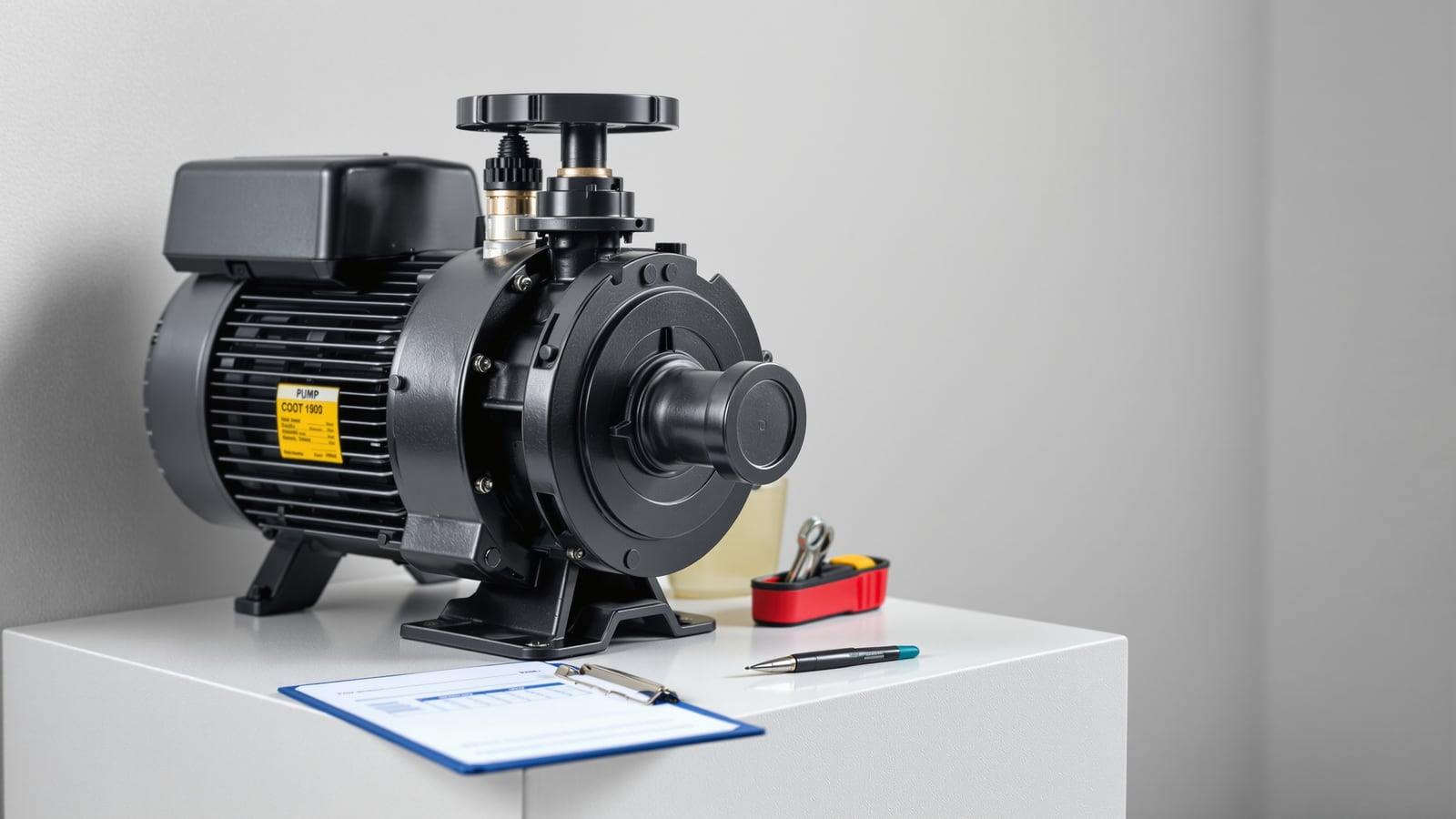
Water Pump Price & Installation Cost in India 2026: ₹ by Type, HP & Fitting
What a water pump actually costs to buy and install in an Indian home in 2026 — indicative ₹ by type and horsepower for monoblock, submersible, jet and booster pumps, plus installation labour, piping, foot valve, starter and the extra borewell items (cable, delivery pipe) that quietly double a deep-set job.
A water pump is one of those purchases where the sticker price is only half the story. The pump on the shelf might read ₹6,500, but by the time the foot valve, delivery pipe, a starter and the fitter's labour are added, the working figure on your wall can be two to three times that — and for a deep borewell, the cable and pipe alone can outweigh the pump. This guide breaks the real 2026 numbers down so you can budget honestly.
This is a cost guide under the Studio Matrx plumbing cost pillar. It costs the pump and its installation only — to choose the right pump for your home, read the water pumps buying guide first, and for deep-set jobs the borewell pumps guide. If your problem is weak pressure rather than lifting water, price that separately with the booster pumps guide, and size any pump with the pump size calculator before you buy.
Every ₹ figure below is indicative for India in 2026. Get 2-3 local quotes — pump and installation rates swing hard by brand, phase, city and how deep your water sits.
What you are actually paying for
A pump job is never just the pump. Budget for four buckets:
- The pump — the motor-and-impeller unit itself, priced mostly by type and horsepower (HP).
- Fittings and pipe — foot valve, non-return valve (NRV), gate valve, delivery pipe, elbows, unions, Teflon and clamps.
- Controls and wiring — a starter or control panel, capacitor (single-phase), and the cable from panel to pump.
- Labour and civils — the fitter's charge, plus a small concrete plinth and any lifting rig for a borewell.
For a shallow monoblock sitting next to a sump, the pump is the biggest line. For a deep submersible, the cable and delivery pipe often cost more than the pump, because both are billed per metre of depth.
Pump price by type and HP
The single biggest driver of pump price is the pairing of type and HP. Below are indicative 2026 retail ranges for the pump unit alone (Standard-brand tier), before any fittings or labour.
| Pump type | Typical HP | Indicative pump price ₹ | Best for |
|---|---|---|---|
| Monoblock / centrifugal (self-priming) | 0.5 HP | ₹3,500 - ₹6,500 | Sump to overhead tank, low lift |
| Monoblock / centrifugal | 1.0 HP | ₹5,500 - ₹9,500 | Standard 1-2 floor home |
| Monoblock / centrifugal | 1.5-2.0 HP | ₹9,000 - ₹18,000 | Taller lift, larger home |
| Jet / shallow-well pump | 0.5-1.0 HP | ₹6,000 - ₹14,000 | Open wells, mild suction lift |
| Booster / pressure pump | 0.5-1.0 HP | ₹7,000 - ₹22,000 | Pressure at showers & taps |
| Borewell submersible (4") | 1.0 HP | ₹9,000 - ₹16,000 | Borewell up to ~150 ft |
| Borewell submersible (4") | 1.5-2.0 HP | ₹14,000 - ₹28,000 | Borewell ~150-300 ft |
| Borewell submersible (4") | 3.0-5.0 HP | ₹26,000 - ₹55,000 | Deep or high-yield borewell |
A few patterns worth knowing before you shop:
- HP scales price steeply. Doubling HP rarely doubles price, but it lifts every downstream cost too — heavier cable, bigger starter, thicker pipe.
- Submersibles cost more than monoblocks at the same HP because the motor is sealed and water-cooled for continuous underwater duty.
- Booster pumps carry a control premium — a constant-pressure VFD booster can cost 3-4x a plain pressure-switch model of the same HP.
- Brand tiers matter. Budget/local brands sit below these ranges; premium and imported units (with better efficiency and warranty) sit above.
Installation: fittings, controls and labour
For a surface pump (monoblock, jet or booster), the installation add-ons are fairly bounded. Indicative 2026 ₹:
| Installation item | Unit | Indicative rate ₹ | Notes |
|---|---|---|---|
| Foot valve (suction) | 1 no. | ₹250 - ₹900 | Brass lasts longer than plastic |
| Non-return valve + gate valve | set | ₹400 - ₹1,500 | On delivery line |
| Delivery / suction pipe + fittings | job | ₹800 - ₹3,000 | GI or PVC, short run |
| Starter / control panel | 1 no. | ₹800 - ₹4,000 | Single-phase DOL to 3-phase panel |
| Wiring + capacitor + earthing | job | ₹500 - ₹2,500 | Depends on run length |
| Concrete plinth / mounting | 1 no. | ₹500 - ₹2,000 | Isolates vibration & keeps motor dry |
| Fitter labour (surface pump) | visit | ₹800 - ₹3,000 | Higher in metros |
Add these up and a 1 HP monoblock installed typically lands around ₹9,000 - ₹18,000 all-in for a straightforward sump-to-tank job. A booster with a pressure tank and tidy panel runs higher.
The borewell surcharge
A submersible sitting 200-300 feet down carries two costs that surface pumps simply do not have, and both scale with depth:
- Submersible cable — a 3-core flat cable rated for the motor, billed per metre, indicatively ₹60 - ₹200/m depending on core size. At 250 ft (~76 m) that alone is ₹5,000 - ₹15,000.
- Delivery pipe / column — rigid PVC or HDPE riser plus clamps, indicatively ₹120 - ₹350/m. Another ₹9,000 - ₹27,000 at that depth.
- Rig / lowering charge — lowering and later pulling the pump needs a tripod or small rig: ₹2,000 - ₹8,000 per operation, more for very deep sets.
- Control panel with dry-run protection — a good 3-phase panel with a submersible-specific starter: ₹2,500 - ₹9,000.
This is why a 1.5 HP borewell pump listed at ₹18,000 can become a ₹45,000-₹60,000 job by the time it is 250 feet down and running. Depth is the quiet cost multiplier — see the borewell pumps guide for how to match pump to yield before you commit.
What drives the price
- Horsepower — the base driver; more HP means a costlier motor and heavier everything downstream.
- Brand tier — budget vs standard vs premium can swing the pump price by 40-100% for the same HP.
- Phase — single-phase suits most homes; a 3-phase pump needs a 3-phase panel and connection, adding cost but running more efficiently at higher HP.
- Depth / head — the master multiplier for borewells, driving cable and pipe metres.
- Controls — a plain switch is cheap; dry-run protection, auto cut-off and VFD constant-pressure add real money (and save the motor).
Running cost — the number people forget
The purchase is one-off; the electricity is forever. A 1 HP pump draws roughly 0.75 kW, so running it one hour a day for a month is about 22-23 units — at ₹7-8/unit that is only ₹150-180/month. But a 5 HP borewell running several hours daily can cost thousands a month. A slightly pricier, higher-efficiency pump often repays its premium in a year or two of lower bills, especially for pumps that run long hours.
Quality tiers and ways to save without cutting corners
| Tier | What you get | Indicative pump-only ₹ (1 HP) |
|---|---|---|
| Budget | Local/unbranded, thin warranty | ₹3,500 - ₹5,500 |
| Standard | Known Indian brand, 1-2 yr warranty | ₹5,500 - ₹9,500 |
| Premium | High-efficiency / imported, longer warranty | ₹9,500 - ₹20,000+ |
Sensible ways to trim the bill:
- Right-size the HP. An oversized pump costs more to buy and to run, and cavitates. Size it with the pump size calculator, don't guess.
- Never cheap out on the foot valve, cable or NRV. These are the parts that fail and flood — a ₹300 saving here invites a ₹5,000 callout.
- Buy pump and fittings together and negotiate installation as a package; separate line items inflate.
- Match phase to load. Don't pay for 3-phase you don't need, but do use it for genuinely high-HP borewells.
Hidden and recurring costs
- Pulling and re-lowering a submersible for service repeats the rig charge every time.
- Cable joints and pipe replacement on old borewells during a pump swap.
- Voltage stabiliser where supply is erratic, to protect the motor.
- Annual servicing — see pump maintenance & troubleshooting for what upkeep actually costs.
Budget honestly by adding all four buckets — pump, fittings, controls, labour — then, for a borewell, layering the per-metre cable and pipe on top. Do that, collect two or three local quotes against these indicative ranges, and the number on your wall will match the number in your plan.
Export this guide
Related Guides — Deep-dive reading
Water Pumps Guide for India: Types, How to Choose & Size (Head, Flow, Phase)
The master overview of domestic and building water pumps — what a pump actually does (lift plus pressure), the two numbers that decide everything (HEAD in metres and FLOW in LPM), a pump-type-to-use table, single vs three phase, priming, foot valve and NRV needs, dry-run protection, and BEE star rating with running cost at a glance for an Indian home.
PlumbingBorewell Pumps in India: How to Size HP by Depth, V3/V4/V6 Types, Stages and Running Cost
The deep-well submersible pump is the heart of a private borewell — a slim multi-stage unit that sits underwater and pushes your supply up to the tank. This guide explains how to pick horsepower by borewell depth, water level and yield, which body diameter (V3/V4/V6) fits your bore, why more stages mean more head, and how oversizing wastes electricity and can dewater the bore.
PlumbingBorewell Cost in India 2026: Drilling, Casing, Pump and Plumbing — The Full ₹ Breakdown by Depth
What it really costs to sink a private borewell and connect it to your tank — drilling per foot, casing pipe, the submersible pump and control panel, cable and delivery pipe by depth, sump connection and permissions. Depth is the biggest and least predictable variable, so every figure here is indicative: get 2-3 local quotes before you dig.
PlumbingRelated Tools — Try Free
Rainwater Tank Sizer
How big should your rainwater tank be? Computes annual harvest, recommended tank capacity in litres, water-bill savings, and payback — for 10 Indian cities.
RWH CalculatorCurtain Maintenance Cost Calculator
Estimate the annual upkeep cost of your curtains — washing, dry-cleaning and motor servicing.
Cost CalculatorShower Pump Calculator
Check whether your shower needs a pressure-boost pump and what size — available vs required pressure from your tank height or supply.
Bathroom Calculator