
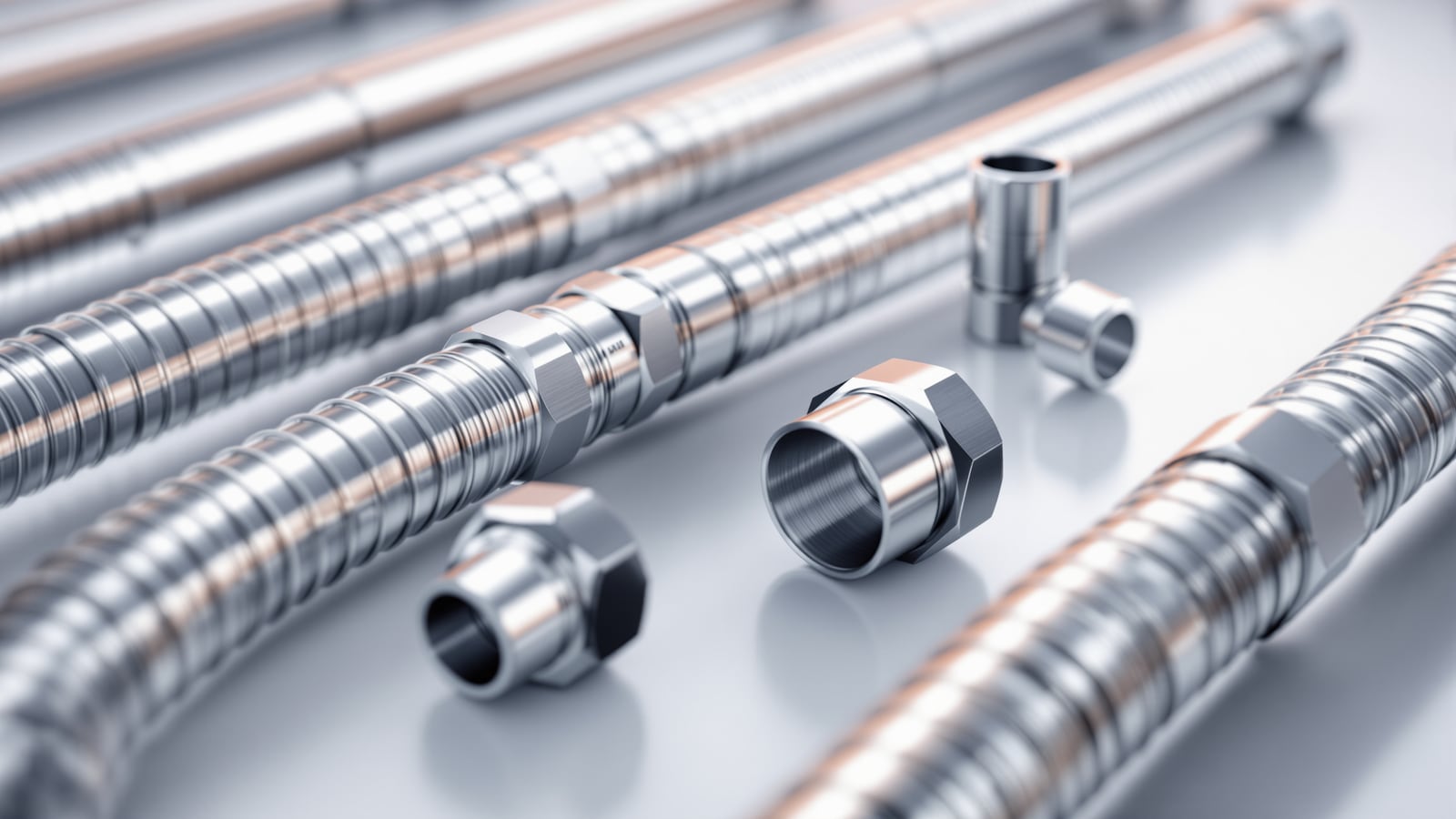
Stainless Steel Pipes in India: Hygienic, Corrosion-Free Water Supply Piping
The specifier's guide to SS304 and SS316 water pipe — press-fit versus welded versus threaded joints, potable-grade hygiene, exposed premium runs, high-rise risers, and where the cost is worth it against copper and GI.
Stainless steel is the pipe you specify when failure is not an option and the pipe will be seen. It does not rust like GI, it does not need the delicate flame-brazing of copper, and its inner wall stays smooth and biologically inert for decades. Stainless steel pipes occupy the premium tier of Indian water-supply piping — chosen for hotel and hospital potable systems, high-rise risers, and exposed architectural runs where a plastic pipe would look cheap and a galvanised one would streak the wall with rust.
This is a material profile within the Studio Matrx Plumbing Pipes hub. It sits alongside the copper pipe guide and the GI pipe guide — the two metals stainless most often displaces. This guide stays on the pipe itself: grades, jointing, where it earns its cost, and where it does not.
Stainless steel does not "resist" corrosion the way a coating does — it is the metal itself that is inert, so there is nothing to wear off, scratch through, or wash away. That is why a 40-year design life is a defensible number, not marketing.
What stainless steel pipe actually is
Stainless steel is an iron alloy carrying at least 10.5% chromium. The chromium reacts with oxygen to form an invisible, self-healing chromium-oxide passive layer a few atoms thick. Scratch it, cut it, thread it — the layer re-forms instantly wherever bare metal meets air or water. This is fundamentally different from GI, where a sacrificial zinc coating is consumed over time and, once gone, leaves bare steel to rust from the inside out.
For water plumbing you will almost always specify an austenitic grade — the 300 series — which adds nickel for ductility and better corrosion resistance:
- SS304 (UNS S30400): the workhorse. 18% chromium, 8% nickel. Excellent for potable cold and hot water in normal municipal and borewell supply.
- SS304L: the low-carbon variant, preferred where the pipe is welded, because low carbon avoids "sensitisation" (chromium-carbide precipitation at grain boundaries) that can cause corrosion along a weld seam.
- SS316 (UNS S31600): adds ~2% molybdenum, which sharply improves resistance to chlorides. Specify it for coastal sites, high-TDS or high-chloride borewell water, swimming-pool plant, RO reject lines, and hospital/pharma loops.
- SS316L: the low-carbon 316, the default for welded sanitary and pharma-grade systems.
The single most common — and expensive — specification mistake is using SS304 where chloride is high. Coastal air, softened water, and borewell water above roughly 200 mg/l chloride can pit 304. When in doubt near the sea, step up to 316.
Grades, sizes and pressure at a glance
Stainless plumbing tube is thin-walled compared with steel pressure pipe — its strength lets it carry high pressure at a fraction of the wall thickness, which is part of why it can be press-fitted rather than threaded. The figures below are indicative for thin-wall press-fit systems; always confirm against the manufacturer's published rating for the exact series you buy.
| Nominal OD (mm) | Typical wall (mm) | Grade | Working pressure (indicative) | Max continuous temp | Typical use |
|---|---|---|---|---|---|
| 15 | 1.0 | SS304 | up to 16 bar | ~90 C | Fixture branches, small risers |
| 22 | 1.2 | SS304 | up to 16 bar | ~90 C | Bathroom groups, hot water |
| 28 | 1.2 | SS304 | up to 16 bar | ~90 C | Floor mains, apartment inlets |
| 35 | 1.5 | SS316 | up to 16 bar | ~90 C | Wet risers, potable risers |
| 42 | 1.5 | SS316 | up to 16 bar | ~90 C | High-rise risers, plant rooms |
| 54 | 1.5 | SS316 | up to 16 bar | ~90 C | Main risers, header pipes |
Note the flat temperature line: unlike CPVC or PPR, stainless steel is effectively indifferent to hot water within domestic ranges — its pressure rating barely moves between cold and geyser-hot service, so it does not need de-rating for hot runs.
How stainless pipe is joined
The jointing method drives both the cost and the site logistics, and it is where stainless has changed most in the last decade.
- Press-fit (mechanical crimp): the modern default for building services. A stainless fitting carries a factory-fitted EPDM O-ring; the pipe is inserted and a battery-powered tool crimps the socket in a few seconds. No flame, no hot-work permit, no thread-cutting. Fast, clean, and repeatable by trained fitters — but the fittings and the press tool are expensive, and each series has its own dedicated jaw profile.
- TIG / orbital welding: the gold standard for hygiene-critical and high-pressure work. A full-penetration, back-purged weld gives a joint as strong and inert as the parent pipe, with a smooth crevice-free bore. Essential for pharma and premium potable loops, but it needs a certified welder, argon purging, and inspection — slow and costly.
- Threaded / screwed: stainless can be threaded like GI, but it work-hardens and galls badly. Threading cuts through the passive layer and creates a crevice; it is used mainly for connecting to valves and equipment, ideally with the right anti-seize compound, not for long runs.
- Compression / push-fit couplings: available for repairs and transitions, useful where a press tool is unavailable, but rarely the primary method on a serious job.
For a new building, press-fit is almost always the right answer for speed and consistency; reserve welding for the hygiene-critical spine and threading for equipment tie-ins.
Where stainless steel earns its cost
Stainless is not a general-purpose domestic pipe — at its price you specify it deliberately, where a cheaper material would fail on hygiene, longevity, or appearance.
- Hotel and hospital potable risers: long design life, biofilm resistance, and confidence that the pipe will not shed rust or metal into drinking water. Hospitals value the smooth bore that resists Legionella-friendly biofilm and tolerates chlorine/chloramine dosing and periodic thermal disinfection.
- High-rise main risers: stainless takes the standing pressure of a tall column and the water-hammer of pumped systems without the corrosion GI suffers at threaded joints, and without the support-spacing fuss of plastics.
- Exposed premium and architectural plumbing: in a hotel lobby, a designer bathroom, or a visible plant room, polished stainless reads as quality. It stays bright where GI streaks and CPVC yellows.
- Aggressive water: high-TDS borewell, softened, or coastal supply that pits GI and stresses copper — here SS316 is the durable answer.
- Rooftop and UV-exposed runs: unlike plastics, stainless is completely unaffected by sunlight, so exposed terrace mains do not embrittle.
Stainless versus copper versus GI
Each metal has a niche. Copper is the traditional premium potable pipe; GI is the legacy galvanised-steel option now largely superseded for supply. Stainless splits the difference — copper's inertness with steel-like strength — at the highest price.
| Factor | Stainless steel | Copper | GI (galvanised iron) |
|---|---|---|---|
| Corrosion resistance | Excellent (passive layer, self-healing) | Very good; can pit in aggressive water | Poor long-term; zinc depletes, rusts |
| Potable hygiene | Inert, biofilm-resistant, no leaching | Inert; trace copper leaching possible | Rust bleed, tuberculation, taste |
| Jointing | Press-fit / TIG weld / thread | Brazing / soldering / press | Threaded (galls, leaks at threads) |
| Hot water | Unaffected in domestic range | Excellent | Acceptable but corrodes faster |
| Typical life | 40+ years | 30-50 years | 15-25 years (often less) |
| Cost | Highest | High | Lowest of the three |
| Best fit | Hospitals, hotels, high-rise risers, coastal | Premium homes, hot water, gas | Legacy, low-cost non-critical lines |
For the CPVC-versus-UPVC plastic decision that sits below all three metals on cost, see the Bathrooms hub's CPVC vs UPVC comparison. Stainless competes at the top of the market, not against plastics on price.
Indicative cost in India
Stainless is the most expensive water pipe you can specify, and the fittings and tooling drive the number as much as the pipe. Treat all figures as indicative and get a live quote for the exact grade and series.
- SS304 press-fit tube: roughly ₹350 to ₹700 per metre for 15-28 mm sizes.
- SS316 tube: typically 30-50% above the equivalent 304, so a 42 mm run can cross ₹1,500 per metre.
- Press fittings: each elbow, tee or coupling is a significant cost — a single fitting can run ₹250 to ₹1,200 depending on size and grade.
- Press tool: a professional battery crimping tool with jaw set is a capital item, often ₹1,20,000 or more, amortised across projects.
- Installed, a stainless potable riser can land at several times the cost of the same run in CPVC — which is exactly why it is reserved for jobs where longevity and hygiene justify it.
Budget the tool and the fittings, not just the pipe. On a small job the fittings and press tool can dwarf the metal cost; stainless only makes economic sense at the scale where its 40-year life is amortised across the building.
Specifying stainless well: a short checklist
- Confirm the grade to the water: SS316/316L for coastal, high-chloride, softened, or hospital service; SS304/304L is fine for normal municipal potable.
- Standardise on one press-fit system across the job so a single tool and jaw set serves the whole site.
- Use low-carbon (L) grades where welding is planned, and insist on back-purged welds for hygienic loops.
- Avoid galvanic contact — do not thread stainless directly onto plain steel or leave it clamped by mild-steel supports without isolation, or you invite bimetallic corrosion at the junction.
- Keep threaded joints to equipment tie-ins only; long runs should be pressed or welded.
References
- ASTM A312 — Seamless and welded austenitic stainless steel pipe.
- ASTM A270 — Seamless and welded austenitic sanitary tubing.
- ASTM A554 — Welded stainless steel mechanical tubing.
- ASTM A240 — Stainless steel plate, sheet and strip (grade designations 304, 304L, 316, 316L).
- EN 10312 — Welded stainless steel tubes for the conveyance of water.
Grades and figures here are indicative for building water-supply service; confirm the grade against your local water chemistry and the current manufacturer and IS/ASTM specification before ordering.
Export this guide
Related Guides — Deep-dive reading
Copper vs CPVC Pipes: Which to Use in India (2026)
A fair, India-first head-to-head: copper is the premium, decades-lasting, heat-proof metal that needs a skilled brazier and costs a fortune; CPVC is the cheaper, corrosion-proof, DIY-friendly plastic that has become the default modern Indian supply pipe. Cost, lifespan, heat, install skill, water quality, theft — and a clear verdict by use-case.
PlumbingGI Pipes in India: The Legacy Steel Water Pipe, Why It Rusts, and When It Still Makes Sense
Galvanised iron was the standard water pipe in Indian homes for decades. Here is what GI is, how its threaded joints work, why it corrodes and chokes flow, where it still earns its place, and how to read its sizes and IS 1239 classes.
PlumbingEpoxy Grout vs Cement Grout for Tiles in India: Which to Specify (2026)
A plain-English guide to tile grouts for Indian homes: what grout does, how cementitious grout compares with epoxy grout on cost, stain and water resistance, hygiene and durability, and exactly where each one belongs - kitchens, bathrooms, pools, dry rooms and more.
Building MaterialsRelated Tools — Try Free
Plumbing Pressure-Test & Leak Checklist
Pre-closure pressure and leak test — 9 categories, 60+ checkpoints across water supply, drainage, fixtures, waterproofing, hot water, tanks.
Pre-Closure TestRainwater Tank Sizer
How big should your rainwater tank be? Computes annual harvest, recommended tank capacity in litres, water-bill savings, and payback — for 10 Indian cities.
RWH CalculatorBefore vs After — Cost Reality Check
Compare what you expected to pay vs what you actually paid, category by category.
Reality Check