
Steel Door Maintenance India 2026: Rust-Free Care Guide
Keep MS security doors, flush leaves and metal gates rust-free with simple cleaning, touch-ups, lubrication and coastal-corrosion care.
A steel door is the toughest leaf in most Indian homes — the MS security door at your flat entrance, a galvanised flush door, or the powder-coated gate at the boundary. But steel only stays tough if you keep water and air away from bare metal. Get steel door maintenance right and the same leaf will serve 20-30 years; neglect it and you will watch rust creep from a tiny chip into a flaking, weeping patch in a single monsoon. The good news: almost all of this is easy, cheap DIY. This guide covers rust prevention and treatment, touch-ups, lubrication, seal checks, and the extra care coastal homes need.
Why steel doors fail in India
Steel does not rot or warp like wood, and termites ignore it — which is exactly why MS (mild steel) security doors are so popular. The enemy is corrosion. Rust needs three things: bare iron, oxygen and moisture. The factory coating (paint over primer, or zinc galvanising, or a powder-coat) blocks all three. Every scratch, chip, drilled hole or worn edge is a doorway for rust.
India stacks the odds against the coating: monsoon humidity, salt-laden coastal air, hard-water splashes, and the heat that makes paint chalk and crack. Once rust starts under a coating it spreads sideways, lifting the paint as it goes. The whole game is find the breach early, treat it before it spreads.
Difficulty for routine care: easy. Time: 30-60 minutes a quarter. When to call a pro: deep structural rust that has eaten through the sheet, a sagging frame, or any electrical/auto-operator on a powered security door — isolate the power and call the installer.
Galvanised vs powder-coated vs painted — know your finish
How you maintain a steel door depends on its finish. Check what you have before you start.
| Finish | How to recognise | Upkeep approach | Touch-up product |
|---|---|---|---|
| Painted MS (enamel) | Glossy or matt colour, chips show grey/brown metal | Clean, spot-treat rust, repaint as needed | Rust-converter + metal primer + enamel |
| Galvanised (GI) | Dull silver-grey, sometimes spangled pattern | Rarely rusts; protect cut edges and scratches | Cold-galvanising (zinc-rich) spray |
| Powder-coated | Even thick matte/satin colour, very hard | Wipe clean; chips need careful spot repair | Zinc primer + matching air-dry enamel |
| Pre-painted steel flush | Smooth factory colour leaf | Gentle clean, avoid abrasives | Touch-up marker / matching enamel |
Galvanised steel is the most forgiving — the zinc layer sacrifices itself to protect the iron, so a small scratch often "self-heals" chemically. Powder-coat is the hardest and best-looking but is hard to repair invisibly; the priority is sealing chips fast so rust does not undermine the coat.
Steel door maintenance: the routine checklist (with cadence)
Steel is low-effort if you stay ahead of rust. Here is the schedule that keeps a leaf and its hardware healthy.
| Task | Cadence | Why |
|---|---|---|
| Wipe down leaf and frame with damp cloth | Monthly | Removes salt, dust and grime that hold moisture |
| Inspect for chips, scratches and rust spots | Quarterly | Catch breaches before they spread |
| Touch up any bare metal or rust spot | As found | Stop corrosion at source |
| Lubricate hinges, lock and tower bolts | Quarterly | Prevents seizing and squeak |
| Check and clean weatherseals / draught strips | Quarterly | Keeps water and dust out |
| Tighten loose hinge and handle screws | Half-yearly | Stops sag and rattle |
| Full clean + protective wax/wipe | Half-yearly | Renews surface barrier |
| Repaint leaf (painted MS) | Every 3-5 years | Refresh the rust barrier |
| Inspect frame base / floor joint for standing water | Monsoon (June and Sept) | Bottom edge is where rust starts |
Coastal homes (within ~5 km of the sea): move the wipe-down to weekly, the inspection to monthly, and rinse off salt film with plain water before wiping dry. Salt is the single biggest rust accelerator in India.
Tools and materials you'll need
- Soft cloths and a sponge; mild soap; bucket of water
- Fine sandpaper (220-320 grit) and a wire brush or abrasive pad for rust
- Rust converter / rust-converting primer (₹150-400)
- Metal primer (red-oxide or zinc) and matching enamel or air-dry paint (₹150-500)
- Cold-galvanising spray for GI doors (₹300-600)
- Touch-up brush or marker; masking tape; newspaper
- Silicone spray or light machine oil for hinges; graphite/PTFE for locks
- Gloves, mask and eye protection (rust dust and paint fumes)
Keeping the leaf rust-free yourself costs a few hundred rupees of consumables a year. A carpenter or painter visit to repaint a door runs ₹500-1,500 including material, and a painter half-day is ₹400-800 — worth it for a full re-coat, but overkill for the spot work below.
How to treat a rust spot — step by step
This is the core repair: a chip or rust patch on a painted or powder-coated steel door. Difficulty easy; time 30-45 minutes plus drying.
1. Isolate any power. If it is an automatic or sensor-operated security door, switch off the supply before touching it.
2. Clean the area. Wash off dirt and grease with mild soap, rinse, and dry fully. Moisture trapped under new paint causes fresh rust.
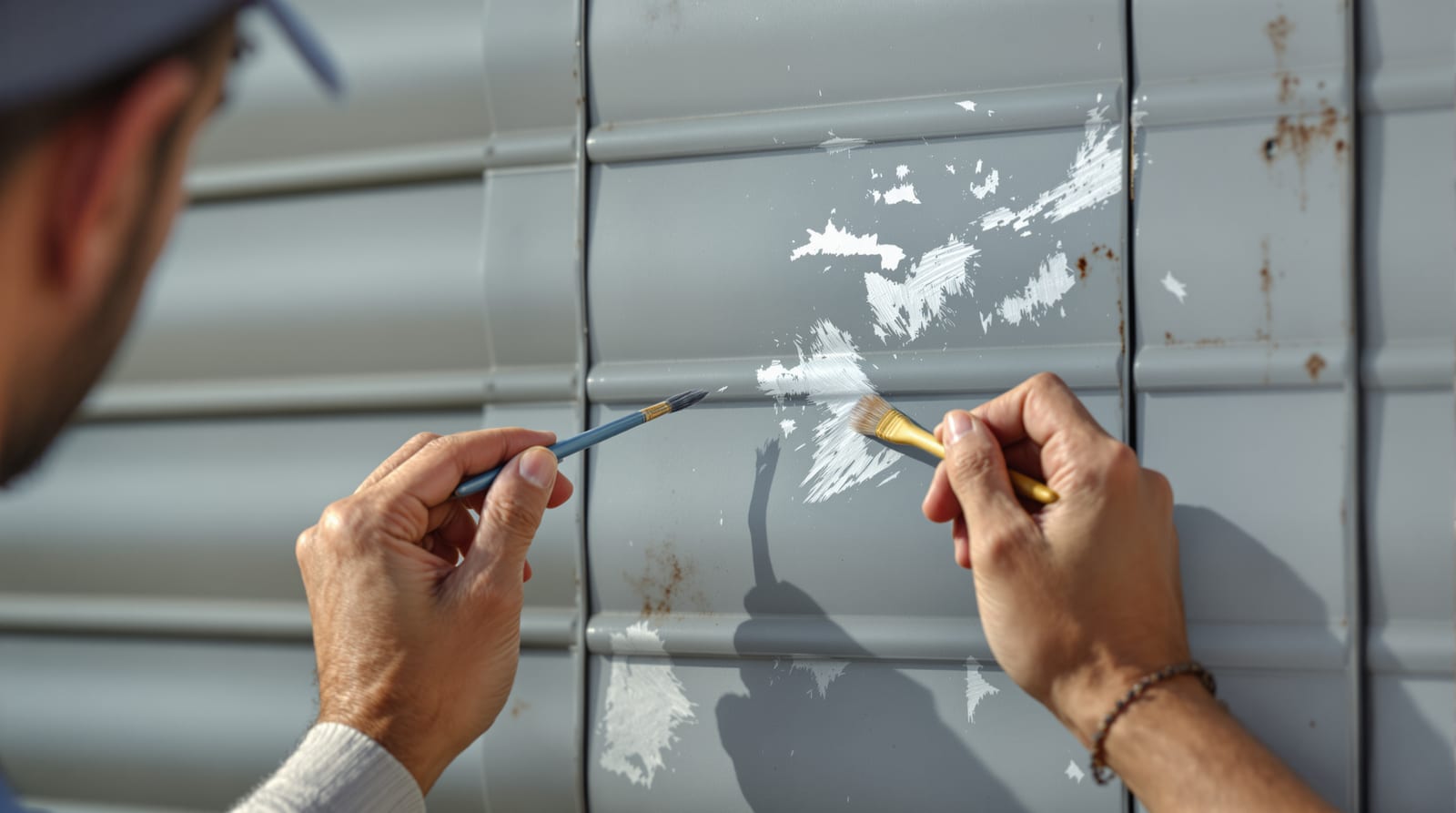
3. Remove the rust. Use the wire brush or 220-grit paper to take the spot back to clean, sound metal. Feather the edges of surrounding paint so the repair blends. Wipe away all dust.
4. Apply rust converter (recommended for any pitted or stained metal). Brush it on; it chemically turns remaining rust into a stable, paintable surface. Let it cure as per the tin (usually a few hours).
5. Prime the bare metal. One or two thin coats of red-oxide or zinc primer. For galvanised doors, use cold-galvanising spray instead — it restores the zinc layer. Let each coat dry.
6. Repaint to match. Two thin coats of enamel or air-dry metal paint, light sanding between coats. Mask edges for a crisp line. For powder-coat, choose the closest air-dry enamel — it will never be invisible, but it seals perfectly.
7. Cure and inspect. Leave to harden a day before heavy use. Check again in a week to confirm no rust is bleeding back.
The colours in the diagram below show why each layer matters — every step rebuilds the barrier between iron and the Indian air.
Touch up chips before they rust
The cheapest maintenance is the touch-up you do the same day you spot a chip. A nick from a moved sofa, a drilled hole for a new latch, a scratch from a key — any of these exposes metal. Carry a touch-up marker or a small tin of matching enamel and dab fresh chips immediately. On galvanised doors, a quick spray of cold-galvanising restores protection in seconds. Thirty seconds of touch-up now saves a 45-minute rust repair next monsoon.
Pay special attention to the bottom 100 mm of the leaf and the frame base — this is where mopping water, monsoon splash and standing puddles attack first, and where you cannot see rust until it has eaten through. Wipe this zone dry after the floor is washed.
Lubricate hinges, locks and bolts
Steel doors are heavy, so their hardware works hard. Quarterly lubrication keeps everything smooth and stops the squeak.
| Hardware | Lubricant | Note |
|---|---|---|
| Hinges | Silicone spray or light machine oil | Wipe drips; oil attracts dust on dusty sites |
| Mortise / cylinder lock | Graphite or PTFE (dry) | Avoid thick oil — it gums the pins |
| Tower bolts / aldrop | Silicone spray | Frees stiff, salt-stuck bolts |
| Hinge / handle screws | (tighten, don't oil) | Snug screws prevent sag and rattle |
If a hinge is already rusted and squeaking, deal with the corrosion first — see rusted door hinges fix and lubricate door hinges for the full method. Loose hardware that lets the leaf droop needs tightening or re-fixing per fix loose door hinges.
Check the weatherseals
Steel security doors usually carry a draught/dust seal around the frame and sometimes a bottom strip. These keep monsoon driving-rain and street dust out — and they protect the metal edges. Inspect them quarterly: press to check they still spring back, look for splits, and clean off grime that stops them sealing. Replace flattened or torn seals (₹100-500). A failed bottom seal lets water sit against the leaf base, the worst place for rust. The full method is in door seals and weatherstripping.
Coastal and humid-climate care
If you live near the sea — Mumbai, Chennai, Kochi, Goa, Visakhapatnam — salt makes steel rust many times faster. Build these habits:
- Rinse, don't just wipe. Salt film is invisible; flush the door with plain water weekly, then dry it.
- Inspect monthly, not quarterly, and touch up the smallest chip at once.
- Choose better coatings at repaint time: a zinc-rich primer plus a marine-grade or PU topcoat lasts far longer than ordinary enamel.
- Watch fixings — screws and washers rust too; replace any weeping ones with stainless.
When a security door has corroded right through the sheet, or the frame is rusted and loose, maintenance is no longer the answer. Compare your options with the door replacement guide and the door cost guide, and learn what good steel doors should offer in steel doors.
When to stop and call a professional
- Rust has perforated the sheet or the leaf is structurally weakened — replace, don't patch.
- The frame is rusted loose in the wall — needs refitting or replacement.
- Powered or sensor security doors — isolate the supply and call the installer for any operator, motor or electrical fault.
- Glass-panel steel doors — handle broken or cracked glass with care and call a pro for toughened-glass faults.
For everything else, use the door maintenance guide for the whole-home routine and the complete door guide as your reference. Not sure if a fault is fixable? The door troubleshooting guide helps you diagnose, and you can plan your year with the home door maintenance planner or weigh a fix against a new leaf using the repair vs replace door calculator.
Frequently asked questions
How often should I repaint a steel door in India?
A painted MS door usually needs a fresh coat every 3-5 years inland, and more often near the coast where salt attacks the finish. Don't wait for visible rust — repaint when the colour chalks, fades or starts hairline-cracking, because that is when the barrier is thinning. A full repaint costs ₹500-1,500 including material if you hire a painter, or far less as DIY.
Can I just paint over rust on my steel door?
No. Paint over active rust traps moisture and the corrosion keeps spreading underneath, lifting your new coat within months. Always remove the rust back to sound metal, apply a rust converter on any pitting, prime, and only then topcoat. The extra 20 minutes is what makes the repair last.
Do galvanised steel doors need any maintenance?
Less, but not none. The zinc layer self-protects against small scratches, so galvanised (GI) doors rarely rust. Your job is to keep them clean, and to seal any deep cut, drilled hole or worn edge with cold-galvanising spray so bare iron is never left exposed — especially at the bottom edge and near the coast.
What is the best rust treatment for an MS security door?
For stains and light pitting, a rust converter (which turns rust into a stable, paintable film) followed by zinc or red-oxide primer and enamel works well and is cheap. For coastal homes, upgrade the primer to zinc-rich and the topcoat to a PU or marine-grade paint for much longer life.
Why does rust always start at the bottom of my steel door?
The bottom 100 mm catches mopping water, monsoon splash and standing puddles, and it is the part you least often look at. Wipe this zone dry after the floor is washed, check it every monsoon, keep the bottom weatherseal intact, and touch up any chip there immediately.
My steel door's hinges squeak and stick — what do I do?
Clean off any rust on the hinge knuckle, then apply silicone spray or a little light machine oil and work the door a few times. If it still binds, the screws may be loose or the hinge corroded; tighten the screws or replace a badly rusted hinge. Do this every quarter to prevent it returning.
Export this guide
Related Guides — Deep-dive reading
Door Maintenance Guide India: A Seasonal Care Routine to Keep Doors Smooth for Decades
Oil the hinges, tighten the screws, lube the lock, check the seals and re-coat the finish — a simple seasonal calendar that stops Indian doors from binding in the monsoon, sagging, tarnishing on the coast or falling to termites.
Home Doors & EntrancesGate Finishes and Rust Prevention in India: Paint, Powder Coat and Galvanising (2026)
A plain, India-grounded guide to keeping a steel gate looking good and not rusting — the protection system in layers (surface prep, primer, topcoat), site enamel and PU paint vs factory powder coating vs hot-dip galvanising compared on durability, cost and best-fit, where gates rust first, coastal and monsoon care, and the maintenance cycle that makes any finish last.
Compound WallsDoor Repair Guide India: Fix Holes, Dents, Swelling, Hinges & Locks (2026)
A fix-it reference for Indian homes: every common door problem with a quick fix, a proper repair, a replace verdict, the materials needed, and indicative rupee costs.
Home Doors & EntrancesRelated Tools — Try Free
Door Paint Calculator
Estimate paint and primer litres and cost to paint your doors by size, number of doors, coats and paint type.
Door CalculatorWindow Hardware Cost Calculator
Estimate window hardware cost — hinges, handles, locks, rollers and multipoint gears.
Window CalculatorMaterial Schedule Generator
Generate a room-wise finish schedule — walls, floors, ceilings, trim, and joinery by location.
Material Schedule