
The Palace of Sennacherib at Nineveh: The Palace Without Rival
Twenty-seven centuries ago, on the Tigris opposite modern Mosul, an Assyrian king built a palace so vast he named it, in his own words, 'the Palace that has no rival' — and lined its walls, room after room, with miles of carved stone panels telling the story of his wars. It is the birthplace of narrative art, the home of the winged guardian, and a wonder destroyed not once but twice. The second article in our chapter on the palaces of worldly power.
In our last article we stood in Europe's first palace, on the sunlit island of Crete, and admired the joyful dolphins and lilies the Minoans painted on their walls — an art, we noted, "very different from the grim war-temples of some of its neighbours." Now we travel east and back in time to meet exactly that grimness, and one of its supreme monuments: the palace of a king who covered his walls not with dolphins but with the carved record of every city he had crushed. This is the Palace Without Rival at Nineveh — the masterpiece of the Assyrian king Sennacherib, and one of the most extraordinary, and most tragic, buildings in this whole series.
This is the sixty-fifth article in our Architectural Wonders series, and the second in our chapter on the great palaces and pleasures of worldly power.
Nineveh sat on the east bank of the River Tigris, directly across from what is now Mosul, in northern Iraq. Around 700 BCE it was, for a time, the largest city in the world — the capital of the Assyrian empire at its terrifying height, the superpower of the ancient Near East. And Sennacherib's palace is a wonder that pulls in two directions at once: it is the birthplace of visual storytelling — the ancestor of every carved narrative, every history painting, arguably every comic strip and newsreel since — and it is also a monument to loss, a building destroyed twice over, whose very site was, until modern times, a nameless mound in the earth.
1. The palace without rival
Let us begin with the king, and the boast built into the name.
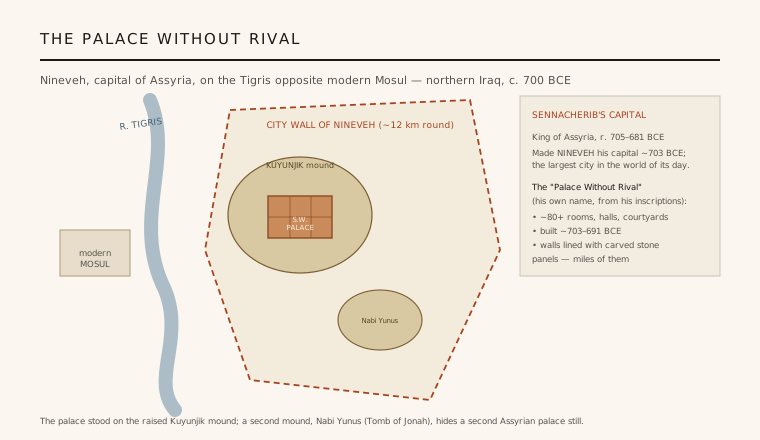
Sennacherib (who reigned from 705 to 681 BCE) was the son of Sargon II and one of the most powerful men alive — ruler of an empire that stretched from the Persian Gulf to the edge of Egypt. His father had built a brand-new capital from scratch; Sennacherib abandoned it and moved the seat of empire to the ancient city of Nineveh, which he then rebuilt on a colossal scale — new walls some twelve kilometres round, great gates, aqueducts, streets and, at its heart, a palace to end all palaces. He raised it on a high artificial mound called Kuyunjik, and he named it, quite literally and quite immodestly, in his own inscriptions: "the Palace Without Rival" — ekallu ša šānina lā īšû, "the palace that has no equal." (Archaeologists call it the South-West Palace.) It was vast — some eighty or more rooms, halls and courtyards spread across the mound. But its size is not what made it a wonder. What made it a wonder is what covered its walls.
2. A story carved in stone
Step inside any important room of the palace, and you would find yourself surrounded, floor to shoulder height, by carved stone.
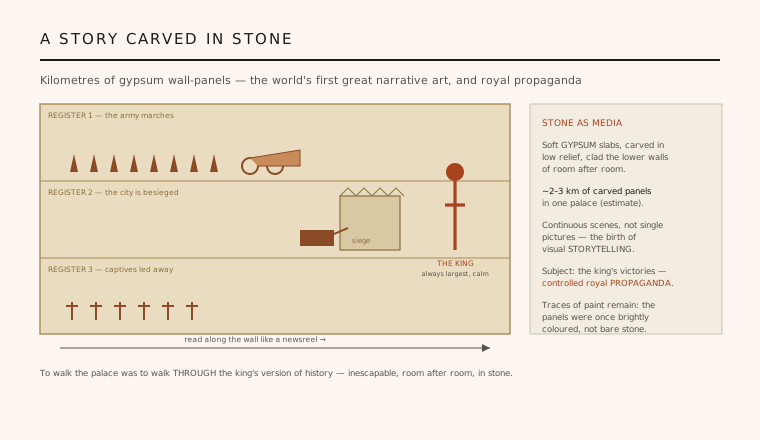
The Assyrians lined the lower walls of their state rooms with great slabs of soft gypsum stone — a stone easy to carve — and covered them in low relief with continuous pictures. Not single framed scenes, but flowing, unbroken narratives that ran right along the wall and turned the corners, arranged in horizontal bands, or registers, that you "read" as you walked, exactly like a comic strip or a newsreel: the army mustering, marching, fording rivers, storming a city, and then the long, sorrowful files of captives and plunder led away. One palace could hold an estimated two to three kilometres of this carved stone. And at the centre of it all, always, stood the king — depicted larger than everyone else, serene, receiving the submission of the world.
This is one of the first great works of narrative art anywhere on Earth — the moment when architecture learned to tell a continuous story across its own surface. But we should be clear-eyed about what it was for. It was propaganda — meticulous, state-controlled propaganda, designed to overwhelm every ambassador, hostage and provincial governor who walked through and to leave him in no doubt of what happened to those who defied Assyria. (And these walls were not the bare, honey-coloured stone we see in museums today: traces of pigment show they were once brightly painted, in reds, blues and blacks — a blaze of colour.) It is propaganda of genius, but propaganda still, and nowhere is that clearer than in its single most famous room.
3. The siege seen from three sides
In one suite of rooms, Sennacherib had his artists carve the assault on a single city — Lachish — and by an extraordinary accident of survival, it has become one of the best-documented events in all of ancient history.
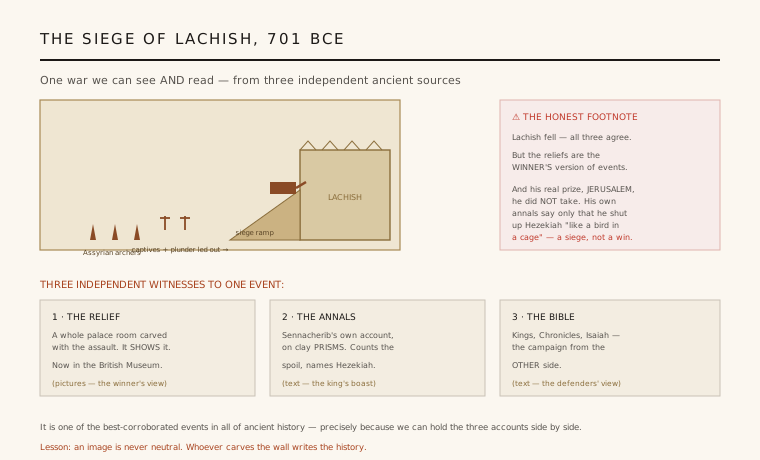
In 701 BCE Sennacherib marched into the kingdom of Judah and besieged the fortified city of Lachish. The reliefs show the whole terrible mechanism of an Assyrian siege in gripping detail: the great earthen siege ramp heaped against the walls, wheeled battering rams grinding forward under covering fire, archers and slingers, defenders hurling down torches, and then the aftermath — the city's people driven out in long lines, carrying their bundles into exile, some impaled, the survivors deported. It is vivid, and it is horrifying.
What makes Lachish unique, though, is that we can check it. The very same campaign is recorded by three independent ancient sources that survive to be compared: the palace relief, which shows it; Sennacherib's own annals, carved onto hexagonal clay prisms (like the famous "Taylor Prism"), which count the captured towns and the tribute; and the Hebrew Bible — the Books of Kings, Chronicles and Isaiah — which records the same invasion from the other side, the side of the besieged. Three witnesses, three media, two enemies, one war. They agree on the essential fact: Lachish fell.
But here honesty demands a caution that echoes everything in this palace. The relief is, always, the winner's version. And it is most revealing in what it does not show. Sennacherib's real target was Jerusalem, and Jerusalem he did not take. His own annals — for all their boasting — can only claim that he shut up King Hezekiah in his capital "like a bird in a cage": a siege, not a conquest. The Assyrians withdrew; Jerusalem survived (the Bible credits a sudden catastrophe in the Assyrian camp). So the king who filled a room with his triumph at Lachish carefully carved no room for his failure at Jerusalem. That silence is the most eloquent thing in the whole palace — and the sharpest lesson it teaches: an image is never neutral, and whoever carves the wall writes the history.
4. The winged guardians
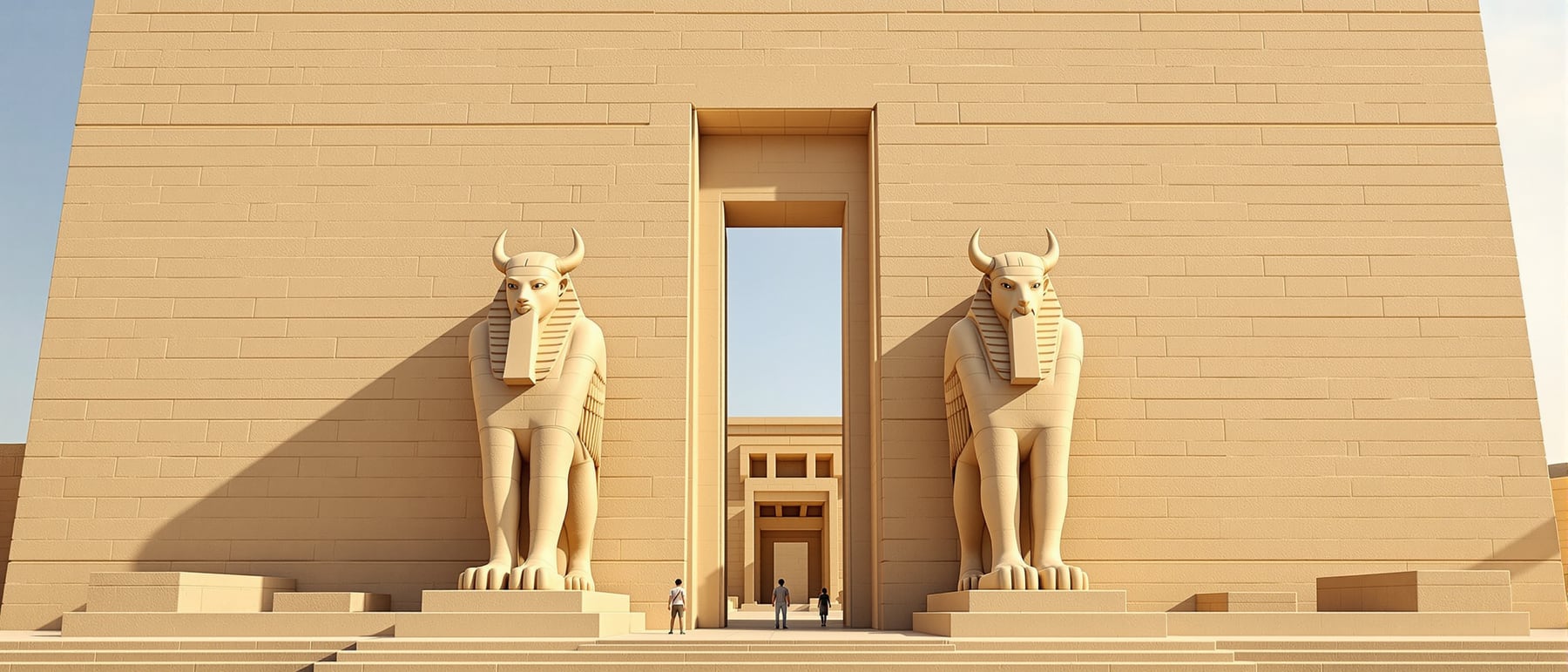
Guarding the great gateways of this palace stood some of the most unforgettable figures in all of ancient art — the lamassu.
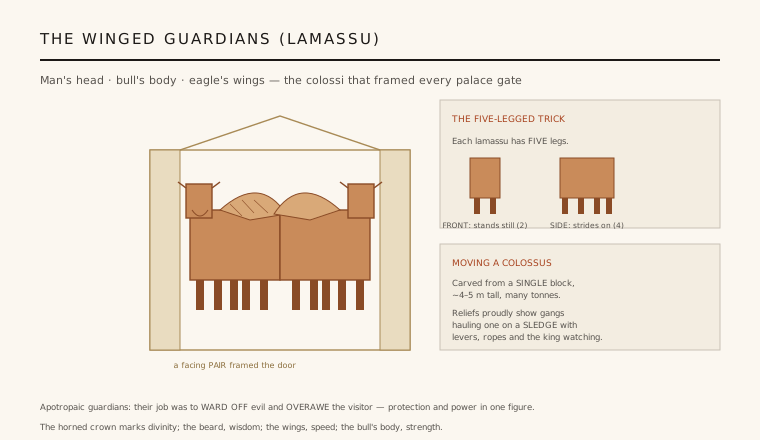
A lamassu is a composite creature carved from a single colossal block: the powerful body of a bull (or sometimes a lion), the sweeping wings of an eagle, and the calm, bearded head of a man crowned with a horned cap that marks him as divine. They stood in facing pairs, framing the palace doorways — protective spirits, apotropaic guardians, whose double job was to ward off evil and to overawe every human visitor with the sheer scale and strangeness of Assyrian power. Each element is a message: the crown, divinity; the beard, wisdom; the wings, swiftness; the bull's body, brute strength.
And they carry one of the most delightful problems-and-solutions in the history of sculpture. The Assyrians wanted a lamassu to look complete from the front (standing still, planted, symmetrical) and complete from the side (striding forward, alive). Their solution was to carve it with five legs. Look at it head-on, and you see two front legs, firmly at rest. Walk alongside it, and you see four legs in mid-stride — the front corner leg does double duty, read as a resting leg from one angle and a striding leg from the other. It is a small, brilliant piece of design thinking, solving a real problem of how a corner figure is actually seen. Moving these many-tonne monsters from quarry to gate was a feat in itself — and, characteristically, the Assyrians carved a relief of themselves doing it, showing gangs of workers hauling a lamassu on a great sledge with ropes and levers while the king looks on. Even the logistics became propaganda. (The guardian bull was so potent an idea that the Persians who inherited Assyria's empire took it straight to their own gates at Persepolis — as we will see in the next article.)
5. Rivers, gardens, and a double death
For all its images of war, the Palace Without Rival was also a marvel of engineering and delight — and its end is the most haunting part of the story.
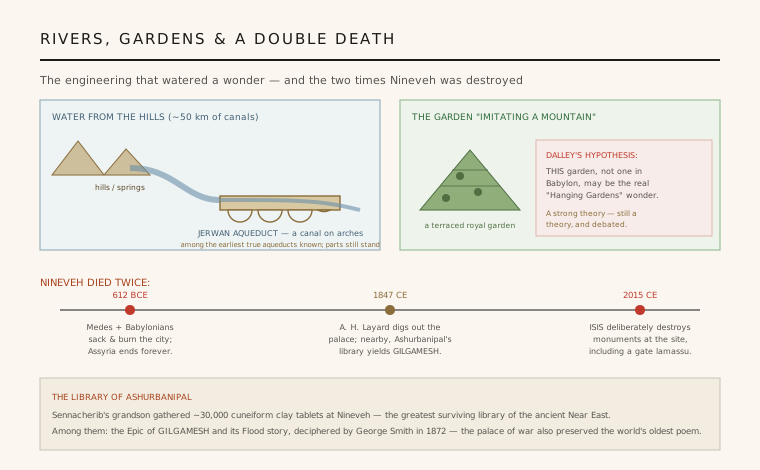
To water his enormous new capital, Sennacherib built one of the most ambitious hydraulic systems of the ancient world: a network of canals and dams carrying fresh water some fifty kilometres from the hills — including a great stone aqueduct at Jerwan, which carried a canal across a valley on stone arches, and which counts among the earliest true aqueducts known anywhere. Parts of it still stand in northern Iraq. With that water he created a spectacular royal garden, which his own inscriptions describe as "a wonder for all peoples," a high garden "imitating a mountain." And here this palace reaches out and touches an earlier article in our series: the scholar Stephanie Dalley has argued, on the strength of Sennacherib's genuine inscriptions, the surviving aqueduct, and a palace relief showing trees on terraces, that this garden at Nineveh — not any garden in Babylon — was the true original of the fabled Hanging Gardens of Babylon, one of the Seven Wonders of the Ancient World. It is a strong and beautiful theory — though, in honesty, still a theory, and still debated.
And then the darkness. Nineveh has the terrible distinction of being destroyed twice. In 612 BCE, less than a century after Sennacherib, a coalition of Medes and Babylonians stormed the city, sacked and burned it, and ended the Assyrian empire forever — so completely that the city was abandoned, buried, and its very name half-forgotten. (When the Greek soldier Xenophon marched past the mounds two centuries later, he did not even know he was walking over Nineveh.) It slept under the earth for millennia — until, from 1847, the British excavator Austen Henry Layard dug into the mound of Kuyunjik and brought the Palace Without Rival, its reliefs and its lamassu, back into the light; nearby, the great library of Ashurbanipal — Sennacherib's grandson, who gathered some thirty thousand cuneiform tablets here — gave the world the Epic of Gilgamesh, including its ancient Flood story, deciphered by George Smith in 1872. The palace of war had also preserved the oldest poem in the world. And then, in 2015, Nineveh died a second time: the militant group ISIS, occupying Mosul, deliberately destroyed ancient monuments across the site — bulldozing, smashing and blowing up what it could, including a great winged lamassu at the Nergal Gate that had survived for twenty-seven centuries. A wonder ended once by an ancient army, and again, in our own lifetime, by iconoclasts with power tools. To write about Nineveh now is, unavoidably, to write an act of remembrance.
6. What a modern architect can learn from Nineveh
- Architecture can narrate. Sennacherib's walls are the ancestor of every carved frieze, mural cycle and lobby installation that tells a story. A building's surfaces are not just cladding — they can be a medium, and the sequence in which a visitor moves past them is a kind of editing. Design the journey through the images, not just the images.
- Every image is an argument. These reliefs are gorgeous and they are propaganda — and the gap between what they show (Lachish) and what they hide (Jerusalem) is the real lesson. Whenever you present a design, a render, a case study, ask the Nineveh question: what is this picture choosing not to show?
- Solve for how a thing is actually seen. The five-legged lamassu is pure design thinking — it answers the honest question "what does this look like from each direction someone will really approach it?" Great detailing comes from taking the viewer's actual path seriously, corners and all.
- The infrastructure is the wonder. The fifty-kilometre canals and the Jerwan aqueduct made the palace and its garden possible; the water system was as much a marvel as the sculpture. The unglamorous systems — water, structure, services — often are the deepest achievement. Give them the design attention we lavish on the facade.
- Guard the thresholds. The lamassu understood that a doorway is a psychological event, not just an opening. What a building does at the moment of entering — how it welcomes, warns, or awes — sets the terms for everything inside.
- Everything built can be unbuilt — so build meaning that outlives the stone. Nineveh was destroyed twice, and yet its story reached us, through buried tablets and museum galleries and, now, this page. What endured was not the wall but the record and the memory. The most durable thing a maker leaves behind may not be the object at all, but the meaning we keep telling about it.
References & further reading
1. The British Museum — Assyria: Sennacherib and the palace reliefs of Nineveh (including the Lachish reliefs). https://www.britishmuseum.org/collection/galleries/assyria-lachish
2. World History Encyclopedia — Nineveh and Sennacherib. https://www.worldhistory.org/nineveh/
3. Encyclopaedia Britannica — Nineveh and Sennacherib. https://www.britannica.com/place/Nineveh-ancient-city-Iraq
4. Stephanie Dalley — The Mystery of the Hanging Garden of Babylon (the Nineveh hypothesis). https://global.oup.com/academic/product/the-mystery-of-the-hanging-garden-of-babylon-9780199662265
5. The Metropolitan Museum of Art — Assyrian sculpture and the lamassu. https://www.metmuseum.org/toah/hd/khor/hd_khor.htm
6. UNESCO / news reporting on the 2015 destruction of Nineveh and Mosul heritage (e.g. UNESCO statements). https://whc.unesco.org/en/news/1268
*Last verified 2026-07-05. Figures follow the British Museum, the World History Encyclopedia, Britannica, the Metropolitan Museum of Art and standard Assyriological scholarship, and are given as widely cited approximations that vary by source. Nineveh, on the east bank of the Tigris opposite modern Mosul (northern Iraq), was made the Assyrian capital by Sennacherib (r. 705–681 BCE), who built the "South-West Palace," which he named in his inscriptions the "Palace Without Rival" (ekallu ša šānina lā īšû). Its state rooms were lined with carved gypsum bas-reliefs (an estimated 2–3 km in total within the palace), originally painted, depicting the king's military campaigns — among the earliest great narrative art; the reliefs are royal propaganda. The "Lachish reliefs" (siege of 701 BCE, now in the British Museum) record an event also attested in Sennacherib's annals (clay prisms, e.g. the Taylor/Sennacherib Prism) and in the Hebrew Bible (2 Kings 18–19, 2 Chronicles 32, Isaiah 36–37); Lachish fell, but Sennacherib did NOT capture Jerusalem, claiming only to have shut up Hezekiah "like a bird in a cage." Gateways were guarded by lamassu — colossal human-headed winged bulls/lions carved with five legs (to read correctly from front and side). Sennacherib built extensive water works (~50 km of canals; the stone Jerwan aqueduct, among the earliest known, partly extant) and a famed royal garden; Stephanie Dalley's hypothesis (that this Nineveh garden was the real "Hanging Gardens of Babylon") is a leading but not settled theory. Nineveh was sacked and burned by the Medes and Babylonians in 612 BCE, ending the Assyrian empire. Austen Henry Layard excavated the palace from 1847; the nearby Library of Ashurbanipal (~30,000 tablets, incl. the Epic of Gilgamesh and its Flood account, deciphered by George Smith in 1872) is one of the greatest finds of the ancient Near East. In 2015 ISIS deliberately destroyed heritage at Nineveh/Mosul, including a Nergal Gate lamassu. This is the second article in the "palaces and pleasures of worldly power" chapter of the Architectural Wonders series.
Export this guide
Related Guides — Deep-dive reading
Persepolis: The Palace Where Every Nation Came Bearing Gifts
On a vast stone terrace in southern Iran, the kings of Persia built the grandest ceremonial capital of the ancient world — a forest of impossibly tall columns whose walls, unlike those of any conqueror before them, carved not war and captives but a peaceful procession of twenty-three nations bringing gifts. It is the gentlest image of empire the ancient world produced — until Alexander burned it to the ground. The third article in our chapter on the palaces of worldly power.
Architectural WondersChan Chan: The Vast City of Mud Where Every King Built His Own Palace
On the desert coast of Peru sprawl the ruins of the largest city ever built of mud — a thousand-year-old capital of adobe walls three storeys high, carved with fish and seabirds, that survived only because it almost never rains. It was a city of ten royal palaces, one for each king, driven by a strange rule of inheritance; and today, an earthen city in a warming world, it is racing the rain to survive. The ninth article in our chapter on the palaces and pleasures of worldly power.
Architectural WondersThe Palace of Knossos: Europe's First Palace and the Labyrinth of Myth
Nearly four thousand years ago on Crete, Europe's first great civilisation built a palace so vast and maze-like — over a thousand rooms on many floors, with running water, flushing toilets and light wells — that the Greeks who came after remembered it as the Labyrinth of the Minotaur. It is a genuine Bronze Age marvel; it is also, thanks to one archaeologist's concrete and imagination, a monument to how we rebuild the past in our own image. The first article in our chapter on the palaces of worldly power.
Architectural WondersRelated Tools — Try Free
Home Colour Studio
Colour every room — living, bedroom, dining, kitchen, bathroom — surface by surface in any HEX/RGB/CMYK colour, or from 80+ curated Indian shades.
Colour StudioWindow Orientation Planner
Pick the best window type, glass and shading by wall direction — north, east, south and west.
Window ToolBefore & After Studio
Generate AI before-and-after renders to preview how your redesign could look.
DesignAI