
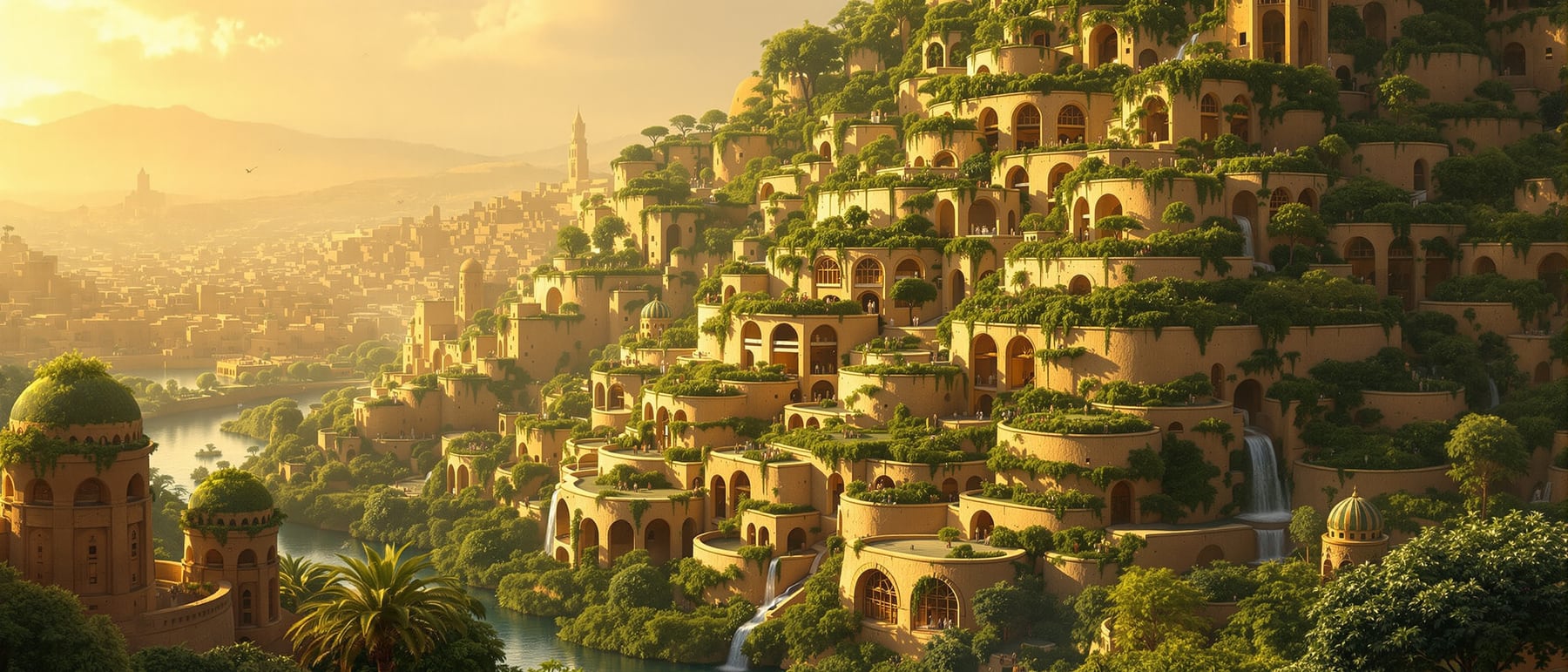
The Hanging Gardens of Babylon: The Wonder That May Never Have Been
How a green mountain of terraced gardens became the most famous garden in history — and the one Wonder of the Ancient World with no Babylonian text to name it, no ruins to prove it, and a leading theory that it never stood in Babylon at all, but a hundred kilometres and a hundred years away, at Nineveh.
The last wonder we visited, the Pyramids of Giza, is the one member of the Seven Wonders you can still walk up to and touch. This one is its opposite in every way. It is the most romantic of the seven, the most painted, the most dreamed-about — a mountain of gardens spilling green over the roofs of an ancient city. And it may be the only wonder on the list that never actually existed.
The Hanging Gardens of Babylon are a genuine historical mystery. Unlike the pyramids, or the temple, or the lighthouse, there is no ruin to visit, no stone to measure, and not one line of Babylonian writing that mentions them. Everything we "know" comes from Greek writers who wrote centuries after the fact and mostly never saw Babylon. So the honest way to tell this story is not to describe a building, but to open a case — and to follow the evidence, or its absence, wherever it leads. It leads somewhere genuinely surprising.
This is the thirty-second article in our Architectural Wonders series.
1. The wonder that may never have been
Start with the uncomfortable truth the postcards never mention: of the Seven Wonders, six are located and at least partly attested by archaeology. The Hanging Gardens are the one exception — and the silences around them are deafening.
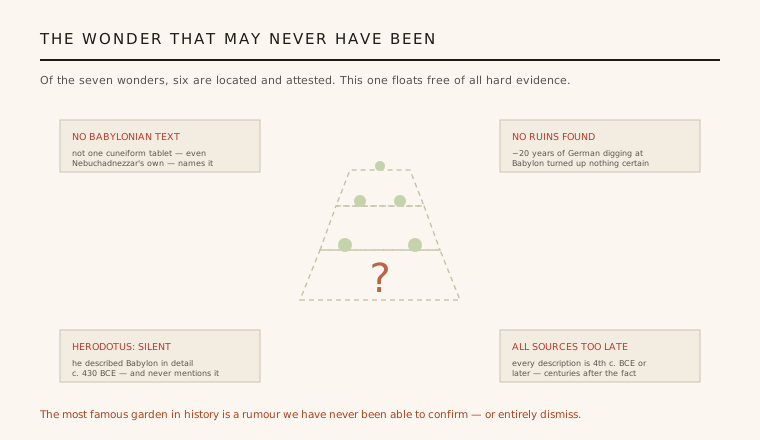
Consider the evidence that isn't there. Not one cuneiform tablet — from the reign of Nebuchadnezzar II or any other Babylonian king — mentions a hanging garden, even though Nebuchadnezzar documented his building works obsessively. Twenty years of German excavation at Babylon from 1899 turned up nothing that can be securely identified as the gardens. Herodotus, the "Father of History," described Babylon's walls and canals in loving detail around 430 BCE — a mere century after Nebuchadnezzar — and says not a word about any hanging garden. And every description we do have was written in the fourth century BCE or later, generations after the gardens supposedly bloomed, by authors reworking still-earlier accounts that are themselves lost. The most famous garden in the world is, on the hard evidence, a rumour we have never been able to confirm or entirely dismiss.
2. A green mountain, described by strangers
So where does the vivid picture in our heads come from? From a handful of Greek and Roman writers — Berossus, Diodorus Siculus, Strabo, Quintus Curtius Rufus — none of whom was an eyewitness, and several of whom were copying older books that no longer survive.
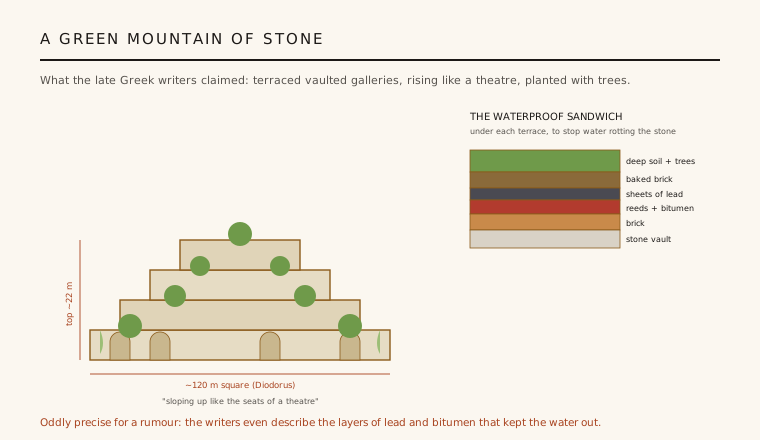
Piece their accounts together and a consistent image emerges: a stepped, terraced structure of vaulted stone galleries, rising tier on tier "like the seats of a theatre," roughly 120 metres square with the highest terrace some 22 metres up, planted with full-grown trees so that the whole thing read as an artificial green mountain. The word usually translated "hanging" really means something closer to "overhanging" or "out-thrust" — the plants spilled over the edges of the terraces. Most tellingly, the writers are oddly specific about the waterproofing: beneath the soil, they say, lay a sandwich of reeds set in bitumen, then baked brick, then sheets of lead, precisely to stop the constant irrigation water from seeping down and rotting the stone galleries below. It is a strangely practical, engineer's detail to invent — one of the small things that keeps the legend from being dismissed outright. But notice: this is a building described entirely by people who were not there, retelling a marvel they had only read about.
3. The homesick queen
Then there is the love story — the part everyone remembers, and the part with the least evidence of all.
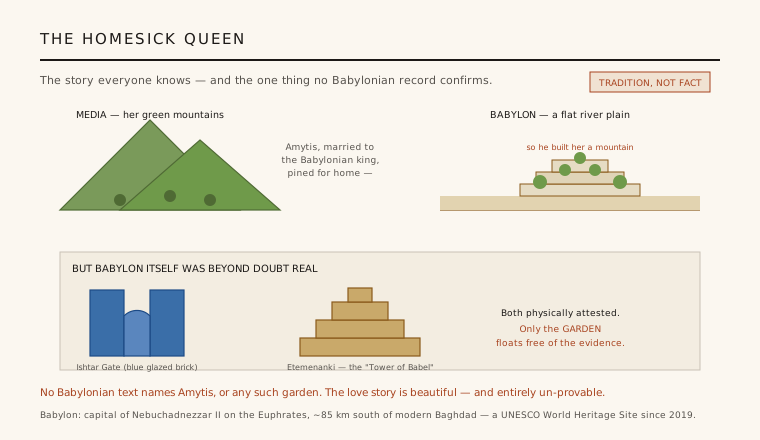
The tradition, first written down by the Babylonian priest Berossus around 290 BCE, is irresistible: King Nebuchadnezzar II built the gardens to comfort his wife, Queen Amytis of Media, who was homesick on the flat river-plain of Babylon for the green mountains of her Median homeland — so he raised her a mountain of gardens to look upon. It is one of the great romantic images in all of architecture, and it may be entirely made up: no Babylonian record names Amytis, and none records Nebuchadnezzar building any such garden. Treat it, honestly, as beloved tradition, not documented fact.
And here we must be careful of a bigger confusion. The garden is doubtful — but Babylon itself was spectacularly, provably real. Nebuchadnezzar's capital on the Euphrates gave us the Ishtar Gate, glowing with blue glazed brick (a reconstruction stands in Berlin today), and the vast ziggurat Etemenanki, widely thought to be the original "Tower of Babel." Babylon is a UNESCO World Heritage Site. The city's grandeur is beyond dispute; it is only this one garden that floats free of the evidence.
4. The problem of water
If the gardens did stand, they set their builders one genuinely brutal engineering problem — and that problem turns out to be a crucial clue.
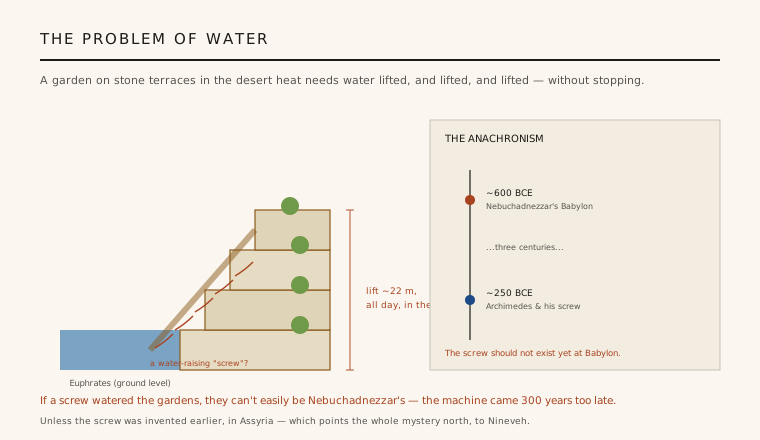
A garden of mature trees on stone terraces in the Mesopotamian summer is a thirsty machine. Water had to be raised, continuously, some 22 metres from the river to the topmost terrace — no small feat with ancient technology. Chain-and-bucket hoists and the counterweighted shaduf could do it in stages. But the geographer Strabo mentions something more specific: "screws." That points to the water-raising screw — a helix turning inside a cylinder, scooping water upward — the device we call the Archimedes screw. And there the story trips over a beautiful contradiction. Archimedes lived around 250 BCE, roughly three centuries after Nebuchadnezzar's Babylon. If a screw watered these gardens, they can hardly be Nebuchadnezzar's, because the machine that watered them hadn't been invented yet. It is the kind of quiet anachronism that, once you notice it, refuses to sit still — and it points the whole mystery north, away from Babylon.
5. The garden that may have been at Nineveh
Which brings us to the most compelling modern answer — a piece of detective work by the Oxford Assyriologist Stephanie Dalley, who argues the "Hanging Gardens of Babylon" were real, but were never at Babylon.
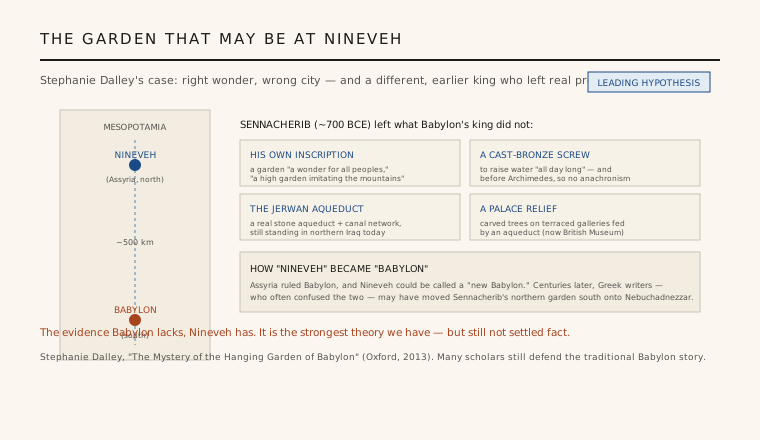
Dalley's case is strong precisely because it rests on things that actually exist. About a century before Nebuchadnezzar, the Assyrian king Sennacherib built a palace garden at Nineveh (near modern Mosul), beside his Palace Without Rival — and unlike any Babylonian king, Sennacherib left records of it. His own inscriptions describe a spectacular garden "a wonder for all peoples," a "high garden imitating the mountains." He describes casting a bronze water-raising screw to lift water "all day long" — a screw that would pre-date Archimedes and dissolve the anachronism entirely. He built the enormous stone Jerwan aqueduct and a canal network to bring the water, and parts of it still stand in northern Iraq today. And a famous Assyrian palace relief, now in the British Museum, actually shows trees growing on terraced, arched galleries fed by an aqueduct. The final piece is a slip of memory: Assyria ruled Babylon, Nineveh was sometimes called a "new Babylon," and Greek writers notoriously confused the two — so a garden built by Sennacherib at Nineveh could, over centuries of retelling, drift south and be re-attributed to Nebuchadnezzar's Babylon. The evidence Babylon lacks, Nineveh has. It is the best theory we have — though, honestly, still a theory, and many scholars defend the traditional story. Like the lost library we rebuilt at Bibliotheca Alexandrina, the Hanging Gardens live now mostly in the imagination — a wonder made of words, watered by longing.
6. What a modern architect can learn from the Hanging Gardens
- A building can be immortal without being real. No wonder is more vivid in the mind than the one we are least sure existed. What endures is the image — a green mountain in a desert city — proof that architecture lives in memory and story as much as in stone.
- The oldest dream of "green architecture" is very old indeed. Terraces dripping with trees, a tower turned into a hillside — the roof garden and the vertical forest our own age is so proud of were being described over two thousand years ago. Ambitions repeat; only the technology changes.
- Water is the hardest part of any garden — plan it first. The whole marvel stood or fell on lifting water 22 metres, every day, without rotting the structure. In any planted building, the irrigation and waterproofing are not afterthoughts; they are the design.
- Beware the anachronism — evidence has to line up in time. The Archimedes-screw problem shows how a single detail out of its century can unravel a whole story. Check that your sources, and your claims, actually belong together.
- Be honest about what you don't know. The responsible way to tell this story is to flag every uncertainty, not paper over it. A clear "we are not sure" is worth more than a confident fiction — in history, and in practice.
- Distinguish the doubtful part from the certain whole. Babylon was gloriously real even if this garden is not. Precision about which claim is shaky keeps a healthy scepticism from curdling into "it was all a myth."
References & further reading
1. World History Encyclopedia — Hanging Gardens of Babylon. https://www.worldhistory.org/Hanging_Gardens_of_Babylon/
2. Stephanie Dalley — The Mystery of the Hanging Garden of Babylon: An Elusive World Wonder Traced (Oxford University Press, 2013). https://global.oup.com/academic/product/the-mystery-of-the-hanging-garden-of-babylon-9780198728849
3. PBS Secrets of the Dead — The Lost Gardens of Babylon (Q&A with Dr. Stephanie Dalley). https://www.pbs.org/wnet/secrets/the-lost-gardens-of-babylon-qa-with-dr-stephanie-dalley-tv-host-author-of-lost-gardens-of-babylon/1172/
4. National Geographic — We know where the 7 wonders of the ancient world are — except one. https://www.nationalgeographic.com/history/history-magazine/article/know-where-7-wonders-ancient-world-except-one-hanging-gardens-babylon
5. Biblical Archaeology Society — Where Are the Hanging Gardens of Babylon? https://www.biblicalarchaeology.org/daily/ancient-cultures/ancient-near-eastern-world/hanging-gardens/
6. UNESCO World Heritage Centre — Babylon (inscribed 2019). https://whc.unesco.org/en/list/278/
Last verified 2026-07-04. This article is deliberately framed around uncertainty. The core facts are that the Hanging Gardens are the only one of the Seven Wonders with no contemporary Babylonian textual or secure archaeological evidence; that all surviving descriptions (Berossus via Josephus, Diodorus Siculus, Strabo, Quintus Curtius Rufus, and a text attributed to Philo) are late and second-hand; and that the Nebuchadnezzar-and-Amytis attribution derives from those late Greek sources, not Babylonian records. Dimensions (~120 m square, ~22 m high) come from Diodorus and are ancient testimony, not measurement. Stephanie Dalley's Nineveh/Sennacherib hypothesis (2013) is presented as a leading, evidence-backed theory — resting on Sennacherib's genuine inscriptions, the extant Jerwan aqueduct, a British Museum palace relief, and the pre-Archimedes bronze screw — but it is not settled consensus, and the traditional Babylon attribution still has defenders. Babylon's own monuments (Ishtar Gate, Etemenanki) and UNESCO 2019 status are firmly attested.
Export this guide
Related Guides — Deep-dive reading
The Palace of Sennacherib at Nineveh: The Palace Without Rival
Twenty-seven centuries ago, on the Tigris opposite modern Mosul, an Assyrian king built a palace so vast he named it, in his own words, 'the Palace that has no rival' — and lined its walls, room after room, with miles of carved stone panels telling the story of his wars. It is the birthplace of narrative art, the home of the winged guardian, and a wonder destroyed not once but twice. The second article in our chapter on the palaces of worldly power.
Architectural WondersBibliotheca Alexandrina: A Lost Wonder, Reborn in Our Time
How a young Norwegian practice won a global competition to bring the legendary Library of Alexandria back to life — as a vast tilted disc rising from the Mediterranean like a second sun, wrapped in a wall carved with all the world's writing. The series' first modern wonder, and proof its great theme is alive today.
Architectural WondersThe Palace of Knossos: Europe's First Palace and the Labyrinth of Myth
Nearly four thousand years ago on Crete, Europe's first great civilisation built a palace so vast and maze-like — over a thousand rooms on many floors, with running water, flushing toilets and light wells — that the Greeks who came after remembered it as the Labyrinth of the Minotaur. It is a genuine Bronze Age marvel; it is also, thanks to one archaeologist's concrete and imagination, a monument to how we rebuild the past in our own image. The first article in our chapter on the palaces of worldly power.
Architectural WondersRelated Tools — Try Free
AI Measurement Tool
Measure your room using voice, photos, or video sweep — no tape measure needed.
DesignAIBefore & After Studio
Generate AI before-and-after renders to preview how your redesign could look.
DesignAICircadian Light Meter
Patient-centric circadian lighting visualizer for Indian healthcare design — time-of-day × intensity → CCT, melanopic lux (EML / mEDI), melatonin suppression, and an alertness curve. Calibrated against WELL v2 L03 Circadian Lighting Design, CIE S 026:2018, Brainard 2001, and Lucas et al. 2014.
Circadian Tool