
Imported vs Indian Marble & Flooring (India): Is the Premium Worth It?
Italian Carrara vs Makrana, Spanish vs Morbi tiles, imported vs Indian wood and vinyl — where the premium buys real value and where you are paying for a label.
Walk into any premium flooring showroom in India and you will be steered toward the imported wall: Italian Carrara, Spanish porcelain, German engineered oak, Belgian vinyl. The pitch is always the same — world-class quality, better finish, a home that "looks expensive". Some of that is true. A lot of it is a label markup of 3 to 10 times over an Indian product that performs just as well underfoot. This guide cuts through the showroom theatre and tells you, material by material, where the imported premium buys real value and where you are paying mostly for an origin sticker.
The honest framing: what "imported" actually changes
For a floor, only a few things genuinely matter — how it looks, how hard it wears, how it handles water and stains, how it ages, and what it costs all-in. Country of origin affects some of those, but far less than the marketing implies. A fully vitrified Morbi tile and a Spanish porcelain tile of the same water-absorption group and PEI rating will wear identically. The difference you pay for is design range, finish consistency, batch quality control, and — bluntly — prestige.
Imported flooring also carries costs Indian product does not: import duty, ocean freight, inland transport from the port, currency risk, longer lead times, and a much higher embodied-carbon footprint from shipping heavy stone or tiles halfway around the world. Those are real rupees and real trade-offs, not just snobbery. The skill is knowing which materials still come out ahead despite that load.
Marble: Italian vs Indian — the biggest gap, the biggest scam
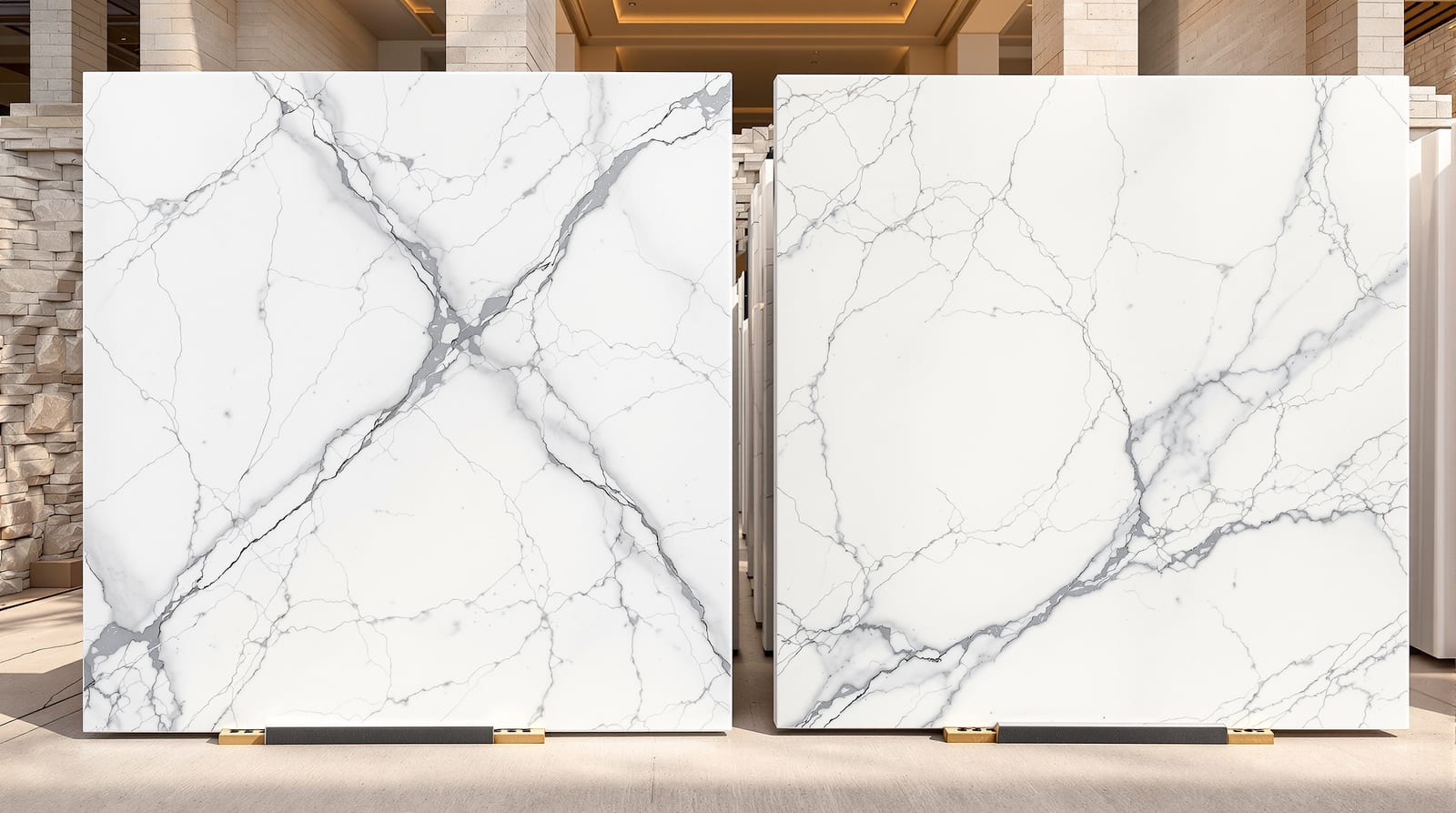
This is where the premium is largest and the confusion is deepest. Italian marble — Carrara (soft grey veining), Statuario (white with bold grey veins), Botticino (beige), Calacatta (dramatic gold-grey veining) — has a depth of translucency, crystalline whiteness and consistency that the best Indian marble only approaches. For a statement living-room or lobby floor where the stone IS the design, imported Italian genuinely wins on look.
But Indian marble is not a poor cousin. Makrana (Nagaur, Rajasthan — the Taj Mahal marble) is exceptionally dense, ages beautifully and resists yellowing better than many soft Italian whites. Morwad and Rajnagar (Udaipur belt) white marbles are bright and well-priced. Indian green marble (Himmatnagar/Kesariyaji) and Banswara whites give you serious visual punch at a fraction of imported cost.
| Marble | Origin | Look | Indicative ₹/sq ft (slab, material) | Best for |
|---|---|---|---|---|
| Statuario / Calacatta | Italy | Bright white, bold dramatic veining, translucent | 350-900+ | Statement floors, feature walls, vanities |
| Carrara / Botticino | Italy | Soft grey or beige veining, refined | 250-600 | Premium living areas |
| Makrana | Rajasthan | Dense bright white, ages superbly | 90-250 | Floors, temples, durable luxury |
| Morwad / Rajnagar white | Udaipur belt | Clean white, good value | 70-150 | Whole-home white floors |
| Indian green / Udaipur green | Gujarat/Rajasthan | Deep green, high drama | 80-200 | Accent floors, borders |
Costs are indicative and vary by city, vendor, lot and slab grade; add laying (₹35-60/sq ft metros, ₹20-40 tier-2), adhesive, polishing, skirting and 12-18% GST.
The relabelling scam — verify origin before you pay imported prices
The single most important thing to know: a large amount of stone sold as "Italian marble" in India is not Italian. Kishangarh — Asia's largest marble market — imports rough blocks AND processes domestic stone, and some dealers relabel Indian or third-country marble as "Italian" to charge a 3-5x premium. Others sell engineered/reconstituted marble (resin-bound stone chips) as natural Italian.
Protect yourself: ask for the country-of-origin and the import documentation (bill of entry / supplier invoice naming the Italian quarry or processor); inspect full slabs in daylight for the natural translucency and random veining of real Carrara/Statuario; be suspicious of suspiciously uniform "veining" (often printed engineered stone); and remember that genuine imported Italian is expensive for a reason — a "₹120/sq ft Italian Statuario" almost certainly is not. When the only proof of origin is the dealer's word, treat it as Indian-priced stone. See our deeper breakdowns of italian-marble-flooring-india and indian-marble-flooring-india.
When imported marble genuinely wins
Imported Italian is the smarter buy when: you want a specific bright-white translucent look (Statuario/Calacatta) that no Indian quarry reliably gives; you need large, consistent matched slabs for a seamless book-matched floor; the floor is a low-traffic showpiece where appearance dominates; and your budget treats the floor as a design centrepiece, not a commodity surface. For everyday whole-home flooring, durable Makrana or Morwad usually delivers 80-90% of the effect for a quarter of the cost.
Tiles: Spanish/Italian vs Morbi — the gap has nearly closed
A decade ago, imported Spanish (Porcelanosa, Roca, STN) and Italian porcelain were clearly ahead of Indian tiles on design, surface finish and large-format capability. That gap has shrunk dramatically. Morbi (Gujarat) — which makes roughly 70-90% of India's ceramic and vitrified tiles across hundreds of factories — now produces double-charged vitrified, GVT and PGVT, large-format slabs and high-design collections that match global quality on the metrics that matter. Indian brands like Kajaria, Somany, Nitco, Johnson, Orient Bell, Simpolo and Varmora ship products that are technically equivalent to mid-market imports.
| Attribute | Imported (Spanish/Italian) | Indian (Morbi / branded) |
|---|---|---|
| Wear/water performance (same group + PEI) | Identical | Identical |
| Design/finish range (very high end) | Slight edge, newest looks first | Closing fast, vast range |
| Large-format / slab tiles | Strong | Now widely available |
| ISI/BIS marking | Must comply (often retested) | Standard, easy to verify |
| Indicative ₹/sq ft (material) | 200-700+ | 40-200 |
| Lead time & replacement stock | Weeks, hard to re-source | Days, easy to re-source |
For tiles, the verdict is blunt: for the overwhelming majority of Indian homes, premium Morbi or branded Indian vitrified at a fraction of the price is the rational choice. Reserve imported porcelain for a specific cutting-edge design that genuinely is not yet made domestically — and even then, check whether a Morbi factory is already producing a near-identical look. See morbi-tiles-guide-india for how to buy from the source.
Engineered wood and vinyl: imported brands vs Indian
Wood and resilient floors tilt more toward imports — but selectively.
Engineered wood: imported European/American brands (German, Austrian, Scandinavian oak) lead on top-layer quality, finish durability and species range. Indian and Indian-assembled engineered wood (often using imported veneer over local plywood cores) has improved but can vary in core quality and moisture stability. If you want a genuine European oak floor with a thick wear layer, imported is usually the honest answer. For value, well-made Indian engineered wood works in low-moisture rooms — see engineered-wood-flooring-india and wooden-flooring-india.
Vinyl (LVT/SPC/WPC): the market is dominated by imports and import-spec product anyway, much of it manufactured in China and Southeast Asia and sold under Indian and global brands. Quality tracks the spec sheet — wear-layer thickness (0.3-0.5 mm for homes), board construction, and warranty — far more than the brand's flag. A well-specified "imported" SPC and a well-specified Indian-marketed SPC of the same wear layer perform the same. Buy on wear layer and warranty, not on the word imported. See spc-flooring-india, luxury-vinyl-tile-lvt-india and vinyl-flooring-india.
The hidden cost stack of importing
The sticker price is only part of the imported premium. Heavy materials like stone and tile carry a disproportionate freight and duty load, plus a steep embodied-carbon penalty from ocean and road transport.
Practical money points: import duty and freight can add a meaningful slice to the landed price of stone and tile; currency moves can swing imported quotes between order and delivery; lead times run to weeks (re-sourcing a broken box of imported tile mid-project is painful); and the carbon footprint of long-haul heavy material is hard to justify when an equivalent product is made in Gujarat or quarried in Rajasthan. For the carbon angle in depth, see natural-stone-sustainability-india.
BIS compliance — imports are not exempt
Ceramic and vitrified tiles fall under a Quality Control Order (QCO), so they require mandatory BIS/ISI certification and marking to IS 15622 (and the related IS 13753/13755/13756) — and imported tiles must comply too. Do not assume "imported" means "higher standard certified"; insist on the ISI mark on imported tile boxes just as you would on Indian. For natural stone, Indian standards IS 1130 (marble), IS 14223 (granite) and IS 1124 (water absorption) define the quality benchmarks. A genuine imported product will meet or exceed these; a relabelled one often dodges the paperwork entirely — another reason to demand documentation. See bis-marking-flooring-india.
Verdict table: is the premium worth it?
| Material | Imported premium | Performance gain | Look gain | Verdict |
|---|---|---|---|---|
| Statuario / Calacatta marble | 3-10x | None (often softer) | High, distinctive | Worth it for statement showpiece floors only |
| Carrara / Botticino marble | 2-5x | None | Moderate | Usually not — Makrana/Morwad get close |
| Spanish/Italian porcelain | 2-4x | Negligible (same spec) | Marginal, narrowing | Rarely — Morbi/branded Indian matches |
| Engineered wood | 1.5-3x | Real (core + wear layer) | Real (species, finish) | Often worth it for genuine European oak |
| LVT / SPC / WPC vinyl | Varies | Spec-driven, not origin | None | Buy on wear layer + warranty, not flag |
The pattern is clear: imported wins where it buys a genuinely better material (premium engineered wood, a unique Italian white). It loses where you are paying for a label on a product an Indian factory already makes to the same standard (most tiles, value vinyl, everyday marble).
When local is the smarter buy
Choose Indian when: you want durable, beautiful everyday flooring at sane cost (Makrana/Morwad marble, branded vitrified); you value short lead times and easy re-sourcing of matching stock; you care about a lower carbon footprint and want stone/tile sourced close to home (granite from the south, marble from Rajasthan, tiles from Morbi); or the imported "premium" cannot be verified at origin. Buy stone closest to its source to cut transport — granite is cheapest in Bangalore/Hyderabad/Chennai, marble around Jaipur/Udaipur, tiles in the Ahmedabad-Morbi belt. Cross-check imported quartz claims against italian-marble-vs-quartz-india before committing.
Frequently asked questions
Is Italian marble really better than Indian marble?
For a specific bright-white translucent look (Statuario, Calacatta), yes — Italian has a depth Indian quarries rarely match. But for durability and ageing, dense Indian Makrana is excellent and resists yellowing better than many soft Italian whites. For most homes, Indian marble delivers 80-90% of the effect at a quarter of the cost.
How do I know if "Italian marble" sold to me is genuine?
Demand country-of-origin documentation (bill of entry or supplier invoice naming the Italian quarry/processor), inspect full slabs in daylight for natural random veining and translucency, and be wary of suspiciously uniform patterns (often printed engineered stone) or prices far below the going imported rate. If origin cannot be proven, price it as Indian stone.
Are Morbi tiles as good as Spanish or Italian tiles?
On the metrics that matter — water-absorption group, PEI rating, breaking strength — premium Morbi and branded Indian vitrified now match mid-market imports. Imports retain a slight edge in the newest high-end designs and some large-format slabs, but for most homes Indian tiles are the rational choice at a fraction of the price.
Do imported tiles need BIS/ISI certification in India?
Yes. Ceramic and vitrified tiles fall under a Quality Control Order, so imports must carry BIS/ISI certification to IS 15622 just like Indian tiles. Always check for the ISI mark on the boxes — imported does not mean automatically certified or superior.
Is imported flooring worse for the environment?
Generally yes, because shipping heavy stone and tile across continents adds substantial embodied carbon plus inland transport on top. Sourcing locally — granite from the south, marble from Rajasthan, tiles from Morbi — cuts both freight cost and carbon. See our natural-stone-sustainability-india guide for the full picture.
Export this guide
Related Guides — Deep-dive reading
Flooring Cost Comparison Across Indian Cities 2026: Installed ₹/Sq Ft by Material
A single cross-city reference comparing installed flooring rates across Mumbai, Delhi-NCR, Bangalore, Hyderabad, Chennai, Pune, Kolkata, Ahmedabad and Jaipur — vitrified, granite, marble, wood/laminate and vinyl, plus laying labour — and why each city differs.
Flooring & SurfacesImported vs Indian Furniture: Quality, Cost & What to Buy (2026)
An honest, non-nationalist comparison for Indian homes — what imported furniture really is, why it costs more, whether it is actually better made, how European-built pieces cope with Indian humidity, and where local wins on service, fit and footprint.
FurnitureMarble Flooring Cost in India 2026: ₹/Sq Ft by Type + Installed Price Breakdown
What marble flooring really costs in India in 2026 — material ₹/sq ft for Indian (Makrana, Morwad, Banswara, green) and Italian (Carrara, Statuario, Botticino, Dyna) marble, PLUS the laying, grinding-and-polishing, sealing, wastage, skirting and 18% GST add-ons, with a fully worked living-room example and an honest real-marble-vs-PGVT comparison.
Flooring & SurfacesRelated Tools — Try Free
Marble Flooring Cost Calculator
Estimate installed marble-floor cost — material, laying, grinding and polishing, sealing, wastage and GST.
Flooring CalculatorFlooring Cost Calculator
Estimate the all-in cost of a floor — material, laying, wastage, skirting and GST — by area and material.
Flooring CalculatorTile Water Absorption Classifier
Classify a tile by its water-absorption percentage into its IS 15622 group and see where it can be used.
Flooring Tool